Some links on this page are affiliate links: if you buy through them we may earn a commission, at no extra cost to you.
There is no single best fan for every room. Choose an air circulator for whole-room airflow, a tower fan for a bedroom or narrow space, a window fan for ventilation, a box fan for inexpensive utility airflow, or a desk fan for cooling one person. For most shoppers who want powerful, simple room circulation, the Vornado 630 Medium Air Circulator is the strongest general-purpose choice. The best value tower is the Dreo Nomad One/307, while the Vornado Transom is the most capable window-fan option.
A fan usually cools people, not the room itself. It increases air movement over skin, helps distribute air conditioning, or replaces indoor air through a window. It does not normally lower the room temperature on its own.
As an Amazon Associate I earn from qualifying purchases.
Quick wins for a faster PC:
Repair Windows errors before they cause bigger problemsFix Now →Fix the driver behind crashes, sound loss and screen glitchesFind Drivers →Clear out junk files and repair common Windows errorsFree Scan →Best fans at a glance
Prices and availability can change during heat waves. The price signals below were reported or observed on or around August 16–18, 2026, and should be checked before purchase.
| Pick | Best for | Type | Price signal | Main drawback |
|---|---|---|---|---|
| Vornado 630 | Powerful general-purpose airflow | Air circulator | $79.99 at Vornado when checked | Three speeds; no remote or broad oscillation |
| Dreo Nomad One/307 | Most tower-fan shoppers | Tower | Varies by retailer | Less forceful room circulation than a dedicated circulator |
| Vornado Transom | Window intake and exhaust | Window fan | $109.99 listed by Vornado | Requires a suitable, securely fitted window |
| Dreo PolyFan 513S or TurboPoly 765S | Smart controls and flexible placement | Smart pedestal/circulator | $159.99 U.S. list price reported for 765S | App and connected-device complexity |
| Dyson Cool AM07 | Premium design | Tower | About $400 reported by WIRED | Weak value compared with cheaper towers |
| Lasko box, tower, or window fan | Low-cost utility airflow | Varies | Model-dependent | Usually fewer controls and refinements |
These are category recommendations, not a single standardized ranking. Consumer Reports, WIRED, Good Housekeeping, HGTV, Forbes Vetted, TODAY, and TechRadar use different testing methods, rooms, and comparison groups. Their results should not be treated as directly interchangeable.
Popular on Amazon

- Small floor or tabletop fan: Honeywell TurboForce Air Circulator Fan is a cooling fan that is 25% quieter than comparable fans.** It’s sized to be a table or desk fan or wall-mounted, and provides cooling in small to medium-sized rooms
- Feel the power: Honeywell TurboForce fans have an aerodynamic turbo design to maximize air movement and power for intense cooling or energy-saving air circulation. You can feel the power of this small floor or desk fan from up to 25 feet away
- Customize your comfort: With 3 speeds and a 90° pivoting adjustable head, you’ll always be comfortable and cool! Customize your cooling to however you like with this powerful and quiet fan. #1 selling table fan
- Smart savings: Quiet fans for bedroom and home are an easy way to cool down any space and improve airflow. Give your air conditioner a break by using a portable indoor fan to help reduce your energy consumption and costs
- Honeywell quality: Help improve cooling and energy savings in your home or office using a Honeywell personal desk fan. Honeywell has personal fans for bedroom, whole room fans, tower fans, and oscillating fans that are a great choice
Best overall air circulator: Vornado 630
Buy the Vornado 630 if you want strong, focused airflow, straightforward controls, and a fan that can mix air across a room or help distribute conditioned air. Its head tilts vertically, allowing you to aim air upward, across the room, or toward a particular seating area. Vornado lists three speeds and a five-year warranty claim on the product page.
The 630 is a better choice than a tower when airflow strength and simplicity matter more than a remote, timer, app, or horizontal oscillation. Its limitations are equally clear: it is not the best bedside fan for someone who wants a gentle sweeping breeze, and it does not provide the feature set common on newer towers. Vornado’s shop showed a price of $79.99 when checked, but the live price may differ.
What’s actually slowing this PC down?
Pick the symptom - the matching free tool is one click away.
Best tower fan for most people: Dreo Nomad One/307
Choose the Dreo Nomad One, also identified as model 307 in current coverage, when you need a slim fan for a bedroom, office, apartment, or other narrow floor area. WIRED’s 2026 guide identified it as a value-oriented tower pick because it combines the convenience expected from a tower with more features than basic models.
A tower fan generally offers oscillation, a remote, timer functions, sleep settings, and a small footprint. It is usually better at creating a localized breeze than at throwing a powerful stream across a large room. Retailer naming and availability can vary, so confirm the exact model before buying.
Do not choose a tower solely because it has many speed settings. Check whether its lowest setting is genuinely comfortable at night, whether the display can be dimmed, and whether the oscillation mechanism makes clicking or rattling sounds. Towers also contain more controls and moving mechanisms than simple circulators, creating more potential long-term failure points, although that is a general design consideration rather than a claim about every Dreo unit.
Best window fan: Vornado Transom
The Vornado Transom is the strongest choice when the goal is to move air through a window rather than simply blow air around a room. It electronically reverses between intake and exhaust, fits windows from 26 to 40 inches according to Vornado, and uses a relatively low-profile design. The listed price was $109.99 when checked, although stock signals varied.
Crashes, No Sound, or Screen Glitches?
Random freezes, missing sound and display glitches usually trace back to one bad driver. Find and replace yours safely.Free scan · under a minutePC Slower Than It Used to Be?
A free scan shows the junk files, broken settings and background clutter dragging Windows down - then fixes them in one click.Free scan · Windows 10 & 11Electronic reversal is more useful than a fan that only blows inward. You can exhaust stale indoor air, draw in cooler outdoor air, or change modes as conditions change. Vornado lists four speeds, a remote, temperature-sensing control, and a five-year satisfaction guarantee.
Window fans are not universal cooling solutions. Use intake when outdoor air is cooler than indoor air and reasonably clean. If outdoor air is hotter, more humid, smoky, polluted, or full of allergens, keep the window closed or use exhaust and air conditioning instead. The fan is not an air purifier.
Also popular on Amazon

- 𝗢𝗻𝗲 𝗙𝗮𝗻 𝗳𝗼𝗿 𝗔𝗹𝗹 𝗬𝗼𝘂𝗿 𝗡𝗲𝗲𝗱𝘀: From a gentle breeze to a powerful wind, it adapts to your everyday needs with up to 28 ft/s airflow and a wide oscillation angle to deliver fast, whole-room cooling
- 𝗤𝘂𝗶𝗲𝘁 𝗦𝗹𝗲𝗲𝗽 𝗔𝗹𝗹 𝗡𝗶𝗴𝗵𝘁: Perfect bedroom fan with a near-silent noise level on low speed. Includes a 12-hour timer for all-night comfort and is ideal for light sleepers, babies, and pets
- 𝗔𝘂𝘁𝗼-𝗔𝗱𝗷𝘂𝘀𝘁𝘀 𝘁𝗼 𝗬𝗼𝘂𝗿 𝗥𝗼𝗼𝗺: Use Auto Mode for automatic fan speed adjustments according to room temperature. Built-in temperature sensor automatically adapts airflow to match your environment, keeping you cool without the temperature getting too cold or too warm
- 𝗦𝗶𝗺𝗽𝗹𝗲 𝗢𝗽𝗲𝗿𝗮𝘁𝗶𝗼𝗻: 5 fan speeds and 4 fan modes (Normal, Turbo, Sleep, and Auto) give you the ideal airflow for any situation
- 𝗥𝗲𝗺𝗼𝘁𝗲 𝗜𝗻𝗰𝗹𝘂𝗱𝗲𝗱 & 𝗘𝗮𝘀𝘆 𝘁𝗼 𝗖𝗹𝗲𝗮𝗻: Adjust settings from bed or the couch with the remote, and when needed, simply remove the back grille for a quick cleaning. The slim design fits perfectly in any bedroom, living room, or office
Install the Transom only within the manufacturer’s stated window range. Use the supplied supports or foam, check that the unit is stable, and do not rely on improvised mounting. An incorrectly fitted window fan can fall or compromise window security.
Best smart and adjustable fan: Dreo PolyFan 513S or TurboPoly 765S
Choose a Dreo PolyFan 513S or the newer Smart TurboPoly Fan 765S if you want one appliance that can serve as a pedestal fan, desktop fan, or air circulator and can be controlled remotely. The 765S was reported at a U.S. list price of $159.99 in July 2026.
Free tools Windows power users keep installed
One-click scans. No signup required.
This category makes sense when scheduling, voice control, or changing the fan’s position matters. Smart control can let you start the fan before bedtime, adjust it without getting up, or integrate it with Alexa and other home routines. It does not automatically mean better airflow.
Before buying, confirm that basic controls work without the app, identify the supported Wi-Fi band and voice assistant, and decide whether an account or connected appliance fits your privacy preferences. A smart fan is poor value if its main advantage is an app layered over weak airflow.
Best premium tower: Dyson Cool AM07
The Dyson Cool AM07 is the premium design choice for buyers who specifically want Dyson’s bladeless form factor and are willing to pay for it. Its appearance, remote, and smooth-feeling airflow may appeal in a carefully designed room.
It is difficult to recommend as the best value. WIRED’s 2026 coverage placed it at roughly $400 and noted that less expensive Dreo towers offer a stronger price-to-feature proposition. Buy it for the design, brand, or form factor—not because a premium price guarantees the strongest cooling.
The Tool Desk
Outbyte PC Repair FREEClear out junk files and repair common Windows errorsFree Scan →Outbyte Driver Updater FREEFix the driver behind crashes, sound loss and screen glitchesFind Drivers →Best budget fan: choose the right Lasko type
Lasko is a practical budget choice, but the best model depends on the job. Consumer Reports included Lasko among its tested room-fan candidates, and Good Housekeeping selected a Lasko twin window fan in its 2026 coverage.
- Lasko box fan: inexpensive, high-volume utility airflow for workshops, windows, and general ventilation.
- Lasko tower: a slim option for bedrooms or offices when a remote and oscillation matter.
- Lasko window fan: useful when you need simple intake or exhaust at a lower price.
Verify the exact model, current price, warranty, noise behavior, and mounting provisions. Budget fans commonly give up refined controls, low-speed smoothness, timers, or premium construction. That can be an acceptable trade-off for a garage, temporary room, or heat-wave backup.
Also popular on Amazon

- 3 Quiet Speeds
- Tilt-Back Feature
- Fully-Adjustable Height
- Wide-Area Oscillation
- Simple "No Tool" Assembly
Which type of fan should you buy?
Air circulator
Choose an air circulator for room mixing, hot and cool zones, or distributing air from an air conditioner. It usually tilts rather than oscillates broadly and produces a focused stream that can feel stronger than a tower’s breeze. The Vornado 630 is the clearest general-purpose example; larger Vornado 660 or 783 models may suit bigger spaces, but size, noise, and price rise with them.
Tower fan
Choose a tower for a narrow footprint, bedroom use, office use, oscillation, a remote, and timer or sleep functions. It is generally more convenient and attractive than a circulator, but often less forceful over long distances. Look for a stable base, a display-off mode, accessible controls, and an easy cleaning procedure.
Do these 3 things before closing this tab:
1Repair Windows errors before they cause bigger problems2Scan for outdated or missing drivers - takes under a minute3Clear out junk files and repair common Windows errorsPedestal fan
Choose a pedestal fan when the airflow must pass over a bed, sofa, desk, or other furniture. Height adjustment is its major advantage, and a large blade assembly can move substantial air. The trade-offs are a larger footprint, a more visible grille, and the need for a stable base.
Window fan
Choose a window fan only when you have a suitable window and a ventilation strategy. Reversible intake and exhaust are especially valuable. Avoid intake during wildfire smoke, poor air quality, high pollen, or hot and humid weather.
Box fan
Choose a box fan for inexpensive, high-volume airflow and utility work. It is usually louder and less refined than a tower or circulator and may lack a timer, thermostat, remote, or oscillation. Secure it carefully if placed in a window.
Desk or personal fan
Choose a desk fan when one person needs face-level airflow. It is often more efficient for personal comfort than trying to circulate an entire room. Rechargeable models can help during outages, but compare actual runtime, charging time, and battery replacement options—not just the word “portable.”
Does a fan cool the room?
A conventional fan normally does not lower the temperature of an occupied room. It cools people by moving air over skin and improving evaporation. In an empty room, leaving it running usually wastes electricity unless it is helping distribute air conditioning or moving cooler outdoor air indoors.
Keep these functions separate:
- Personal cooling: airflow directed at your body.
- Room mixing: circulation that reduces hot and cool pockets.
- Ventilation: replacing indoor air with outdoor air.
- Air-conditioning assistance: spreading cooled air more evenly.
- Evaporative cooling: potentially helpful in dry conditions, but not equivalent to air conditioning.
In hot, humid climates, a fan may make you feel better without removing humidity. If indoor temperatures remain dangerously high, use air conditioning, heat-pump cooling, or dehumidification rather than relying on airflow alone.
Also popular on Amazon
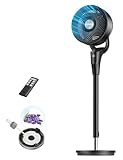
- 𝙐𝙡𝙩𝙧𝙖 𝙋𝙤𝙬𝙚𝙧𝙛𝙪𝙡 𝘼𝙞𝙧 𝘾𝙞𝙧𝙘𝙪𝙡𝙖𝙩𝙤𝙧 𝘽𝙮 𝙐𝙥𝙜𝙧𝙖𝙙𝙚𝙙: Compared with previous DREO fan for bedroom, the 2026 upgraded air circulator fan for whole room powered by DREO's advanced airflow tech circulates air up to 90 ft away and 1000 CFM to circulate all the air in your bedroom, living or kitchen in under 2 min. (DR-HPF013, TurboPoly Fan 353)
- 𝙐𝙡𝙩𝙧𝙖 𝙌𝙪𝙞𝙚𝙩 𝘾𝙤𝙢𝙛𝙤𝙧𝙩: Powered by a DC motor, DREO's unique blade design delivers smooth airflow with quiet operation. You can also mute beep sounds with a single touch on the remote and set an 8-hour timer.
- 𝘿𝙞𝙧𝙚𝙘𝙩 𝘼𝙞𝙧 𝙒𝙝𝙚𝙧𝙚 𝙔𝙤𝙪 𝙉𝙚𝙚𝙙 𝙄𝙩: This oscillating fan offers 90˚ horizontal oscillation, a 105˚ pivoting head, and an adjustable height range (38"–42"). You can set it low for kids or pets, mid-height for relaxing in the living room, or high to stay cool in bed.
- 𝘼𝙪𝙩𝙤 𝙈𝙤𝙙𝙚 𝙃𝙖𝙣𝙙𝙡𝙚𝙨 𝙒𝙞𝙣𝙙 𝙛𝙤𝙧 𝙔𝙤𝙪: The standing fan for bedroom has 8 speeds and an auto mode that automatically adjust fan speed for a seamless comfort experience, increasing 1 wind speed whenever room temp goes up 2˚F.
- 𝙈𝙤𝙧𝙚 𝙩𝙝𝙖𝙣 𝘼𝙞𝙧 𝘾𝙞𝙧𝙘𝙪𝙡𝙖𝙩𝙞𝙤𝙣: This pedestal fan has detachable design, letting you take the blade, front, and rear grill separately for an easy clean, while its built-in aroma pad lets you add fragances for a fresher air.
What matters more than speed count?
- Useful airflow at an acceptable noise level. A three-speed fan can be better than a 12-speed fan if its settings are meaningfully different.
- Direction and coverage. Check tilt, oscillation, circulation pattern, and whether the airflow reaches where you sit or sleep.
- Stability. A broad base matters for floor fans; secure supports matter for window fans.
- Cleaning. Removable grilles and accessible blades make regular maintenance easier.
- Controls. A remote, timer, thermostat, and display-off mode can matter more than extra speeds.
- Energy use. Compare stated wattage or measured consumption rather than vague efficiency claims.
- Parts and warranty. Check warranty length, replacement parts, and service support.
- Smart features. Pay extra only if scheduling or voice control solves a real problem.
Choosing a quiet bedroom fan
Manufacturer decibel numbers are not directly comparable unless the testing distance, speed, room acoustics, and measurement method match. “Quiet” or “whisper-quiet” should be treated as a product description, not a universal measurement.
For a bedroom, check whether the lowest setting creates a useful breeze, whether the display can be turned off, whether button beeps can be disabled, and whether the timer lasts through the night. Listen for high-pitched motor tones, clicking during oscillation, and rattling from the grille or base. Smooth airflow may also be more comfortable than a buffeting stream.
Using a fan more effectively
- Aim a circulator upward or across the room to mix air rather than always pointing it at your face.
- Use a fan to distribute air from an air conditioner or heat pump.
- Use window intake or exhaust only when outdoor temperature and air quality support it.
- Turn the fan off in an empty room unless it is serving ventilation or air-distribution work.
- Unplug the fan before cleaning. Follow the owner’s guide and never spray liquid into the motor.
- Clean dust from the grille and blades regularly; buildup can reduce airflow and increase noise.
Important safety and edge cases
Keep fingers, toys, pet tails, and loose fabric away from the grille. Do not place an unstable fan on furniture, and route cords away from walkways. Keep window installations secure and verify the window’s width range.
A fan is not a substitute for an air purifier during wildfire smoke or pollution events. Do not draw contaminated outdoor air indoors merely because a window fan is available.
Misting fans can provide localized relief but add water, humidity, cleaning, and mineral-deposit problems. Cooling plates cool a small contact area and should not be treated as whole-room cooling.
Ceiling fans may be a better permanent solution for large rooms, but installation, ceiling height, light fixtures, wiring, and landlord restrictions make them a separate decision. During a power outage, ordinary plug-in fans stop working; a rechargeable or USB model can provide temporary relief if its battery capacity is adequate.
Recommended Free Tools
What to avoid
- Claims such as “most powerful” or “quietest” without a stated measurement method.
- Vague airflow or “CPS” claims that cannot be compared across models.
- App-only operation when physical controls are important to you.
- A window fan without secure mounting or a clear fit range.
- A premium price based mainly on appearance when a cheaper model provides the needed airflow.
- A misting fan for a humid climate unless localized misting is specifically desired.
- Imported models such as Meaco or Duux without confirming U.S. voltage, inventory, returns, and warranty service.
How these recommendations should be interpreted
Current fan guides combine independent testing, editorial home testing, product evaluation, and manufacturer specifications. Consumer Reports reported testing nine popular room fans, while HGTV reported testing nearly two dozen; those studies do not use one universal laboratory protocol. Prices are retailer- and promotion-dependent, and availability can change quickly.
For most rooms, start with the problem rather than the brand: choose a desk fan for one person, a circulator for room mixing, a tower for a narrow bedroom footprint, a reversible window fan for suitable ventilation, and a box fan for inexpensive utility work. Choose smart control only after the basic airflow, noise, safety, and maintenance requirements are satisfied.
Quick Recap
Product prices and availability are accurate as of the date/time indicated and are subject to change. Any price and availability information displayed on Amazon at the time of purchase will apply.

