Recommended Free Tools
The best electrical outlet box is the one that matches the job: the wall condition, wiring method, device depth, conductor count, support requirements, and environment. For most interior residential DIY receptacle and switch projects, that means a UL-listed nonmetallic PVC box with enough cubic-inch capacity for the wiring. Use a new-work nail-on or screw-on box when framing is open. Use an old-work remodel box when drywall is already installed. Use an adjustable-depth box when tile, backsplash, paneling, or uncertain wall thickness could leave the device sitting too deep or too proud.
That is the fast answer. The better answer is that outlet boxes are not one-size-fits-all. A small 14 cubic inch old-work box may technically fit in the wall, but it can become miserable or noncompliant once you add 12 AWG cable, a GFCI receptacle, a USB outlet, a smart switch, internal clamps, and multiple cable entries. On our job sites, we default to deeper boxes whenever the framing, wall cavity, and listing allow it. A 20 to 24.5 cubic inch one-gang box usually gives cleaner folds, less device pressure, and fewer callbacks than the smallest box on the shelf.
This guide walks through the best box type for common DIY projects, what the 2026 cost range looks like, where plastic makes sense, when metal is the better call, and when the job should move from DIY to a licensed electrician.
As an Amazon Associate I earn from qualifying purchases.
Do these 3 things before closing this tab:
1Scan for outdated or missing drivers - takes under a minute2Clear out junk files and repair common Windows errors3Fix the driver behind crashes, sound loss and screen glitchesStart With the Project, Not the Box
Electrical boxes get selected correctly when you work in the right order. First decide what the circuit is doing. Then count the conductors and devices. Then check box fill. Then choose the box style and support method. Only after that should you cut drywall, drill framing, or buy devices.
A normal one-gang receptacle in an open stud wall is a different problem than an exterior outlet, a kitchen backsplash GFCI, a workshop receptacle in surface conduit, or a ceiling fan rough-in. They may all be called outlet boxes, but they carry different loads, take different fittings, and fail in different ways when chosen poorly.
#1 Best Overall

- 【 Easy to use 】 By using the box's built-in fixing ears and screwing them onto the wall, old work box is very suitable for adding new sockets to existing walls. It has a rotatable buckle and can prevent them from falling off
- 【Problem Solving】Solve common problems encountered during decoration, such as "digging holes affects aesthetics, wiring is time-consuming and laborious, and switch disassembly is inconvenient". Repair is easy, and small electrical outlet box solve big problems
- 【Product Installation】 The size of this electric switch box is 4-1/3-Inch Length By 2-1/5-Inch Width By 2-3/4-Inch Depth, it weighs 88 grams,AWG for 7/14,6/12,5/10,with a snap on connection to avoid loosening and reinstallation.
- 【Excellent Material】Newly upgraded flame retardant PVC material with light weight, safe and reliable, integrated injection molding, not easily deformed, and pvc outlet box has long service life.
- 【 Diverse Scenarios 】 Old house renovation and upgrading,old work wall box is suitable for various decoration styles, easy to solve decoration sequelae, DIY renovation
For a clean residential installation, evaluate these six items before buying:
- Wall condition: open framing, finished drywall, masonry, tile, paneling, ceiling, floor, or exposed surface.
- Wiring method: NM-B cable, conduit, metal-clad cable, armored cable, low-voltage cable, or exterior-rated wiring.
- Device depth: standard receptacle, GFCI, USB receptacle, dimmer, timer, smart switch, or multi-gang control.
- Box fill: required free volume for conductors, grounds, internal clamps, device yokes, and fittings under NEC Article 314.16.
- Support: nailed to a stud, screwed to framing, clamped to drywall, attached to a brace, mounted to masonry, or supported by a listed floor box assembly.
- Location: dry interior, damp exterior wall, wet location, garage, basement, attic, bathroom, kitchen, or ceiling fan location.
The common mistake is shopping by price or color first. The right box is rarely the most expensive product, but the cheapest box is often the wrong choice once the job includes a bulky device or more than one cable.
Best Electrical Box Types by DIY Project
The table below is the practical job-site version of the decision. Prices are typical 2026 U.S. retail material ranges based on common listings; local store pricing changes by region, quantity, and brand.
| DIY project | Best box choice | Typical capacity or rating | Typical 2026 material cost | Key warning |
|---|---|---|---|---|
| Adding an outlet in finished drywall | Old-work PVC remodel box | 14 to 20 cu. in. for many one-gang boxes | About $2.37 to $4.57 | Do the box-fill math before cutting the opening. |
| Open-stud remodel or new wall | New-work nail-on or screw-on PVC box | Often around 22.5 cu. in. for deeper one-gang boxes | About $1.10 and up | Set depth for finished drywall, tile, or paneling. |
| Kitchen backsplash | Adjustable-depth PVC box | Often 20 to 24.5 cu. in. | Usually several dollars more than basic boxes | Account for tile, thinset, backer, and device depth. |
| Bathroom GFCI outlet | Deep PVC old-work or new-work box | 20 cu. in. or larger preferred | About $4 to $10 for many common boxes | GFCI devices are bulky and bathroom rules are strict. |
| Garage or workshop outlet | Metal box or 4 in. square box with raised cover | More wiring room than small handy boxes | Often $3 to $15 before fittings | Metal boxes must be bonded and fitted correctly. |
| Exterior receptacle | Weatherproof box with WR/GFCI setup and in-use cover | Listed wet-location assembly | Often $20 to $75+ for full assembly | The cover, gasket, fittings, and protection all matter. |
| Ceiling fan | Listed fan-rated ceiling box or brace kit | Common ratings include 35 lb fan/50 lb fixture or 70 lb fan/200 lb fixture | Varies widely by brace and access | A standard light box is not automatically fan-rated. |
| Low-voltage data or TV cable | Low-voltage bracket or open-back ring | Not for 120V power conductors | Often $1 to $8 | Do not mix line-voltage and low-voltage wiring casually. |
| Floor receptacle | Listed floor box kit with approved cover | Rated for floor use | Often $30 to $184 depending on finish and rating | Wall boxes do not belong in floors. |
New-Work Boxes: Best When Framing Is Open
Use a new-work box when the studs or joists are exposed. These boxes fasten directly to framing before drywall goes up. Most residential PVC new-work boxes have nails or screw tabs and are made for NM-B cable. A common one-gang PVC new-work outlet box may cost around $1.10, while deeper versions with more cubic-inch capacity cost more.
New-work boxes are the right choice during basement finishing, kitchen gut remodels, additions, wall relocations, and any project where drywall has been removed. They are easier to align, stronger than drywall-clamped remodel boxes, and better for repeated plug use because the box is supported by framing instead of the gypsum board.
Set the front edge carefully. For standard 1/2 inch drywall, many boxes have depth marks or side tabs that help position the face flush with the finished wall surface. If the wall will receive 5/8 inch drywall, tile, shiplap, paneling, or stone veneer, plan for that thickness before fastening the box. A box set 1/2 inch too deep creates device and cover problems later; a box proud of the wall can keep the cover plate from sitting flat.
Best Use Cases
Choose a new-work box for open-stud receptacles, switch boxes, roughed-in bedrooms, living rooms, unfinished basements before drywall, and kitchen walls before cabinets and backsplash. For future flexibility, a deeper one-gang box around 22.5 cubic inches is often a better buy than a shallow box, especially where you may install a dimmer, USB receptacle, or smart control later.
Old-Work Remodel Boxes: Best for Finished Drywall
Old-work boxes, also called remodel boxes, are made for finished walls. Instead of nailing to a stud, they clamp to drywall with swing-out ears, wings, or tabs. They are the common choice when adding a receptacle behind a TV, installing a new switch leg, replacing a small old box, or adding a low-use outlet in an existing finished room.
Retail examples show why capacity matters. A one-gang 14 cubic inch PVC old-work box may be around $2.37. A deeper 20 cubic inch one-gang old-work box may be around $3.98 to $4.57. That extra dollar or two can make a real difference when folding conductors behind a bulky receptacle.
Rank #2

- 【 Product Advantages 】 Our 1gang old work box is compact in size, but powerful in function. When you encounter trouble, using this blue outlet box is the most convenient and effective
- 【 How to install 】 The size of old work standard outlet is 4-1/3-Inch Length By 2-1/5-Inch Width By 2-3/4-Inch Depth, it weighs 88 grams,AWG for 7/14,6/12,5/10,and it has flanges and rotatable buckles. It can be easily installed by fixing it to the wall with screws without spending too much time
- 【Safety Material】 ETL certification, rated fire resistance for 2 hours, plastic junction for switches uses PVC material, very safe, so you have no worries
- 【 Enjoy DIY 】 The fun of DIY is endless. Installing this 14cubic inch junction box by hand and solving decoration problems can bring self-improvement and a sense of accomplishment
- 【 Applicable Scenarios 】 Electric switch box can be used for various scenarios such as house decoration, commercial space renovation, and upgrading of existing buildings
Old-work boxes are convenient, but they are not magic. They depend on the drywall being sound. Crumbling plaster, damaged drywall, thick tile, wet areas, or heavy-use receptacles may need a different support method. If the outlet will be plugged and unplugged often, such as at a kitchen counter or workbench, we prefer framing support where practical.
What’s actually slowing this PC down?
Pick the symptom - the matching free tool is one click away.
Do Not Modify a New-Work Box Into an Old-Work Box
A common DIY shortcut is cutting the nails off a new-work box and trying to wedge it into a finished wall. Do not do that. Use a listed remodel box, a listed side-mount remodel product, or open the wall enough to fasten a new-work box correctly. The box support is part of the installation, not an optional convenience.
Adjustable-Depth Boxes: Best for Tile, Backsplash, and Uncertain Finishes
Adjustable boxes solve a very common remodel problem: you do not always know the final wall surface at rough-in. A kitchen backsplash might include 1/2 inch drywall, thinset, tile, and an irregular finished face. A bathroom wall might receive backer board plus tile. A basement remodel might shift from drywall to wall paneling after rough-in.
An adjustable-depth box lets the installer move the box face forward or backward so the device finishes correctly at the wall surface. That matters because recessed boxes can expose combustible wall material around devices, while boxes that stick out too far create ugly cover-plate gaps.
For kitchen and bath work, adjustable boxes also tend to offer better wiring room than the smallest one-gang boxes. A 24.5 cubic inch new/old-work PVC box is a good example of the extra-capacity category. It costs more than a basic box, but on a backsplash with a GFCI or USB receptacle, that extra room is usually worth it.
Quick wins for a faster PC:
Fix the driver behind crashes, sound loss and screen glitchesFind Drivers →Clear out junk files and repair common Windows errorsFree Scan →Plastic vs. Metal Electrical Boxes
Plastic and metal boxes are both legitimate when used in the right place. The wiring method often decides the issue.
Plastic PVC boxes are common in residential interiors with NM-B cable. They are inexpensive, lightweight, nonconductive, and often include integral clamps. They also do not need a grounding pigtail to the box itself because the box is nonmetallic. For typical bedroom, living room, hallway, and many interior remodel receptacles, PVC is the practical choice.
Metal boxes are stronger and better suited for exposed work, garages, unfinished basements, workshops, utility rooms, conduit systems, armored cable, and areas where impact resistance matters. Metal boxes must be bonded to the equipment grounding conductor. That usually means grounding screws or clips, approved clamps, proper bushings where needed, and pigtails to devices. If metal conduit is part of the grounding path, the box and fittings need to maintain that continuity.
The simplest rule: if you are using NM-B cable inside finished residential walls, plastic is often fine. If you are using conduit, metal-clad cable, exposed boxes, or a location where the box may be hit, metal deserves serious consideration and may be required by the wiring method or local code.
Windows Errors? Fix Them Before They Spread
Repair common Windows errors and clear accumulated junk for a smoother, more stable PC - no reinstall needed.Free scan · no reinstallOutdated Drivers Are Slowing You Down
One free scan finds every outdated or missing driver and matches the right update for your exact hardware.Free scan · exact hardware matchRank #3
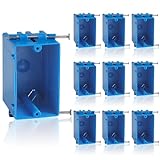
- New Work Box 1 Gang Package Content: You will receive 10 pieces of single gang electrical outlet boxes at the size of 57x71x93mm / 2.24x2.79x3.66in. 18 cubic inches in capacity, It is 2-1/4 inches long and 2-4/5 inches wide, It's depth is 3-5/8 inches. The overall quality of new work electrical box 1-gang, high reliability
- Easy To Use: This plastic electrical junction box is conveniently designed to make life easier for the electrician. With captive screws and positioning tabs, it's easy to simply hammer into the stud. This blue electrical box has four removable tabs to allow wiring in and out if the box
- Problem Solving: Solve common problems encountered during decoration, such as "wiring is time-consuming and laborious, digging holes affects aesthetics, and switch disassembly is inconvenient". Repair is easy, and small electrical outlet box solve big problems, new work box with nail is adaptable and reliable, with enough space to accommodate standard equipment and switches
- Excellent Material: The device box utilizes an ultra-thick PVC material with light weight, safe and reliable, that enhances stability and rigidity, providing exceptional rust resistance and durability. With its non-conductive properties, it guarantees a safe user experience
- Diverse Scenarios: New work 1-gang box are suitable for residential or commercial buildings. Not only for walls, but also for other panels. The switch boxes is suitable for various decoration styles, easy to solve decoration sequelae, DIY renovation, make remodeling projects quick and easy
Handy Boxes vs. 4 Inch Square Boxes
Small metal handy boxes are useful, but they get crowded fast. In garages and workshops, a 4 inch square metal box with a raised cover usually gives more room for splices and devices. It also looks more professional in exposed conduit work. The material cost may be a few dollars higher once you include the raised cover, clamps, connectors, grounding screw, and cover plate, but the installation is cleaner and easier to service.
Box Fill: The Detail That Separates Good Work From Bad Work
NEC Article 314.16 requires boxes to have enough free volume for the conductors and components inside. This is not just a comfort issue. Overfilled boxes can damage insulation, stress device terminals, make devices sit crooked, and create heat and maintenance problems.
Box fill counts more than the visible wires. Current-carrying conductors count. Device yokes count. Internal clamps count. Equipment grounding conductors count. Pigtails can matter depending on how they are used. Wire size matters too: 14 AWG and 12 AWG conductors require different volume allowances. Because 12 AWG cable is common on 20 amp kitchen, bathroom, laundry, garage, and exterior circuits, small boxes can become noncompliant quickly.
That is why a 14 cubic inch one-gang box is not our default when the project includes anything more than a simple device and limited wiring. A GFCI receptacle, smart switch, dimmer, or USB receptacle has a deeper body than a standard duplex receptacle. Add two 12/2 cables and the box gets tight. A 20 cubic inch box is often the minimum practical choice, and 22.5 to 24.5 cubic inches is better when the wall cavity allows it.
Free tools Windows power users keep installed
One-click scans. No signup required.
Bigger is not automatically better, though. The box still has to be listed for the use, properly supported, compatible with the wiring method, and appropriate for the location. Do not install a large loose box just because it has more volume. Support and listing matter as much as capacity.
Outdoor Outlet Boxes: Buy the Whole Assembly, Not Just the Box
Exterior receptacles require more than a gray weatherproof box. The full assembly matters: a weather-resistant receptacle, GFCI protection where required, a weatherproof enclosure, gasketed cover, correct fittings for conduit or cable entry, corrosion-resistant fasteners, and an in-use cover for wet locations where a cord may remain plugged in.
NEC 406.9 addresses weatherproof covers and wet-location receptacle protection, including listed extra-duty outlet-box hoods in many wet-location uses. In practical homeowner terms, that means the cover should remain weatherproof while a plug is inserted. A simple flip cover may not be enough for an outlet on a porch, patio, exterior wall, or landscape circuit where the cord stays connected.
Expect exterior projects to cost more than interior box swaps. The box itself may be modest, but the full material list can include the weatherproof box, WR receptacle, GFCI breaker or receptacle, in-use cover, gaskets, conduit, fittings, caulk, and hardware. A complete outdoor receptacle assembly commonly lands in the $20 to $75+ material range before labor, depending on quality and configuration.
Ceiling Fixture and Fan-Rated Boxes
A ceiling light box is not automatically rated for a ceiling fan. Fans create dynamic load from rotation and vibration, and the box must be listed for fan support. If a ceiling fan may ever be installed in a bedroom, living room, office, or covered porch, use a fan-rated box or fan-rated brace kit now. It is cheaper to rough it in correctly than to reopen a finished ceiling later.
Rank #4

- For New Work Applications: The electrical outlet box is side-mounted on fixed points, such as vertical beams, making it convenient to determine the electrical box placement in advance and plan the room layout accordingly
- 22.5 CU.IN: The deeper internal space of 22.5 cubic inches accommodates products with larger power compartments such as GFCI outlets, dimmer switches, and step lights, providing ample space for wiring. In addition, the built-in cable clamps securely hold the wires in place
- Compliance Certification: ETL Listed. Designed and listed for use with non-metallic sheathed cable in accordance with Article 314 of the National Electrical Code
- Safe To Use: The device box utilizes an ultra-thick PVC material that enhances stability and rigidity, providing exceptional rust resistance and durability. With its non-conductive properties, it guarantees a safe user experience
- Product Dimensions: 4 3/16-Inch Length; 2 3/8-Inch Width; 3 7/16-Inch DepthC. Ideal for standard devices and switches with 3-1/4” screws spaced
NEC language commonly limits fan boxes used as the sole support to fans not over 70 pounds, and boxes supporting fans over 35 pounds must be marked with the maximum supported weight. Retail fan boxes often show ratings such as 35 pounds for a fan and 50 pounds for a fixture on some residential polycarbonate bar-hanger products. Heavy-duty steel fan supports may advertise ratings such as 70 pounds for a fan and 200 pounds for a fixture.
Match the rating to the actual fan, ceiling framing, and access conditions. If you have attic access, a brace kit can often be installed cleanly between joists. Without attic access, old-work fan brace kits are available, but plaster ceilings, unusual joist spacing, or heavy fans can make the job harder.
Low-Voltage Rings and Floor Boxes
Low-voltage brackets are useful for data, coax, HDMI, speaker wire, thermostat cable, and certain control wiring. They are usually open-backed and are not substitutes for 120 volt electrical boxes. Keep line-voltage and low-voltage wiring separated according to code and device listing. Behind a wall-mounted TV, for example, use a proper power receptacle box for 120 volt power and a separate low-voltage bracket for signal cables.
The Tool Desk
Outbyte PC Repair FREERepair Windows errors before they cause bigger problemsFix Now →Outbyte Driver Updater FREEFix the driver behind crashes, sound loss and screen glitchesFind Drivers →Floor boxes are their own category. A wall box installed in a floor is the wrong product. Floor receptacles need listed floor box assemblies with covers designed for foot traffic, cleaning, dust, and in some locations moisture. Depending on finish and rating, floor box kits can range from about $30 to well over $100, with broad retail electrical box categories reaching about $184.
Independent reader supportYour contribution helps us test, update, and keep practical guides available for everyone.2026 Cost Guide for Electrical Outlet Boxes
For materials only, common electrical boxes range widely. Broad retail categories show prices from roughly $0.75 to $184, with many everyday residential boxes near $1 to $10. Lowe’s lists a typical electrical-box price around $8, while common PVC one-gang boxes are often much less.
Professional installation is a different number because labor, access, permits, wall repair, circuit routing, and troubleshooting drive the cost. HomeGuide reports professional junction-box installation around $100 to $300 typical, with a $200 national average, a $50 minimum, and up to $1,200 depending on location, accessibility, box size, material, and indoor or outdoor rating. Outlet installation estimates vary by region and scope, but any new circuit, finished-wall fishing, exterior penetration, panel work, or permit inspection can move the cost well beyond the price of the box.
| Item | Typical 2026 cost | Notes |
|---|---|---|
| Basic one-gang PVC new-work box | About $1.10 | Good for open framing with NM-B cable. |
| 14 cu. in. one-gang old-work PVC box | About $2.37 | Fine only when box fill works and device depth is modest. |
| 20 cu. in. one-gang old-work PVC box | About $3.98 to $4.57 | Better for GFCI, USB, smart devices, or 12 AWG cable. |
| 25 cu. in. two-gang old-work PVC box | About $4.98 | Useful for paired switches or receptacle combinations. |
| Weatherproof exterior outlet assembly | Often $20 to $75+ | Includes more than the box: cover, WR/GFCI, fittings, gaskets. |
| Professional junction-box installation | Typically $100 to $300 | National average around $200; difficult jobs can reach $1,200. |
When to DIY and When to Hire a Pro
A careful homeowner can often replace a damaged low-voltage bracket, install an old-work box for low-voltage cable, or replace an existing electrical box during an accessible remodel if the circuit is off, the wiring is understood, and local rules allow the work. Adding a basic receptacle in finished drywall may be DIY-friendly for someone who can identify the circuit, verify power is off with a tester, calculate box fill, secure the cable properly, and make code-compliant terminations.
Hire a licensed electrician when the project involves a new circuit, panel work, aluminum wiring, knob-and-tube wiring, unclear grounding, exterior outlets, bathrooms, kitchens, garages, unfinished basements, multi-wire branch circuits, conduit design, ceiling fan support uncertainty, or any work requiring a permit that you are not comfortable managing. Also hire out any job where you cannot verify the cable path before cutting or drilling. Hitting plumbing, HVAC, or another electrical cable can turn a small project into a serious repair.
Permits are local. Some jurisdictions allow homeowners to perform limited electrical work on their own primary residence with a permit and inspection. Others require a licensed contractor for more scopes. County and state examples vary widely, from local residential electrical permit rules to state-level licensing systems and online electrical permit portals. Before closing a wall, document the circuit, box location, cable path, permit number, and inspection result. Photos taken before insulation and drywall are cheap insurance.
Best Value

- EXTRA DUTY RATED: Get maximum toughness and protection. Our 1-Gang Weatherproof In-Use Electrical Outlet Cover for home improvement is EXTRA DUTY rated and cULus listed for wet and damp locations.
- EASY TO INSTALL: Set up your outdoor outlet cover in no time at all. Our Quick-Fit keyhole mounting system allows installation in under a minute with an EZ Change Pin for horizontal or vertical mount.
- CUSTOM CONFIGURATIONS: Our weatherproof outlet cover uses UFAST 16-in-1 custom device configuration. You can mount and protect duplex, switch, or GFCI.
- QUALITY CONSTRUCTION: Our socket cover for outlets is built from high-impact polycarbonate for maximum durability. You have more room for electrical cords and includes gasket and mounting hardware.
- SAFE AND SECURE: Our weatherproof cover is tested and certified to cULus and NEMA standards. Lockable tab secures with a full-size padlock for protection against tampering.
Our Practical Buying Recommendations
For most interior outlet additions in finished drywall, buy a 20 cubic inch old-work PVC box instead of the smallest 14 cubic inch box. The cost difference is usually around a dollar or two, and the working room is worth it. For open framing, use a deep new-work PVC box around 22.5 cubic inches where possible. For kitchens, baths, and tile, use adjustable-depth boxes with enough room for GFCI or smart devices. For garages, workshops, and exposed conduit, use metal boxes or 4 inch square boxes with raised covers. For exterior work, buy the entire weatherproof assembly, not just the box. For ceiling fans, buy only boxes or brace systems clearly marked fan-rated.
The best electrical outlet box is not the fanciest one on the shelf. It is the box that gives you enough volume, proper support, correct grounding, the right environmental rating, and a finished device that sits straight and serviceable. Spend the extra few dollars on capacity and the correct listing. It is one of the cheapest ways to make an electrical project easier to install, easier to inspect, and easier to live with.
Frequently Asked Questions
What size electrical box should I use for a standard outlet?
For a simple interior receptacle, many one-gang boxes work, but a 20 cubic inch box is a better default than a 14 cubic inch box when space allows. It gives more room for 12 AWG wire, pigtails, GFCI outlets, USB receptacles, and cleaner wire folds.
Can I use a plastic electrical box with metal conduit?
Usually no. Metal conduit systems often rely on metal boxes, listed fittings, and proper bonding for grounding continuity. Plastic boxes are common with residential NM-B cable, but they are not a grounding path for metal conduit or armored cable systems.
What is the difference between old-work and new-work boxes?
New-work boxes fasten to studs or joists before drywall is installed. Old-work boxes clamp to finished drywall with wings or ears and are used for remodel work where the wall is already closed.
Do outdoor outlets need special boxes?
Yes. Outdoor receptacles generally need a weatherproof box, weather-resistant receptacle, GFCI protection where required, gasketed cover, correct fittings, and an in-use cover in wet locations where a cord may stay plugged in.
Quick wins for a faster PC:
Repair Windows errors before they cause bigger problemsFix Now →Scan for outdated or missing drivers - takes under a minuteDriver Scan →Clear out junk files and repair common Windows errorsFree Scan →Can a regular ceiling box hold a fan?
No, not unless it is specifically listed and marked for fan support. Ceiling fans require fan-rated boxes or fan-rated brace systems. Common ratings include 35 pounds for some residential fan boxes and up to 70 pounds for heavier fan supports.
How much does it cost to have an electrical box installed?
In 2026, professional junction-box installation commonly runs about $100 to $300, with a national average near $200. Difficult access, outdoor work, larger boxes, new circuits, permits, and repairs can push the cost much higher.
Quick Recap
Product prices and availability are accurate as of the date/time indicated and are subject to change. Any price and availability information displayed on Amazon at the time of purchase will apply.

