Free tools Windows power users keep installed
One-click scans. No signup required.
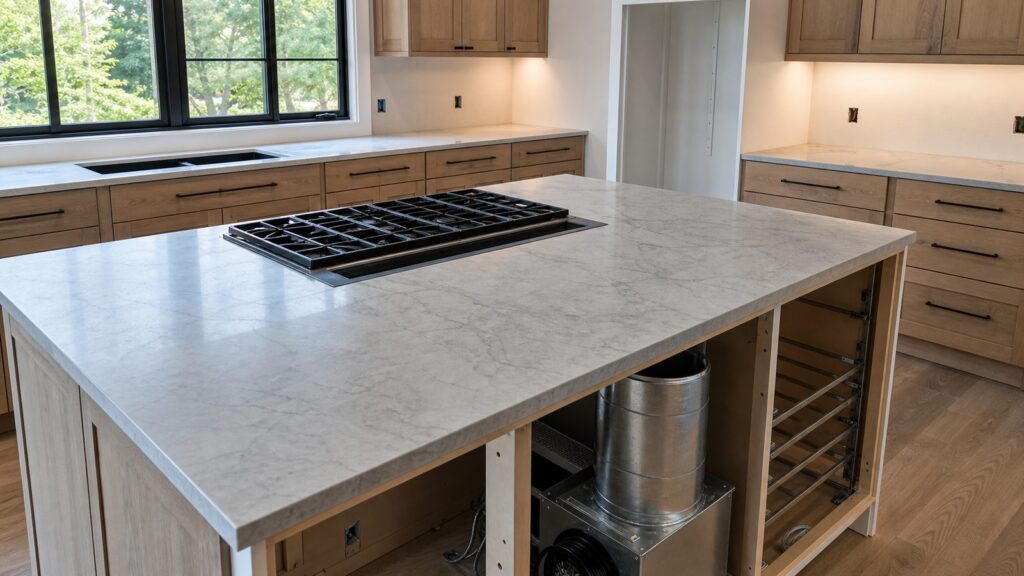
Downdraft ventilation is best for one specific kind of kitchen: an island, peninsula, or open-plan layout where an overhead hood would interrupt sightlines and the cooking load is moderate. It is not the strongest ventilation choice for every home. Smoke, steam, grease, and heat naturally rise, so a downdraft has to pull them sideways or downward before they escape into the room.
That does not make downdrafts bad. It means they have to be selected and installed carefully. On our kitchen remodels, we treat a downdraft as a design-and-construction decision, not just an appliance purchase. The duct path, cabinet base, electrical work, countertop cutout, blower location, and makeup-air requirements matter as much as the brand name on the cooktop.
As an Amazon Associate I earn from qualifying purchases.
For 2026 projects, most integrated downdraft cooktops sit around 300 to 345 CFM. KitchenAid gas and electric downdraft cooktops commonly list 300 CFM exhaust ratings. Newer premium induction downdraft models, such as JennAir NextGen induction downdraft units, list about 345 CFM extraction power and start around $4,999. Installed costs commonly range from about $1,500 to $3,000 for simpler downdraft projects, and $2,350 to $5,200 or more when island ducting, cabinet modification, electrical work, or slab routing is involved.
The short answer: choose a downdraft when preserving the room matters and your cooking habits fit the system. Choose a proper ducted hood when performance matters most.
#1 Best Overall

- Great tools at a great price
Best Downdraft Picks by Kitchen Type
The best downdraft is not one universal model. It is the one that matches your cooktop, cabinet, duct route, and cooking style. A 30-inch induction downdraft in a clean island layout is a different problem than replacing a discontinued 36-inch gas downdraft in an older cabinet base.
Best Overall Premium Choice: Induction Downdraft Cooktop
For most higher-end remodels where the homeowner wants open sightlines, induction paired with downdraft ventilation is the cleanest combination. Induction does not create gas combustion byproducts, heats quickly, and generally produces less waste heat than a gas burner. That gives a moderate-CFM downdraft a better chance of doing its job.
JennAir’s NextGen induction downdraft cooktop is a good example of the premium category. The published starting price is around $4,999, with vented or recirculating installation options and extraction power listed around 345 CFM. KitchenAid’s newer 30-inch induction downdraft cooktop has been reported with a roughly 332 CFM exhaust system through retailer specification information. These are not bargain appliances, but they are aimed at the homeowner who wants an island cooktop without a visible hood.
Best fit: open kitchens, islands, premium remodels, electric-service-ready homes, and homeowners who saute, boil, simmer, and cook daily without frequent high-smoke searing.
Best Replacement Gas Downdraft: 30- or 36-Inch Gas Downdraft Cooktop
If your existing kitchen already has a JennAir or KitchenAid gas downdraft cutout, replacing it with a current gas downdraft cooktop can be the most practical path. KitchenAid’s 36-inch 5-burner gas downdraft cooktop lists a 300 CFM exhaust rating, and 2026 product pricing commonly falls around $2,249 to $2,399. A 30-inch gas downdraft may land around $2,299, depending on finish and retailer.
The main advantage is not raw performance. It is reducing construction scope. If the old duct, cabinet depth, countertop opening, gas location, and electrical connection can be reused, the project may stay closer to a replacement installation than a full island reconstruction.
Best fit: like-for-like replacements, homeowners committed to gas cooking, and kitchens where overhead ventilation is not acceptable aesthetically.
Do these 3 things before closing this tab:
1Fix the driver behind crashes, sound loss and screen glitches2Clear out junk files and repair common Windows errors3Scan for outdated or missing drivers - takes under a minuteBest 36-Inch Electric Downdraft: Radiant Electric Cooktop With Integrated Vent
A 36-inch electric downdraft cooktop is a practical middle option for homeowners who want more cooking surface but do not want gas. KitchenAid’s 36-inch electric downdraft models commonly price around $2,299 to $2,398 and list a 300 CFM exhaust rating.
Radiant electric is usually less responsive than induction, but it avoids gas combustion byproducts and can work well for moderate cooking. The 36-inch width gives more room between pots, which can help capture when cookware is positioned near the intake.
Best fit: replacement projects, moderate cooking loads, and kitchens where induction is not desired or existing electrical conditions make radiant electric simpler.
Best Separate Pop-Up Downdraft: Remote or Inline Blower System
A separate pop-up downdraft sits behind or beside the cooktop and rises when needed. This can be a better fit when the homeowner wants a specific cooktop rather than an all-in-one downdraft cooktop. Premium pop-up systems may allow internal, inline, or remote blowers, which gives the design team more flexibility with noise and duct routing.
The tradeoff is installation complexity. A pop-up unit needs cabinet space below the counter, clearance behind the cooktop, a compatible countertop layout, and a duct route that does not collide with drawers, structural framing, plumbing, or electrical runs. In island cabinets, this often means giving up storage or using custom cabinet modifications.
Best fit: custom kitchens, premium islands, homeowners who want a specific cooktop, and projects where the cabinet plan can be designed around the vent from the beginning.
Best Budget or Light-Cooking Option: Existing-Route Replacement
The best budget downdraft is usually not the cheapest appliance. It is the model that fits the existing opening and duct path with the least reconstruction. A low-priced unit can become expensive if it requires a new countertop cutout, cabinet rebuilding, duct resizing, or electrical relocation.
Rank #2

- 【Material】The 4 inch backdraft damper is made of a Galvanized steel, the flap leaves are made of aluminum
- 【Installation】The backdraft damper is installed by pushing it into the ventilation pipe as far as it will go. The position of the spring should be horizontal when the flap is installed horizontally so that it can be opened and closed optimally. This also applies to the vertical installation
- 【Function】This airflow regulating backdraft shutter fits over the TD lip and is designed to improve ventilation by preventing air from re-circulating when the fans are not in use
- 【Wide Application】 These backdraft dampers can be widely used in ACs, exhaust fans, extractors, range hoods, heating ducts, vents and other residential, commercial and industrial applications
- 【Note】Back draught valves can be inserted into ventilation ducts which are flexible or non flexible. Cannot be used with plastic ducts as the sizes are different. All dimensions are measured manually, please allow 1-3mm differences
For light cooking, a 300 CFM integrated downdraft may be acceptable if the duct run is short and smooth. It is less ideal for frying bacon every morning, blackening fish, wok cooking, or regular cast-iron searing.
Quick wins for a faster PC:
Scan for outdated or missing drivers - takes under a minuteDriver Scan →Clear out junk files and repair common Windows errorsFree Scan →Fix the driver behind crashes, sound loss and screen glitchesFind Drivers →Best fit: condos or homes with existing downdraft infrastructure, light-to-moderate cooking, and projects where avoiding cabinet and countertop changes saves thousands.
Downdraft vs Island Hood vs Ceiling Vent
Before ordering a downdraft, compare the three common ventilation paths for an island kitchen: downdraft, island hood, and ceiling cassette or flush ceiling ventilation. We often price and sketch all three early because the correct answer changes once the duct route is visible.
| Option | Best For | Typical Strength | Main Drawback |
|---|---|---|---|
| Integrated downdraft cooktop | Open sightlines, moderate cooking, replacements | Usually around 300 to 345 CFM | Pulls against rising heat and smoke |
| Pop-up downdraft | Custom islands and premium cooktops | Can use internal, inline, or remote blower options | Cabinet space and duct routing are demanding |
| Island hood | Heavy cooking and better capture | Usually stronger capture area over the cooking surface | Visible hood over island |
| Ceiling cassette | Open kitchens with high design requirements | Keeps the ceiling cleaner than a hood | Performance depends heavily on height and blower design |
If the homeowner cooks heavily, an overhead hood is usually the better-performing system. Capture area matters. A hood sits above the heat plume and catches rising contaminants before they spread. A downdraft has to pull them away from their natural path.
That distinction is especially important with gas. Gas burners create combustion byproducts in addition to normal cooking grease, moisture, and odor. If the client wants a high-output gas cooktop, we are direct about the tradeoff: open sightlines may cost them ventilation performance.
What Downdrafts Cost in 2026
A downdraft budget has two parts: the appliance and the construction required to make it work. National range hood installation benchmarks are useful, but they often understate the cost of a complicated island downdraft.
Homewyse’s May 2026 benchmark for installing a vent hood starts around $564 to $1,030 per hood. HomeGuide’s 2026 data puts replacement installation around $300 to $850 and a new range hood with outlet and ductwork around $650 to $2,100. Angi’s 2026 data lists downdraft range hoods around $1,500 to $3,000 for materials and labor. Downdraft-specific estimates from CountBricks put typical installed investment around $2,350 to $5,200.
| Cost Item | Typical 2026 Range | Notes |
|---|---|---|
| Downdraft unit or blower | $950 to $1,800 | Premium induction models may start around $4,999 before installation |
| Ductwork and fittings | $250 to $600 | Rigid metal duct, elbows, transitions, wall or roof cap |
| Cabinet modification or new base | $400 to $1,200 | Often needed in islands and pop-up installations |
| Electrical work | $150 to $400 | Can be higher if a new circuit is needed |
| Labor and testing | $600 to $1,200 | Includes fitting, sealing, startup, and airflow checks |
| Typical installed project | $2,350 to $5,200 | Complex slab, countertop, or long duct runs can exceed this |
The biggest cost drivers are new versus replacement installation, island versus wall or peninsula location, slab-on-grade routing, basement or crawlspace access, duct length, number of elbows, cabinet work, countertop cutout changes, electrical circuit needs, gas line work, permits, and makeup-air requirements.
A simple replacement may stay near the low end if the new unit fits. A new island downdraft with cabinet changes, countertop cutting, ducting, and electrical work should be treated as a remodel line item, not an appliance swap.
Recommended Free Tools
How to Choose the Right Downdraft
Start With the Duct Route
The duct route should be designed before the appliance is purchased. A less expensive unit with a short, straight, properly sized duct can outperform a premium unit forced through a long, twisted route with undersized transitions.
Use rigid metal duct, not flexible dryer-style duct. Keep the run short and smooth. Minimize elbows. Follow the manufacturer’s required duct diameter and approved transitions. Every elbow and restriction adds static pressure, which reduces delivered airflow. The CFM printed on the spec sheet is not always the airflow you get at the exterior wall cap.
Rank #3

- An antidraft duct insert designed for use with range hoods, bathroom fans and other home HVAC applications.
- Features outer rubber gaskets that create an airtight seal and grip between the damper and ducts.
- Mounts horizontally or vertically to prevent backflow and debris from entering ducting.
- Galvanized steel body with spring-loaded aluminum damper blades that open with minimal airflow.
- Fit for 6 in. Duct Openings | Product Length: 5.03 inches | Finish: Powder Coat
For islands, the duct may need to travel down through the cabinet and out through a floor system, crawlspace, basement, or slab. Slab-on-grade routing is often the most expensive and least forgiving. Once concrete cutting enters the scope, the project moves out of simple appliance territory.
Match CFM to Cooking Habits
Many integrated downdraft cooktops list around 300 CFM, with some newer induction downdraft models around 332 to 345 CFM. That can work for boiling pasta, simmering sauces, light sauteing, and everyday family meals. It is less convincing for high-smoke cooking.
If you frequently sear steaks in cast iron, stir-fry in a wok, grill indoors, deep fry, or use high-BTU gas burners, a downdraft is usually not the best first choice. In those cases, a ducted overhead hood with adequate capture area and airflow is the better tool.
Look Beyond the CFM Number
CFM matters, but it is not the only specification. Compare noise rating in sones or dBA, duct size, blower location, filter access, installation depth, cutout dimensions, cooktop compatibility, and whether the model is HVI or AHAM listed where required.
Noise deserves attention. A downdraft working hard at high speed can be loud, especially with an internal blower in an island cabinet. Remote or inline blowers can reduce perceived kitchen noise, but they add cost and installation planning.
Plan for Service Access
In premium remodels, we specify service access in the island base where possible. Future blower, filter, control, or duct service should not require cabinet demolition. This is a small planning detail during construction and an expensive oversight later.
What’s actually slowing this PC down?
Pick the symptom - the matching free tool is one click away.
Ducted vs Recirculating Downdrafts
A ducted downdraft is usually preferable. It exhausts moisture, grease, smoke, odors, and cooking contaminants to the exterior. That is the point of ventilation.
Recirculating downdrafts filter the air and return it to the room. They may be useful when exterior venting is impractical or prohibited, such as some multifamily buildings, but they are a compromise. Charcoal filters can help with odor, but they do not remove moisture the same way exterior exhaust does, and they require replacement.
Local code also matters. Some jurisdictions require kitchen exhaust to terminate outdoors, and manufacturer instructions can control what is allowed for a specific appliance. Do not assume a recirculating kit is acceptable just because it is sold as an accessory.
Code, Makeup Air, and Safety Notes
Kitchen ventilation touches building code, mechanical code, electrical work, and sometimes gas work. In many US jurisdictions, domestic cooking exhaust equipment must discharge outdoors unless the appliance is specifically listed and installed for recirculation. Exhaust should not terminate in an attic, crawlspace, wall cavity, or garage.
Outdated Drivers Are Slowing You Down
One free scan finds every outdated or missing driver and matches the right update for your exact hardware.Free scan · exact hardware matchPC Slower Than It Used to Be?
A free scan shows the junk files, broken settings and background clutter dragging Windows down - then fixes them in one click.Free scan · Windows 10 & 11Makeup air is another common miss. Under the International Residential Code, range hoods capable of exhausting more than 400 CFM may trigger a makeup-air requirement. The system generally needs to bring in outdoor air at a rate roughly equal to the exhaust and include a means of closure. Local amendments vary, so the inspector’s requirements should be checked before ordering equipment.
Rank #4

- COMPATIBILITY – Male fit coupler is designed for standard round ventilation ducts used in bathroom fans, inline extractor fans, hydroponics setups, and general air movement systems.
- DURABLE PLASTIC CONSTRUCTION – Air Duct Connector is made from lightweight, corrosion-resistant PVC that performs reliably in temperatures from 23°F to 140°F, making it suitable for everyday ventilation use.
- BUILT-IN BACKDRAFT PROTECTION – Designed to allow airflow in one direction only, helping prevent reverse air movement, drafts, and unwanted odors entering the duct system.
- QUIET & LOW-RESISTANCE OPERATION – Balanced lightweight flap opens easily under airflow and closes gently when the fan stops, maintaining smooth, efficient ventilation without mechanical noise.
- EASY INSERT INSTALLATION – Simple push-in design allows quick installation inside ducting without complex tools, suitable for residential and commercial ventilation setups.
Even if your downdraft is only 300 to 345 CFM, tight homes can still have pressure issues. Strong exhaust fans can backdraft fireplaces, water heaters, or other combustion appliances if replacement air is not planned. In newer, tighter homes, we coordinate kitchen ventilation with HVAC and combustion safety instead of treating it as a stand-alone appliance.
For indoor air quality, use the fan before cooking starts, cook on back burners when practical, and leave ventilation running 10 to 20 minutes after cooking. That simple habit helps capture lingering moisture, odor, and fine particles.
Independent reader supportYour contribution helps us test, update, and keep practical guides available for everyone.When to DIY vs When to Hire a Pro
A homeowner with solid skills may be able to handle a like-for-like downdraft replacement if the new unit fits the existing cutout, uses the same duct route, does not require gas line changes, and connects to an existing code-compliant electrical supply. Even then, the manufacturer instructions need to be followed closely.
The Tool Desk
Outbyte Driver Updater FREEScan for outdated or missing drivers - takes under a minuteDriver Scan →Outbyte PC Repair FREEClear out junk files and repair common Windows errorsFree Scan →Before ordering a replacement, photograph and measure the existing cutout, cabinet interior, duct location, electrical connection, gas connection if present, countertop thickness, and clearances. Many older downdraft layouts are not true drop-in matches with current models. A half-inch conflict can become a countertop or cabinet problem.
Hire a pro when the project includes new ductwork, island cabinet modification, countertop cutting, gas line work, a new electrical circuit, slab routing, roof or exterior wall penetrations, makeup air, or permit inspections. Those are construction tasks, not just appliance tasks.
On our job sites, we also test the system before calling the project finished. That means verifying fan operation on every speed, checking damper movement, confirming exterior discharge, listening for vibration, checking filter fit, and confirming makeup-air operation where installed. A downdraft that powers on but exhausts poorly is not complete.
Common Downdraft Mistakes
The first mistake is choosing a downdraft purely for aesthetics. Sightlines matter, but the system still has to match how the household cooks. Heavy frying, searing, wok cooking, and high-output gas burners are hard for most downdrafts to manage.
The second mistake is designing the island before designing the duct. Cabinet drawers, trash pullouts, plumbing, electrical boxes, structural members, and duct fittings all compete for the same space. The vent needs room to breathe.
The third mistake is accepting a bad duct route. Too many elbows, undersized duct, flexible duct, long horizontal runs, and awkward transitions can turn a decent appliance into a weak performer.
The fourth mistake is forgetting replacement air. A kitchen exhaust system removes air from the house. That air has to come from somewhere. In tight homes, ignoring that fact can create comfort problems and combustion-safety risks.
The fifth mistake is skipping access. Filters need cleaning. Blowers can fail. Dampers can stick. If the only way to reach the system is to tear apart the island, the original installation was not planned well.
Crashes, No Sound, or Screen Glitches?
Random freezes, missing sound and display glitches usually trace back to one bad driver. Find and replace yours safely.Free scan · under a minutePC Slower Than It Used to Be?
A free scan shows the junk files, broken settings and background clutter dragging Windows down - then fixes them in one click.Free scan · Windows 10 & 11Best Value

- PRODUCT SIZE: Diameter 100MM/4 inch, length 88MM/3.5 inch, thickness 0.5MM/0.02 inch. Please confirm the size before purchase
- HIGH QUALITY MATERIALS: Galvanized steel damper is made of quality galvanized steel, and the axis and spring are made of stainless steel, product Very solid and well made, good tension on the spring
- EASY TO INSTALLATION: The backflow flap is installed by inserting it into the ventilation pipe until it stops. The position of the spring should be horizontal for horizontal installations so that it can open and close optimally. The backdraft shutter is installed so that the damper blades open only in the outflowing air direction
- PRACTICAL DESIGN: Backdraft damper has a smooth-running spring. The backflow flap opens and closes automatically at low air volumes. Backdraft damper can ventilate an area to avoid toxic fumes from building up
- WIDE RANGE OF USAGES: These draft blocker set can be widely applied in exhaust fan pipe, a dryer duct, range hoods, heating ducts, vents and other residential and industrial applications
Our Practical Recommendation
If you want the best overall downdraft setup in 2026, start with induction, exterior ducting, a short rigid duct route, and a cabinet plan that preserves service access. That combination gives you the strongest balance of clean design, indoor air quality, and real-world usability.
If you are replacing an existing downdraft, prioritize fit and duct compatibility before features. A current KitchenAid or JennAir-style replacement may be the most cost-controlled route if it matches the existing opening and utilities.
If you cook hard and often, choose performance over invisibility. A properly sized ducted island hood will usually beat a downdraft because it works with rising heat instead of against it. That is not a design failure. It is physics.
The best downdraft is the one chosen early, coordinated with the cabinet and mechanical plan, installed to the manufacturer’s specifications, and tested before the kitchen is handed over. Done that way, a downdraft can support a clean, open kitchen without turning ventilation into an afterthought.
Do these 3 things before closing this tab:
1Scan for outdated or missing drivers - takes under a minute2Repair Windows errors before they cause bigger problems3Fix the driver behind crashes, sound loss and screen glitchesFrequently Asked Questions
Are downdraft vents as good as range hoods?
Usually no. A ducted overhead hood normally captures smoke, steam, grease, and heat better because those contaminants rise naturally. Downdrafts are best when open sightlines matter and cooking loads are moderate.
How much does it cost to install a downdraft vent in 2026?
A simple downdraft installation commonly runs about $1,500 to $3,000 for materials and labor. More involved island projects with ducting, cabinet modification, electrical work, and testing often land around $2,350 to $5,200 or more.
Is a ducted downdraft better than a recirculating downdraft?
Yes, in most homes. A ducted system exhausts moisture, grease, smoke, and odors outdoors. A recirculating system filters and returns air to the kitchen, so it should be treated as a compromise when exterior venting is not practical or allowed.
How many CFM do I need for a downdraft cooktop?
Many integrated downdraft cooktops are around 300 CFM, while newer premium induction downdrafts may be around 332 to 345 CFM. That can work for moderate cooking, but frequent high-smoke cooking usually calls for a stronger overhead hood.
What’s actually slowing this PC down?
Pick the symptom - the matching free tool is one click away.
Does a downdraft range hood require makeup air?
It can. Under the IRC, exhaust systems over 400 CFM often trigger makeup-air requirements, and local code may be stricter. Even lower-CFM systems should be reviewed in tight homes or homes with combustion appliances.
Can I install a downdraft cooktop in a kitchen island?
Yes, islands are one of the most common reasons to use downdraft ventilation. The duct path, cabinet clearances, electrical or gas connections, countertop cutout, and service access should be planned before the appliance is ordered.
Quick Recap
Product prices and availability are accurate as of the date/time indicated and are subject to change. Any price and availability information displayed on Amazon at the time of purchase will apply.

