Recommended Free Tools
Some links on this page are affiliate links: if you buy through them we may earn a commission, at no extra cost to you.
For an Indian kitchen in a US home, the best dishwasher is usually not a specialty imported appliance. It is a well-built 24-inch American-market dishwasher with the right tub, racks, wash power, drying system, filtration, and installation details. Daily Indian cooking creates a tougher load than a few plates and glasses: turmeric film, oil-heavy gravies, tea stains, pressure-cooker inserts, kadai curves, tawa residue, stainless steel thalis, katoris, lids, strainers, and long serving spoons.
On our kitchen remodel job sites, the dishwasher problems we see are rarely about one brand being magically better than another. The trouble usually starts earlier: the homeowner buys for Wi-Fi or a sale price, but the machine cannot fit the cookware, the drain is routed poorly, the water is hard, the filter never gets cleaned, or the cabinet opening was not measured after flooring and countertop changes.
As an Amazon Associate I earn from qualifying purchases.
If you cook Indian food several times a week, prioritize a stainless-steel tub, a strong heavy or pots cycle, high-temperature or sanitize wash, soil sensing, an adjustable middle rack, fold-down lower tines, a useful third rack, and a noise rating under 45 dBA if the kitchen is open to living space. Budget roughly $500 to $1,100 for a strong mainstream 24-inch dishwasher, $1,100 to $2,000 or more for premium quiet models, and about $600 to $1,700 total for a typical replacement including the appliance. A first-time install can cost more because cabinet, plumbing, electrical, drain, and permit conditions drive the job.
What Makes an Indian Kitchen Harder on a Dishwasher?
Indian cooking is not just “more dishes.” It creates a different type of soil. Oil and ghee cling to stainless steel. Turmeric can stain plastic and light-colored interiors. Masala residue dries into corners. Dal, rice starch, tea, coffee, milk solids, and pressure-cooker steam residue behave differently than a typical American dinner load.
#1 Best Overall
- 3 Stage Ultra Wash Filter: The 3-stage UltraWash Filter captures particles as small as a grain of fine sand and drains them away, so they can’t redeposit on dishes - for a sparkling clean every time. The filter removes easily for monthly cleaning
- SmartWash Adjusts to the Mess: Sensor technology detects soil levels and automatically adjusts the water temperature, pressure, and cycle time. Leak detection prevents damage before it starts
- SmartDry Technology: SmartDry drying selects the best drying cycle and adjusts for optimized drying performance. Hot water forces condensation onto the stainless tub, and down the drain
- Roomy Interior & Adjustable, Removable Rack: Fit up to 14 place settings or just a few items using the Half Load option. The MoreSpace Adjustable Upper Rack raises, lowers, or removes entirely to make room for pots, tall items, or delicate stemware
- Sani Rinse Option: This ENERGY STAR certified dishwasher has a UL-certified Sani Rinse option for seriously clean dishes
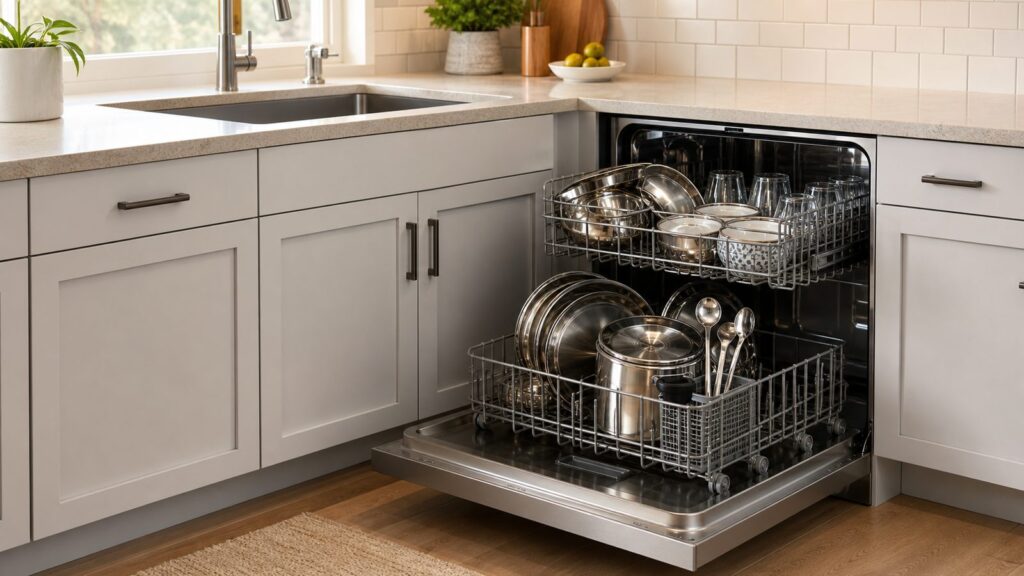
The shape of the cookware matters too. A flat dinner plate is easy. A deep kadai, curved katori, stainless steel thali, large saucepan, cooker insert, idli plate, chutney jar, tea strainer, and long-handled ladle need rack flexibility. Many dishwashers advertise a high place-setting count, but that does not tell you how well they handle round bowls, tall inserts, and concave cookware that must face the spray arms.
For that reason, we look at dishwashers the way we look at a cabinet layout: by workflow, clearance, access, and maintenance. The right machine should reduce handwashing without damaging cookware or creating a service problem under the counter.
The Best Dishwasher Type for Most Indian Kitchens
For most US homes, the best choice is a 24-inch built-in dishwasher. Standard built-ins are typically designed for a cabinet opening about 24 inches wide, 24 inches deep, and roughly 34 to 36 inches high. That size gives you the most model choice, the best rack flexibility, and the strongest cleaning performance for family cooking.
An 18-inch built-in dishwasher can work in a condo, accessory dwelling unit, basement kitchen, or tight remodel, but it is a compromise. It may be fine for one or two people, but it fills quickly if you cook full Indian meals with pots, bowls, plates, and storage containers.
Countertop dishwashers are a last-resort option for renters or very small kitchens. They can handle cups, plates, and small bowls, but they are not a real replacement for a built-in unit when you routinely use kadai, cooker inserts, large pans, and meal-prep containers.
Best Overall Setup: 24-Inch Built-In, Stainless Tub, Third Rack
This is the sweet spot for most Indian-American households. A 24-inch built-in with a stainless-steel tub, third rack, adjustable middle rack, fold-down tines, and high-temp wash gives you the best mix of capacity, durability, and cleaning power. Stainless tubs retain heat better for drying, resist odor better than plastic tubs, and are less likely to discolor from turmeric and spice oils.
Quick wins for a faster PC:
Fix the driver behind crashes, sound loss and screen glitchesFind Drivers →Repair Windows errors before they cause bigger problemsFix Now →Best for Open-Plan Kitchens: 39 to 44 dBA
If your kitchen opens into the family room, noise matters. A dishwasher under 45 dBA is a practical target. Premium quiet machines often sit around 39 to 44 dBA. Models in the 45 to 49 dBA range are still acceptable for many homes. Once you get to 50 dBA or higher, the machine is better suited to a separated kitchen, rental unit, basement kitchen, or budget installation where noise is not the main concern.
Best Budget Choice: Simple 24-Inch Built-In With Stainless Interior
Budget built-ins can be found under $400 at large US retailers, but for an Indian kitchen we would rather see the budget stretch toward a stainless or hybrid stainless tub, better filtration, and a heavy cycle. A cheap dishwasher that cannot handle oil and dried-on food will push you back to handwashing the hardest items, which defeats the point.
Features That Actually Matter for Indian Cooking
Do not shop only by brand. Shop by the parts of the machine that change daily use. The following features matter more than app controls, colored status lights, or decorative handles.
Stainless-Steel Tub
A stainless-steel tub is one of the first upgrades we recommend. It improves heat retention, supports better drying, reduces odor, and holds up better over time. Plastic tubs can clean dishes, but they are more likely to hold smells and discolor from turmeric-heavy loads.
Do these 3 things before closing this tab:
1Scan for outdated or missing drivers - takes under a minute2Clear out junk files and repair common Windows errors3Fix the driver behind crashes, sound loss and screen glitchesHeavy, Pots, High-Temp, or Sanitize Cycle
For oily cookware, a normal cycle may not be enough. Look for a heavy or pots cycle and a high-temperature or sanitize option. You will not use the hottest cycle for every load, but it is useful after cooking rajma, chole, biryani, meat curries, fried snacks, or heavy tadka.
Soil Sensor
A soil sensor helps the machine adjust wash time and water use based on how dirty the load is. For mixed loads with plates, bowls, tea cups, and oily pots, this is more useful than a long list of novelty cycles.
Adjustable Middle Rack
An adjustable middle rack lets you raise or lower the rack to fit tall glasses above or large cookware below. This matters when loading Instant Pot inserts, cooker vessels, stockpots, and deep mixing bowls.
Third Rack or Flexible Cutlery Tray
A third rack is excellent for Indian kitchens because it handles long spoons, spatulas, small lids, measuring spoons, tea strainers, and flat utensils. It also frees the lower rack from a bulky cutlery basket, which gives you more room for thalis and pots.
Fold-Down Tines
Fold-down lower-rack tines are more valuable than they look. Fixed tines are fine for plates, but they fight you when loading kadai, mixing bowls, cooker inserts, and serving dishes. Flexibility is capacity.
Drying Performance
Stainless steel dries fairly well, but plastics, lids, silicone pieces, and deep katoris can hold water. Use rinse aid even with premium detergent pods. It reduces spotting, improves drying, and helps water sheet off stainless utensils and plastic containers.
Dishwasher Comparison for Indian Kitchens
Instead of naming one universal winner, it is more useful to match the dishwasher type to the way you cook. A household making fresh roti, sabzi, dal, rice, and tea every day has different needs than a couple that cooks Indian food on weekends.
| Kitchen situation | Best dishwasher setup | Target price for appliance | What to prioritize |
|---|---|---|---|
| Daily Indian cooking for a family | 24-inch built-in, stainless tub, third rack | $800-$1,500 | Heavy cycle, high-temp wash, adjustable racks, strong drying |
| Open-plan kitchen | Premium quiet 24-inch built-in | $1,100-$2,000+ | 39-44 dBA, stainless tub, reliable drying, flexible racks |
| Budget remodel or rental | Basic 24-inch built-in | Under $400-$700 | Heavy cycle, decent filtration, acceptable noise, simple controls |
| Small condo or tight cabinet run | 18-inch built-in | $500-$1,000+ | Rack layout, stainless tub if possible, realistic capacity |
| Rental with no cabinet opening | Countertop dishwasher | $250-$600 | Small bowls, cups, plates, easy faucet connection |
| High-end custom kitchen | Panel-ready or luxury integrated model | $2,500-$3,500+ | Cabinet integration, quiet operation, service access, drying |
US models commonly considered in 2026 include Bosch 500 and 800 Series, Miele fully integrated models, GE Profile models with advanced drying features, KitchenAid KDFM-series units, Whirlpool budget models, Samsung quiet top-control models, Midea 18-inch units, and Danby countertop units. The right one depends on the cabinet opening, cookware, noise tolerance, budget, and service expectations in your area.
The Tool Desk
Outbyte Driver Updater FREEFix the driver behind crashes, sound loss and screen glitchesFind Drivers →Outbyte PC Repair FREERepair Windows errors before they cause bigger problemsFix Now →What Indian Cookware Can Go in the Dishwasher?
This is where many homeowners get frustrated. A dishwasher can save a lot of labor, but it should not be treated as a universal cookware cleaner. Some Indian kitchen items do very well. Others should stay in the sink.
Rank #2
- 3 Stage Ultra Wash Filter: The 3-stage UltraWash Filter captures particles as small as a grain of fine sand and drains them away, so they can’t redeposit on dishes - for a sparkling clean every time. The filter removes easily for monthly cleaning
- SmartWash Adjusts to the Mess: Sensor technology detects soil levels and automatically adjusts the water temperature, pressure, and cycle time. Leak detection prevents damage before it starts
- SmartDry Technology: SmartDry drying selects the best drying cycle and adjusts for optimized drying performance. Hot water forces condensation onto the stainless tub, and down the drain
- Roomy Interior & Adjustable, Removable Rack: Fit up to 14 place settings or just a few items using the Half Load option. The MoreSpace Adjustable Upper Rack raises, lowers, or removes entirely to make room for pots, tall items, or delicate stemware
- Sani Rinse Option: This ENERGY STAR certified dishwasher has a UL-certified Sani Rinse option for seriously clean dishes
Usually Dishwasher-Safe
Stainless steel plates, thalis, katoris, spoons, forks, ladles, triply stainless cookware, glass, ceramic, many everyday mugs, and dishwasher-safe plastic containers usually handle machine washing well. Always check manufacturer markings, especially on pressure-cooker parts and insulated items.
Usually Better Hand-Washed
Aluminum, cast iron, carbon steel tawas, many nonstick pans, wooden handles, copper, brass, bronze, hand-painted dishes, pressure-cooker gaskets, sharp knives, and heirloom utensils should usually be hand-washed. Dishwasher detergent is alkaline and aggressive. Heat, water pressure, and long cycles can dull knives, strip seasoning, discolor metals, loosen handles, and shorten the life of nonstick coatings.
Pressure-cooker stainless inserts are often fine if the manufacturer allows it, but gaskets, safety valves, and small removable parts should be handled carefully. If a part affects pressure safety, we prefer handwashing and inspection.
What’s actually slowing this PC down?
Pick the symptom - the matching free tool is one click away.
How to Load Thalis, Katoris, Kadai, and Cooker Inserts
A good dishwasher still needs a good loading pattern. The goal is simple: dirty surfaces must face the spray, water must drain off, and nothing should block the spray arms.
Load thalis and dinner plates vertically in the lower rack with enough spacing for water to pass between them. Avoid nesting stainless steel plates tightly together. Katoris and small bowls should be angled downward, not placed flat where they hold water. If the middle rack has flexible rows, use them for bowls and tea cups rather than forcing everything into one corner.
For a kadai, place it in the lower rack at an angle so the concave surface faces downward and toward the spray path. If it blocks the lower spray arm, wash it by hand or run it alone with other large pieces. Cooker inserts and Instant Pot liners usually fit best in the lower rack after lowering or clearing the upper rack. Do not let a tall insert interfere with the spray arm under the upper rack.
Long spoons, spatulas, skimmers, and tongs belong in the third rack if the machine has one. If not, place them flat on the upper rack or handle-down in the cutlery basket only if they cannot fall through and block the spray arm. Sharp knives should be hand-washed to protect the edge and reduce injury risk.
Oil, Turmeric, Masala, and Hard Water: Cleaning Strategy
The best habit is scrape, do not fully pre-rinse. Remove bones, rice clumps, seeds, curry leaves, excess oil, and thick sauce before loading. Full pre-rinsing wastes water and can confuse modern sensors, but leaving heavy solids in the machine creates odor and filter problems.
Use a quality enzyme detergent and keep rinse aid filled. For greasy loads, run the heavy or high-temp cycle. For lighter breakfast and tea loads, normal or auto cycles are usually enough. If your dishwasher has a filter, clean it frequently. In an Indian kitchen with daily cooking, that may mean once a week at first, then adjusting based on what you find. If the filter smells, drains slowly, or shows visible oil and food paste, it has gone too long.
Hard water changes everything. Mineral spotting on stainless steel thalis, cloudy glasses, chalky residue, and poor drying often point to water hardness rather than a bad dishwasher. Some premium machines offer built-in softening systems. Otherwise, plan for rinse aid, detergent adjustment, and possibly a whole-home or point-of-use water-softening solution during a remodel.
Energy and Water Use
A modern efficient dishwasher usually uses far less water than handwashing. Current ENERGY STAR dishwasher criteria, effective July 19, 2023 and still current in 2026, require standard models to use no more than 240 kWh per year and 3.2 gallons per cycle. Compact models are limited to 155 kWh per year and 2.0 gallons per cycle.
Outdated Drivers Are Slowing You Down
One free scan finds every outdated or missing driver and matches the right update for your exact hardware.Free scan · exact hardware matchWindows Errors? Fix Them Before They Spread
Repair common Windows errors and clear accumulated junk for a smoother, more stable PC - no reinstall needed.Free scan · no reinstallFor comparison, less efficient dishwashers may use around 5.0 gallons per cycle, while handwashing can easily use 10 to 25 gallons or more depending on faucet habits. In a busy Indian kitchen, the savings can be meaningful because dishes are not occasional. They happen every day, often twice a day.
Energy use also depends on cycle choice. Heavy, sanitize, heated dry, and extra-dry settings use more energy than normal cycles. That does not mean you should avoid them. Use the right cycle for the load. A heavy cycle that actually cleans a greasy pot is better than running a weak cycle twice.
Installation Details Homeowners Should Not Ignore
Dishwasher installation is where a good appliance becomes a good kitchen system. Before buying, measure the actual finished opening, not the rough memory of what used to be there. Standard built-ins usually need about 24 inches of width, 24 inches of depth, and 34 to 36 inches of height, but flooring buildup, thick countertops, uneven cabinets, and old tile can trap an existing dishwasher or make a new one hard to level.
In a remodel, we design the sink base and dishwasher bay together. The water shutoff should be accessible. The drain hose should route cleanly to the disposer or sink drain. The electrical connection should comply with current local requirements. The machine should have enough slack in water, drain, and power connections to slide out for service without tearing anything loose.
Free tools Windows power users keep installed
One-click scans. No signup required.
Many jurisdictions require a dishwasher air gap at the countertop or sink deck. Others allow a high loop under the sink. This is not a cosmetic afterthought. If an air gap is required, it affects sink-hole planning, countertop drilling, faucet accessory layout, and the final look of the sink area. Decide early.
Electrical rules also matter. Dishwashers commonly require GFCI protection under modern code practice, and some installations need a dedicated circuit or a properly located receptacle. Local code and manufacturer instructions control the final answer. If the project involves new wiring, a new outlet, or a new circuit, bring in a licensed electrician where required.
Independent reader supportYour contribution helps us test, update, and keep practical guides available for everyone.2026 Dishwasher Costs: Appliance, Labor, and Remodel Extras
The sticker price is only part of the budget. A straightforward replacement is very different from adding a dishwasher to a kitchen that never had one.
Rank #3

- ADJUSTABLE DESIGN: Upper rack features 2-inch height adjustment capability to accommodate taller dishes and provide flexible loading options
- QUIET OPERATION: Library Quiet technology delivers peaceful dishwashing at just 52 dBA noise level, perfect for open-concept homes
- EFFICIENT CLEANING: Half Load Option enables washing smaller loads while reducing water and energy usage for daily convenience
- HYBRID CONSTRUCTION: Features a durable stainless steel interior combined with heavy-duty plastic floor for optimal performance
- VERSATILE CAPACITY: Accommodates 12 place settings with fold-down tines for flexible loading of various dish sizes and shapes
| Cost item | Typical 2026 range | Notes |
|---|---|---|
| Budget built-in dishwasher | Under $400-$700 | Basic models; often louder and fewer rack features |
| Mainstream stainless 24-inch dishwasher | $500-$1,100 | Good range for many Indian kitchens |
| Premium quiet dishwasher | $1,100-$2,000+ | Better noise ratings, racks, drying, and fit/finish |
| Luxury integrated or panel-ready model | $2,500-$3,500+ | Used in custom kitchens with cabinet panels |
| Labor-only replacement | $130-$500 | When opening, water, drain, and power are already correct |
| Typical installed replacement | $600-$1,700 | Includes unit and installation in many common cases |
| Broader replacement range | $540-$2,175 | Can vary by brand, site conditions, and labor market |
| National install estimate | $904-$1,678 | May 2026 estimate range for installing one dishwasher |
| Cabinet removal or modification | $150-$400 | Common in first-time installs |
| New outlet | $150-$350 | Depends on access and code requirements |
| New circuit | $250-$900 | Panel distance and access drive cost |
Cost drivers include brand tier, stainless versus plastic tub, sound rating, third rack, panel-ready front, smart features, old-unit haul-away, flooring height conflicts, drain rework, shutoff replacement, countertop air-gap drilling, and whether permits are needed. In older homes, the hidden costs are often behind the cabinet face: brittle shutoffs, ungrounded wiring, no GFCI protection, improvised drain connections, or flooring installed after the old dishwasher was set.
When to DIY vs. When to Hire a Pro
A like-for-like dishwasher replacement can be a reasonable DIY project for a careful homeowner if the cabinet opening is correct, the shutoff works, the drain connection is accessible, the electrical setup is already code-compliant, and the homeowner is comfortable checking for leaks. Expect a few hours for a clean replacement, plus time to level the machine and run a test cycle.
Hire a pro when the kitchen never had a dishwasher, the cabinet must be modified, the floor height traps the old unit, the countertop needs an air-gap hole, the shutoff valve is corroded, the drain must be rerouted, or electrical work is required. Also hire a pro if the dishwasher is part of a larger kitchen remodel. The appliance touches cabinets, countertop planning, sink layout, plumbing, electrical, flooring, and sometimes permitting.
On our projects, we test the installation before calling it done. That means checking level, door swing, rack movement, water fill, drain performance, leaks at the shutoff and supply line, disposer knockout removal if applicable, high-loop or air-gap routing, and a full cycle test. A dishwasher can look installed and still fail because one small connection was rushed.
Our Practical Buying Checklist
Before you buy, measure the finished opening: width, depth, height, floor clearance, and door swing. Confirm the handle will not collide with adjacent drawers or a perpendicular cabinet pull. Check whether the model needs side mounting, top mounting, or special brackets for stone countertops.
Inside the showroom, bring your real cookware dimensions if possible. Measure the diameter and height of your largest cooker insert, kadai, and everyday thalis. Check lower-rack tine spacing and whether the upper rack can adjust enough to make room. Open and close the third rack with long spoons in mind. A dishwasher that looks large online may not load Indian cookware efficiently.
Set your noise target before shopping. For an open kitchen, aim under 45 dBA. For a closed kitchen, 45 to 49 dBA is often fine. For a rental or budget secondary kitchen, 50 dBA or higher may be acceptable if cost is the priority.
Finally, match the dishwasher to the household, not the fanciest spec sheet. A family cooking twice daily should pay for racks, tub quality, wash strength, and drying. A light-use household can spend less. A custom kitchen should plan for panel-ready integration and service access before cabinets are ordered.
Bottom Line
The best dishwasher for an Indian kitchen in a US home is a system choice: the right 24-inch machine, the right rack layout, the right detergent and rinse aid, and a clean installation that respects plumbing, electrical, cabinet, and code requirements. For most households, that means a stainless-tub built-in dishwasher with a third rack, adjustable middle rack, fold-down tines, heavy or high-temp cycle, good drying, and a sound rating below 45 dBA if the kitchen is open.
What’s actually slowing this PC down?
Pick the symptom - the matching free tool is one click away.
Spend where it changes daily use. Rack flexibility beats Wi-Fi. Stainless interior beats cosmetic trim. A correct drain route beats a rushed install. And for Indian cooking, maintenance matters: scrape solids, avoid full pre-rinsing, load curved vessels so spray can reach them, use rinse aid, and clean the filter before it becomes a problem.
Frequently Asked Questions
Can a dishwasher clean oily Indian cookware?
Yes, if you choose a strong model and use it correctly. Scrape excess oil and solids, use a quality enzyme detergent, keep rinse aid filled, load cookware so spray reaches the dirty surface, and use heavy or high-temp cycles for greasy loads.
Is a stainless-steel tub worth it for an Indian kitchen?
Yes. A stainless-steel tub retains heat better, improves drying, resists odor, and is less likely to discolor from turmeric and spice residue than a plastic tub.
What size dishwasher do most US kitchens need?
Most US built-in dishwashers fit a roughly 24-inch-wide, 24-inch-deep, 34- to 36-inch-high opening. Compact 18-inch models are available, but they are less practical for families cooking Indian meals daily.
Which Indian utensils should not go in the dishwasher?
Avoid dishwashing cast iron, carbon steel tawas, aluminum, copper, brass, many nonstick pans, wooden handles, sharp knives, pressure-cooker gaskets, and hand-painted or heirloom pieces unless the manufacturer specifically says they are dishwasher-safe.
How much does dishwasher installation cost in 2026?
A simple labor-only replacement often runs about $130 to $500. A typical installed replacement including the unit commonly lands around $600 to $1,700, while more complex installs with cabinet, plumbing, or electrical work can cost more.
Do dishwashers save water compared with handwashing?
Usually, yes. Current ENERGY STAR standard dishwashers are limited to 3.2 gallons per cycle, while handwashing can use 10 to 25 gallons or more depending on faucet habits.
Quick Recap
Product prices and availability are accurate as of the date/time indicated and are subject to change. Any price and availability information displayed on Amazon at the time of purchase will apply.

