Recommended Free Tools
Some links on this page are affiliate links: if you buy through them we may earn a commission, at no extra cost to you.
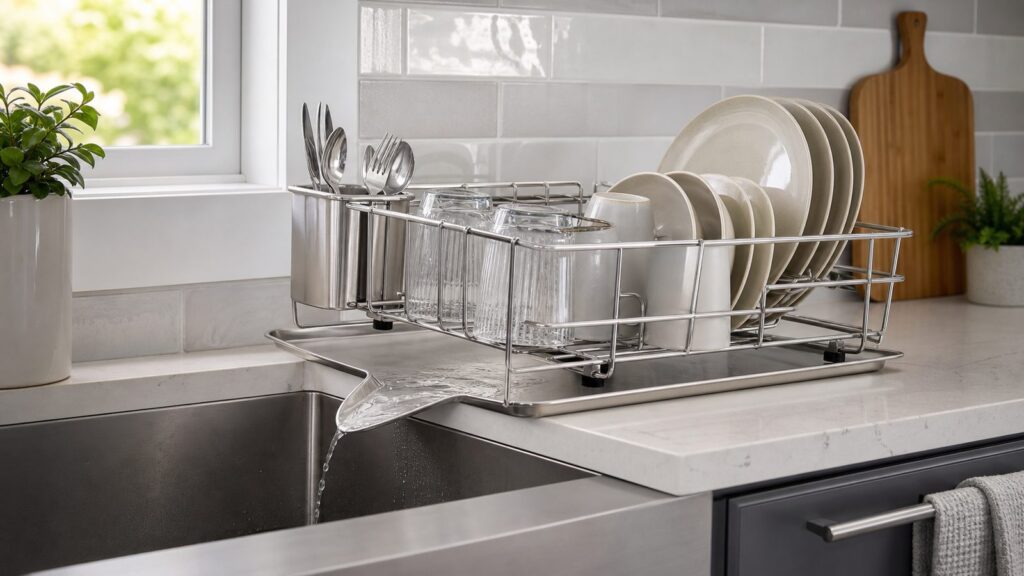
The best dish drain tray is the one that fits your sink area, drains water completely, gives dishes enough airflow, and does not turn into permanent countertop storage. For most homes, that means a rust-resistant rack with a removable sloped tray or swivel spout, sized for one normal dishwashing session. For small kitchens, a roll-up over-sink mat often works better. For remodels or high-use kitchens, a dedicated drying zone or integrated drainboard can be worth planning into the countertop and sink layout.
On our job sites, we look at dish drying differently than a product shelf does. A tray is not just a kitchen accessory. It is a small wet zone sitting next to cabinets, backsplash seams, countertop joints, outlets, caulk lines, wood trim, and sometimes stone or butcher block. If the tray holds standing water or drains the wrong direction, it can create staining, mineral buildup, odors, swollen laminate seams, mildew at the backsplash, and clutter that never leaves the counter.
As an Amazon Associate I earn from qualifying purchases.
What’s actually slowing this PC down?
Pick the symptom - the matching free tool is one click away.
This guide explains how to choose a dish drain tray by layout, material, cost, and maintenance, with the same practical lens we use when planning kitchens for real daily use.
What Makes a Dish Drain Tray Work Well?
A good dish drain tray has four traits: positive slope toward the sink, removable parts for cleaning, rust-resistant materials, and enough spacing for airflow. If one of those is missing, the tray may still look fine on day one, but it usually becomes harder to live with after a few weeks.
Popular on Amazon
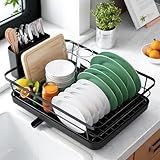
- COMPACT VOLUME: Kitsure dish rack is suitable for kitchens with limited space. The bottom layer measures only 12''W x 15.5''L and the overall height is 5". The rack is capable of holding 10 plates and other bowls and glasses. With a Kitsure dish rack, you can perfectly save your countertop space.
- PREMIUM MATERIAL: Kitsure Kitchen dish drying rack has a plastic drainboard and premium rust-proof metal which can effectively prevent rust and deformation. And you can clean the rack easily by rinsing it under a running tap. Tips: Water may not drain smoothly if the sink edge is above the counter.
- EASY INSTALL & CLEAN: Kitsure dish drainer is easy to install with the attached installation manual. In addition, with the waterproof coating, the rack is also easy to clean. All you need to do is wipe the rack with a damp cloth or rinse it under a running tap after use. The water pipe can also be disassembled for cleaning.
- EASY TO USE: Kitsure drying rack for kitchen consists of a cutlery holder, a dish rack, and a drainboard set. With such a simple structure, it is easy to install as no tool is needed in the process. the dish rack stays firmly where it is.
- DETACHABLE CUTLERY HOLDER: The cutlery holder of this dish drying rack is divided into two spaces for cutlery and other small items. With this dish rack, you can always find the right place for various tableware!
The first thing to check is drainage. A flat tray under a dish rack traps water. That standing water collects food residue, soap film, and hard-water minerals. A sloped tray with a drain spout sends water into the sink before it can pool under plates and cups. In a well-planned kitchen, water should move from clean dish to rack, rack to tray, tray to sink, and nowhere else.
Airflow matters just as much. Plates packed too tightly stay wet. Nested bowls hold water along their rims. Cups placed flat on a tray can trap moisture inside. The best racks separate plates, bowls, cups, utensils, and knives so air can move around them. Faster drying means fewer odors and less temptation to leave clean dishes stacked on the counter all day.
Crashes, No Sound, or Screen Glitches?
Random freezes, missing sound and display glitches usually trace back to one bad driver. Find and replace yours safely.Free scan · under a minutePC Slower Than It Used to Be?
A free scan shows the junk files, broken settings and background clutter dragging Windows down - then fixes them in one click.Free scan · Windows 10 & 11Cleaning access is the third test. Removable trays, detachable utensil cups, open drain channels, and smooth corners are easier to keep clean than ribbed trays with tight grooves. If you cannot reach the low points with a sponge or small brush, grime will collect there.
Finally, the tray needs to respect the countertop. Quartz, granite, solid surface, laminate, and butcher block all handle water differently, but none benefit from constant standing moisture at the sink edge. Rubber or silicone feet, a full tray under metal racks, and a drain path aimed into the basin help prevent scratches, stains, and swollen seams.
Dish Drain Tray Types Compared
The right type depends on how much counter space you have, how many dishes you wash by hand, and how your sink is built. A family kitchen with a deep undermount sink needs a different setup than a compact apartment kitchen or a laundry-room utility sink.
| Type | Typical 2026 Cost | Best For | Watch For |
|---|---|---|---|
| Plastic dish drainer with drainboard | $6-$20 | Rentals, temporary setups, low-volume kitchens, utility rooms | Staining, warping, scratches, standing water, shorter replacement cycle |
| Basic stainless or coated-steel rack with tray | $20-$50 | Most everyday kitchens | Rust at welds or cut edges, undersized drain channels, non-removable trays |
| Midrange rack with swivel spout or expandable frame | $35-$80 | Busy kitchens needing better drainage and organization | Counter footprint, faucet clearance, utensil cup cleaning |
| Premium modular or two-tier rack | $80-$195 | High-use kitchens, larger households, design-focused spaces | Height under cabinets, tipping risk, trapped moisture if overloaded |
| Roll-up over-sink mat | $10-$45 | Small kitchens, apartments, occasional drying, prep support | Sink span, faucet clearance, cleaning between rods or folds |
| Integrated drainboard or sloped countertop grooves | Few hundred to several thousand dollars | Remodels, aging-in-place kitchens, high-use sink zones | Countertop material, fabrication cost, sink removal, plumbing reconnection |
Countertop Rack With Drain Tray
This is the most common setup: a rack sits beside the sink, and a tray below it carries water back to the basin. For most homeowners, the sweet spot is a stainless or coated-steel rack in the $35-$80 range with a removable tray and directional spout. That price range usually gets better drainage, better utensil organization, and a sturdier frame than the cheapest plastic set.
Measure the actual landing zone before buying. Do not use only the overall counter length. Measure the clear space between the sink, backsplash, faucet base, soap dispenser, outlet cover, window trim, and any wall or appliance edge. Many kitchens have a 24-inch counter run beside the sink but only 16 to 18 inches of truly usable drying space once the faucet and backsplash are considered.
Roll-Up Over-Sink Mat
A roll-up mat spans the sink and lets water fall directly into the basin. It is one of the best options for small kitchens because it frees the counter when not in use. Many cost $10-$45 depending on silicone thickness, stainless rod quality, heat resistance, and load rating.
Check the inside sink width, outside rim width, and faucet swing before buying. The mat should rest securely on the sink rim or countertop, not rock on a narrow undermount reveal. If you have a pull-down sprayer, disposal air switch, filtered-water tap, or soap dispenser, make sure the mat does not block normal movement.
Absorbent Drying Mat
Absorbent mats are useful for occasional items, glassware, or protecting a counter under a small rack. They are not ideal as the primary drying system for a busy kitchen. A damp mat can hold moisture against the countertop and must be washed and dried frequently. If it stays wet overnight, it can re-contaminate clean dishes and create odors.
Also popular on Amazon

- COMPACT DESIGN: Measuring only 12.0''W x 15.5''L, Sakugi dish rack features a compact design. Meanwhile, it's capable of holding 6 plates and other bowls and glasses. Sakugi drying rack makes full use of your kitchen space.
- PREMIUM STAINLESS STEEL: Made of premium stainless steel, Sakugi kitchen dish drying rack is free of rust and deformation. It's ideal for long-term use. Meanwhile, you can clean it effortlessly by rinsing it with running water and letting it air dry.
- EFFICIENT WATER DRAINAGE: This large dish drying rack is designed to efficiently drain water, ensuring that excess water flows away and keeps your countertop dry. No more worry about water on the countertop!
- EASY INSTALLATION: Sakugi drying rack for kitchen counter is easy to install with its simple structure. No tool is needed in the installation process. Meanwhile, the four anti-slip silicone leg covers make the rack stays firmly in place.
- CONVENIENT CUTLERY HOLDER: The cutlery holder of this dish drying rack with drainboard is separated into two spaces. You can set your spoons, knives, forks, and other small kitchenware in two categories. With this drying rack, you can have your various tableware well-organized!
Built-In Drainboard
A built-in drainboard is not a simple accessory purchase. It may involve countertop fabrication, sink removal, plumbing reconnection, and sometimes backsplash or cabinet adjustments. Minor countertop work can run a few hundred dollars, while a sink and countertop replacement can move into the several-thousand-dollar range.
That said, built-in drainage is worth considering during a remodel. A sloped drainboard, workstation sink ledge, or integrated counter grooves can make daily cleanup easier and keep water away from seams and cabinet edges.
Best Materials for Dish Drain Trays
Material choice affects durability, cleaning, appearance, and countertop protection. The main options are 304 stainless steel, coated steel, aluminum, food-grade silicone, polypropylene or other plastics, bamboo, and wood.
304 Stainless Steel
For a long-term rack, 304 stainless steel is usually the strongest choice. It resists corrosion better than cheaper plated steel and lower-grade stainless, especially in kitchens with frequent wet use. Still, stainless does not mean rust-proof. Salty water, acidic residue, hard-water minerals, and standing water can cause spots, staining, or corrosion, especially around welds and cut edges.
If you are buying stainless, look for smooth welds, removable plastic or silicone feet, and a tray that keeps metal off the counter. In hard-water areas, daily wipe-downs and weekly or biweekly descaling will keep the finish in better shape.
Coated Steel
Coated steel can be a good budget-to-midrange option, commonly $20-$50. The weakness is coating failure. Once the coating chips, the steel below can rust. Pay attention to utensil cups, knife slots, and plate dividers because those areas see repeated abrasion.
Plastic
Plastic drainboards are inexpensive, lightweight, and easy to move. Budget sets often cost $6-$20, which makes sense for rentals, temporary kitchens, laundry rooms, or low-volume use. The tradeoff is service life. Plastic can stain, warp, scratch, and hold biofilm in grooves. If a plastic tray has tight ribbing and no removable parts, it will usually need replacement sooner.
Silicone
Food-grade silicone is common on roll-up mats and protective feet. It is flexible, grippy, and gentle on counters and sink rims. It also handles heat better than many plastics, though actual heat limits vary by product. Silicone needs regular cleaning between rods, folds, or seams. If the mat rolls up while still wet and is stored in a dark cabinet, mildew and odor become more likely.
Free tools Windows power users keep installed
One-click scans. No signup required.
Bamboo and Wood
Bamboo and wood racks look warm, but they need more maintenance. They can split, blacken, or mildew if they stay wet or sit in a poorly ventilated area. If you use one, dry it fully after use and keep it away from constant backsplash splash. Wood is a style choice, not the lowest-maintenance choice.
How to Measure Before You Buy
Most dish drain tray problems start with bad measuring. A rack can technically fit on the counter and still fail because the spout misses the sink, the utensil cup hits the backsplash, or the top tier blocks an upper cabinet door.
Also popular on Amazon

- RUST-RESISTANT WIRES FOR LASTING DURABILITY: Satin powder-coated wires resist rust and corrosion over time, securely holding dinnerware in place while protecting plates, bowls, and glasses from scratches during drying
- HIGH-CAPACITY BASKET FOR ALL YOUR DISHES: The generously sized drying basket accommodates a wide variety of dinnerware, cookware, and flatware at once - ideal for families who need reliable kitchen counter dish rack space after every meal
- 3-COMPARTMENT REMOVABLE FLATWARE CADDY: Organize and separate silverware, utensils, and kitchen tools with ease; the 3-section flatware caddy lifts out completely for quick, convenient unloading and easy cleaning
- SELF-DRAINING BOARD WITH NON-SLIP FEET: The removable draining board channels water away from your counter and doubles as a drying surface for large pots, pans, and roasters; soft non-slip feet keep the rack stable and protect countertops
- EASY TO CLEAN AND BUILT FOR EVERYDAY USE: Designed with the home cook in mind and manufactured to the highest standards, this dish drying rack set wipes clean effortlessly - keeping your kitchen organized, tidy, and ready for the next meal
Use a tape measure and check these dimensions before ordering:
- Counter landing zone: Measure width and depth of the clear space beside the sink. Leave at least 1 inch behind the rack for cleaning and airflow when possible.
- Sink edge to backsplash: Many racks need 12-15 inches of depth. Tight sink runs may only have 10-12 inches available.
- Drain spout reach: The spout should discharge into the basin, not onto the sink rim, caulk line, or countertop seam.
- Upper cabinet clearance: Two-tier racks may stand 15-22 inches tall. Check cabinet doors, window sills, shelves, and pendant lights.
- Faucet and sprayer swing: The rack should not block a pull-down sprayer, side sprayer, soap dispenser, or filtered-water tap.
- Electrical clearance: Keep the wet drying zone away from outlet faces, plug-in appliances, and under-cabinet power strips.
For clutter control, size the rack for one normal dishwashing session, not your largest holiday cleanup. Oversized racks become permanent storage. If the rack is big enough to hold three days of dishes, it will probably hold three days of dishes.
Countertop and Sink Details That Matter
Dish drain trays sit in one of the most vulnerable areas of the kitchen: the sink-side counter. Water, soap, minerals, and repeated wiping all concentrate there. A better tray protects the counter by sending water into the sink and keeping wet metal off finished surfaces.
Quartz and Granite Counters
Quartz and granite tolerate routine kitchen moisture, but seams, caulk joints, and undermount sink edges still need protection. Water should not be directed toward the backsplash or sink-side seam. Use a rack with silicone feet and a tray or spout that drains directly into the basin. Avoid sliding metal racks across polished stone because grit trapped under the feet can scratch or dull the surface.
Butcher Block and Wood Counters
Wood counters need the most care. Do not place a wet rack directly on butcher block. Use a full waterproof tray, keep the rack from sitting in one damp spot all day, and wipe the area dry after use. If the finish near the sink is worn, reseal it before relying on any dish drying setup.
Laminate Counters
Laminate is vulnerable at seams, edges, and sink cutouts. Standing water can swell the substrate below the laminate. A sloped drain tray is especially important here. Check caulk around the sink regularly and avoid any tray that drains toward a seam.
Do these 3 things before closing this tab:
1Repair Windows errors before they cause bigger problems2Fix the driver behind crashes, sound loss and screen glitches3Clear out junk files and repair common Windows errorsUndermount and Farmhouse Sinks
For undermount sinks, confirm where an over-sink rack will bear weight. It should rest securely on the countertop or a designed sink ledge, not unevenly on a narrow stone edge. For farmhouse sinks, measure both the interior basin span and the rim-to-counter transition. Apron-front sinks can be deep and wide, but not every over-sink accessory fits their front edge or faucet placement.
Cleaning and Maintenance Schedule
Air drying is the preferred sanitation practice because it avoids reintroducing contamination from damp towels. Foodservice rules are stricter than residential kitchens, but the principle is useful at home: clean items should be allowed to air-dry or drain adequately, and drainboards should be self-draining.
For a home kitchen, use this maintenance rhythm:
- Daily: Empty the rack, rinse the tray, wipe visible water, and let the parts dry.
- Weekly: Wash the tray, utensil cup, spout, and rack feet with mild dish soap and a non-scratch sponge.
- Weekly or biweekly in hard-water areas: Descale mineral deposits with white vinegar, then rinse thoroughly and dry.
- Monthly: Check for rust spots, cracked plastic, loose silicone feet, mold at corners, and clogged drain channels.
For stubborn buildup, use a baking soda paste and a soft brush. Avoid aggressive abrasives on stainless, coated steel, and plastic because scratches create more places for residue to collect. A bottle brush or small detail brush works well for utensil cups, drain spouts, silicone folds, and corners.
Common Mistakes We See in Kitchen Projects
The most common mistake is buying by product dimensions instead of kitchen dimensions. A rack that measures 18 by 13 inches may not fit an 18-inch landing zone once you account for the backsplash radius, sink rim, faucet base, and outlet plate.
Quick wins for a faster PC:
Repair Windows errors before they cause bigger problemsFix Now →Fix the driver behind crashes, sound loss and screen glitchesFind Drivers →Also popular on Amazon

- Expandable Design: SNTD's dish drying rack adapts to your kitchen—its width flexes from 15.2" to 22.1", making it a storage solution for small kitchens or apartments. Tight on space? Retract it to fit compact counters. Post-dinner rush with stacks of dishes? Extend for all the extra drying room you need
- Efficient Drainage: No more water pooling on your counter! Our dish drying rack features an angled drip tray and a large water outlet, so excess water flows directly into the sink—not onto surfaces. Keep your kitchen dry, clean, and free of messy puddles
- Rustproof & Sturdy: Built with premium 304 stainless steel guardrails, black anti-rust coated wires, and a fingerprint-resistant PP drip tray, this dish drying rack resists rust and warping—even with daily exposure to water
- Safe & Steady: High-sided guardrails lock plates, bowls, and glasses firmly in place—no more slips or falls—while protective silicone feet grip tight to your counter, keeping it steady and scratch-free, even when wet
- Versatile Organization: With a dedicated dish rack, flexible multi-use rack, and detachable utensil caddy, this drying rack effortlessly holds 10 plates, 6 bowls, cups, and all your utensils. It maximizes counter space while keeping every item neatly in place—everything has its spot
The second mistake is choosing a flat tray. If there is no slope, no spout, and no clear drainage path, water sits under the rack. That causes mineral scale, odor, staining, and sometimes corrosion. A tray should drain by gravity without needing to be tilted by hand every time.
Another frequent problem is assuming all stainless steel is equal. A low-cost rack may be plated steel or lower-grade stainless. In normal use, rust often appears first at welds, screw points, cut edges, or where utensils scrape the finish.
We also see homeowners put wet racks directly on butcher block, laminate seams, or old caulk lines. That is asking a finish to do more than it was designed to do. A full tray or over-sink draining setup is a better choice near vulnerable materials.
Two-tier racks create their own issues. They can be useful in a tight footprint, but heavy pots on the upper level can make them unstable. They also trap moisture if plates, bowls, and lids are stacked too closely. If you choose one, check the load rating and keep heavy cookware on the lower level.
The Tool Desk
Outbyte PC Repair FREEClear out junk files and repair common Windows errorsFree Scan →Outbyte Driver Updater FREEScan for outdated or missing drivers - takes under a minuteDriver Scan →When to DIY vs When to Hire a Pro
Most dish drain tray upgrades are simple DIY purchases. If you are replacing a countertop rack, adding a roll-up mat, installing replacement silicone feet, or improving the cleaning routine, you do not need a contractor. Measure carefully, choose the drainage path, and keep water directed into the sink.
Hire a pro when the work affects the sink, countertop, plumbing, electrical layout, or cabinetry. That includes adding integrated countertop grooves, replacing an undermount sink, switching to a farmhouse sink, cutting stone or solid surface material, relocating an outlet near the wet zone, modifying a cabinet, or changing a dishwasher air gap or disposal switch location.
Permit requirements vary by city and county. A loose dish rack does not require a permit. A sink replacement may require plumbing work that must meet local code. Electrical changes near a sink need proper GFCI protection and should be handled by a licensed electrician where required. Countertop fabrication generally does not need a building permit by itself, but it can become part of permitted work when bundled into plumbing, electrical, or structural changes.
During remodel planning, we like to establish a dedicated drying zone next to the sink. That means durable counter surface, backsplash protection, uninterrupted landing space, outlet placement outside the wet zone, good cabinet-door clearance, and a drainage route that does not rely on homeowners constantly wiping up pooled water.
Best Choices by Kitchen Situation
Small Apartment or Compact Kitchen
Use a roll-up over-sink mat or compact rack with a direct-to-sink spout. Keep the rack sized for daily use, not occasional entertaining. A $10-$45 roll-up mat can reclaim valuable counter space when the sink is not full.
Family Kitchen
Choose a midrange rack in the $35-$80 range with a removable tray, utensil holder, cup rail, and adjustable spout. Families usually need separation more than raw size. Plates, cups, lunch containers, and utensils dry faster when they are not piled together.
Also popular on Amazon
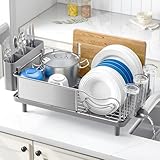
- 【PREMIUM 304 SURGICAL-GRADE STAINLESS STEEL】Built with professional-grade 304 stainless steel (the same quality trusted in hospitals and commercial kitchens!), this dish drying rack resists rust forever. Unlike cheap 201 steel or plastic racks that rust, stain, or crack over time, our 304 stainless steel maintains its shine and strength for years. No flaky coatings, no rust stains on your counter - just a durable drying rack that survives daily kitchen chaos. Invest once, use forever.
- 【MASSIVE CAPACITY FOR DISHES + 3-SLOT UTENSIL ORGANIZER】Holds plates, bowls, pots, pans, and cutting boards with room to spare. The integrated 3-slot utensil holder keeps forks, knives, spoons, and chopsticks organized and drying separately. The detachable cup shelf provides dedicated space for mugs, glasses, and bottles for milk. Perfect for families of 4-6, this large capacity rack handles post-dinner cleanup without cluttering your counter.
- 【SMART DRAINAGE SYSTEM WITH REMOVABLE DRIP TRAY】The sloped design guides water directly into the removable drain board, keeping your counter dry and clean. The drip tray catches excess water and empties easily - no more puddles under your rack. The open-wire design promotes airflow for faster drying. Say goodbye to wet counters and hello to a tidy kitchen.
- 【VERSATILE 4-IN-1 MODULAR DESIGN】This isn't just a dish rack - it's a complete kitchen organization system. Use the main rack for dishes, the utensil holder for cutlery, the cup shelf for mugs, and the drain board for extra drying space. All components are detachable for easy cleaning and customization. Rearrange based on your needs - wash a big pot today? Remove the cup shelf for extra space. Flexibility meets functionality.
- 【EASY ASSEMBLY + LIFETIME DURABILITY】Most customers complete setup in 10-15 minutes with included instructions and hardware. No special tools required. The solid stainless steel construction means this rack will outlast your current plastic or coated wire racks by 5-10 years. Backed by Urackify's responsive customer service and quality guarantee. This is the last dish rack you'll ever need to buy.
Quartz or Granite Kitchen
Use silicone feet and a tray that prevents metal contact with the stone. Aim the spout into the basin and away from seams. Wipe hard-water deposits before they become visible scale.
Butcher Block Kitchen
Use an over-sink mat or a full waterproof tray under the rack. Do not leave a damp towel or wet mat on the wood. Dry the counter daily and maintain the finish near the sink.
Aging-in-Place Kitchen
Prioritize a stable, low rack with easy-reach utensil storage and no awkward upper tier. Avoid heavy lifting over a tall rack. In a remodel, consider a workstation sink with ledges so dishes, rinsing, and prep tools stay within a controlled wet zone.
High-Use Remodel
Plan the drying zone before countertop fabrication. A workstation sink, integrated drainboard, or sloped countertop grooves can reduce clutter and protect cabinets. This is where accessory cost and remodel cost separate: a $50 rack can solve the symptom, but a redesigned sink zone may solve the daily workflow.
Final Buying Checklist
Before buying, confirm the drainage style first. For daily dishwashing, choose a direct-to-sink spout. For small kitchens, consider a roll-up over-sink mat. For occasional drying, an absorbent mat may be enough. For a remodel, look at built-in drainboards, workstation sinks, and sloped surfaces.
Then check the practical details: rust-resistant material, removable tray, wide drain channels, smooth corners, stable feet, utensil separation, knife safety, cup storage, and airflow. Measure the counter and sink instead of guessing. If you have hard water, choose parts that can be scrubbed and descaled easily.
Quick wins for a faster PC:
Fix the driver behind crashes, sound loss and screen glitchesFind Drivers →Clear out junk files and repair common Windows errorsFree Scan →A good dish drain tray is not the most expensive one. It is the one that keeps clean dishes moving, keeps water off vulnerable surfaces, and disappears back into the kitchen routine without becoming another mess to manage.
Frequently Asked Questions
What is the best material for a dish drain tray?
For long-term daily use, 304 stainless steel with a removable sloped tray is usually the best choice. Silicone is excellent for roll-up over-sink mats, while plastic is best for low-cost or temporary setups.
Are stainless steel dish racks rust-proof?
No. Stainless steel is rust-resistant, not rust-proof. Lower-grade stainless, plated steel, welds, salty water, acidic residue, hard-water minerals, and standing water can all lead to staining or rust spots.
Is a dish drying mat or dish rack better for a small kitchen?
For a small kitchen, a roll-up over-sink mat is often better because water drains directly into the sink and the mat can be stored when not in use. Absorbent mats work for occasional items but should not stay wet on the counter.
Windows Errors? Fix Them Before They Spread
Repair common Windows errors and clear accumulated junk for a smoother, more stable PC - no reinstall needed.Free scan · no reinstallCrashes, No Sound, or Screen Glitches?
Random freezes, missing sound and display glitches usually trace back to one bad driver. Find and replace yours safely.Free scan · under a minuteHow often should you clean a dish drain tray?
Rinse and dry it daily, wash removable parts weekly, and descale with vinegar weekly or biweekly in hard-water areas. Check monthly for rust, clogged spouts, loose feet, and mildew in corners.
Do dish drain trays cause countertop damage?
They can if they hold standing water or drain toward seams, caulk, backsplash joints, butcher block, or laminate edges. Use a sloped tray, silicone feet, and a drain path aimed into the sink.
Do I need a permit to add a built-in drainboard or change my sink area?
A countertop dish rack does not need a permit. Sink replacement, plumbing reconnection, outlet relocation, or electrical changes near a wet zone may require permits or licensed trades depending on local rules.
Quick Recap
Product prices and availability are accurate as of the date/time indicated and are subject to change. Any price and availability information displayed on Amazon at the time of purchase will apply.
What’s actually slowing this PC down?
Pick the symptom - the matching free tool is one click away.

