What’s actually slowing this PC down?
Pick the symptom - the matching free tool is one click away.
Some links on this page are affiliate links: if you buy through them we may earn a commission, at no extra cost to you.
A good convertible plastic window cleaner is the right tool for a homeowner who wants one lightweight setup for routine glass, patio doors, vinyl window frames, and first-story exterior windows. In plain terms, it is usually a 2-in-1 microfiber scrubber and rubber squeegee head that can be used by hand or attached to a telescoping pole. The best one is not necessarily the most expensive. It is the one with a clean replaceable rubber blade, a washable microfiber sleeve, a head width that fits your windows, and a pole connection that stays rigid enough to control.
On our job sites, we use the same logic for window cleanup that we use for finish carpentry: the tool matters, but the sequence matters more. A $20 plastic combo tool can leave excellent results on ordinary house windows if the rubber is sharp, the sleeve is clean, and the glass is not too hot. The same tool will struggle on large picture windows, baked-on mineral stains, mortar residue, paint overspray, or upper-story glass that forces you into awkward ladder work.
As an Amazon Associate I earn from qualifying purchases.
For 2026 pricing, expect a common DIY plastic 2-in-1 scrubber/squeegee head to run about $18 to $21 for 10-inch to 14-inch consumer models. A 14-inch scrubber/squeegee with a short 5-foot telescoping pole is commonly around $28. Extended-reach kits with a pole, cleaner, bucket, and/or 24-foot pole usually land around $68 to $102. By comparison, a professional residential window cleaning visit often runs about $150 to $450, with many companies charging roughly $8 to $16 per window for interior and exterior cleaning. That means a basic DIY kit can pay for itself after one cleaning, but only if your windows are safe to reach and the residue is appropriate for homeowner cleaning.
What a Convertible Plastic Window Cleaner Actually Is
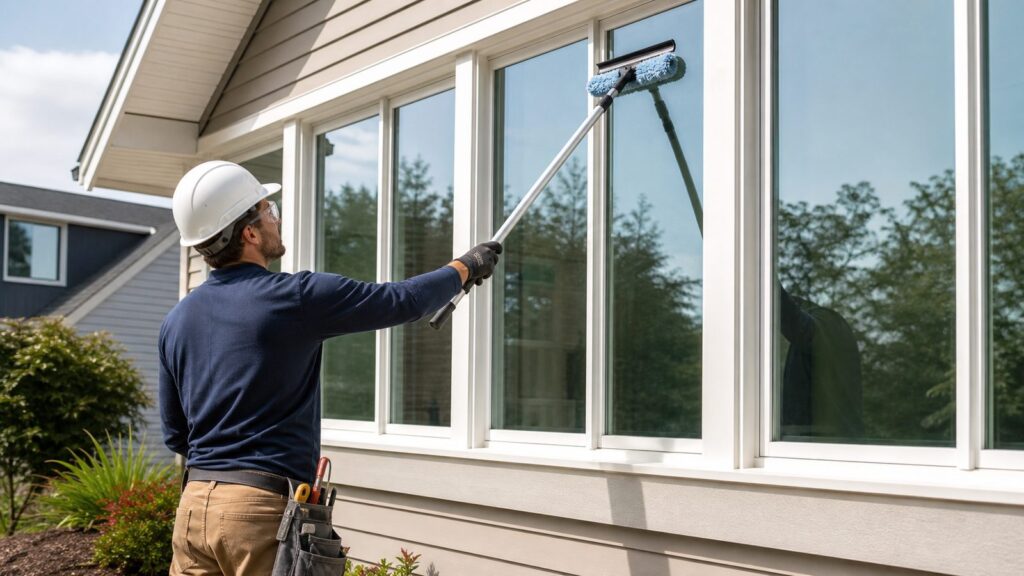
A convertible plastic window cleaner is a lightweight cleaning head that combines two tools: a microfiber scrubber sleeve to wet and loosen dirt, and a rubber squeegee blade to remove water from the glass. The “convertible” part means you can use it by hand on reachable glass or thread/snap it onto an extension pole for higher windows, patio doors, sunroom glass, and exterior panes.
Popular on Amazon

- Valued Carpenter Pencil Set: You will get 2 pcs solid carpenter pencils with 26 piece 2.8 mm refills, 1 replaceable sharpener, 1 plastic storage box.The complete carpenter pencils combination allows you to finish your work faster and more easily
- Deep Hole Marker Pencil: The deep-hole construction pencils adopts 45mm elongated tip design, which is more convenient to mark in the small hole or in other tight areas that other carpenter markers cannot reach
- Carpenter Pencils with Sharpener: The sharpener is screwed into the top of the work pencil, which won't get lost either. Built-in pencil sharpener that keep the lead with pointed and smooth to Improves line of sight in fine work
- Stronger Solid Lead: This work pencil is matched with a 2.8 mm thick lead , which is much thicker and stronger during the drawing process of construction work, it will not break or damage easily
- Marks on Various Surfaces: 3 colors solid construction pencil can marks on various surfaces,such as metal, plastic, wood, paper etc. Ideals for woodworkers, contractors, craftsmen, builders, merchants and masons
Most homeowner models are 10 inches or 14 inches wide. The head body is usually plastic, the scrubber sleeve is microfiber or a similar synthetic material, and the blade is rubber. Some heads swivel or lock at an angle, which helps when you are cleaning from the side or using a pole below a window. Others are fixed, which can be simpler and more stable for basic glass.
The best use cases are straightforward: routine exterior glass cleaning, sliding glass doors, patio doors, vinyl window frames, sunrooms, first-story windows, and light dust after remodeling. A plastic combo tool is especially useful when you want to clean the frames and glass in one pass without assembling a full professional kit.
Free tools Windows power users keep installed
One-click scans. No signup required.
Where these tools struggle is just as important. Plastic heads flex more than brass or stainless professional channels. On a big picture window, that flex can create chatter marks, missed edges, or faint vertical streaks. Plastic combo tools also are not the right answer for baked-on hard-water deposits, paint overspray, stucco or cement splatter, silicone smears, scratched tempered glass, or high windows that require risky access.
Our Pick Criteria: What Makes One Worth Buying
If you are buying one convertible plastic window cleaner, prioritize the working edge over the handle. The rubber blade is the part that actually determines whether water comes off cleanly. A fancy handle with a nicked rubber edge will leave streaks every time.
Replaceable Rubber Blade
Look for a tool with replaceable rubber. This is the first thing we check. Rubber that is nicked, wavy, hardened, flattened, or loaded with grit is one of the biggest causes of streaks. If the rubber cannot be replaced, the entire tool becomes disposable once the blade wears out.
For a homeowner cleaning windows two to four times per year, a replaceable blade can extend the useful life of the tool for several seasons. For frequent cleaning, the replacement rubber matters even more because sun, detergent, grit, and storage conditions all degrade the edge.
Right Width for Your Windows
A 10-inch head is easier to control on divided-lite windows, smaller bathroom windows, narrow sidelites, and older sash windows. A 14-inch head is a better all-around size for patio doors, sliding glass doors, and standard double-hung windows. Wider professional channels, such as 18 inches, can be faster on large panes but are harder to maneuver around muntins, locks, trim returns, and tight frames.
Do not buy the widest tool just because it looks more efficient. Oversized blades are awkward on small panes and leave corner streaks. Undersized blades work on large glass but require more passes, which increases the chance of overlap marks.
Microfiber Sleeve Quality
The sleeve should hold enough solution to wet the glass evenly without dripping excessively. It should also rinse clean easily. A dirty sleeve redeposits grit, and grit is what scratches coated glass, tinted film, acrylic panels, and polycarbonate glazing. On remodel cleanup, we rinse loose dust first before putting a sleeve on the glass.
Pole Compatibility and Head Control
For exterior windows, pole compatibility is a major advantage. A 5-foot pole helps with low exterior glass, garage windows, and patio doors. A 12-foot to 24-foot pole can reach higher, but reach is not the same as control. If the pole is flexing, whipping, bouncing, or skipping across the glass, the work becomes less safe and the result gets worse.
Check whether the head uses a standard threaded connection or a brand-specific locking system. A non-slip grip is helpful for hand use, but for pole work the connection and head angle matter more.
Best Uses for a Plastic 2-in-1 Window Cleaner
A plastic convertible scrubber/squeegee is a homeowner maintenance tool, not a full construction cleanup system. Used in the right situation, it saves time and money. Used in the wrong situation, it can smear residue, scratch glass, or create a fall hazard.
Routine Exterior Windows
For typical pollen, dust, fingerprints, rain spotting, and light grime, a plastic combo tool is usually enough. Use a bucket with clean water and a small amount of window cleaning concentrate or mild dish soap. The goal is slip, not suds. Too much detergent leaves haze and attracts dirt after the glass dries.
For a standard first-story house with 15 to 25 windows, expect a homeowner cleaning session to take about 2 to 4 hours if you include screens, sills, and detail wiping. A first pass may take longer because you are learning the tool and removing built-up dirt. Regular maintenance cleanings go faster.
Recommended Free Tools
Also popular on Amazon

- Ergonomically Designed: Work in tight areas with a compact design that gets into tough spots
- Both tools are designed to fit into difficult to reach spaces
- Complete a wide range of applications with a high-performance motor that delivers up to 300 UWO, and an impact driver delivering up to 1,400 in-lbs of torque
- Both the DEWALT impact driver and drill driver feature integrated LED work lights with a convenient 20-second delay, ensuring enhanced visibility in dimly lit or challenging work areas
- One-Handed Loading - Keep one hand free with a 1/4 in. hex chuck that accepts 1 in. bit tips
Vinyl and Plastic Window Frames
Convertible plastic tools work well around vinyl windows because they are lightweight and less likely to dent or mark the frame than heavy metal tools. Still, vinyl frames can oxidize. That chalky residue will run onto clean glass if you skip the frame cleaning step.
We clean frames first, then glass. Use a soft brush or microfiber towel on the frame, rinse or wipe the runoff, and only then scrub the pane. Pay attention to weep holes, tracks, and sill corners. Dirt sitting in the track can wick back onto the glass after you think the job is finished.
Sliding Glass Doors and Patio Doors
Patio doors are one of the best reasons to own a 14-inch convertible cleaner. They are large enough for a squeegee to be efficient, but low enough to clean safely from the ground. Clean the door frame, handle area, track, and glass. A microfiber detail towel is useful at the bottom rail because water collects there.
Light Post-Remodel Dust
After drywall sanding, flooring work, cabinet installation, or trim work, windows often hold a fine film of dust. A plastic scrubber/squeegee can handle that if the dust is loose and non-abrasive. Pre-rinse or vacuum nearby tracks first. Do not drag a dry sleeve through grit. On our projects, we treat glass like a finished surface, not a cleanup tray.
The Tool Desk
Outbyte PC Repair FREERepair Windows errors before they cause bigger problemsFix Now →Outbyte Driver Updater FREEFix the driver behind crashes, sound loss and screen glitchesFind Drivers →Where a Plastic Combo Tool Is Not Enough
Some window problems should not be attacked with a homeowner combo tool. The risk is not just a poor finish; it is permanent damage to expensive glass.
Paint, Mortar, Stucco, and Cement Residue
Construction residue needs identification before cleaning. Ordinary dust is one thing. Mortar, stucco, cement slurry, paint overspray, silicone, adhesive, and hard-water scale are different problems. Each may require a different cleaner, dwell time, rinse method, or professional process.
Avoid razor scraping unless the window manufacturer approves it for that specific glass. Tempered glass can contain surface defects or debris that scratch badly when scraped. Low-E coatings, tinted film, acrylic, polycarbonate, and manufacturer-coated glass can also be damaged by blades, abrasive pads, melamine sponges, or harsh chemicals.
Hard-Water Stains
Mineral deposits from sprinklers or long-term runoff often need a dedicated mineral remover and careful technique. A plastic scrubber may remove fresh water spots, but baked-on scale is usually beyond soap and a squeegee. If the stain has been on the glass for months, budget for specialty cleaning or professional restoration.
Quick wins for a faster PC:
Scan for outdated or missing drivers - takes under a minuteDriver Scan →Clear out junk files and repair common Windows errorsFree Scan →Large Picture Windows
Large panes expose the weakness of plastic tools: flex. A plastic channel can bow slightly, especially with uneven pressure from a pole. That bow leaves water behind. For big glass, frequent cleaning, or demanding finish work, a brass or stainless professional squeegee channel is usually better. A common 18-inch brass hand squeegee costs about $23, with replacement rubber and separate scrubber sleeves adding to the total. The results are more consistent, and the tool lasts longer under regular use.
Cost Comparison: DIY Tool vs Professional Cleaning
The price gap between a DIY setup and one professional visit is large, but the cheapest option is not always the best decision. The deciding factors are height, residue, time, and the value of the glass.
| Option | Typical 2026 Cost | Best Fit | Limitations |
|---|---|---|---|
| 10-inch to 14-inch plastic 2-in-1 head | $18-$21 | Hand cleaning, first-story windows, smaller panes | No pole unless purchased separately; plastic flex on large panes |
| 14-inch combo tool with 5-foot pole | About $28 | Patio doors, exterior first-story glass, reachable upper portions | Limited reach; still needs towels, bucket, and cleaner |
| Extended-reach DIY kit | $68-$102 | Higher exterior windows where footing is stable | Pole control becomes harder with height; not for difficult access |
| Pro-grade brass/stainless squeegee setup | About $23 for an 18-inch brass squeegee, plus sleeve and refills | Large panes, frequent cleaning, sharper finish | Less convenient as a single combined tool |
| Professional residential cleaning | Commonly $150-$450 per visit | Whole-house cleaning, upper stories, heavy buildup, construction residue | Higher upfront cost; pricing varies by access and window count |
Professional residential pricing in 2026 commonly falls around $8 to $16 per window for interior and exterior cleaning. Many companies set minimum trip fees around $100 to $250. Full residential jobs often land in the $150 to $450 range. Other common pricing methods include $10 to $18 per window, $4 to $8 per pane, or $45 to $75 per cleaner-hour. Homeowners often see totals around the low-to-mid $200s for typical jobs, depending on window count and access.
The break-even point is simple. If you spend $28 on a combo tool with a short pole and another $10 to $20 on towels, cleaner, and a bucket, you may be under $50. One professional visit may cost $150 to $450. If you clean safe, reachable windows twice per year, DIY can pay back quickly. But if you need a 24-foot pole, ladder work, specialty cleaners, or you have hard-water stains and construction debris, the cost advantage narrows fast.
How to Clean Windows Without Streaks
Most streaks come from five causes: dirty rubber, too much soap, hot glass, dirty sleeves, or poor squeegee overlap. Fix those and even a basic plastic cleaner performs much better.
Use the Right Weather Window
Clean on a cloudy day or when the glass is cool. Direct sun flashes water and detergent dry before the squeegee can remove it. Morning shade is often better than late afternoon heat. If the glass feels warm to your hand, expect more streaks.
Also popular on Amazon

- 【Great Compatibility】This Katerk 1/4 inch hex shank bit holder is specifically designed for 1/4 inch hex shank drill bits. It's compatible with most 1/4 fast hex handles, hex sockets, various electric screwdrivers, and handheld screwdrivers. The bit holder makes it a valuable addition for any handyman.
- 【Secure and Safe】Built with a secure backup nut design, each drill bit holder securely locks onto your bits, ensuring they stay firmly in place. Additionally, our bit holder incorporates a high-quality steel ball rolling design that holds up to several kilograms of weight, ensuring your various drill bits don't fall off.
- 【Easy One-Handed Operation】The bit holder for impact driver allows you to change bits single-handedly, simplifying your workflow. Its multi-color design further allows for quick identification of the drill bit you need.
- 【Compact and Convenient】Thanks to its compact size, this 1/4 inch bit holder is easy to carry around. The bit holder allows for easy attachment to various tools, making this a convenient addition to your construction accessories. The Katerk bit holder is cast from high-quality alloy material, promising a long product lifespan. Despite its rugged strength, the bit holder remains lightweight, making it portable.
- 【Cool Christmas Gift For Men Stocking Stuffers】 This screwdriver bit holder, driver bit holder, impact bit holder, can be given as a gift to your loved one, especially for anyone involved in construction or electrical work. It's a must-have for stocking stuffers for men and women, tools gifts for dad, tech gadgets for men, gifts for dad, gifts for him, gifts for husband, gifts for boyfriend, cool gadgets for men, and cool gifts for dad.
Mix Less Soap Than You Think
You only need enough detergent to give the rubber blade slip. A bucket of clean water with a small amount of window cleaning concentrate or mild dish soap is enough for routine grime. Heavy suds are not a sign of cleaning power. They are usually a sign you will be detailing haze afterward.
Follow the Right Sequence
First, dust or rinse the screen, frame, sill, and track. Second, wet the scrubber and wash the glass, working debris loose without grinding. Third, set the squeegee on a dry edge at the top or side of the pane. Fourth, pull smoothly with even pressure. Fifth, wipe the blade after each pass. Sixth, detail the perimeter with a clean microfiber towel.
PC Slower Than It Used to Be?
A free scan shows the junk files, broken settings and background clutter dragging Windows down - then fixes them in one click.Free scan · Windows 10 & 11Outdated Drivers Are Slowing You Down
One free scan finds every outdated or missing driver and matches the right update for your exact hardware.Free scan · exact hardware matchOn divided-lite windows, work pane by pane with a smaller head. On wide glass, overlap each pass by about 1 inch. If the squeegee skips, the glass may be too dry, the rubber may be dirty, or the angle may be wrong. If the blade chatters, reduce pressure and check for old rubber.
Keep Towels Separate
Use one towel for dirty frames and another for glass edges. This sounds minor, but it prevents frame oxidation and grit from smearing onto the finished pane. Microfiber works better than paper towels because it leaves less lint and gives better edge control.
Safety, Ladders, and Upper Windows
Window cleaning becomes a safety issue as soon as access gets awkward. A telescoping pole is safer than a ladder only when you can keep stable footing, maintain control of the tool, and see the glass well enough to work. If the pole is whipping or the squeegee is skipping, you are past the practical limit of that setup.
For homeowners, there usually is no permit requirement to clean your own second-story residential windows, but that does not make the work low-risk. Professional crews must account for fall protection, ladder rules, and job-site access requirements. OSHA construction standards address fall protection at elevations of 6 feet or more in many construction contexts, and ladder rules cover setup, use, extension, and safe access. State plans, including California’s, can add their own requirements.
The practical homeowner version is this: do not lean out of windows, do not stand on the top steps of a ladder, do not overreach sideways, and do not carry buckets while climbing. Keep ladders on stable ground, maintain three points of contact, and move the ladder instead of stretching. For many two-story homes, hiring a pro is the better decision once the window cannot be cleaned comfortably from the ground with a controlled pole.
Also watch overhead electrical service lines, sloped grade, wet concrete, mulch beds, deck edges, and uneven pavers. A wet extension pole and a rushed stance are a bad combination.
Cleaner Choice and Runoff Around Finished Work
For routine windows, use a mild glass cleaner, diluted window cleaning concentrate, or a small amount of dish soap in clean water. Some homeowners use vinegar-based glass cleaner. That can work on ordinary glass, but be careful around natural stone, fresh sealants, specialty coatings, and surfaces where the manufacturer warns against acidic cleaners.
Avoid ammonia on tinted film, certain coatings, and surfaces where the window or film manufacturer prohibits it. Avoid abrasive pads and magic-eraser-style melamine sponges on coated glass, film, acrylic, and polycarbonate unless the manufacturer specifically allows it.
Do these 3 things before closing this tab:
1Scan for outdated or missing drivers - takes under a minute2Clear out junk files and repair common Windows errors3Fix the driver behind crashes, sound loss and screen glitchesOn newer projects, runoff matters. Keep cleaner and rinse water controlled around new landscaping, ponds, storm drains, fresh paint, stained wood, masonry, and newly finished exterior surfaces. The U.S. EPA’s Safer Choice program is a useful reference point when you want products screened for safer chemical ingredients. Even then, “safer” does not mean careless. Use the minimum effective amount, rinse deliberately, and keep dirty water out of sensitive areas.
Independent reader supportYour contribution helps us test, update, and keep practical guides available for everyone.When to DIY vs When to Hire a Pro
DIY makes sense when the glass is first-story or safely reachable from the ground, the residue is ordinary dirt or light dust, the frames are vinyl or painted surfaces in sound condition, and you have time to clean screens, tracks, and edges properly. A $28 combo tool with a short pole can handle a surprising amount of routine maintenance.
Hire a professional when the windows are above safe reach, the grade is sloped, the glass requires ladder or roof access, or the residue is not ordinary dirt. Hard-water staining, paint overspray, stucco, mortar, adhesive, silicone, and unknown construction debris are all good reasons to pause. So are specialty windows: tempered glass with questionable debris, low-E surfaces, tinted film, skylights, storm windows, acrylic, polycarbonate, or manufacturer-coated glass.
Cost also affects the decision. If a pro charges $8 to $16 per window and you have 20 standard windows, basic service may land around $160 to $320 before add-ons. Screens, tracks, second-story access, hard-water removal, storms, skylights, and construction debris can raise that. If you only need patio doors and several first-story windows cleaned twice a year, DIY is efficient. If you need a full house with upper windows and buildup, a professional visit is often worth the time and risk reduction.
Also popular on Amazon

- Long Nib and Deep Hole Marker: Our mechanical carpenter pencil with 45mm nib is designed for easy marking of deep holes or narrow areas. These construction pencils are the great choice for woodworking tools, construction tools, carpenter tools, contractor tools, wood carpentry tools and architect tools
- Extra Refills in 2 Colors for Versatile Marking: The construction mechanical pencil comes with 12 extra 2.8mm refills, including 6 red and 6 black refills. The black refill is suitable for light surfaces, while the red wax is perfect for dark surfaces. Our carpenter mechanical pencil makes sure that you'll have an ample supply for extended use
- Built-in Sharpener: Our construction pencil comes with a built-in sharpener to ensure the mechanical pencil tip is always sharp and ready for use. Never buy an extra pencil sharpener again. A great tool for any woodworker pencil, contractor pencils. The refill can easily be extended or retracted with a simple click of the pencils mechanical, allowing you to work more efficiently and accurately
- Portable Clip Design: Our deep hole construction pencil features a portable clip design, easy to carry and attach to your pocket or tool box, so that you can keep the carpenter pencils mechanical close at hand, making it a convenient tool to have on the go. Great gifts choice for carpenters
- Stronger Pencil Lead: The black refills are made of lead, sturdy and smooth. The red refills are made of wax, clear and light. These marking pencils are much thicker and stronger than normal pencils during the marking process of construction work, suitable for various surfaces, such as glasses, metal, boards, floors, walls, furniture, etc. The written marks can be easily wiped with a wet paper towel when needed
Buyer Checklist for the Best Convertible Plastic Window Cleaner
Before you buy, check the tool like you would check a finish tool on a job site. The weak points are predictable.
- Replaceable rubber: The blade should be easy to change, and refills should be available.
- Microfiber sleeve: Choose a washable sleeve that holds solution and rinses clean.
- Pole compatibility: Confirm whether it uses standard threads or a proprietary connection.
- Head width: Pick 10 inches for small or divided panes, 14 inches for most homes, and wider pro tools for large panes.
- Head angle or swivel: Useful for pole work, but it should lock firmly enough to prevent wobble.
- Non-slip grip: Helpful for hand use on patio doors and interior glass.
- Refill availability: Replacement rubber and sleeves matter more than packaging.
- Weight and rigidity: Lighter is easier overhead, but too much flex hurts results.
If the tool costs $18 but has no replaceable rubber, it may be false economy. If a $28 kit includes a short pole and a replaceable blade, it is often a better homeowner buy. If you are cleaning large glass often, step up to a pro-grade squeegee channel and a separate washer sleeve.
Common Mistakes That Cause Streaks and Damage
The first mistake is cleaning glass after the frames. Dirty screens, tracks, and oxidized vinyl can drip onto finished panes. Clean the surrounding assembly first, then the glass.
The second mistake is using too much soap. Excess detergent leaves haze, especially in sun. It also attracts dust after the glass dries. Use enough for glide and no more.
Outdated Drivers Are Slowing You Down
One free scan finds every outdated or missing driver and matches the right update for your exact hardware.Free scan · exact hardware matchWindows Errors? Fix Them Before They Spread
Repair common Windows errors and clear accumulated junk for a smoother, more stable PC - no reinstall needed.Free scan · no reinstallThe third mistake is trusting a dirty sleeve. Rinse it often. If you are cleaning after construction, pre-rinse loose grit before the sleeve touches the pane.
The fourth mistake is using paper towels as the main cleaning method. Paper towels smear and leave lint. Use the scrubber to wash, the squeegee to remove water, and microfiber only for detail work.
The fifth mistake is scraping without approval. A razor blade can permanently scratch tempered glass or damage coated surfaces. Abrasive pads, melamine sponges, and harsh cleaners can do the same on low-E surfaces, window film, acrylic, and polycarbonate.
The sixth mistake is trying to solve an access problem with a longer pole. A 24-foot pole is useful only if you can control it. If you cannot keep the head flat against the glass, you will get streaks at best and unsafe working conditions at worst.
The Tool Desk
Outbyte Driver Updater FREEFix the driver behind crashes, sound loss and screen glitchesFind Drivers →Outbyte PC Repair FREEClear out junk files and repair common Windows errorsFree Scan →Bottom Line
For most homeowners, the best convertible plastic window cleaner is a 10-inch or 14-inch 2-in-1 microfiber scrubber and rubber squeegee with replaceable rubber, a washable sleeve, and solid pole compatibility. Expect to spend about $18 to $21 for the head alone, about $28 for a basic kit with a 5-foot pole, and roughly $68 to $102 for extended-reach bundles.
Use it for routine glass, vinyl frames, patio doors, sunrooms, and safe first-story exterior windows. Step up to pro-grade brass or stainless tools for large panes and frequent cleaning. Bring in a professional for upper windows, difficult access, hard-water stains, construction residue, coated glass concerns, or any situation where a ladder or long pole feels unstable. Clean windows are simple when the glass is ordinary, the access is safe, and the rubber edge is sharp. When any of those three conditions is missing, slow down and choose the better method.
Frequently Asked Questions
What is a convertible plastic window cleaner?
It is usually a lightweight 2-in-1 tool with a microfiber scrubber on one side and a rubber squeegee on the other. Convertible models can be used by hand or attached to a telescoping pole.
Are plastic window squeegees as good as brass or stainless squeegees?
Plastic combo tools are good for routine homeowner cleaning, but brass and stainless pro channels are more rigid and usually perform better on large panes or frequent cleaning jobs.
How much does professional window cleaning cost in 2026?
Typical residential jobs often run about $150 to $450. Many companies charge around $8 to $16 per window for interior and exterior cleaning, with higher pricing for upper stories, screens, tracks, stains, and construction debris.
What is the best way to clean windows without streaks?
Clean frames and screens first, wash the glass with a clean microfiber sleeve, use minimal detergent, squeegee from a dry edge, wipe the blade after each pass, and detail the edges with a clean microfiber towel.
Can I use a plastic window cleaner on vinyl window frames?
Yes. Plastic combo tools work well around vinyl frames, but clean the frames before the glass so oxidized residue and dirt do not run onto the finished pane.
How should I clean construction dust, paint, or mortar from new windows?
Loose dust can usually be rinsed and washed carefully. Paint, mortar, stucco, silicone, adhesive, and hard-water scale should be identified before cleaning. Avoid razors, abrasives, and harsh chemicals unless the window manufacturer approves them.
Recommended Free Tools
Quick Recap
Product prices and availability are accurate as of the date/time indicated and are subject to change. Any price and availability information displayed on Amazon at the time of purchase will apply.

