
Recommended Free Tools
Some links on this page are affiliate links: if you buy through them we may earn a commission, at no extra cost to you.
A good commercial toaster should disappear into the rhythm of the kitchen. Bread goes in, finished product comes out, staff can keep moving, and the breaker does not trip during the breakfast rush. The wrong toaster does the opposite: it blocks a prep line, overheats a corner, creates crumbs in a hard-to-clean seam, or forces an expensive electrical change after the counter is already built.
For most US foodservice kitchens in 2026, the practical choice comes down to three categories: commercial pop-up toasters, conveyor toasters, and vertical contact or bun toasters. Pop-up units are best for low-volume use, breakrooms, light self-serve service, and small cafes. Conveyor toasters are the workhorse for hotels, breakfast lines, cafeterias, and restaurants that need steady production. Vertical contact and bun toasters are built for burger, sandwich, and quick-service operations where consistency and speed matter more than general-purpose flexibility.
As an Amazon Associate I earn from qualifying purchases.
On our commercial kitchen projects, we do not treat a toaster as a loose countertop gadget. We put it in the equipment schedule with the model number, voltage, watts, plug type, listing marks, dimensions, clearances, and cleaning access. That early coordination is what keeps a $700 toaster from becoming a $3,000 field problem once electrical, counters, stainless backsplashes, and inspections enter the picture.
Best Commercial Toaster Types for 2026
The best commercial toaster depends on what you are actually toasting, how many pieces you need during peak demand, and who is operating the equipment. A hotel breakfast bar, a sandwich shop, a church kitchen, and a burger line should not all buy the same machine.
Popular on Amazon
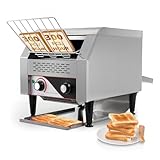
- 300 SLICES/HOUR COMMERCIAL TOASTER - The 1900W commercial conveyor toaster is efficiently high-power fast baking. The restaurant toaster with 7 heating levels and 3 heating modes, you can put the bread continuously and then make 300 slices of toast in one hour.
- FOOD-GRADE SAFE MATERIAL - The heavy-duty commercial restaurant toaster is made of food-grade thickened stainless steel, solid and long-lasting, inside the chain of commercial toaster adopts food-grade 304 stainless steel material, which ensures the safety and health of bread processing.
- 3 BAKING MODES AND 7 HEATING LEVELS - Dyna-Living heavy-duty commercial conveyor toaster with BREAD, BUNS and STBY 3 baking modes, which can be used for single-sided or double-sided baking. 7 different toasting settings for your choice, the stainless steel toaster can make bread of different colors and crispness to suit everyone's taste.
- FRONT/BACK OUTPUT MODES - The baked toast can be taken out from the front or rear of the conveyor toaster on the chute. You can switch at will to meet different needs, making your baking work stable and efficient.
- EASY TO CLEAN - Our commercial conveyor toaster is equipped with air vents for effective heat dissipation. And chain transmission design features a food-grade chain net, which can deliver the bread fast and smoothly, and ensure your bread is healthy and delicious. With a pull-out crumb tray to catch bread crumbs effectively, you can clean the conveyor toaster easily.
Commercial pop-up toasters
A commercial pop-up toaster looks familiar, but the better units are built with stainless steel housings, heavier-duty controls, higher wattage, replaceable parts, and commercial safety and sanitation listings. Most buyers look at 2-slot or 4-slot models. In 2026, a reasonable national budget is about $150 to $350 for low-volume commercial pop-up units, with common 4-slice models around $199 to $226.
Pop-up toasters work well when the volume is intermittent. Think office breakrooms, small cafes with modest toast orders, continental breakfast setups, or a concession stand that only needs a few slices at a time. They are not the right answer for a line that needs 80 breakfast plates in a tight rush. Even if the daily slice count sounds manageable, the peak 15-minute demand is what matters.
What’s actually slowing this PC down?
Pick the symptom - the matching free tool is one click away.
Conveyor toasters
Conveyor toasters use a moving belt to carry bread, bagels, English muffins, or buns through a heated chamber. They are the standard answer for consistent breakfast production because staff can load continuously instead of waiting for a pop-up cycle to finish.
Typical conveyor capacity runs from about 300 to 1,200 or more slices per hour. Compact 120V or entry-level units often sit in the 300 to 800 slices-per-hour range. Mid-range 208V models can approach 800 to 1,200 slices per hour, depending on belt width, opening height, heat settings, and product type. In 2026, budget conveyor toasters commonly cost about $240 to $500, mid-range units about $500 to $1,200, and premium conveyor models about $1,200 to $4,500 or more.
The construction detail that gets missed is discharge space. Some conveyor toasters discharge to the rear, some return product to the front, and some can be configured either way. A rear-discharge unit pushed against a wall may technically fit on the counter but fail in daily use. We like to show the feed side, landing side, cord path, and crumb tray access on the counter layout before the owner signs off.
Vertical contact and bun toasters
Vertical contact toasters are purpose-built for buns and sandwich lines. They press the cut face of the bun against a heated platen or contact surface, often with release sheets and thickness adjustment. The result is fast, repeatable browning that supports high-volume burger and sandwich service.
Windows Errors? Fix Them Before They Spread
Repair common Windows errors and clear accumulated junk for a smoother, more stable PC - no reinstall needed.Free scan · no reinstallOutdated Drivers Are Slowing You Down
One free scan finds every outdated or missing driver and matches the right update for your exact hardware.Free scan · exact hardware matchThese units cost more because they are specialized. A practical 2026 range is about $1,000 to $3,500 or more, with one real market example around $1,469. The cost can be worth it when consistency protects ticket time and product quality. A general conveyor toaster may be cheaper, but it may not give the same compression, caramelization, or line speed for buns.
Commercial Toaster Comparison Table
Use this table as a first-pass selection tool. It will not replace a final equipment schedule, but it helps narrow the field before you spend time pricing models and coordinating utilities.
| Toaster type | Best use case | Typical 2026 cost | Common output | Construction concerns |
|---|---|---|---|---|
| 2- or 4-slot commercial pop-up | Breakrooms, low-volume cafes, small self-serve areas | $150-$350 | Low-volume batch use | Counter space, cord location, GFCI protection, cleanable crumb area |
| Compact conveyor toaster | Small hotels, churches, cafes, moderate breakfast service | $240-$500 | About 300-800 slices per hour | Feed/discharge clearance, heat at wall, dedicated circuit, crumb tray access |
| Mid-range conveyor toaster | Busy breakfast lines, cafeterias, restaurants with steady morning volume | $500-$1,200 | About 800-1,200 slices per hour | 208V circuit planning, plug type, landing counter, ventilation review |
| Premium conveyor toaster | High-output institutional or hotel service | $1,200-$4,500+ | 1,000+ slices per hour on many models | Panel capacity, heat management, service access, replacement belt availability |
| Vertical contact or bun toaster | Burger, sandwich, and QSR lines | $1,000-$3,500+ | High bun throughput, model-dependent | Line placement, release sheets, thickness setting, cleaning procedure, electrical load |
How Many Slices Per Hour Do You Really Need?
Do not size a toaster from average daily sales. Size it from the rush. A cafe that sells 160 toast items across a day may only need modest equipment if orders are spread out. The same cafe serving 80 breakfast orders between 7:30 and 8:15 a.m. can overwhelm a pop-up toaster and create a visible bottleneck at the pass.
A useful estimating method is to count peak 15-minute demand, then multiply by four. If you need 80 slices in 15 minutes, that is a 320-slices-per-hour pace before you add a margin. A 300-slices-per-hour conveyor may look adequate on paper but feel tight in operation. We usually want extra capacity because real kitchens lose time to bagels, thicker bread, staff interruptions, reheats, and product changes.
Quick wins for a faster PC:
Clear out junk files and repair common Windows errorsFree Scan →Scan for outdated or missing drivers - takes under a minuteDriver Scan →Also popular on Amazon

- 【High Quality Materials】 Commercial toast machine is made of stainless steel body and food-grade 304 stainless steel chain mesh. It can better prevent rust and ensure the safety and health of food processing.
- 【300 Slices/Hour toaster】 Commercial electric conveyor toaster can bake about 300 slices of bread per hour, with 7 heating levels and 3 baking modes. BREAD mode is simultaneous high-temperature baking of the upper and lower tubes, STBY mode is simultaneous low-temperature baking of upper and lower tubes, BUNS mode is only high-temperature heating on the upper tube. Fast baking and high thermal efficiency. You can make bread in different colors and crispness according to different needs. meet the needs of daily use.
- 【Friendly design】 Our stainless steel toasters has front and back double exits, free to choose the direction you want to take the bread. Chain transmission design features a food-grade 304 stainless steel, which can accommodate 2 pieces of bread and transport bread quickly and smoothly. Greatly improve work efficiency, save time and energy.
- 【Easy to clean】 The toaster has a smooth stainless steel surface, which can effectively reduce the accumulation of oil and dust. Commercial large toaster uses detachable crumb tray, convenient residue collection and cleaning.
- 【Perfect Occasion】 This conveyor toaster is widely used in restaurants, bakeries, buffets, hotels, schools and large family breakfasts to bake bread, bun, bagel, donuts, croissants, etc. Can meet the busy kitchen needs and provide perfect baking.
For light service under roughly 50 to 100 slices during a rush period, a 4-slot commercial pop-up may be enough. For steady breakfast service, a conveyor unit rated around 300 to 800 slices per hour is usually a better fit. For larger hotels, schools, hospitals, and cafeterias, start looking at 800 to 1,200 slices per hour or more. For burger and sandwich concepts, do not compare only slice ratings. Compare bun cycle time, contact surface, compression, and whether the toasted result matches the menu standard.
Electrical Planning Is the Hidden Cost
The toaster price is often the small number. Electrical work is where a cheap equipment decision can become expensive. Commercial toasters may look like countertop appliances, but many draw serious power.
A 120V toaster rated at 1,750 watts draws about 14.6 amps before design margin and circuit-loading considerations. That is already close to the practical limit of a typical 15-amp circuit and still meaningful on a 20-amp circuit when other loads are nearby. Conveyor and bun units can also use 208V or 240V, with listed examples around 3,300 to 3,600 watts. Those units usually require dedicated planning, the correct receptacle, compatible plug, and enough panel capacity.
On our job sites, we want the toaster model selected before electrical rough-in. Moving from a 120V pop-up toaster to a 208V conveyor toaster after tile, stainless, and counters are installed can mean opening finished surfaces, revising permits, adding a breaker, changing receptacles, or delaying inspection. That is avoidable if the equipment schedule is real instead of a placeholder.
What to include in the equipment schedule
At minimum, list the manufacturer, model number, dimensions, voltage, phase, wattage, amperage, plug type, cord length, required clearance, listing marks, and ventilation status. If the toaster has a rear discharge, note the discharge direction. If it has a removable crumb tray, show the side or front clearance needed to pull it out without moving the appliance.
For commercial kitchen receptacles, GFCI protection also deserves early attention. The 2023 NEC expanded GFCI requirements in non-dwelling kitchen-type locations, with summaries of NEC 210.8(B) pointing to protection for 125V through 250V receptacles supplied by single-phase circuits of 50 amps or less and three-phase circuits of 100 amps or less in these areas. Local adoption and interpretation vary, so the electrical contractor and authority having jurisdiction should confirm the exact requirement for your project.
Safety, Certifications, and Inspection Readiness
A residential toaster does not belong in most commercial kitchen buildouts. Even if it works, it can create trouble with the health department, insurer, fire inspector, or electrical inspector. Commercial kitchens should generally use commercial-grade listed equipment that is appropriate for foodservice duty.
Look for sanitation and electrical safety marks. NSF/ANSI sanitation certification, or an accepted equivalent, tells the reviewer that the equipment has been evaluated for cleanable materials, design, construction, and food-equipment performance. UL or ETL electrical listing helps document that the appliance has been evaluated for electrical safety. The exact accepted marks can vary by jurisdiction, but unlabeled residential equipment is a weak position in a permitted commercial kitchen.
The FDA Food Code emphasizes food-contact surfaces that are smooth, durable, corrosion-resistant, nonabsorbent, and easily cleanable. Around a toaster, that matters more than people expect. Crumbs migrate. Heat discolors nearby finishes. Staff need to wipe the counter and backsplash quickly. We avoid exposed wood, open seams, rough grout transitions, and decorative trim directly behind crumb-producing heat equipment. Stainless wall panels, washable backsplashes, sealed counter joints, and accessible crumb trays make the daily cleaning routine easier and reduce inspection friction.
Does a Commercial Toaster Need a Hood?
Ventilation is jurisdiction-specific. Plain bread toasters are often treated differently than grease-producing cooking equipment, but that does not mean every toaster can be placed anywhere without review. A toaster used for bread in a breakfast area may be treated as a light-duty appliance. A toaster placed under a cookline hood, integrated into a burger line, or used near grease-producing equipment may receive more scrutiny.
Also popular on Amazon

- Capacity: High-output commercial conveyor toaster processes up to 450 slices per hour, perfect for busy cafes, diners, and breakfast bars during peak service times
- Construction: Heavy-duty brushed stainless steel toaster design ensures durability and professional appearance in commercial kitchen environments with easy maintenance
- Versatility: Wide slot toaster accommodates bread and bagels up to 2 in thick, making it ideal for diverse breakfast menus in restaurants and food service operations
- Portability: Compact toaster design at 15.5 x 13.5 x 19.5 in allows easy countertop placement while maintaining commercial-grade performance standards for small appliances
- Power: Electric toaster operates at 1800W with 120V power requirements, featuring POWER ON and READY indicator lights for efficient workflow management in commercial kitchens
NFPA 96 governs ventilation control and fire protection for commercial cooking operations, and local building, fire, mechanical, and health departments decide how those requirements apply to the actual kitchen. Some cities require plan review for restaurant equipment changes. Others may allow like-for-like replacement but require review when the equipment changes fuel, voltage, heat output, ventilation assumptions, or layout.
Before buying, confirm whether the toaster is part of a Type I hood area, a Type II hood area, a ventless equipment strategy, or an exemption path. If a hood or mechanical permit is triggered, the cost and timeline can exceed the appliance cost quickly. A simple toaster swap may take one afternoon. A change involving electrical rough-in, stainless protection, ventilation review, and inspection can run several weeks depending on drawings, permit queues, and contractor availability.
Counter Layout, Clearances, and Workflow
Commercial toaster placement is about motion. Staff need a place for untoasted product, a loading path, a landing zone for hot toast or buns, and a way to clean crumbs without lifting a hot machine every hour.
For pop-up toasters, allow enough side space for plates, tongs, wrapped bread, and finished product. A compact unit may only be about the size of a small countertop appliance, but the working footprint is larger once staff are using it. For conveyor toasters, plan both feed and discharge. A unit that is roughly 15 to 20 inches wide and 18 to 24 inches deep may need several more inches of functional space around it, especially if product exits at the rear.
Heat clearance also matters. Follow the manufacturer’s stated clearance from combustible materials. Keep paper goods, plastic wrap, ticket printers, laminated menus, and squeeze bottles away from the toaster zone. Where counters are being rebuilt, we prefer durable, heat-tolerant, cleanable surfaces nearby: stainless steel, commercial solid surface where appropriate, sealed stone, or tile assemblies detailed for cleanability. Avoid tight inside corners where crumbs collect and staff cannot reach.
Do not forget the cord. Commercial toaster cords are often short by design, and extension cords are generally the wrong answer in a foodservice kitchen. Put the receptacle where the cord can reach without crossing a wet prep area, a hot surface, or a traffic path. If the appliance sits on a movable counter or service station, coordinate strain relief, cord routing, and cleaning access.
Free tools Windows power users keep installed
One-click scans. No signup required.
Best Picks by Kitchen Scenario
Best for a small office breakroom or light self-serve station
Choose a commercial 2-slot or 4-slot pop-up toaster with stainless construction, NSF or equivalent sanitation listing, and UL or ETL electrical listing. Budget $150 to $350. A 4-slot unit is usually worth the small cost increase because it handles bagels, multiple users, and short rushes better than a 2-slot model.
Best for a cafe with moderate breakfast volume
Choose a compact conveyor toaster rated around 300 to 800 slices per hour. Budget $240 to $500 for entry-level equipment, and more if you need better insulation, faster recovery, or serviceable parts. Confirm whether 120V is enough or whether the selected model requires 208V. This is the category where buyers most often underestimate peak demand.
Best for a hotel breakfast line
Choose a front-return or carefully planned conveyor toaster with enough belt width and heat control for bread, English muffins, and bagels. Budget $500 to $1,200 for a solid mid-range unit, with premium models above that when the breakfast room is large or service is continuous. Front-return models can work well for self-serve areas because guests do not need to reach around the back.
Best for a burger or sandwich line
Choose a vertical contact or bun toaster. Budget $1,000 to $3,500 or more. Pay attention to bun thickness adjustment, release sheets, platen design, cleaning time, and parts availability. For a quick-service line, the best unit is the one that gives the same bun texture every cycle while keeping pace with the grill and assembly station.
Also popular on Amazon

- Excellent Efficiency: Engineered for maximum efficiency, our commercial toaster delivers up to 300 slices per hour—perfect for high-volume demands. Whether during morning rushes, lunch peaks, or late-night services, it effortlessly handles your restaurant’s busiest 24/7 demands. Its 10.1-inch wide opening fits up to three standard slices at once—saving time on batch toasting. Built with full-body stainless steel, it shields internal components from wear and tear, while thickened, high-quality heating tubes ensure years of reliable performance.
- 7 Bread Colors: This commercial toasters for restaurant is very simple to operate, with only two knobs on the control panel—one to control the color of the toasted bread and the other to control the toasting method. One knob regulates the chain speed: the faster the speed, the lighter the bread color; the slower the speed, the darker the bread color, depending on your preferred toasting degree. The other knob controls the heater operation, with 3 baking modes in total: BREAD, BUNS, and STBY.
- BREAD, BUNS, and STBY: For the BUNS and BREAD modes, you usually just need to put the toast on the feeding tray. The toast will then slide it onto the conveyor belt, where the heating elements will heat the toast. Finally, it will fall from the chain to the exit position. The STBY mode keeps the elements at reduced power to conserve energy between meal periods, while reducing preheat time during high-service periods. thanks to its energy-saving standby mode, you can conserve energy when this toaster isn't in use.
- Convenient Versatility: For versatility, this toaster can dispense product from the front or back on the included chutes. Plus, it features a 3" slot to fit a variety of your most popular foods, from traditional sliced bread to bagels and texas toast. Dispensing the product out of the back allows for pass-through versatility from back of house to front of house, while dispensing the product in the front reduces the countertop footprint of the unit, and even allows users to toast product themselves to reduce labor cost.
- Easy to Clean: It's easy to get bread crumbs everywhere during the toasting process, so this toaster oven is designed with a tray that collects the crumbs that fall off during toasting. The tray has a handle, making it easier to install and remove. Two shelves are designed on the side of the toaster oven for holding bread clips. The machine's non-slip legs keep it stable on the countertop and won't scratch your countertop. Its shell is made of 100% stainless steel, the material is resistant to high temperature.
Best for institutional or high-output kitchens
Choose a premium conveyor toaster from a serviceable commercial brand. Budget $1,200 to $4,500 or more. The higher price is usually tied to duty cycle, recovery speed, programmable controls, energy-saving modes, insulation, heavier components, warranty support, and parts availability. For schools, hospitals, casinos, and large cafeterias, downtime costs more than the price difference between a light-duty and heavy-duty unit.
Independent reader supportYour contribution helps us test, update, and keep practical guides available for everyone.What Commercial Toasters Cost in 2026
For a realistic budget, separate the appliance cost from the installed cost. The appliance might be $265. The project cost might be much higher if the kitchen needs a new circuit, GFCI breaker, receptacle change, counter modification, stainless wall protection, or permit review.
| Budget item | Typical 2026 range | What changes the price |
|---|---|---|
| Low-volume commercial pop-up toaster | $150-$350 | Slot count, stainless gauge, listing marks, brand, warranty, element quality |
| Budget conveyor toaster | $240-$500 | 120V vs 208V, belt width, output rating, heat control, housing quality |
| Mid-range conveyor toaster | $500-$1,200 | Higher throughput, adjustable top/bottom heat, insulation, serviceability |
| Premium conveyor toaster | $1,200-$4,500+ | Programmable controls, heavy-duty parts, brand support, continuous-duty design |
| Vertical contact or bun toaster | $1,000-$3,500+ | Platen design, release-sheet system, bun adjustment, duty cycle, controls |
| Installation-related work | Varies widely | Dedicated circuit, 208/240V power, GFCI protection, panel capacity, permits, wall protection, counter changes |
A higher-end commercial toaster is not automatically the right buy. But cheap equipment becomes expensive when replacement belts, elements, controls, or service are unavailable. Before buying a $250 unit for a revenue-producing line, check whether replacement parts are stocked and whether the warranty process is practical. For a low-volume breakroom, that may not matter much. For a breakfast program serving paying guests every morning, it matters a lot.
When to DIY vs When to Hire a Pro
A simple countertop toaster replacement can be handled in-house when the new unit uses the same voltage, same plug type, similar wattage, similar dimensions, and does not change the kitchen layout or ventilation assumptions. The safe DIY version is a like-for-like swap using commercial listed equipment, with the cord plugged into an appropriate existing receptacle and the manufacturer’s clearances followed.
Do these 3 things before closing this tab:
1Repair Windows errors before they cause bigger problems2Fix the driver behind crashes, sound loss and screen glitches3Clear out junk files and repair common Windows errorsHire a licensed electrician when the new toaster needs a dedicated circuit, a 208V or 240V receptacle, a different plug configuration, a GFCI breaker, panel capacity review, or any wiring change. Do not solve a power mismatch with adapters or extension cords. That is poor practice in a commercial kitchen and can become an inspection, insurance, and fire-risk issue.
Bring in a contractor or commercial kitchen designer when the toaster affects counters, stainless wall panels, pass-through layout, self-serve flow, or equipment spacing. Bring in mechanical or hood professionals when the appliance selection changes the cooking line, heat load, or ventilation review. For permitted restaurant work, check with the local authority before purchasing equipment that may alter the approved plan.
A typical like-for-like replacement can be completed the same day. A small electrical addition may take a few days to coordinate, depending on electrician availability and parts. A permitted kitchen modification can take several weeks once drawings, plan review, inspection scheduling, and finish work are included.
Common Buying Mistakes
The first mistake is buying by price instead of throughput. A toaster that cannot keep up during the rush costs money through slow tickets, staff frustration, and poor guest experience.
The Tool Desk
Outbyte Driver Updater FREEFix the driver behind crashes, sound loss and screen glitchesFind Drivers →Outbyte PC Repair FREEClear out junk files and repair common Windows errorsFree Scan →The second mistake is ignoring voltage and plug type. A 120V pop-up toaster and a 208V conveyor toaster are not interchangeable from a construction standpoint. Confirm the electrical requirements before the equipment is ordered and before the electrician roughs in the wall.
The third mistake is forgetting discharge and cleaning access. Rear-discharge conveyor units need usable space behind them. Crumb trays need room to slide out. Staff need a surface where hot product can land without blocking another task.
Also popular on Amazon

- Elevate Your Toasting Experience: VEVOR conveyor toaster is meticulously crafted from stainless steel, from the exterior to the conveyor chain mesh. The knob operation is simple and user-friendly. The removable crumb tray makes cleaning a breeze. This low-noise toaster is suitable for restaurants, bakeries, hotels, schools, buffets, and large family breakfasts.
- Efficiency at Its Best, 300 Slices per Hour: Featuring an 840 stainless steel heating element, our commercial toaster ensures efficient and even heating, resulting in consistently perfect toast every time. The food-grade 304 stainless steel chain mesh ensures smooth bread transport, enhancing toasting efficiency.
- Precision Control with Dual Knobs: One knob controls your toastiness level with 7 settings – the darker the setting, the slower the conveyor speed for a deeper toast. The other knob offers three modes, letting you tailor your toast to perfection. The upper and lower heating elements work separately to meet different baking needs. Simple knob controls mean you'll be a toasting pro in no time.
- Safety and Durability Enhanced: The bun toaster is built tough with stainless steel for heat and corrosion resistance. The 840 heating element stands up to long hours without a hitch. Rear heat dissipation keeps things cool, and user-friendly switches prevent accidents while ensuring quick power cut-off if needed.
- Effortless Cleaning: Our conveyor belt toaster's smooth stainless steel surface minimizes oil and dust buildup, making it easy to wipe clean. Plus, bread crumbs generated during toasting fall into the removable tray. After toasting, simply detach the tray and rinse it with water, ensuring cleanliness inside the machine and saving you significant cleaning time.
The fourth mistake is using residential equipment in a commercial kitchen. It may be cheaper on day one, but it can fail a health, insurance, fire, or electrical review. Commercial-grade listed equipment is the cleaner path.
The fifth mistake is assuming no hood review is needed. Many bread-toasting applications are straightforward, but local rules control the answer. Confirm the treatment before the purchase, especially in restaurants, hotels, schools, and tenant improvement projects under permit.
Our Bottom Line
For light use, buy a 4-slot commercial pop-up toaster with proper listings and a cleanable stainless body. For steady breakfast service, buy a conveyor toaster sized from peak 15-minute demand, not daily averages. For burger and sandwich lines, use a vertical contact or bun toaster built for that menu. In all cases, confirm electrical load, GFCI requirements, plug type, clearances, landing space, crumb management, and ventilation assumptions before the counter is built.
The best commercial toaster is the one that fits the kitchen as a working system. When equipment selection, power, layout, and inspections are coordinated early, the toaster supports production instead of becoming the smallest appliance with the biggest punch list.
Frequently Asked Questions
What type of commercial toaster is best for a restaurant kitchen?
For light toast orders, use a commercial pop-up toaster. For steady breakfast service, use a conveyor toaster. For burger, sandwich, or QSR lines, use a vertical contact or bun toaster because it gives faster and more consistent bun results.
How many slices per hour should a commercial toaster produce?
Size by peak demand, not daily volume. Compact conveyor toasters often handle about 300 to 800 slices per hour, while mid-range and premium models can reach about 800 to 1,200+ slices per hour.
Does a commercial toaster need a dedicated electrical circuit?
Often, yes. A 1,750W toaster on 120V draws about 14.6 amps, and larger conveyor units may require 208V or 240V. Have an electrician confirm circuit capacity, plug type, and GFCI requirements before installation.
Does a commercial toaster need to be NSF certified?
Commercial kitchens should generally use NSF/ANSI certified or equivalent sanitation-listed equipment, plus UL or ETL electrical listing. Local health departments, insurers, and inspectors may reject residential or unlabeled equipment.
Does a commercial toaster need a hood?
It depends on the jurisdiction, equipment type, and kitchen layout. Plain bread toasters are often treated differently than grease-producing appliances, but hood or ventilation requirements should be verified with the local building, fire, mechanical, or health authority.
How much does a commercial toaster cost in 2026?
Commercial pop-up toasters commonly cost about $150 to $350. Conveyor toasters range from about $240 to $4,500+, depending on capacity and duty cycle. Vertical contact or bun toasters usually run about $1,000 to $3,500+.
Recommended Free Tools
Quick Recap
Product prices and availability are accurate as of the date/time indicated and are subject to change. Any price and availability information displayed on Amazon at the time of purchase will apply.

