The Tool Desk
Outbyte PC Repair FREEClear out junk files and repair common Windows errorsFree Scan →Outbyte Driver Updater FREEFix the driver behind crashes, sound loss and screen glitchesFind Drivers →Some links on this page are affiliate links: if you buy through them we may earn a commission, at no extra cost to you.
For most horizontal sliding windows, the best choice is a purpose-built casement-slider window air conditioner, not a standard window AC. These units have a taller, narrower chassis designed to sit in the open side of a slider or casement window, with a rigid panel filling the space above the unit. In 2026, the most common practical sizes are 8,000 BTU for rooms around 300 to 350 square feet and 10,000 BTU for rooms around 400 to 450 square feet.
That quick answer matters because sliding windows create different construction problems than double-hung windows. The sash moves sideways instead of down onto the unit. The opening is often tall. The frame may be vinyl or aluminum with limited bearing strength. The unit may block an emergency escape opening. And the installation usually depends on a custom infill panel, a bracket, weather sealing, and a safe electrical connection.
As an Amazon Associate I earn from qualifying purchases.
On our job sites, we treat a sliding-window AC like a small exterior opening project, not just an appliance drop-in. The unit has to cool the room, but it also has to stay supported, shed water outdoors, resist vibration, keep bugs and rain out, and come back out without destroying the window assembly. A cheap install that leaks, rattles, or overloads a circuit is not a bargain.
Best Types of AC Units for Sliding Windows
The best air conditioner for a sliding window depends first on the window geometry. Product rankings are useful only after you know what can physically and safely fit.
Popular on Amazon
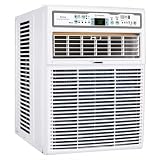
- Powerful 10,000 BTU Cooling - Designed to efficiently cool medium-sized rooms, this 10,000 BTU window air conditioner provides fast, reliable cooling for bedrooms, living rooms, apartments, offices, and other indoor spaces.
- Built for Casement & Sliding Windows - Specially designed for casement windows and vertical sliding windows, this window AC unit includes a secure installation kit for a proper fit and dependable performance.
- Custom Comfort Controls - Easily adjust your ideal temperature with electronic controls, an included remote control, multiple cooling and fan speeds, an adjustable thermostat, and a convenient 24-hour programmable timer.
- Energy-Efficient Performance - Save energy while staying comfortable with Energy Saver mode, helping reduce power consumption without sacrificing cooling performance.
- Easy Maintenance & Quiet Operation - A washable, reusable air filter helps capture dust and keeps your room air conditioner operating efficiently, while the compact design delivers dependable, quiet cooling all season long.
1. Casement-slider window air conditioners
This is usually the right answer for horizontal sliding windows. Casement-slider units are specifically designed for narrow window widths and taller openings. They are often sold as “slider/casement” or “casement window” air conditioners. The chassis is vertical compared with a standard window unit, and the manufacturer usually includes a panel system for the space above the AC.
Typical 2026 examples include 8,000 BTU models rated for about 350 square feet and 10,000 BTU models rated for about 450 square feet. Retail prices for true slider/casement models commonly land around $480 to $700 for 8,000 to 10,000 BTU units. They cost more than many basic double-hung window units because there are fewer models and the cabinet style is more specialized.
For most bedrooms, home offices, dens, and small living rooms with horizontal sliders, this is the category we look at first.
2. Standard window AC with a custom side panel
A standard double-hung window AC can sometimes be installed in a sliding window, but only when the opening, support, and enclosure are designed correctly. The problem is that the unit was built to be held by a bottom sill and a sash closing down behind the upper flange. A sliding sash does not provide the same geometry.
If a homeowner already owns a good standard AC, we check whether there is enough clear opening width, whether the sill or track can support the load, and whether a rigid side panel can be built. That panel should not be cardboard, thin foam board, or a loose accordion insert stretched far beyond its intended use. A better panel is exterior-grade plywood, painted MDO, clear acrylic, polycarbonate, or insulated composite secured into a removable frame.
This approach can save money on the unit itself because standard window ACs broadly range from about $150 to $800. The tradeoff is labor. By the time you fabricate a strong panel, seal it, trim it, and brace the AC, the total cost may come close to a purpose-built slider unit.
Recommended Free Tools
3. Portable AC with a sliding-window vent kit
A portable air conditioner is easier to fit in many sliding windows because it only needs a hose panel, not the full weight of the machine in the window. That makes it attractive for rentals, odd window shapes, or windows that cannot carry a heavy unit.
The downside is performance. Single-hose portable units can pull conditioned air out of the room and create negative pressure, which draws warm outdoor air back through leaks. Dual-hose models are better, but a properly installed window AC is usually more efficient, quieter, and cleaner-looking for the same room.
4. Mini-split or through-wall AC
If you need quiet cooling, year-round heating and cooling, multiple rooms, or a permanent finished look, a window AC may be the wrong solution. A ductless mini-split costs much more than a single window unit, but it avoids blocking the window, improves comfort, and can serve spaces where the window is an egress opening or where the HOA does not allow protruding window units.
A through-wall AC is another option when the room layout supports it. It requires cutting and flashing an exterior wall sleeve, so it is a construction project, not a quick appliance installation.
What’s actually slowing this PC down?
Pick the symptom - the matching free tool is one click away.
Sliding-Window AC Buying Checklist
Before comparing brands, measure the room and the window. Most failed installations start with buying the unit first and solving the fit later.
Use this checklist before ordering:
- Window type: horizontal slider, crank-out casement, vertical slider, or fixed glass beside an operable sash.
- Clear opening width: the actual open space after the sash is moved, not the glass size.
- Clear opening height: from the bottom track or sill bearing point to the top inside stop.
- Track depth: whether the AC base and bracket can sit securely without crushing vinyl tracks.
- Sash travel: whether the sliding panel can still close tightly against the unit or infill frame.
- Room area: length times width, adjusted for open doorways and connected spaces.
- Ceiling height: rooms above 8 feet may need more capacity.
- Sun exposure: south- and west-facing rooms often need roughly 10 percent more cooling capacity.
- Shade: heavily shaded rooms may need roughly 10 percent less capacity.
- Kitchen use: add about 4,000 BTU if the unit serves a kitchen.
- Outlet location: the cord must reach without an extension cord.
- Circuit load: confirm the circuit is not already carrying high-demand equipment.
- Egress status: do not block a required emergency escape and rescue opening.
- Exterior drainage: condensate must drain outside without staining siding, soaking trim, or dripping onto a walkway.
For a contractor-grade fit, we measure twice: once with the window fully open and once with the sash positioned where it will land after the AC and panel are installed. Sliding windows often have latches, interlocks, blinds, security stops, and trim that reduce usable clearance by 1/2 inch to 2 inches.
How Many BTUs Do You Need?
BTU capacity is where many homeowners overspend. Bigger is not automatically better. An oversized window AC can drop the temperature quickly but shut off before it removes enough humidity. The result is a cold, damp room that still feels uncomfortable.
For sliding-window air conditioners, the practical market is concentrated around 8,000 to 10,000 BTU. Frigidaire’s room AC sizing guidance lists 8,000 BTU for up to about 350 square feet, 10,000 BTU for up to about 450 square feet, 12,000 BTU for up to about 550 square feet, and 14,000 BTU for up to about 700 square feet. ENERGY STAR guidance also supports adjusting capacity for shade, sun, and kitchens.
Free tools Windows power users keep installed
One-click scans. No signup required.
| Room condition | Typical size | Starting BTU range | Field adjustment |
|---|---|---|---|
| Small bedroom or office | 150-250 sq. ft. | 5,000-6,000 BTU | Slider/casement models may be limited, so avoid oversizing if possible. |
| Large bedroom, den, or office | 300-350 sq. ft. | 8,000 BTU | Often the best fit for common slider/casement units. |
| Living room or larger bedroom | 400-450 sq. ft. | 10,000 BTU | Check weight, support bracket, and circuit load. |
| Large open room | 500-550 sq. ft. | 12,000 BTU | May be too heavy or too much draw for weak windows or shared circuits. |
| Kitchen area | Varies | Base size + 4,000 BTU | Heat from cooking changes the calculation. |
As a practical example, a 14-by-24-foot bedroom is 336 square feet. An 8,000 BTU slider/casement unit is usually the first model to consider. If that bedroom faces west, has poor attic insulation, and has 9-foot ceilings, stepping up may make sense. If it is shaded by trees and has good insulation, the 8,000 BTU unit may be plenty.
Also popular on Amazon
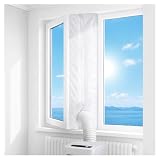
- Portable AC Window Vent Kit: This portable AC window vent kit is fitted between the window frame and the window using a hose. It effectively expels hot air generated by the air conditioner out of the window whilst trapping cool air inside, keeping your room cool for longer
- Improved Cooling Performance and Energy Savings: The AC window seal kits are made from durable nylon, effectively preventing hot air from entering and keeping out insects and rain, creating an ‘airtight environment’. This allows the room to cool down rapidly, enhancing the air conditioning’s cooling efficiency, helping to reduce energy consumption and carbon dioxide emissions, saving on electricity bills and putting money in your pocket
- Suitable For a Wide Range Of Portable Air Conditioners: This portable AC window vent kit features a flexible dual-zipper design, making it suitable for both single-hose and dual-hose units, and allowing the hose to be secured at any height. It effectively resolves the common issue of aligning the air conditioner with the window. The window seal is compatible with portable air conditioners, tumble dryers, dehumidifiers and other household appliances, offering versatile use across a variety of scenarios
- Suitable For a Wide Range Of Windows: We offer five sizes of portable AC window vent kits to choose from, including 300 cm, 400 cm, 500 cm, 560 cm and 600 cm. These are suitable for skylights, sunshade windows, casement windows or left/right-opening outward-opening windows. They are not suitable for sliding windows, vertical sliding windows or pivot windows. Please measure the length of all four sides of your window before purchasing, then select the appropriate size to ensure you buy the correct product, install it correctly and achieve a better seal
- Easy to Install: No drilling required. You won’t need to buy a window installation kit, hose adapters or any extra tools—our portable AC window vent kit includes all the necessary accessories (excluding the exhaust hose), along with a comprehensive installation guide! Simply secure the portable AC window vent kit to the inside of the window frame and the window itself using tape, feed the air conditioning hose out of the window, zip it up, and secure it with cable ties. You can open and close the window at any time without removing the window seal. Of course, you can also remove the AC window seal kit when not in use, store it away and reuse it later
For an open-plan space, do not size only the room where the window sits. If the opening connects directly to a hallway, kitchen, stairwell, or another room, the AC may never cycle properly. In that case, a mini-split or central system improvement may be a better answer than forcing a large window unit into one slider.
What to Look For in the Best Sliding-Window AC
Once fit and BTU capacity are settled, compare the features that actually affect comfort, operating cost, and serviceability.
Efficiency rating
Look for ENERGY STAR-certified room air conditioners and compare CEER or EER ratings. A more efficient unit costs more upfront sometimes, but it can reduce summer electric bills. Inverter models are especially worth considering in bedrooms and offices because they ramp output up and down instead of cycling hard on and off.
Outdated Drivers Are Slowing You Down
One free scan finds every outdated or missing driver and matches the right update for your exact hardware.Free scan · exact hardware matchPC Slower Than It Used to Be?
A free scan shows the junk files, broken settings and background clutter dragging Windows down - then fixes them in one click.Free scan · Windows 10 & 11In 2026, inverter window ACs are one of the strongest buying trends for comfort. They usually run more steadily, make less compressor noise, and avoid some of the temperature swings of older units. Published ENERGY STAR estimates have shown meaningful annual savings for inverter units compared with conventional models in similar capacities.
Noise level
For bedrooms, a few decibels matter. Look for a listed low-speed sound rating, not just marketing words like “quiet.” A conventional compressor turning on at 2 a.m. can be more annoying than a steady fan. If the room is used for sleep, calls, or focused work, noise should rank just behind fit, BTU capacity, and electrical safety.
Weight and support
Many 8,000 to 10,000 BTU slider/casement units weigh roughly 65 to 85 pounds. Larger models can be heavier. That load should not rest casually on a vinyl track or thin exterior trim. Use the manufacturer’s bracket when supplied, or an approved support bracket rated for the unit weight.
We do not like installations where the AC is “held” by friction, foam, and hope. The unit should have a stable base, a slight outward pitch for drainage if required by the manufacturer, and a secure connection that resists wind and vibration.
Quick wins for a faster PC:
Repair Windows errors before they cause bigger problemsFix Now →Fix the driver behind crashes, sound loss and screen glitchesFind Drivers →Filter access
A washable front filter sounds minor until the unit is buried behind blinds or a tight panel. Make sure the filter can slide out without removing the AC. A dirty filter reduces airflow, raises noise, and can cause icing.
Controls and thermostat
A remote thermostat can help in rooms where the unit sits near a hot window but the seating or sleeping area is 10 to 20 feet away. Wi-Fi is convenient, but we consider it secondary. A well-sized, well-sealed, manually controlled unit will outperform a smart unit installed poorly.
2026 Cost: Unit, Labor, and Materials
A sliding-window AC project has three cost buckets: the appliance, the installation labor, and the materials needed to make the window weather-tight and secure.
| Cost item | Typical 2026 US range | Notes |
|---|---|---|
| Basic standard window AC | $150-$800 | Usually intended for double-hung windows, not sliders. |
| True slider/casement AC | $480-$700 | Common range for 8,000-10,000 BTU models. |
| Professional window AC installation | $130-$519 | Many homeowners land near $300 depending on complexity. |
| Rigid infill panel materials | $40-$250 | Plywood is cheaper; acrylic or polycarbonate looks cleaner. |
| Support bracket and fasteners | $30-$150 | Cost depends on weight rating and wall/window conditions. |
| Electrical repairs or new circuit | Varies widely | Can exceed the AC installation cost if a dedicated circuit is needed. |
For a straightforward 8,000 BTU slider/casement unit, a realistic installed budget is often $650 to $1,100: roughly $480 to $600 for the unit, $130 to $350 for labor, and a modest allowance for sealing materials or bracket upgrades. For a more finished installation with a clear polycarbonate panel, trim, weatherstripping, and a heavier 10,000 BTU unit, $900 to $1,400 is not unusual.
Do these 3 things before closing this tab:
1Scan for outdated or missing drivers - takes under a minute2Repair Windows errors before they cause bigger problems3Fix the driver behind crashes, sound loss and screen glitchesThe biggest budget drivers are BTU capacity, window condition, panel height, and electrical readiness. A tall slider may need a panel 14 to 24 inches wide and 36 to 48 inches tall. If that panel is clear polycarbonate instead of painted plywood, material cost rises, but the finished room looks better and keeps more daylight.
If the existing outlet is loose, ungrounded, too far away, or on a heavily loaded circuit, stop and solve the electrical issue. Extension cords are not a professional solution for window AC units. Some manufacturers call for an individual branch circuit, especially as capacity increases. Local AFCI or GFCI requirements may also affect the work.
Installation Details That Separate a Good Job From a Bad One
A sliding-window AC installation should be reversible, but not flimsy. That means the unit can be removed later without permanent damage, while still being strong enough for normal use, storms, vibration, and repeated operation.
Build a rigid infill panel
The open space above or beside the unit needs a panel that resists flexing. Thin plastic accordion panels are rarely enough for a tall sliding-window opening. Better options include 1/2-inch exterior-grade plywood, painted MDO, 1/4-inch to 3/8-inch acrylic, 1/4-inch to 3/8-inch polycarbonate, or an insulated sandwich panel.
Also popular on Amazon

- 【Adjustable universal size】The pneumatic sliding window kit measures 19.5 inches wide and 23.5–43 inches long, with an adjustable length range of 23.5–43 inches. The window kit allows you to adjust the size of the aluminum frame by tightening screws, making it compatible with all Soleus Air exclusive hybrid “saddle” air conditioners. The hybrid air conditioner window sealing kit is designed for horizontal sliding windows (single and double-hung windows). The sealing strips can be easily trimmed to fit your needs.
- 【Easy Installation】No tools required—everything you need is included in our pneumatic sliding window kit. Follow these steps for installation: 1. Loosen the screws on the sides to unlock the panel. 2. Remove the protective film from the acrylic glass. 3. Install and adjust the sliding window frame to fit the window opening. 4. Tighten the screws on both sides to secure the frame. 5. If necessary, use foam sealant to seal the sides. *Note: Please wear gloves and handle with care
- 【High-Quality PV Material】This horizontal window kit features 3.0mm PV material with a light transmittance of up to 88%–90%, allowing you to enjoy a clear view of the outdoors. It resists yellowing even with prolonged use, so you can enjoy the outdoor scenery while staying warm in winter or cool in summer thanks to your air conditioning.
- 【Heavy-Duty Aluminum Alloy Frame】Our window kits feature heavy-duty aluminum alloy profiles and a reinforced double-layer frame, capable of withstanding winter blizzards and summer storms with ease. The robust structure is highly rigid, resistant to warping and vibration, and rust-proof, ensuring it remains as sturdy as new even after years of use. Whether facing strong coastal winds or typhoons, it will keep your windows securely in place, putting an end to drafts, leaks, and noise.
- 【Window Frame Security Lock】All our window frames come equipped with a sturdy lock. Once locked, the sliding panel cannot be opened from the outside, effectively reducing the risk of unauthorized entry. Enjoy a perfect seal while adding a reliable layer of security for your family. Easy to install: 1. Place the lock in the appropriate position on the track. 2. Turn the key to secure the lock.
Plywood is strong and inexpensive, but it blocks light. Acrylic looks good but can crack if drilled poorly. Polycarbonate is tougher and more forgiving, which makes it a good choice near doors, kids’ rooms, and rental spaces where durability matters. Insulated panels perform well but need careful edge sealing.
Seal the edges
Air sealing is comfort work. Gaps around the panel let in hot air, insects, smoke, humidity, and noise. Use compressible weatherstripping where the panel meets the window frame. Use removable sealant only where appropriate. Avoid permanent caulk on rental windows or finished frames unless the owner approves it.
Inside, the installation should look intentional. Trim strips, clean fastener lines, and a straight panel edge matter. A sloppy opening makes the room feel temporary and usually leaks more air.
Support the load
With vinyl sliders, be careful about relying on the track. Vinyl can deform under concentrated loads, especially in direct sun. Aluminum frames can be stronger but still need proper bearing. Wood frames may accept fasteners better, but old sills can be soft from previous water damage.
A support bracket should transfer weight to the exterior wall or sill area according to the manufacturer’s instructions. Do not drill into unknown areas without understanding the window frame, flashing, siding, and water path. One misplaced screw can create a leak behind siding or into the wall cavity.
Manage condensate
Window ACs remove moisture from indoor air. That water has to go somewhere. Most units are designed to drain or sling condensate outdoors. The AC should be pitched as the manufacturer specifies, usually slightly outward. Too much pitch can affect operation; too little can send water inside.
Check where the water lands. Dripping onto a lower window, staining stucco, soaking wood trim, or creating algae on a walkway is poor water management. On multi-family buildings, drainage may also be restricted by HOA or property rules.
Safety, Egress, Permits, and Rules
The safety question we care about most is egress. If the sliding window is a required emergency escape and rescue opening for a bedroom or basement sleeping room, installing an AC can reduce the clear opening below code requirements. That can create a life-safety problem and may violate local building rules.
Do not assume another window in the room solves it. Egress depends on clear opening size, sill height, window operation, and local code interpretation. If the AC blocks the only compliant escape opening, choose another cooling strategy.
Permits for a simple plug-in window AC are often not required, but that changes when the work involves electrical upgrades, cutting framing, changing window size, adding a through-wall sleeve, or modifying an egress opening. Some municipalities also regulate exterior appearance, especially on street-facing elevations, apartments, condos, and historic properties.
For rentals and HOA properties, get written approval before installation. Many leases prohibit window AC units or require specific brackets to prevent falls. Some buildings ban units that drip onto sidewalks or protrude beyond the facade.
When to DIY vs. When to Hire a Pro
A careful homeowner can install some sliding-window AC units, but the project needs more judgment than a basic double-hung window unit.
Quick wins for a faster PC:
Repair Windows errors before they cause bigger problemsFix Now →Scan for outdated or missing drivers - takes under a minuteDriver Scan →DIY can make sense when:
- The unit is a manufacturer-approved slider/casement model.
- The window opening matches the published minimum and maximum dimensions.
- The window is not a required egress opening.
- The outlet is grounded, nearby, and suitable for the unit.
- The unit includes a proper support kit.
- The installation is on the first floor or otherwise safely accessible.
- The panel is simple, small, and removable.
Hire a pro when:
- The unit weighs more than you can safely handle with two people.
- The window is vinyl, damaged, out of square, or unusually tall.
- You need a custom acrylic, polycarbonate, or insulated panel.
- The AC is above a walkway, driveway, lower roof, or neighboring property.
- The room may depend on that window for emergency escape.
- The outlet is questionable or the breaker trips under load.
- You want the installation to look finished from inside and outside.
For labor alone, expect many professional window AC installations to fall around $130 to $519 nationally in 2026, with a common midpoint near $300. A simple first-floor slider may be near the low end. A heavy unit, second-floor access, custom panel fabrication, or electrical coordination pushes the price up.
Independent reader supportYour contribution helps us test, update, and keep practical guides available for everyone.Best Picks by Situation
There is no single best sliding-window AC for every room. The right pick depends on the room size, window structure, noise expectations, and whether the installation has to be temporary or finished.
Best for most bedrooms: 8,000 BTU slider/casement unit
An 8,000 BTU unit is usually the sweet spot for bedrooms and offices around 300 to 350 square feet. It is more affordable, lighter, and easier to support than a 10,000 or 12,000 BTU unit. Look for ENERGY STAR certification, a washable filter, a remote, multiple fan speeds, and a noise rating that works for sleep.
Also popular on Amazon

- Multi-Season Comfort - Midea 8000 BTU window air conditioner with heat is better than standard ac units. It will beat the heat in summer with powerful cooling and dehumidification and keep you warm through the fall with supplemental heat. Best for large rooms up to 350 square feet. NOTE: heat pump function works when outside temp> 41°F.
- Easy To Use – This air conditioner and heat unit comes with an LED display, 5 Modes (Heat, Auto, Cool, Dry, Fan), 3 speed settings (Auto/H/M/L), 24-hr Timer, and ECO energy saver. The Swing button adjusts the louvers up/down to direct the airflow. Wireless control enabled window ac with heat unit from anywhere with the SmartHome App, or with your voice via Alexa and Google Assistant. All functions can be set via the control panel, remote control, and app or voice assistant.
- Save Energy Being Cool – Save on energy costs and enjoy ultimate comfort with this energy star certified unit. This energy efficient air conditioner unit is engineered with variable-speed inverter technology that will quickly cool your bedroom or apartment space while using considerably less electricity; up to 35% energy savings compared to the Energy Conservation Standard. Washable filter is easily accessed from front panel for regular cleaning to maintain peak performance.
- Ultra Low Noise Performance – This ac window unit operates at a noise level as low as 45 dBA. It’s such a quiet air conditioner that you will barely notice it, even when it’s on high. Enjoy your Zoom call, watch your favorite TV show, have a conversation. This ac unit for bedroom also creates just the right amount of white noise so you can get some rest.
- Install Specs – This window air conditioner is designed to fit double hung windows with opening widths of 24 to 38.5 inches. Lower sash must open sufficiently to allow a clear vertical opening of 14.5 inches. AC window unit measures 19.41"W x 22.17"D x 13.9"H. Included components: 8000 btu window air conditioner, remote control, installation kit. This ac heater combo window unit is as a close as you can get to a mini split a/c. You may like it so much you just might buy two!
Best for larger rooms: 10,000 BTU slider/casement unit
For rooms around 400 to 450 square feet, a 10,000 BTU unit is often the better fit. This is common for larger bedrooms, living rooms, and sunny offices. Confirm the circuit, bracket, and window frame before buying. The added cooling capacity also means added weight and current draw.
Best for rentals: portable AC or reversible slider install
For renters, the best choice is often the one that avoids permanent holes and lease problems. A dual-hose portable AC with a neat sliding-window vent panel can be acceptable, especially where exterior brackets are prohibited. If using a window unit, build a removable panel and use approved support that does not damage the frame.
Best for quiet comfort: inverter unit or mini-split
If noise is the main concern, look for an inverter window AC where a compatible slider/casement model is available. If the room is used every day, if appearance matters, or if you need heating too, price out a ductless mini-split before committing to a heavy window installation.
Best for long-term construction value: mini-split
A mini-split is not in the same budget category as a window AC, but it may be the better construction decision. It keeps the window usable, avoids egress conflicts, improves efficiency, and looks cleaner from outside. For additions, finished basements, converted garages, and offices over garages, we usually discuss mini-splits early.
Common Mistakes to Avoid
The most common mistake is buying a standard window AC for a horizontal slider without a real plan for the panel and support. The second is oversizing. A 12,000 BTU unit in a 250-square-foot bedroom may cool fast and still feel clammy because it does not run long enough to dehumidify.
Other mistakes include measuring the glass instead of the clear opening, ignoring the sash lock, setting the unit on a weak vinyl track, blocking an egress window, using an extension cord, and sealing gaps with temporary scraps that fail after the first hot week.
We also see water mistakes. If condensate runs down siding every day for three months, it can stain finishes and find weak spots. If the unit pitches inward, it can leak into the room and damage flooring or trim. Water management is part of the installation, not an afterthought.
Bottom Line
For most homeowners with horizontal sliding windows, the best window air conditioner is a properly sized 8,000 or 10,000 BTU casement-slider model installed with a rigid infill panel, secure support bracket, clean weather sealing, and a suitable electrical outlet. Expect the unit itself to cost about $480 to $700 for common slider/casement models in 2026, with professional installation often adding about $130 to $519 depending on the window and finish quality.
Choose the AC after confirming the window is not required for emergency escape, the frame can carry the load, the outlet is appropriate, and condensate can drain safely outdoors. If those conditions do not check out, a portable AC, through-wall unit, or ductless mini-split may be the smarter construction solution.
What’s actually slowing this PC down?
Pick the symptom - the matching free tool is one click away.
Frequently Asked Questions
Can you put a window air conditioner in a sliding window?
Yes, but the best option is usually a casement-slider window air conditioner designed for narrow, tall openings. A standard window AC can work only if the unit is properly supported and the remaining opening is filled with a rigid, weather-sealed custom panel.
How many BTUs do I need for a sliding-window AC?
For many sliding-window installations, 8,000 BTU works for rooms around 300 to 350 square feet, while 10,000 BTU works for about 400 to 450 square feet. Add capacity for sunny rooms, kitchens, high ceilings, and poor insulation, but avoid oversizing because it can reduce humidity removal.
How much does it cost to install a sliding-window air conditioner in 2026?
A true slider/casement AC commonly costs about $480 to $700 for 8,000 to 10,000 BTU models. Professional installation often runs about $130 to $519 nationally, with many projects near $300 before custom panels, brackets, or electrical work.
Do sliding-window AC units need a support bracket?
Usually, yes. Many slider/casement units weigh roughly 65 to 85 pounds or more, and the load should not rest only on a vinyl track or thin trim. Follow the manufacturer’s support requirements and use a bracket rated for the unit.
Can a window AC block a bedroom egress window?
It should not block a required emergency escape and rescue opening. If the AC reduces the clear opening below local code requirements, choose a different window, a portable unit, a through-wall unit, or a mini-split.
Is a portable AC better than a sliding-window AC?
A portable AC is easier for some rentals and odd window shapes, but a properly installed sliding-window AC is usually more efficient, quieter, and cleaner-looking. A dual-hose portable unit is preferable if you cannot safely support a window unit.
Quick Recap
Product prices and availability are accurate as of the date/time indicated and are subject to change. Any price and availability information displayed on Amazon at the time of purchase will apply.

