Free tools Windows power users keep installed
One-click scans. No signup required.
Some links on this page are affiliate links: if you buy through them we may earn a commission, at no extra cost to you.
Balcony solar can reduce daytime electricity use without a rooftop array, but it is not suitable—or automatically legal—for every home. A successful installation depends on sunlight, secure mounting, the building’s electrical system, utility rules, equipment certification, and permission from the landlord, HOA, condo association, or building owner.
For renters and apartment residents with a sunny balcony, patio, terrace, or small yard, a properly approved system can be a relatively affordable way to offset modest loads. It will not replace rooftop solar, eliminate the utility bill, or normally provide power during a blackout without a battery and approved backup controls.

As an Amazon Associate I earn from qualifying purchases.
What are balcony solar panels?
Balcony solar is a compact photovoltaic system designed for balconies and other small spaces. The basic grid-interactive arrangement is:
Solar panels → microinverter → household circuit → appliances
                                      ↓
                                  utility grid
Panels produce direct-current (DC) electricity. A microinverter converts it into grid-compatible alternating-current (AC) electricity, which enters the home through either a plug or a dedicated electrical connection. Appliances use available solar power first; the utility supplies the remaining demand. Surplus electricity may be exported to the grid, curtailed, or stored, depending on the system and local rules. CESA’s June 2026 Plug-In Solar Q&A describes these configurations and their limitations.
#1 Best Overall

- Simply Put the Solar Panel in the Sun & Plug the Electric Cord to Your Wall.
- Estimated Electricity Generation average 1500kWh per year.
- Estimated to save average 20% to 40% of electric bills for average home.
- 4PCS of 200 Watt Solar Panels (total 800Watt), Micro-Inverter with 50ft Cord.
- NOTE: The system comes in TWO SHIPMENTS: ---------- 1. Micro-Inverter with in-built power monitor, Plugin 50ft cord ---------- 2. Solar Panels (shipped Separately in individual packages for safety)
These systems are sometimes called plug-in photovoltaic equipment, plug-in solar, or plug-and-play solar. “Plug-and-play” describes the connection method—not an exemption from electrical, building, fire, utility, or property requirements.
Three systems that buyers often confuse
- Direct-to-home plug-in solar: Panels and a certified microinverter offset electricity used by the home. A standard grid-interactive system normally shuts down during a power outage.
- Solar plus battery: Panels charge a battery, which can supply selected loads later. More advanced systems may combine bill reduction with approved backup operation.
- Portable power station: Solar charges a battery, and appliances plug into the power station. This is usually simpler for backup use, but it does not automatically reduce consumption on the home’s existing circuits.
Who is balcony solar for?
It is most suitable for:
- Renters who cannot install rooftop solar but have permission to use a balcony or patio.
- Condo and apartment residents with good direct sunlight and a private outdoor area.
- Homeowners with shaded, leased, unsuitable, or structurally constrained roofs.
- Households seeking a modest daytime bill reduction rather than energy independence.
- People with daytime loads such as refrigerators, networking equipment, computers, fans, pumps, or home-office equipment.
- Renters who need a removable system when they move.
It is usually a poor fit for a heavily shaded or north-facing balcony, a property that prohibits exterior equipment, or anyone expecting to run central air-conditioning, electric heating, ovens, dryers, or an entire apartment from a small array.
What’s actually slowing this PC down?
Pick the symptom - the matching free tool is one click away.
How much electricity can it produce?
There is no universal production figure. Output depends on panel wattage, inverter limits, orientation, tilt, latitude, season, weather, temperature, shading, cable losses, and whether surplus energy can be used or stored.
Pay attention to the difference between DC panel capacity and AC inverter output. A panel may be advertised at 400 watts DC, while the inverter has a lower AC limit. The inverter caps the electricity delivered to the home when panel production exceeds that limit. Conversely, an inverter may be paired with more panel capacity than its AC rating to improve production during weak sunlight; the exact limits must follow the manufacturer’s specifications. CESA explains this distinction in its technical overview.
As a practical scale:
- 400–500 W of panels: A small offset for baseline loads.
- An 800 W AC system: Potentially meaningful daytime reduction, but still only a fraction of typical household consumption.
- 1,200 W or more: Greater potential output, with more important questions about circuits, certification, permits, interconnection, and export control.
CESA models an 800 W AC system producing approximately 1,000 kWh per year under a 15% capacity-factor assumption. That is an illustrative scenario, not a guarantee for every balcony.
Rank #2

- 【High Conversion Efficiency, Fast Charging】The upgraded A+ grade monocrystalline solar cells achieve a conversion rate of 24%, maximizing solar energy capture. With ample sunlight, they can generate a maximum output power of 200W. The latest ETFE laminated case offers a light transmission rate of over 95%, significantly improving the performance of the solar cells.
- 【Wide Compatibility, 8-in-1 MC4 Converter】The Twelseavan 200W solar panel features a 5-in-1 MC4 connector cable and 3 DC adapters, making it compatible with most of portable power stations like Jackery, Ecoflow, Bluetti, Flashfish, Anker, and more. With a 9.8ft MC4 connector cable, you enjoy maximum flexibility and effortless connection options for a hassle-free setup.
- 【60W USB-C and 18W QC3.0 Fast Charging Ports】Equipped with a Type-C Port (PD60W Max), a QC3.0 USB Port (18W Max), and a USB Port (5V/3A), you can simultaneously charge your mobile devices wherever you are, including phones, power banks, cameras, iPads, etc. The built-in IC chip detects your devices and adjusts the current for faster charging while preventing overcharging and overload.
- 【HIGH PORTABILITY & EASY SETUP】The weight is only at 15.7 lbs, the folded size is 23*22 inches, and magnetic handle for easy carrying anywhere. Equipped with 4 adjustable kickstands, it can be firmly placed on any ground and easily setting the angle of the solar panel to maximize the absorption of sunlight, taking only a few seconds to set up to capture energy from the sun.
- 【Ultimate Durability: Weather-Resistant and Waterproof】The back of our solar panels is made from high-density polyester canvas, offering excellent wear resistance, dust resistance, and high-temperature resilience. Combined with a highly durable ETFE laminated case, this design enhances outdoor durability and extends the lifespan of the panels. With an IP65 waterproof rating, they can withstand various weather conditions, ensuring reliability for all your outdoor activities.
How much money can it save?
A useful calculation is:
Annual savings = (solar used directly × retail electricity rate)
                 + eligible export credits
                 − additional costs
Self-consumed solar generally has the greatest value because it avoids buying electricity at the retail rate. Exported power may receive a lower credit, require an approved interconnection arrangement, or receive no compensation. A household that is away during the day may therefore save less than a household with steady daytime demand.
The Tool Desk
Outbyte Driver Updater FREEFix the driver behind crashes, sound loss and screen glitchesFind Drivers →Outbyte PC Repair FREERepair Windows errors before they cause bigger problemsFix Now →CESA’s June 2026 analysis cites advertised U.S. plug-in-system pricing near approximately $1.75 per watt, excluding potentially significant shipping costs. Its illustrative 800 W example uses $1,400 in equipment costs and a $0.20-per-kWh electricity rate, producing an estimated payback of about 6.7 years under favorable assumptions. CESA also models a broader simple-payback range of roughly four to 13 years, depending on price, sunlight, electricity rates, self-consumption, and export treatment. These are analytical examples, not guaranteed retail prices or returns.
Include shipping, tax, mounting hardware, electrician fees, monitoring subscriptions, insurance, maintenance, removal, and eventual battery replacement in any calculation. A battery may increase self-consumption and add outage capability, but its cost and degradation can lengthen payback substantially.
Is balcony solar legal in the United States?
There is no single nationwide yes-or-no answer. A system may need to satisfy several separate authorities:
- State law and public-utilities-commission rules.
- Local building, electrical, fire, and wind-load requirements.
- Utility interconnection, registration, export, and compensation rules.
- Equipment certification requirements.
- Landlord, HOA, condo-board, lease, or building-manager rules.
Ask the state public utilities commission, local building department, and utility:
Quick wins for a faster PC:
Fix the driver behind crashes, sound loss and screen glitchesFind Drivers →Repair Windows errors before they cause bigger problemsFix Now →Scan for outdated or missing drivers - takes under a minuteDriver Scan →Rank #3
- Is plug-in solar allowed in this location?
- What is the maximum AC output?
- Is approval, registration, inspection, or a permit required?
- Must the system use a dedicated circuit?
- Is exporting electricity permitted?
- Will exported electricity receive a credit?
- What certification must the complete system carry?
- Are there special rules for multifamily buildings?
UL Solutions reported in January 2026 that Utah was the first state to allow up to 1.2 kW plug-in solar systems without utility approval. CESA’s June 2026 update reported Utah and six additional states had enacted plug-in-solar legislation. Because rules and implementation can change, treat state lists as date-specific and verify the current local pathway before buying.
Is it safe to plug solar into an outlet?
Only when the complete system is specifically designed, certified, and authorized for that use. Do not connect an ordinary inverter or a collection of mismatched components to a wall outlet.
UL Solutions announced a U.S. testing and certification framework based on UL 3700 for interactive plug-in photovoltaic equipment and systems. The framework addresses construction, labeling, overload protection, accidental contact, and prevention of current flowing in the wrong direction. A UL 3700-certified complete system is not the same thing as an inverter marketed as “UL-compatible.” Verify the exact certification scope.
Other grid-interactive equipment may use different applicable standards. For example, PG&E says applicable interconnection applicants must use UL 1741 SB-certified inverters and conform to its Common Smart Inverter Profile requirements. That does not mean every plug-in product meets PG&E’s requirements.
Safety checks before purchase
- Confirm certification for the complete plug-in system, not merely one component.
- Verify U.S. electrical compatibility and anti-islanding protection.
- Check overload and overcurrent protection, weather resistance, warranty, and recall information.
- Confirm the manufacturer’s circuit and GFCI requirements.
- Use mounting hardware rated for outdoor exposure and local wind conditions.
Never use a male-to-male “suicide cord.” Do not use an extension cord unless the manufacturer and local code explicitly permit it. Do not drill into a façade, railing, roof membrane, or balcony structure without authorization. Panels must not fall, block emergency access, obstruct egress, or endanger people below.
Rank #4

- ☀【Class A Solar Cell】The EPOCH solar panel features high-quality grade A+ solar cells and incorporates half-cut cell and bypass diodes.More Busbar,More Power.The Epoch 430W solar panel incorporates a high-level 16BB cell design,enhancing its lifespan for long-term performance.
- ☀【High Conversion Rate】With high transparency up to 91.5% and exceptional efficiency reaching up to 25%,Epoch offers both optimal light transmission and maximum energy conversion.Capture sunlight from double sides with this 400W bifacial solar panel,significantly improves the conversion efficiency even in low-light environments.
- ☀【Durable&Waterproof】Features a rugged design that can tolerate hail and snow loads up to 5400 Pa.High wind tolerance of up to 2400 Pa negative load.Ensure waterproof protection with the IP68 Junction Box,while the IP67 MC-4 solar connectors are versatile and can withstand dirt,dust,debris,and low-pressure water jets.
- ☀【Fast and Easy Installation】 Comes with junction box and solar connectors, which are easy to install. Pre-drilled holes on the back of the panel allow for fast mounting and securing, ideal for off-grid applications including RVs, rooftops, cabins, yachts, and more. They are directly compatible with most ground mounts, Z Brackets, Corner Brackets, Pole Mounts, and Tilt Mounts.
- ☀【Warranty】Each panel undergoes 100% EL(Electroluminescence) testing to ensure there are no microcracks.We proudly offer a 12-year on the quality warranty and 25-year linear power output warranty,ensuring long-lasting durability.
A breaker alone does not resolve every circuit-loading issue. CESA discusses circuit interactions, breaker masking, bidirectional GFCI concerns, and current distribution in its safety and electrical analysis. A qualified electrician is appropriate when the circuit, receptacle, grounding, GFCI arrangement, or building wiring is uncertain. A 20-amp, 120-volt circuit has a theoretical 2.4 kW capacity, but that figure does not prove an existing circuit is suitable for generation.
What to check before buying
- Property permission: Review the lease, condo documents, HOA rules, and building policies. Obtain written approval where possible.
- Sunlight: Check morning, midday, afternoon, and seasonal shading. A cheap system in shade may be a poor investment.
- Mounting: Confirm railing or freestanding supports can withstand wind and do not compromise egress or the structure.
- Electrical circuit: Identify the receptacle and everything else on that circuit. Check grounding, weather protection, GFCI condition, wiring, breaker size, and manufacturer requirements.
- Legal pathway: Confirm state, local, and utility rules before ordering.
- Goal: Choose direct bill offset, backup power, or both. A basic grid-interactive inverter is not blackout power.
- Budget: Compare complete-system cost—not panel-only pricing—with realistic self-consumed production.
Installation and ongoing use
Follow the manufacturer’s installation instructions rather than improvising a high-rise balcony setup. The installation should produce a secure, weather-resistant arrangement with protected cables and no blocked access.
After commissioning, monitor generation, grid import or export if available, inverter temperatures, fault codes, and mounting hardware. Inspect after severe weather. If a breaker trips, a connector overheats, the inverter reports an error, water enters equipment, or the mounting shifts, disconnect it according to the manufacturer’s procedure and obtain qualified help.
Expected behavior for a properly functioning grid-interactive system includes generation monitoring, reduced grid consumption while solar is available, and automatic shutdown during a grid outage unless an approved battery-backed mode is specifically supported.
Independent reader supportYour contribution helps us test, update, and keep practical guides available for everyone.Balcony solar compared with the alternatives
| Option | Best for | Main trade-off |
|---|---|---|
| Balcony or plug-in solar | Small daytime bill reduction in a sunny, authorized location | Low output and evolving rules |
| Rooftop solar | Large bill reduction for homeowners | Higher cost, professional installation, and low removability |
| Community solar | Renters or shaded properties | Depends on local availability and subscription terms |
| Portable power station | Backup for selected appliances | Does not automatically offset the home’s existing circuits |
| Energy-efficiency upgrades | Reducing consumption at the source | Generates no electricity |
Balcony solar is generally cheaper and more removable than rooftop solar, but produces far less electricity. Community solar may be better when mounting is prohibited or sunlight is poor. A portable power station is usually the clearer choice when the main goal is outage protection.
Best Value
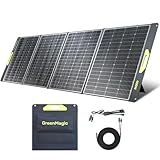
- ULTRA HIGH CONVERSION RATE: Built-in monocrystalline silicon solar cells, which are more heat & chemical resistant with excellent 95% transparency. With a 400W power output and high conversion efficiency 21.5-23.5%, besides it support Parallel /Series wires. This solar panel can provide your large capacity power station with a significant amount of energy with outstanding efficiency
- COMPATIBLE WITH 95% OF POWER STATIONS - There is a built-in cable with MC4 connector, the versatile 400W solar panel is widely compatible with most solar generators on the market, working well with power stations of Jackery, Goal-Zero, Ecoflow, Bluetti, Anker, and others
- BUILT-IN CONVENIENCE - This solar panel comes with 4 built-in adjustable kickstands , which can be set up in a few seconds, placed firmly on the ground, and can be adjusted to maximize solar power harvesting. 4 hanging loops around the edges of the solar panel to accommodate a variety of mounting configurations like off the side of a RV.
- WATERPROOF & DURABLE - With advanced laminated technology, a heat-resistant dustproof and waterproof film on the surface, and 840D Oxford cloth outer, prevent damage of the cells due to moisture and sun and make it more durable, scratch-resistant, and moisture-proof. The solar panel is IP65 waterproof (The junction box is not waterproof) which will protect it from water splashing, making it ideal for outdoor adventure. (Do not place it under the rain, or soak it in water)
- FOLDABLE & PORTABLE - This portable 400 Watts solar panel can be folded down to a quarter of its full size, folded size only 32.09*31.30*1.97in, features a robust rubber handle for easy briefcase-style carrying, weight 21.5lb, lightweight and easy to carry. When taking it camping, this foldable solar panel kit can save even more space in your vehicle! Take this solar panel anywhere you need solar power.
Bottom-line buying guidance
Look for a complete U.S.-compatible system with clearly documented certification, anti-islanding, overload protection, secure weather-rated mounting, monitoring, warranty support, and any required export controls. Official product pages such as EcoFlow STREAM Microinverter, EcoFlow STREAM Ultra, and the EcoFlow U.S. store can help identify system categories, but product availability, specifications, prices, accessories, and certifications should be checked at purchase.
Do not buy based only on a low price, a panel’s wattage, an app’s “zero export” label, or a retailer’s claim that no installation is required. Verify authorization and electrical suitability first.
Frequently Asked Questions
Can renters use balcony solar panels?
Possibly, but a renter still needs to comply with the lease, landlord or building-manager rules, fire and egress requirements, utility rules, and any HOA or condo restrictions.
Do balcony solar panels work during a power outage?
A standard grid-interactive plug-in system normally shuts down to prevent backfeeding utility lines. Backup requires a battery and approved islanding and transfer equipment.
Can I sell excess balcony solar electricity?
Do not assume so. Export credits and interconnection treatment vary by utility and jurisdiction; some programs provide lower credits or none at all.
Is UL 3700 the same as UL 1741?
No. UL 3700 is a framework specifically addressing interactive plug-in photovoltaic equipment and systems. UL 1741 applies to certain power-conversion equipment and utility interconnection requirements; the applicable certification depends on the system and utility.
Recommended Free Tools
Can I mount panels to a balcony railing?
Only if the mounting method is approved for the railing, structure, wind exposure, and building rules. Do not attach panels in a way that blocks egress or creates a falling-object hazard.
Is a battery necessary?
No for daytime grid offset, if an authorized direct-to-home system is used. A battery is needed to shift solar into evening use and is generally required for solar-based outage backup.
Quick Recap
Product prices and availability are accurate as of the date/time indicated and are subject to change. Any price and availability information displayed on Amazon at the time of purchase will apply.

