An automatic fan control system measures a condition such as temperature, humidity, pressure, or airflow and then turns a fan on, turns it off, or adjusts its speed. The correct system depends on the fan motor, voltage, control signal, installation environment, and safety requirements—not simply on the desired temperature.
A USB cabinet fan, a 24 V equipment fan, an EC inline fan, an HVAC blower, and a commercial kitchen exhaust system require different controls. Before buying or wiring anything, identify the fan type, control objective, power supply, and required fault response.
As an Amazon Associate I earn from qualifying purchases.
What an automatic fan control system does
A complete system normally includes a sensor, controller, power or speed-control stage, fan, and—where reliability matters—feedback and protection.
- Sensor: Measures temperature, humidity, pressure, airflow, or another operating condition.
- Controller: Compares the measurement with a set point or control curve.
- Driver: Switches or modulates the fan using a relay, MOSFET, PWM output, triac, 0–10 V signal, or another interface.
- Fan: Must match the controller’s voltage, current capacity, motor type, and signal standard.
- Protection and feedback: May include tachometer monitoring, stall detection, alarms, hysteresis, ramping, and full-speed fallback.
“Automatic” does not necessarily mean smart. A basic thermostat may only switch a relay above a temperature threshold. A more advanced controller can vary speed, use multiple sensors, store settings, issue alarms, follow schedules, and continue local control if an app or network is unavailable.
#1 Best Overall
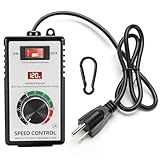
- MULTI FUNCTIONAL DESIGN: the main function of the ac 120v motor speed controller is to change the load power by reducing the main power supply. it is equipped with various protection measures, including surge protection, peak protection, and RC absorption. the variable speed controller has overload protection and overvoltage protection functions, when the instantaneous current exceeds 15A, the switch will automatically cut off the power to protect the controller
- PRODUCT PARAMETERS & MATERIALS: ac motor speed controller input voltage/frequency: 110-120V/60HZ; current capacity: max 15A (rated current 10A); resistive load: max 2000W; inductive load: max 1500W;6-foot cable; plug: American standard A-type and B-type plugs;fan speed controller adopts ABS plastic insulated flame-retardant shell, and the internal accessories are made of thickened phosphor bronze, ensuring safe and reliable quality
- CLEAR INSTRUCTIONS FOR OPERATION: rheostat variable speed control has an indicator light inside the switch, which allows you to know the working status of the switch at any time; a clear LED display screen will display the voltage value in real time; electronic speed controller has precision voltage regulating knob: low speed, medium speed, and high speed, can meet the voltage requirements of equipment in different application scenarios; a hook that allows the governor to be hung on the tool kit for easy portability
- WIDELY APPLICABLE SCENARIOS: motor speed controller 120v suitable for electric fans, exhaust fans, angle grinders, blowers, AC drills, incandescent lamps, kettles, and electric heaters. Note: it cannot be used for appliances with circuit boards and capacitor electronic components, such as microwave ovens, induction cookers, rice cookers, water pumps, washing machines, LED energy-saving lamps (products with circuit boards and capacitor electronic components inside cannot be used)
- WORRY FREE AFTER-SALES SERVICE: we are committed to providing customers with high-quality AC motor speed controllers 120v 15a, so we can proudly assure you that we provide 30-day no-questions-asked returns. If you have any quality issues or suggestions, please feel free to communicate with us at any time
Start with the application
| Application | Typical control | Important considerations |
|---|---|---|
| Computer or electronics enclosure | Temperature-triggered DC or PWM fan | Hot-spot measurement, fan failure detection, low noise |
| AV, network, or cabinet cooling | USB or low-voltage thermal controller | Fan compatibility, probe location, cabinet airflow path |
| Room or workshop ventilation | Thermostat, humidity controller, or complete fan system | Air changes, intake air, noise, condensation, duct resistance |
| Inline duct ventilation | EC or manufacturer-matched speed controller | Duct diameter, static pressure, control signal, make-up air |
| Greenhouse or climate-controlled space | Temperature, humidity, VPD, and schedule control | Condensation, sensor placement, minimum ventilation |
| HVAC fan-coil | Application-specific thermostat or building controller | Fan stages, valves, sensors, changeover, and wiring outputs |
| Commercial kitchen exhaust | Listed hood and make-up-air control | Interlocking, code compliance, combustion air, professional installation |
Identify the fan before choosing the controller
Fan compatibility is the most important selection issue. A controller that works with a four-wire computer fan is not automatically suitable for an AC exhaust fan or an EC inline fan.
USB fans
USB fans are convenient for cabinets, AV equipment, routers, and small electronics enclosures. Some thermal controllers are designed only for a manufacturer’s compatible USB fan family and may limit the number of connected fans or the total current. For example, AC Infinity Controller 1 is specified for compatible USB and cabinet fans and uses a wired thermal probe.
Two-wire DC fans
A two-wire DC fan is generally switched on and off or controlled by varying its supply voltage. A low-voltage system commonly uses a MOSFET as the switching device. The controller must tolerate startup current, and the fan may fail to start or run smoothly at a reduced voltage.
What’s actually slowing this PC down?
Pick the symptom - the matching free tool is one click away.
Never connect a motor directly to a microcontroller GPIO pin. The controller requires a separate power stage, suitable wiring, current capacity, and protection against motor transients.
Three-wire DC fans
Three-wire fans generally add a tachometer output to the two power connections. The tachometer reports rotation; it is not itself a speed-control input. The controller must provide the correct pull-up voltage, interpret the pulse signal correctly, and understand the fan’s pulses-per-revolution behavior.
Four-wire PWM fans
Four-wire computer fans typically have ground, power, tachometer, and a dedicated PWM control input. The PWM input is separate from switching the fan’s power rail. Analog Devices describes four-wire fan-control examples using frequencies in approximately the 20–50 kHz range, including a 25 kHz example, but the fan’s own specification takes precedence. See the Analog Devices fan-control overview.
Do not assume that a generic PWM output, logic level, frequency, or duty-cycle convention will suit every four-wire fan. Confirm the interface before wiring it.
Rank #2

- IMPORTANT - FOR BRUSHED AC MOTORS ONLY: This motor speed controller works by reducing voltage to slow down AC brushed motors. It is NOT compatible with brushless motors, DC motors, or appliances with electronic circuit boards (such as microwaves, rice cookers, water pumps, washing machines, or LED energy-saving lamps). Please verify your motor type before purchasing. Works with: inline duct fans, exhaust fans, ceiling fans, angle grinders, electric drills, routers, incandescent lamps, and resistance heaters.
- REAL-TIME LED VOLTAGE DISPLAY: See your exact output voltage at a glance with the built-in LED meter. The high-precision display shows real-time voltage from 0-120V as you turn the dial, so you always know the exact power being delivered to your device. No more guesswork - dial in the precise speed, brightness, or temperature you need. Works with devices of any wattage for full-range speed control.
- ELECTRONIC OVERLOAD PROTECTION - NO FUSE REPLACEMENT NEEDED: The built-in 15A circuit breaker automatically cuts power when current exceeds 15A, protecting your equipment and the controller. Unlike traditional fuse-based controllers, simply flip the reset switch to restore power - no hunting for replacement fuses. Recommended working current: within 10A for extended use.
- POWERFUL 15A / 1500W CAPACITY: Input: 110-120V AC / 60Hz. Max Current: 15A. Rated Current: 10A. Max Resistive Load: 2000W. Max Inductive Load: 1500W. Stepless variable speed control lets you precisely adjust motor speed, incandescent light brightness, or resistance heater temperature. Features a convenient ON(RESET)/OFF rocker switch and smooth-turning precision dial with 0-100% power range.
- HEAVY-DUTY CONSTRUCTION: Built with flame-retardant ABS plastic shell and thickened phosphor bronze internal contacts for reliable long-term use. Features a grounded 3-prong plug for safety, compatible with both Type A and Type B outlets. Compact size (5.5" x 2.4" x 2.25") with 3 ft power cord and portable hook design for easy mounting. Package includes: 1x AC Motor Speed Controller with LED Display.
EC fans
Electronically commutated fans may accept a dedicated PWM signal, 0–10 V input, or manufacturer-specific control interface. A computer-fan PWM controller should not be connected to an EC inline fan unless the interfaces are explicitly compatible.
AC mains fans
AC fans may require relay switching, a triac controller, capacitor-based speed control, or a manufacturer-specific input. Mains-voltage motor control requires an appropriate enclosure, grounding, overcurrent protection, listed equipment, and—where applicable—a qualified electrician. It is not a suitable beginner soldering project.
HVAC and fan-coil equipment
Fan-coil controllers may use on/off outputs, three-speed outputs, PWM, three-position actuators, or 0–10 V control. Selection depends on the application, pipe arrangement, valve and actuator requirements, sensor inputs, and available outputs. The Siemens fan-coil application documentation illustrates why an HVAC controller cannot be selected from fan speed alone.
How the control loop works
A typical automatic system follows this sequence:
Measure temperature or another condition
        ↓
Compare it with a set point or control curve
        ↓
Apply hysteresis, ramping, or proportional control
        ↓
Switch or modulate the fan
        ↓
Check temperature and, where available, fan feedback
A basic thermostat might use separate thresholds:
If temperature ≥ 30 °C:
    fan = ON

If temperature ≤ 27 °C:
    fan = OFF
The gap between the on and off values is hysteresis. Without it, a fan can repeatedly switch as the measured temperature fluctuates around one threshold.
Quick wins for a faster PC:
Clear out junk files and repair common Windows errorsFree Scan →Fix the driver behind crashes, sound loss and screen glitchesFind Drivers →Repair Windows errors before they cause bigger problemsFix Now →Variable-speed control may use a minimum speed below a lower temperature, progressively increase speed through a temperature range, and command full speed above an upper limit. The relationship is not universally linear. Fans have different minimum duty cycles, startup requirements, loads, and speed responses.
Dedicated fan-control hardware can combine temperature zones, PWM outputs, tachometer monitoring, fan-stall detection, and automatic control curves. The EMC6W201 datasheet is an example of this type of monitoring and control architecture.
On/off control versus variable speed
On/off control
On/off control is the simplest option and is often suitable when the fan is needed only above a clear temperature threshold. It is inexpensive and works with fans that cannot accept a speed-control signal, but it can be noisier and may cause short cycling if hysteresis or minimum run times are not configured.
Rank #3

- This DC12V governor can be controlled according to the ambient temperature of the fan speed, no manual control, automatic stepless speed, the higher the ambient temperature, the faster the fan speed control, saving energy and reducing noise.
- Whether it is a 2-wire, 3-wire or 4-wire fan (only connect power cable), whether PWM or brushless fans, as long as the fan voltage is within 12V, current less than 1A, the governor apply! Also can drive a of fans (total current must<1A). [3-wire/4-wire fans only need to connect the fan's power cord to the controller]
- The temperature sensor is connected with a cable in the form of mounting holes to facilitate detection of the temperature specified temperature point. Temperature probe is sealed with epoxy resin, waterproof and moisture-proof, the temperature probe maximum use temperature of 110 degrees. Sensor probe length: 300mm/11.5inch.
- Dual working mode optional, fixed starting temperature or adjustable starting temperature. Fixed mode temperature and temperature of 30°C(86°F), the governor control fan start, 30 to 50 degrees fan speed linear increase, 50°C(122°F ) above the fan at full speed. Adjustable mode start-up temperature range: 15 to 50 degrees, full speed range of 35 to 70 degrees (start and full-speed temperature difference of 20 degrees).
- Board size: 1.77x1.0x1.18inch/ 45x25x30mm (LXWXH), M3 mounting hole. ( Note that It is best to read the main picture instructions before use)
Variable-speed control
Automatic speed control can reduce noise and avoid running a fan harder than necessary when the heat load changes gradually. It requires a compatible PWM, EC, 0–10 V, or voltage-control interface. PWM is often more efficient than dissipating excess power in a linear voltage regulator for compatible DC fans, but actual system efficiency depends on the motor, controller, power supply, and operating point.
Recommended Free Tools
A fan that runs at 20% duty cycle after starting may not start reliably at 20%. A robust controller may apply a brief startup boost, enforce a minimum running speed, and ramp changes rather than making abrupt adjustments.
Choosing and placing sensors
| Sensor | Advantages | Best suited to |
|---|---|---|
| Thermistor | Low cost, fast response, simple analog interface | Basic thermostats and electronics |
| Digital temperature probe | Simple wiring and readable output | General-purpose controllers |
| Temperature/humidity sensor | Adds humidity information | Basic climate and educational projects |
| Thermal diode | Useful for processor and semiconductor monitoring | Computer and chip cooling |
| Remote probe | Measures at the relevant heat source | Cabinets, ducts, and machinery |
| Multiple sensors | Can identify separate zones and hot spots | Servers, industrial equipment, and large enclosures |
Place the sensor where the controlled condition actually occurs. A probe in the cool intake stream may not detect a hot component inside an enclosure. Keep it away from direct sunlight, motor heat, and turbulent air unless those conditions are what you intend to measure. Protect it from condensation when necessary.
Temperature alone may be insufficient in humid spaces. Moving damp air into a cooler enclosure can increase condensation, corrosion, or mold risk. A humidity-aware controller may be required for those environments.
Building a low-voltage DIY controller
A low-voltage microcontroller project is practical when the system is nonhazardous, the fan is properly matched, and the builder can design the power and fault-handling stages.
Temperature or humidity sensor → microcontroller
                                      ↓
                              control algorithm
                                      ↓
                           MOSFET or PWM driver
                                      ↓
                                  DC fan
Typical parts include an ESP32 or similar controller, a temperature or temperature/humidity sensor, a logic-level MOSFET or suitable driver, a separate fan power supply, protected wiring, and an optional tachometer input. The published ESP32/DHT22 fan-control project demonstrates the educational architecture, but a prototype is not automatically suitable for safety-critical equipment, mains voltage, or code-regulated installations.
A suitable control routine should include:
- Separate fan power rather than motor current through the GPIO.
- Correct logic-level compatibility and a planned common ground where the circuit requires it.
- Startup at full speed or another verified starting level.
- A minimum running speed that prevents stalling.
- Hysteresis, ramping, or minimum on/off times.
- Validation for disconnected or implausible sensor readings.
- Tachometer or airflow feedback when fan failure could damage equipment.
- A safe default after reboot or controller failure.
- An enclosed, strain-relieved, and appropriately fused low-voltage assembly.
For a sensor failure, the safest response depends on the application. Full-speed fallback may protect heat-sensitive equipment; an orderly shutdown may be safer for another system. The response should be deliberately designed and tested rather than left to an accidental firmware value.
Rank #4

- Fan Speed Regulator: This device is a 4 wire temperature-controlled fan speed regulator that allows for automatic or manual adjustment of fan speed based on temperature (℃) readings. It features a digital display showing both the current temperature and the fan’s rotational speed in RPM (revolutions per minute). The system helps maintain optimal cooling performance and energy efficiency by increasing fan speed as temperatures rise and reducing speed when cooling demand is lower.
- X100RPM: The RPM (rotations per minute) is displayed in units of 100 RPM, which allows it to accommodate and clearly show the speeds of high-performance fans, this makes it particularly suitable for industrial or specialized applications that utilize high-RPM fans. The maximum readable value on the display is 300 × 100 RPM = 30,000 RPM, ensuring compatibility with a wide range of fan types.
- 2 Control Modes: The device offers both manual and automatic fan speed control modes, giving users flexibility to adapt to various cooling needs and environments. This dual-mode system provides an ideal balance between user control and intelligent automation.
- Temperature Probe: To ensure accurate thermal regulation, the fan controller is equipped with a 42cm (16.54 inch) temperature probe. This probe continuously senses the surrounding temperature and sends real-time data to the controller, which is then shown on the digital display. The extended cable length provides flexibility in sensor placement, allowing users to position the probe closer to heat-sensitive components or areas where precise temperature monitoring is needed. Temperature probe parameters: NTC10KB = 3590
- Note: This controller only controls the fan speed adjustment controlled by a 4-wire PWM signal. The signal specification is 25KHZ 5V. It cannot control the speed regulation of 2-3 wire fans. The working voltage must be equal to the fan voltage.
Buying options by use case
Basic USB or cabinet cooling
A preset thermal trigger is appropriate for compatible USB fans in small cabinets and electronics enclosures. AC Infinity listed its Controller 1 at $19.99 when observed on August 18, 2026. It is a poor choice for generic mains control, custom PWM, independent zones, or incompatible fan families.
Adaptive cabinet control
For automatic speed adjustment rather than simple switching, AC Infinity listed Controller 2 at $49.99 on August 18, 2026, with temperature monitoring, six fan speeds, an alarm, display, probe, and power adapter. Compatibility remains limited by the manufacturer’s supported ecosystem.
Free tools Windows power users keep installed
One-click scans. No signup required.
Complete cabinet fan
A matched cabinet fan and controller avoids some wiring and interface questions. AC Infinity listed the AIRPLATE T3 at $69.99 on August 18, 2026, in its cabinets and closets catalog. This type of product is intended for enclosed electronics or media furniture, not duct pressure or whole-building ventilation.
Inline duct fan
A complete inline system is often more practical than adapting a generic controller to an EC motor. AC Infinity’s CLOUDLINE range included listed prices observed on August 18, 2026, of $119 for a T4, $149 for a T6, $199 for a T8, $299 for a T10, and $399 for a T12. These are dated manufacturer-page observations, not permanent prices; tax, shipping, bundles, region, and availability can change.
Multi-device climate control
For compatible devices requiring temperature, humidity, VPD, scheduling, alarms, and app access, AC Infinity listed its four-port Controller 69 Pro at $89.99 and eight-port Controller 69 Pro+ at $99 on August 18, 2026. These products are a poor fit when a reader wants a simple standalone thermostat, a building-automation protocol, or control of incompatible fans.
HVAC and commercial kitchen systems
Fan-coils, furnaces, commercial hoods, make-up-air systems, and high-current AC motors need application-specific equipment. A commercial hood controller may coordinate exhaust activation and make-up air and may be listed for that use. The Larkin AFC is an example of a commercial kitchen category that should not be substituted with a hobby thermostat or relay board.
Installation and commissioning checklist
- Verify the fan’s voltage, full-load current, startup behavior, motor type, and control interface.
- Confirm that the controller’s output, connector, frequency, signal level, and current rating match the fan.
- Test the fan independently at its rated supply before connecting automatic control.
- Install the sensor at the relevant heat or air-measurement location.
- Set separate on and off thresholds, or configure minimum speed and ramping.
- Verify airflow direction, duct size, intake clearance, exhaust clearance, and make-up air.
- Test low-temperature operation and confirm the fan does not stall at minimum speed.
- Test the high-temperature response and confirm full-speed or alarm behavior.
- Disconnect or simulate a failed sensor and verify the documented fault response.
- Test tachometer, stall, and alarm functions where provided.
- Check for abnormal noise, vibration, heating at terminals, and repeated short cycling.
Troubleshooting
The fan does not start
Test it directly with its rated supply. Then check startup current, minimum duty cycle, controller compatibility, wiring polarity, PWM signal requirements, and the temperature reading. Some fans need a brief full-speed startup before they can run slowly.
Best Value
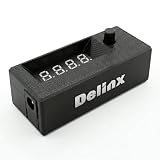
- Complete DIY Kit:Works with any PD USB-C charger,comes with 3.2ft USB-C PD to 12V adapter cable with 3A on/off switch, 3.2ft temperature probe, and 3M adhesive for easy installation. Includes a 5 Channel Fan Hub for controlling up to 5 fans simultaneously
- Wide Compatibility & Safe Protection:DC 5V-30V wide voltage, max 5A output, supports 5V/12V/24V 4-pin PWM fans. Built-in over-voltage, over-current and reverse polarity protection for safe and stable long-term use.Offers power-off memory for all settings.
- Dual Display & Precise Control:Features a digital display that can switch between real-time temperature (range: -13°F ~ 248°F) and fan speed (up to 50,000 RPM). The adjustable start (L) and full-speed (H) temperatures, along with a 0 ~ 27°F hysteresis, provide precise thermal management.
- Dual Control Modes:Supports both automatic temperature-based speed control and manual speed adjustment. When the temperature probe is disconnected, the module automatically switches to manual mode for direct control of the PWM duty cycle.
- Versatile Applications: Ideal for PC cooling, NAS, server cabinet, AV Cabinet,audio amplifier, 3D printe servers, machine rooms, greenhouses, aquariums, and other scenarios requiring efficient thermal regulation. Its compact size (76.5mm24.5mm22mm) allows for easy integration into various projects.
The fan runs continuously
Check whether the controller is in manual mode, the threshold is below ambient temperature, the probe is disconnected or shorted, or a safety override is forcing full speed. A normally closed relay connection can also produce the opposite of the intended logic.
The fan repeatedly cycles
Increase the difference between the on and off thresholds, add minimum on/off times, move the sensor out of turbulent air, or use staged or proportional speed control. A moving average can reduce noise in the measurement, but it also delays response.
The temperature rises despite full speed
This may be a capacity problem rather than a control problem. Check blocked filters, incorrect airflow direction, restrictive ducting, insufficient intake air, poor sensor placement, and heat generation greater than the fan can remove.
The Tool Desk
Outbyte Driver Updater FREEScan for outdated or missing drivers - takes under a minuteDriver Scan →Outbyte PC Repair FREERepair Windows errors before they cause bigger problemsFix Now →The tachometer reports zero
Confirm that the fan actually has a tachometer output, that the signal has the correct pull-up voltage, that the controller expects the correct pulse count, and that the correct channel is being monitored. A physically rotating fan can still have a damaged or incorrectly wired tachometer output.
The fan is too noisy
Check whether the controller is using an incompatible PWM frequency, whether the fan is operating near a resonance, and whether ducting or mounting is transmitting vibration. Ramping and a higher minimum speed can sometimes be quieter than unstable low-speed operation.
Safety and code boundaries
A low-voltage cabinet fan and a commercial exhaust system should not be treated as the same project. Do not use a hobby relay board for furnace blowers, kitchen hood exhaust, make-up-air systems, high-current AC motors, fire- or life-safety ventilation, or equipment governed by electrical, mechanical, or building codes.
Mains and HVAC work may require listed equipment, grounding, overcurrent protection, enclosure requirements, interlocks, commissioning, and qualified installation. Commercial kitchen systems may need exhaust and make-up-air coordination rather than a simple temperature trigger. Select equipment for the actual application and follow the manufacturer’s installation instructions and local requirements.
Do these 3 things before closing this tab:
1Fix the driver behind crashes, sound loss and screen glitches2Clear out junk files and repair common Windows errors3Scan for outdated or missing drivers - takes under a minuteQuick Recap
Final selection matrix
| Choose this | When it makes sense | Avoid it when |
|---|---|---|
| Thermostat and relay | Only simple on/off operation is needed | Short cycling, quiet operation, or fan feedback matters |
| Preset thermal trigger | Compatible USB or cabinet fan | The fan uses another voltage or control ecosystem |
| Intelligent thermal controller | Adaptive speed, alarms, and display are useful | Generic HVAC or industrial outputs are required |
| PWM or EC controller | The fan’s control signal is explicitly compatible | The fan standard, frequency, or logic level is unknown |
| Microcontroller system | Low voltage and custom logging or control are needed | A failure could create a hazardous condition |
| HVAC controller | Fan-coil, furnace, or building-control equipment is involved | The project is only a USB or cabinet fan |
| Listed commercial exhaust controller | Kitchen hood, make-up air, interlocking, and code compliance apply | The requirement is ordinary room or electronics cooling |
Product prices and availability are accurate as of the date/time indicated and are subject to change. Any price and availability information displayed on Amazon at the time of purchase will apply.

