Windows Errors? Fix Them Before They Spread
Repair common Windows errors and clear accumulated junk for a smoother, more stable PC - no reinstall needed.Free scan · no reinstallOutdated Drivers Are Slowing You Down
One free scan finds every outdated or missing driver and matches the right update for your exact hardware.Free scan · exact hardware matchArdumower Sunray is an experimental, open-source robotic-mower firmware and navigation stack that uses RTK-GNSS positioning to guide a compatible DIY mower without a buried perimeter wire. It is not a complete plug-and-play mower, nor will it run on an arbitrary Arduino Uno, Nano, or Mega. A practical build requires the Ardumower mechanical platform, compatible motor-control electronics, a supported 32-bit controller, RTK correction infrastructure, calibration, mapping, and substantial testing.
What Ardumower Sunray actually is
Ardumower is an open-source robotic lawn-mower reference platform covering hardware, software, PCB designs, CAD and documentation. It is intended for people who want to assemble, modify and repair a mower—not shoppers looking for a finished consumer appliance.
As an Amazon Associate I earn from qualifying purchases.
Sunray is an alternative firmware and navigation stack for compatible mower hardware. It combines motor and mowing control with GNSS positioning, RTK corrections, heading and course estimation, inertial sensing, path finding, mapping and app-based configuration. The project also documents integration paths for platforms such as Alfred, SMARTMOW-DIY/owlRobotPlatform, Linux systems and ROS, but features and hardware compatibility vary by platform.
The phrase “Arduino-compatible” therefore needs qualification. Sunray supports the Arduino Due and Adafruit Grand Central M4 through the Arduino toolchain. It is not a generic sketch for every Arduino board.
#1 Best Overall
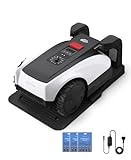
- RTK Precision Navigation for Wire-Free, Accurate Mowing. Powered by advanced RTK technology, this robotic lawn mower delivers centimeter-level positioning accuracy without the need for perimeter wires. It follows efficient, systematic mowing paths instead of random movement, ensuring full lawn coverage, cleaner lines, and a consistently even cut.
- CARE Version Upgrade – Extra Blades for Long-Term Performance. The O1000 RTK CARE bundle includes 36 additional replacement blades, significantly extending maintenance cycles and keeping cutting performance sharp over time. Ideal for homeowners looking for lower long-term cost, fewer interruptions, and consistently clean results.
- RTK Extension Cable Included – Stronger Signal, Flexible Setup. Comes with an RTK extension cable that allows optimal antenna placement for improved satellite signal reception. This ensures more stable positioning, better boundary accuracy, and reliable performance, even in complex yard environments with trees or obstacles.
- Smart Auto Mapping & Multi-Zone Lawn Management. Automatically scans and maps your yard, enabling precise multi-zone management through the app. Customize mowing schedules, define different cutting areas, and optimize efficiency for front yard, backyard, and side zones with ease.
- Fully Automated Lawn Care – Set It and Forget It. From intelligent path planning to automatic recharging, the mower handles everything on its own. Enjoy a hands-free lawn care experience, saving time and effort while maintaining a perfectly trimmed lawn every day.
Why RTK can replace a perimeter wire
A conventional robotic mower normally detects a buried boundary wire. Sunray is designed to use geographic coordinates instead, allowing the operator to map a virtual working area and guide the mower by position.
The basic RTK system has four parts:
- A GNSS rover receiver mounted on the mower.
- A fixed base receiver or network correction service.
- A radio, Wi-Fi, cellular or internet link carrying correction data.
- Sunray software using the corrected position alongside heading and other sensors.
Ordinary standalone GNSS is generally too imprecise for dependable lawn boundaries. RTK compares satellite observations from the rover and base, potentially producing centimeter-level positioning when corrections, antenna placement, satellite visibility and signal conditions are good. The u-blox ZED-F9P-based simpleRTK2B, identified by the project as suitable RTK hardware, can output up to 10 RTK positions per second. That is a receiver capability, not a guarantee that a mower will remain centimeter-accurate everywhere.
Fixed, Float and correction delivery
- RTK Fixed: the high-precision solution has been established.
- RTK Float: corrections are being used, but the receiver has not achieved its best resolved position.
- NTRIP: correction data delivered through the internet from a network service.
- Local radio: corrections transmitted directly from a base station near the property.
A mower should not be mapped or trusted for autonomous cutting until the correction link and a stable RTK Fixed solution have been confirmed. If the correction stream disappears, the receiver may fall back to a less precise state or lose usable positioning.
Quick wins for a faster PC:
Clear out junk files and repair common Windows errorsFree Scan →Fix the driver behind crashes, sound loss and screen glitchesFind Drivers →Repair Windows errors before they cause bigger problemsFix Now →Hardware required for the classic Ardumower build
| Component | Purpose | Status |
|---|---|---|
| Ardumower chassis | Mechanical platform | Required for the classic build |
| Drive and mowing motors | Movement and cutting | Required |
| Ardumower PCB 1.3 or 1.4 | Motor-control and I/O interface | Required for the documented platform |
| Arduino Due or Adafruit Grand Central M4 | Main Sunray controller | Required |
| ZED-F9P-class RTK rover | Precision positioning | Required for RTK navigation |
| GNSS antenna | Satellite reception | Required |
| Base station or NTRIP access | Correction data | Required for RTK operation |
| BLE UART module | Phone-to-mower communication | Listed requirement |
| IMU, Wi-Fi, sonar and other sensors | Orientation, communications and platform functions | Optional or configuration-dependent |
The antenna must be mounted securely with a clear view of the sky, and its position relative to the mower’s wheelbase and rotation center must be measured correctly. A mechanically displaced antenna or incorrect offset can create a consistent map error even when the RTK receiver reports a Fixed solution.
Sunray’s configuration documentation identifies the Ardumower RTK system as u-blox F9P hardware and uses DRV_ARDUMOWER 1 for the Ardumower driver. The example configuration lists 115200 baud as the default for the console, BLE, GPS, Wi-Fi and robot interfaces; these are configuration defaults rather than immutable requirements. See the project’s configuration example for the exact options.
Rank #2

- Centimeter-Level RTK Cloud Accuracy: Commercial-grade RTK Cloud technology delivers centimeter-level positioning for this robotic lawn mower with no local antenna installation and no additional cloud costs.
- Auto Mapping for More Complete Coverage: Vision AI helps the robot lawn mower understand lawn shapes and boundary types, then automatically maps your yard for smooth paths, closer edge-following, and fuller coverage from day one.
- AI Obstacle Avoidance with Neural Processing: Vision AI recognizes and understands common yard objects, using a trained neural network and up to 10 trillion operations per second to help mowing stay smooth, safe, and uninterrupted.
- Infinite Zone Mowing & App Remote Control: Create unlimited mowing zones, set custom paths, define no-go areas, edit your map, and monitor your remote control lawn mower from the app anytime.
- Reliable Navigation Even in Shade: RTK Cloud provides centimeter-level accuracy in open areas, while V-SLAM sensor fusion with Vision AI helps maintain precise navigation in shaded or partially covered lawn spaces.
Building and flashing Sunray
1. Assemble the compatible hardware
Prepare the chassis, drive system, mowing assembly, PCB, controller, battery, charging arrangement, communications hardware and RTK antenna. Establish either a local base station or an NTRIP correction path before attempting autonomous navigation.
2. Use a tagged release
Do not treat the repository’s master branch as a stable firmware download. The project warns that it may be unstable. Select a tagged version from the Sunray Releases page. One documented tagged release is Sunray Firmware v1.0.318, marked experimental and containing path-finder, obstacle-avoidance, controller-support, docking and RTK course-estimation changes. Release tags and status can change, so the exact version should be recorded for each build.
Recommended Free Tools
3. Configure the board
Copy or rename config_example.h to config.h, select the correct board target, enable the hardware actually installed and compile using the documented Arduino workflow.
The supported targets include:
BOARD "Arduino Due"
BOARD "Adafruit Grand Central M4"
The Grand Central M4 may require I2C SDA/SCL pull-up resistors. The project also documents a possible reset-circuit adjustment for some Due-clone configurations. If Grand Central compilation fails, the configuration notes identify Adafruit SAMD Boards version 1.7.5 as a possible compatibility workaround; treat that as project-specific rather than a universal current requirement.
4. Select the correct Due USB path
For an Arduino Due, the native USB and programming USB ports are separate. The configuration notes distinguish:
Rank #3

- RTK+Vision, Fit into Every Garden: Lawn covered by trees? Narrow corridor? However complicated your garden layout is, enhanced EFLS 2.0 got you covered. Customized RTK technology with Vision enhancement provides stable centimetre-level positioning to handle an incredibly diverse range of lawn layouts. Even when it’s under the trees or in a narrow corridor, Navimow still works perfectly with accurate navigation.
- No Perimeter Wires & Automatic AI-assisted Mapping: Quick, wire-free setup in just a few taps, simply use your smartphone to guide Navimow and map out virtual boundaries around your lawn. Furthermore, with the revolutionary AI-powered Assist Mapping feature, Navimow identifies the clear edges of your lawn during mapping and automatically navigates and maps the entire working area, making setup easier than ever.
- Efficient Flawless Lawn Maintenance: Navimow mows your lawn with planned mowing patterns to ensure systematic and efficient grass cutting, changes mowing direction after 100% coverage to minimize tracks on the lawn, intelligently recharges, and keeps mowing until the job is done, so your lawn always looks fresh.
- Identifies 150+ Types of Obstacles: Compared to ultrasonic sensors or bumper, Navimow’s 140° field-of-view camera with built-in Al algorithms can detect 150+ types of common objects in the garden to ensure stronger obstacle avoidance capabilities and a higher level of safety.
- Smart App Control & Multi-Zone Management: With the Navimow App, you can edit the mowing map, set different schedules and mowing directions for up to 12 zones, remotely control your lawn mower, keep track of the mowing progress, and locate your mower in case of theft (optional with Access+). You can also easily download over-the-air (OTA) updates to access the latest features and improvements.
- Arduino Due native: select the Due native board option and native port.
- Arduino Due programming: select the programming option and programming port.
A wrong board, wrong port, missing board package, occupied serial port or unstable source branch can make a healthy controller appear unusable.
5. Commission the mower slowly
- Verify power, motor direction, emergency stop and blade control.
- Confirm satellite reception and correction delivery.
- Wait for RTK Fixed before mapping.
- Calibrate or verify the IMU, heading, wheel or motor direction, antenna offset and mower dimensions.
- Map or define the working area.
- Test manual movement at low speed.
- Test boundary behavior, RTK loss, communication loss, docking, obstacle response and recovery before allowing autonomous mowing.
Yard conditions matter more than the headline accuracy
The Ardumower Sunray documentation says the mower should have a good, open view of the sky at all locations where RTK-GPS is used. Trees, buildings, walls, fences and wet foliage can block satellites or reflect signals. A mower that works in the middle of an open lawn may lose its Fixed solution beside a wall or under a dense tree canopy.
Test the most difficult parts of the property, not only the best-looking test area. Virtual boundaries also do not make hazards safe by themselves. Ponds, roads, drops, children, pets and steep slopes require physical exclusion, supervised commissioning and an emergency-stop strategy.
Common failure modes
RTK never reaches Fixed
Check the correction source, NTRIP credentials and mountpoint, base-rover compatibility, antenna placement, satellite visibility, radio range, cellular coverage, serial wiring, power and baud rate. Diagnose the receiver independently first; only after the correction stream is proven should you investigate Sunray’s mower-navigation layer.
The mower is consistently in the wrong place
A repeatable offset usually points to a measured or configured geometry problem: antenna-to-wheelbase offset, mower dimensions, map origin, coordinate reference or heading alignment. This differs from random position noise and may be corrected without changing the RTK receiver.
Rank #4

- No Boundary Wire, Ready in Just 5 Minutes - Skip the hassle of digging and installing perimeter wires. GOAT O1000 RTK automatically maps your lawn with LiDAR-Enhanced RTK navigation, allowing quick setup in about 5 minutes and delivering accurate mowing for lawns up to 1/4 acre (10,890 sq.ft.)
- Precise RTK Navigation for Complete Lawn Coverage - Powered by RTK + Vision + 3D ToF technology, GOAT O1000 RTK maintains centimeter-level positioning to mow efficiently with fewer missed areas. Intelligent route planning delivers neat mowing patterns while maintaining reliable performance around trees and complex landscapes.
- Smart Obstacle Avoidance Protects Your Yard - Featuring AIVI 3D Obstacle Avoidance, GOAT intelligently detects lawn furniture, toys, trees, pets and other common yard obstacles. It safely navigates narrow passages as small as 2.3 ft and climbs slopes up to 45% (24°) for uninterrupted mowing.
- Fully Customizable Lawn Care from the ECOVACS App - Control every aspect of mowing directly from your smartphone. Create multiple mowing zones, set no-go areas, adjust cutting height and schedules, monitor mowing progress in real time, and enjoy hands-free lawn maintenance all season long.
- Take Back Your Weekends with Fully Automated Mowing - No more pushing heavy mowers or spending hours maintaining your lawn. GOAT O1000 RTK automatically follows customized mowing schedules, keeping your grass consistently healthy and neatly trimmed while you relax or spend time with family.
The position jumps near structures
RTK does not eliminate multipath or satellite blockage. The receiver can move from Fixed to Float or lose corrections. Do not rely on a map created during degraded reception.
The mower drives curved lines
Heading is difficult to estimate when the mower is stationary or moving slowly. The release notes describe more robust RTK course estimation and line-tracking improvements, but calibration and operating conditions still matter. IMU rotation during a two-point course measurement can also affect whether a point is accepted.
Docking fails
Docking depends on physical alignment, reliable charging contacts, approach behavior and recovery logic—not global coordinates alone. The release notes mention dock-touch recovery improvements, but they do not guarantee reliable docking in every installation.
Independent reader supportYour contribution helps us test, update, and keep practical guides available for everyone.Runtime and total project cost
The Ardumower wiki gives approximate average runtimes of about three hours with a 125 Wh battery and six hours with a 250 Wh battery. These are project-published averages, not independent test results. Grass height, slope, cutting width, speed, motor load, temperature, battery age, docking trips and navigation interruptions can change the result substantially.
The RTK receiver is only one part of the budget. A realistic cost stack includes:
Best Value

- Dual AI Vision System with NRTK Technology:The M5 robotic lawn mower, featuring Adaptive Cruise Control (ACC) and RTK positioning system, delivers centimeter‑level precision through its integrated dual‑camera vision system. M5 easily adapts to diverse lawn layouts and maintains reliable performance even in challenging environments
- Package Contents: This set includes 1 ANTHBOT M5 robotic lawn mower, 1 charging base station, 1 blade set (5 blades in total), and 1 RTK reference station.Your items will be shipped in multiple separate packages
- Efficient Mowing Performance: Handles slopes up to 45% gradient, M5 is suitable for over 99% of residential yards. Features adjustable cutting height (1.2-2.7in) and 5 Free-Rotating Blades design to create a carpet-like lawn. Intelligent path planning allows selection of multiple mowing paths via the app
- Multi-Zone Management & App Control: Easily manage up to 20 work zones via the app. Create seamless paths between different areas and set customizable no-go zones for a tailored lawn care experience. Its self-charging feature ensures it returns to recharge and resumes work automatically, while the ANTHBOT app allows you to monitor your yard anytime, anywhere.
- Beginner-Friendly Design: The ANTHBOT M5 robot lawn mowers is ideal for small to medium-sized yards, max mowing size 0.15 Acre. Powered by advanced AI vision technology, M5 creates a virtual map all by itself in the ANTHBOT app in only 10 minutes-no need to manually drive it around the property anymore, making setup a breeze
- Chassis, drive motors and mowing motors.
- PCB, controller, wiring, enclosure and replacement parts.
- Rover receiver and antenna.
- Base receiver and antenna, or NTRIP and cellular service.
- Radio, BLE, Wi-Fi or other communications hardware.
- Battery, charger and dock.
- Tools, fabrication time and debugging time.
ArduSimple’s product pages showed, during the August 2026 research window, a simpleRTK2B Budget board at about USD $215, a basic starter-kit presentation at about USD $263.75, a long-range base-and-rover kit at USD $740, and a 4G/LTE NTRIP kit at €420. Prices, currencies, shipping, taxes, stock and regional radio legality vary; these figures should not be mistaken for a complete mower cost. See the official starter-kit listings and store before buying.
Who should—and should not—build one?
Sunray is a strong fit for an experienced maker who wants open schematics, repairable components, modifiable navigation software and a wire-free boundary system. It is especially attractive when the lawn has broad sky visibility and the builder is comfortable with electronics, firmware, RTK configuration, calibration and supervised testing.
It is a poor fit for anyone expecting instant setup, factory-validated safety, universal yard coverage or a simple Arduino Uno project. The project labels Sunray experimental, and open-source availability does not imply the reliability, support or safety validation of a commercial mower.
What’s actually slowing this PC down?
Pick the symptom - the matching free tool is one click away.
Alternatives
A commercial RTK mower is the better choice when integrated hardware, warranty support, polished docking and minimal assembly matter more than source-code access and customization.
OpenMower is another open-source RTK approach focused on adapting selected commercial mower hardware with a Raspberry Pi-based system. It is not a drop-in Sunray replacement: compatibility depends on the donor mower and the relevant project hardware and software.
Sunray’s own repository documents alternative Linux-based and hardware paths, including Alfred and SMARTMOW-DIY/owlRobotPlatform. Those options may suit builders wanting a more powerful computer or a different conversion architecture, but they should be evaluated separately from the classic Ardumower Due or Grand Central build.
Verdict
Ardumower Sunray delivers the interesting part of an open-source RTK mower: the ability to replace a buried perimeter wire with mapped, correction-assisted positioning. But the real product is a complete engineering project, not a single Arduino board or firmware download. For capable DIY robotics builders with a suitable yard, it offers unusual flexibility and educational value. For homeowners seeking dependable mowing with little maintenance, a commercial system remains the safer and simpler choice.
Free tools Windows power users keep installed
One-click scans. No signup required.
Quick Recap
Product prices and availability are accurate as of the date/time indicated and are subject to change. Any price and availability information displayed on Amazon at the time of purchase will apply.

