Crashes, No Sound, or Screen Glitches?
Random freezes, missing sound and display glitches usually trace back to one bad driver. Find and replace yours safely.Free scan · under a minutePC Slower Than It Used to Be?
A free scan shows the junk files, broken settings and background clutter dragging Windows down - then fixes them in one click.Free scan · Windows 10 & 11American basswood (Tilia americana L.), also called American linden, is native to eastern and central North America. It grows best on deep, moist, fertile, well-drained soils, especially loams, in protected, mesic settings. Coarse soils and exposed rocky ridges are documented exceptions, not the general preference.
How to recognize American basswood
American basswood is a large deciduous hardwood. The USDA Forest Service’s FEIS species review reports mature heights of 75–130 feet (23–40 m) and trunk diameters of 36–48 inches (91–122 cm); these are reported ranges, not dimensions every tree will reach. Mature bark becomes thick and furrowed into narrow, flat-topped ridges with horizontal cracks, while young trees have thinner, smoother bark. The wood is soft and light, and the tree is valued as a honey tree; wildlife eat its seeds and twigs. [USDA Forest Service FEIS review]

American basswood is the botanical species name; American linden is a common landscape name. The USDA Forest Service’s 1990 Silvics chapter also lists “honey-tree” as a common name. [USDA Forest Service Silvics chapter]
Where American basswood grows
Its native range reaches from southwestern New Brunswick and New England west across Quebec and Ontario to southeastern Manitoba. From there it extends south through parts of the northern Great Plains and central states to northeastern Oklahoma, northern Arkansas, Tennessee, western North Carolina, and New Jersey. Boundary descriptions vary slightly among sources. [USDA Forest Service Silvics chapter]
Recommended Free Tools
#1 Best Overall

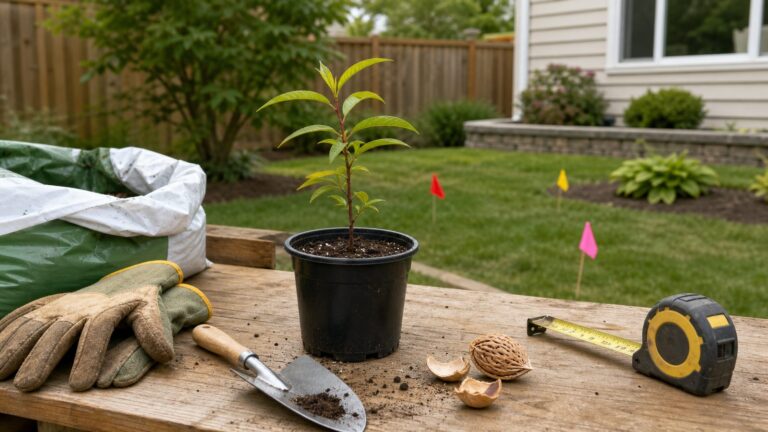
- ✅ Tilia Americana tree, 2 year old (American basswood) about 18-25 inches tall plant, give or take. Plant will be sent soil less with roots wrapped in wet media during it's dormancy. After it break it's dormancy May to September - it will be sent out planted in container with soil. USDA hardiness zones: 3-8.
- ✅ American basswood is a stately, wide-spreading tree, 60-80 ft. tall, occasionally growing taller. Conical in its younger form, the crown becomes rounded with age.
- ✅ Your item will arrive in good condition; if any issues occur with the item while it is on the way to you, contact us the very same day with describing the issue and attach pictures of the issue so we can see it.
The range has a continental climate, with cold winters, warm summers, and humid to subhumid moisture conditions. The Forest Service’s 1990 account reports mean annual precipitation of about 530 mm (21 inches) at the western range limit and 1,140 mm (45 inches) in the northeast. It associates maximum development with average July temperatures of 18–27°C (65–80°F), growing-season precipitation of 250–380 mm (10–15 inches), and frost-free periods across the range of 80–180 days. These describe broad ecological conditions, not a planting prescription for every location. [USDA Forest Service Silvics chapter]
What soil and site conditions suit it best?
Deep, moist, fertile soil
The broad site preference is for deep, moist, fertile, well-drained soil. Basswood-dominated stands are commonly reported on sandy loams, loams, and silt loams, with stronger development on finer-textured soils. The USDA NRCS guide describes rich, mesic sites and commonly deep, well-drained soils. [USDA Forest Service Silvics chapter] [USDA NRCS plant guide]
Rank #2
Moisture, slope, and shelter
Mesic conditions are the general optimum. Basswood often grows on moist north- and east-facing slopes, in coves, ravines, protected valleys, and on lower slopes. Near the western edge of its range, it is often localized around lakes and major drainages. Local patterns can differ: the FEIS review notes that in Wisconsin the species is important on both wet-mesic and dry-mesic sites. [USDA Forest Service Silvics chapter] [USDA Forest Service FEIS review]
Soil reaction and nutrients
The Forest Service reports basswood on soils with pH values from 4.5 to 7.5, more often toward less acidic to slightly basic conditions, and notes an association with calcareous soils. The FEIS review describes the species as nitrogen-demanding and reports poor growth on nitrogen-deficient sites. These broad ecological observations do not by themselves establish that a particular planting site needs soil amendments. [USDA Forest Service Silvics chapter] [USDA Forest Service FEIS review]
Quick wins for a faster PC:
Clear out junk files and repair common Windows errorsFree Scan →Scan for outdated or missing drivers - takes under a minuteDriver Scan →Repair Windows errors before they cause bigger problemsFix Now →Rank #3

- 🌳 NATIVE HARDWOOD SHADE TREE American Beech is a classic North American hardwood known for its smooth gray bark and dense canopy, perfect for creating long-term shade and natural beauty.
- 📦 3 LIVE TREES – READY TO PLANT Includes three healthy American beech saplings with strong root systems, carefully packaged to arrive fresh and ready for planting success.
- 🌎 IDEAL FOR LANDSCAPING & CONSERVATION Great for yards, woodlots, and habitat restoration. Supports wildlife with nuts (beechnuts) and provides excellent forest diversity.
- 🌱 STRONG, LONG-LIVING GROWTH Beech trees are slow to moderate growers that develop into large, majestic trees that can thrive for generations.
- ☀️ ADAPTABLE & HARDY Performs best in well-drained soils with partial to full sun. Suitable for USDA Zones 3–9 and tolerant of a range of conditions once established.
What sites can it tolerate?
American basswood is not limited to ideal loams. It has been documented on coarse soils, including dunes near Lake Michigan, and on dry, exposed rocky ridges in parts of Ontario and Quebec. The FEIS review also describes moderate flood tolerance and occurrence on some floodplain sites. Such records show that the tree can persist under particular local conditions; they do not change its usual preference for fertile, moist sites. [USDA Forest Service Silvics chapter] [USDA Forest Service FEIS review]
Independent reader supportYour contribution helps us test, update, and keep practical guides available for everyone.How it grows in forests and responds to shade
Basswood usually grows among other hardwoods and only rarely forms pure stands. Sugar maple–basswood is a recognized forest type, particularly in parts of Minnesota and Wisconsin. The species is moderately shade tolerant, but its response changes with life stage: some shade can help seedlings establish and survive, while heavy shade limits subsequent growth and development. It is therefore more accurate to describe it as able to establish under some shade than simply as “shade-loving.” [USDA Forest Service Silvics chapter] [USDA Forest Service FEIS review]
Rank #4

- Woodland Scenics - Premium Basswood (4" - 1 pkg.) - Ready Made Tree - TR1618
Planting context
American basswood is also planted as a shade tree in eastern urban settings. For a planting, match the site to the general preference—deep, fertile, moist but well-drained soil—and consider local conditions such as drainage, exposure, and available space for a large mature tree. A regional guide can add useful context, but regional recommendations should not be treated as range-wide rules. [USDA NRCS plant guide] [Iowa State University Extension]
Quick Recap
Product prices and availability are accurate as of the date/time indicated and are subject to change. Any price and availability information displayed on Amazon at the time of purchase will apply.
What’s actually slowing this PC down?
Pick the symptom - the matching free tool is one click away.