Some links on this page are affiliate links: if you buy through them we may earn a commission, at no extra cost to you.
Amazon owns both Blink and Ring because they target different parts of the video-security market. Blink is the value-oriented option, emphasizing lower prices, simple setup, and long battery life. Ring is the broader, more feature-rich home-security platform, with more doorbells, cameras, alarms, accessories, and advanced services.
Amazon has kept the brands separate rather than merging them. That gives shoppers different price points and product philosophies without forcing one brand to serve every type of household.
As an Amazon Associate I earn from qualifying purchases.
Does Amazon own both Blink and Ring?
Yes. Amazon completed its acquisition of Ring on April 12, 2018. In its acquisition announcement, Amazon said Ring, Blink, and Amazon Cloud Cam would continue under their respective brands. Amazon’s 2018 announcement described the brands as separate solutions within its home-security business.
Amazon’s 2018 annual report recorded approximately $839 million in cash consideration, net of cash acquired, for the Ring acquisition. That confirms the corporate relationship, but ownership does not mean that Ring and Blink are the same consumer platform.
Popular on Amazon

- AI-Powered Smart Detection: Advanced AI technology accurately identifies people while filtering out vehicles and animals, so you only get the alerts that matter most
- Secure Cloud Storage: Protect your recordings with AES-128 encrypted cloud storage
- Pre-Capture Recording: Cloud subscribers benefit from pre-capture functionality, ensuring the camera starts recording right at the moment motion begins - never miss a thing
- Reliable 2.4GHz Wi-Fi Connection: Optimized for 2.4GHz networks to deliver stable, uninterrupted performance. (Not compatible with 5GHz Wi-Fi.)
- Exceptional Night Vision: Equipped with four powerful infrared LEDs and an advanced image sensor, providing sharp, detailed footage even in total darkness
Why did Amazon not merge them?
Amazon has not publicly disclosed a detailed internal explanation of its brand strategy. The most defensible interpretation is that keeping the brands separate lets Amazon cover different customer segments while preserving each brand’s identity.
- Different price positions: Blink can compete for buyers who want an inexpensive camera or doorbell, while Ring can support higher-priced hardware and services.
- Different product philosophies: Blink focuses on simplicity, battery operation, and low ownership costs. Ring is built around a wider security system and more advanced video and AI features.
- Existing brand recognition: Ring was already strongly associated with video doorbells and neighborhood security before Amazon acquired it. Merging it with Blink could weaken that positioning.
- Less disruption for customers: Separate brands allow existing users to retain their established apps, devices, accounts, and support arrangements.
- Broader market coverage: Amazon can offer several combinations of price, resolution, installation type, battery life, and subscription features instead of relying on one product family.
These are strategic inferences, not publicly quantified Amazon financial objectives. There is no reliable public evidence showing exactly how Amazon allocates sales or profit between the two brands.
Blink versus Ring: the practical difference
| Category | Blink | Ring |
|---|---|---|
| Core position | Affordable, straightforward monitoring | Broader and more feature-rich home security |
| Typical buyer | Someone prioritizing price, simplicity, or battery life | Someone planning a larger or more advanced security setup |
| Video range | HD models and newer 2K products | HD, 2K, and newer 4K options |
| Battery emphasis | A major selling point; Amazon advertises up to two years in stated conditions with a Sync Module | Battery models are available, alongside wired, solar, and higher-performance choices |
| Storage | Cloud plans plus local-storage options in compatible configurations | Cloud-based history and advanced features commonly linked to Ring plans |
| Broader ecosystem | Blink cameras, doorbells, and Sync Modules | Doorbells, cameras, alarms, sensors, lighting, accessories, and services |
| App | Blink app | Ring app |
| Alexa | Works with Alexa-compatible devices | Works with Alexa-compatible devices |
Every row depends on the exact model, plan, and country. Comparing a new Blink doorbell with an older Ring model can produce a misleading result: generational differences may matter more than the logo.
What Blink offers
Blink is designed for buyers who want basic monitoring without paying for the largest possible security platform. Its products generally emphasize wireless installation, replaceable batteries, simple controls, and lower upfront costs.
The first Blink Video Doorbell launched in 2021 at $49.99, with 1080p video, two-way audio, Alexa compatibility, and wired or wire-free installation. Amazon also described optional local recording through a compatible Sync Module and USB flash drive. That launch price is historical, not a guarantee of today’s checkout price.
Amazon’s 2025 buying guide listed the second-generation Blink Video Doorbell at $59.99 and advertised up to two years of battery life with a Sync Module under stated conditions. Battery life varies with motion activity, settings, temperature, Wi-Fi conditions, and installation environment.
Free tools Windows power users keep installed
One-click scans. No signup required.
In May 2026, Blink introduced its first 2K doorbells. The Wired Doorbell 2K+ launched in the United States at $49.99. The Battery Doorbell 2K+ added a head-to-toe view and improved dynamic range; some smart video-description features were tied to a subscription and described as U.S.-only at launch. See Amazon’s Blink 2K announcement for model-specific details.
What Ring offers
Ring is the better fit for shoppers who want to build beyond one doorbell. Its range includes doorbells, indoor and outdoor cameras, alarms, sensors, lighting, solar accessories, and other security products. The brand also has more high-end video and software options.
In March 2026, Ring announced 2K doorbells starting at $79.99 and a 4K battery-powered model announced at $99.99. Ring AI Pro was described as adding video descriptions, keyword-based video search, extended live view, and up to 180 days of video history. Availability depends on the device, plan, and region. See Amazon’s Ring announcement for the stated features and pricing.
Ring also publishes model-specific minimum security-update commitments. Its current support table includes some models with commitments extending into 2030 and 2031, but those dates do not guarantee that every feature will remain available for the entire period. Check the Ring support table for the exact model.
Recommended Free Tools
Also popular on Amazon
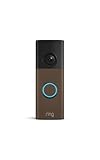
- Capture it all with Retinal 2K video — From wide views to tighter focus, it’s easy to see your home or business in crisp clarity with Retinal 2K.
- Zoom in up to 6x — Catch details at a distance, inspect faces, and more with up to 6x Enhanced Zoom.
- Connect to who’s there — See, hear, and speak in real time with Live View and Two-Way Talk.
- Get real-time alerts — Receive real-time notifications on your phone when motion is detected.
- Easily recharge — Simply insert the included removal tool to detach your doorbell from the wall, then recharge the built-in battery via USB-C. (Cable not included.)
Are Ring and Blink products compatible?
Treat them as separate ecosystems. Both can work with Alexa-compatible Echo and Fire devices, but Alexa does not turn them into one unified security system.
In practical terms:
- A Ring device is managed through the Ring app and Ring ecosystem.
- A Blink device is managed through the Blink app and Blink ecosystem.
- Ring and Blink subscriptions should not be assumed to be interchangeable.
- They do not automatically share one device-management system or one native camera history.
- Alexa can provide a common voice-control or display layer, but the underlying accounts and product management remain separate.
If you are installing several cameras, choosing one ecosystem is usually simpler. Mixing brands can make sense when you already own products from both, but expect separate apps, settings, storage arrangements, and subscription decisions.
Do Blink cameras require a subscription?
Not for every basic function. Blink offers local-storage configurations that can avoid recurring cloud-storage fees, but they require compatible hardware, such as an appropriate Sync Module and USB storage. The exact feature split depends on the model, storage setup, plan, and region.
Before buying, separate these functions:
- Live view and alerts: check what the specific model provides without a plan.
- Cloud recording and event history: commonly associated with a Blink subscription.
- Local recording: available only in compatible configurations and still requires setup and storage hardware.
- AI descriptions and newer intelligent features: may require a subscription and may be limited geographically.
Local storage also does not necessarily mean that the entire system operates offline. App access, alerts, account services, firmware updates, and some processing may still depend on cloud infrastructure.
The Tool Desk
Outbyte Driver Updater FREEFix the driver behind crashes, sound loss and screen glitchesFind Drivers →Outbyte PC Repair FREEClear out junk files and repair common Windows errorsFree Scan →Read the current Blink plan details for the exact product you are considering.
Do Ring cameras require a subscription?
A Ring device can provide some basic functions without a paid plan, but cloud video history and advanced features are commonly plan-linked. Ring’s 2026 announcement specifically tied features such as video search, descriptions, and up to 180 days of history to Ring AI Pro.
Ring’s plans and feature entitlements can change by model and region. Check the current Ring plans page and the relevant Ring support documentation before purchase.
Independent reader supportYour contribution helps us test, update, and keep practical guides available for everyone.Which one should you buy?
Choose Blink if you want the lowest practical cost
Blink is the natural starting point for a single door, shed, side entrance, rental property, or small installation where basic alerts and live viewing are sufficient. Its lower-cost positioning can also make it easier to equip several locations.
Choose it when your priorities are:
- Low upfront cost.
- Simple setup.
- Long battery life.
- Basic Alexa-connected monitoring.
- Potentially avoiding recurring cloud-storage fees through compatible local storage.
Blink is a weaker fit if you expect to add alarms, sensors, lighting, and advanced whole-home security services later.
Choose Ring if you want a broader security platform
Ring is usually the stronger choice when the doorbell is the first part of a larger home-security system. It offers more installation choices and more advanced hardware and software options, including higher advertised resolutions in newer models.
Also popular on Amazon

- Capture it all with Retinal 2K video — From wide views to tighter focus, it’s easy to see your home or business in crisp clarity with Retinal 2K.
- Zoom in up to 6x — Catch details at a distance, inspect faces, and more with up to 6x Enhanced Zoom.
- Connect to who’s there — See, hear, and speak in real time with Live View and Two-Way Talk.
- Get real-time alerts — Receive real-time notifications on your phone when motion is detected.
- Easily recharge — Simply insert the included removal tool to detach your doorbell from the wall, then recharge the built-in battery via USB-C. (Cable not included.)
Choose it when your priorities are:
- Whole-home expansion.
- More camera and alarm choices.
- Higher-end video options.
- Advanced event history, search, or AI tools.
- A more established security-focused ecosystem.
The trade-off is potentially higher device and subscription costs. If you only need a basic alert when someone approaches the front door, Ring’s additional features may not justify the price.
Compare the total cost, not just the doorbell
The cheapest product on the product page may not be the cheapest system over several years. Include:
Quick wins for a faster PC:
Fix the driver behind crashes, sound loss and screen glitchesFind Drivers →Repair Windows errors before they cause bigger problemsFix Now →- The doorbell or camera.
- A chime or compatible indoor alert device.
- A Blink Sync Module and USB storage, if using local recording.
- Spare batteries, charging equipment, or solar accessories.
- Installation materials or professional installation.
- Cloud or AI subscriptions.
- Additional cameras, sensors, and mounts.
- The likely replacement cycle and remaining software-support period.
Launch prices are useful comparisons but can differ from current sale prices, bundles, regional prices, and checkout prices. Verify the current product pages immediately before buying: Blink products and Ring doorbells.
Important limitations before installation
Check Wi-Fi at the door
Both systems depend on reliable wireless networking for remote access and timely alerts. Test signal strength at the installation point before choosing a device. A mesh system or additional access point may help, but it cannot eliminate every interference, latency, or internet-service problem.
Check chime compatibility
Do not assume that every doorbell works with an existing mechanical or digital chime. The original Blink announcement described compatibility with an existing in-home chime when wired, but current models and bundles can differ. Confirm the exact wiring and chime requirements for the model you select.
Do not assume identical AI features
Ring and Blink both offer AI-related features, but the names, supported models, plan tiers, launch dates, and geographic availability differ. A feature advertised for one brand should not be assumed to exist on the other.
Outdated Drivers Are Slowing You Down
One free scan finds every outdated or missing driver and matches the right update for your exact hardware.Free scan · exact hardware matchWindows Errors? Fix Them Before They Spread
Repair common Windows errors and clear accumulated junk for a smoother, more stable PC - no reinstall needed.Free scan · no reinstallConsider privacy and storage
Compare cloud and local storage, retention periods, account security, two-factor authentication, searchable video, and whether a desired AI feature requires footage to be uploaded. Also consider neighborhood-sharing or public-safety integrations where applicable. Amazon ownership alone does not establish that Ring and Blink use identical cloud infrastructure or have identical data policies.
Bottom line: two brands are useful because they are not identical products
Amazon keeps Blink and Ring separate because they cover different positions. Blink lets Amazon compete on affordability, simplicity, and battery-focused monitoring. Ring lets it compete on product breadth, advanced hardware, alarms, accessories, and higher-value services.
For a budget-conscious buyer who needs straightforward monitoring, Blink is often the better fit. For a buyer building a larger, more advanced security system, Ring is generally the stronger platform. Neither is automatically “better”: compare the exact model, storage method, subscription requirements, installation, battery burden, and long-term support before choosing.
Quick Recap
Product prices and availability are accurate as of the date/time indicated and are subject to change. Any price and availability information displayed on Amazon at the time of purchase will apply.
Do these 3 things before closing this tab:
1Scan for outdated or missing drivers - takes under a minute2Clear out junk files and repair common Windows errors3Fix the driver behind crashes, sound loss and screen glitches
