Free tools Windows power users keep installed
One-click scans. No signup required.
The right air-filtration system depends on what you are trying to remove. For particles such as dust, pollen, smoke, and many airborne aerosols, the most dependable residential approach is usually a properly sized portable air cleaner in the room people occupy, combined where practical with a compatible MERV 13—or the highest compatible—central HVAC filter. Odors and gases require a substantial activated-carbon medium; UVGI/GUV is a specialized supplemental treatment, not a replacement for mechanical filtration.
In construction and renovation work, the best results come from treating filtration as part of an indoor-air-quality system: control pollutants at the source, provide appropriate ventilation, select equipment that can move air through the filter, seal the installation, and make replacement straightforward. No purifier makes a room universally sterile or makes every indoor pollutant harmless.
As an Amazon Associate I earn from qualifying purchases.
Start with the pollutant, not the product name
Air cleaners are often marketed as if one technology handles every indoor-air problem. It does not. Before selecting equipment, identify the main contaminant and the space that needs cleaner air.
The Tool Desk
Outbyte PC Repair FREEClear out junk files and repair common Windows errorsFree Scan →Outbyte Driver Updater FREEFix the driver behind crashes, sound loss and screen glitchesFind Drivers →| Goal | Most relevant approach | Important limitation |
|---|---|---|
| Dust, pollen, pet dander, and smoke particles | Mechanical filtration, such as a portable HEPA/high-CADR cleaner or a compatible high-MERV HVAC filter | The unit must be sized for the room and operated long enough to deliver meaningful filtered airflow. |
| Wildfire smoke | A closed cleaner-air room with a high smoke-CADR portable cleaner, plus compatible HVAC filtration where available | Reduce outdoor-air entry as well; filtration does not make severe smoke exposure automatically safe. |
| Airborne infectious particles | Portable or built-in HEPA filtration, compatible MERV 13-or-better HVAC filtration, ventilation, and other public-health measures | Filtration can reduce airborne particle concentrations but is not a guarantee against infection. |
| Odors and selected gases or VOCs | Source control, ventilation where appropriate, and an air cleaner with a meaningful quantity of activated carbon or another gas-targeted medium | A thin carbon sheet may have limited capacity, and particle CADR does not measure gas removal. |
| Whole-home particle reduction | A properly fitted central HVAC filter, supplemented by portable units in high-occupancy rooms | Central filtration works only while the HVAC blower is operating and only if the system can safely handle the filter. |
EPA’s guide to air cleaners for homes explains the same basic distinction: mechanical filters target particles, while activated carbon is the relevant technology for gases and odors. Source control remains important. For example, repairing a moisture problem, exhausting cooking contaminants, isolating dusty construction work, or stopping a chemical source is more effective than asking a filter to handle an unlimited pollutant load.
#1 Best Overall

- ENHANCED AIR QUALITY: Merv 8 rating air filters effectively captures household irritants like lint, dust, and pollen, to help provide cleaner and healthier air in your home
- ENHANCED AIR QUALITY: Merv 8 rating air filters effectively captures household irritants like lint, dust, and pollen, to help provide cleaner air in your home
- DURABLE CONSTRUCTION: Made with a beverage board frame and wire mesh support, this home air filter provides reliable, long-lasting performance
- ELECTROSTATICALLY CHARGED MATERIAL: The air filters are made with synthetic material that is electrostatically charged to attract and capture allergens as small as 3 microns
- CONVENIENT 6-PACK: This convenient 6-pack of air conditioner filters provides you with replacements on hand for up to 12 months with regular changes every 60 to 90 days
Portable air cleaners: the practical room-by-room solution
A portable unit cleans the air that passes through its filter. It does not clean an entire house equally well simply because its packaging lists a large maximum square-footage figure. A unit in a closed bedroom can provide a useful cleaning rate there; the same unit in a large open floor plan may be overwhelmed by the total air volume and leakage between spaces.
For a portable purchase, begin with a HEPA air purifier or another mechanical cleaner with a documented high particle CADR. HEPA is useful for particle filtration, but the filter label alone does not tell you how quickly the complete appliance cleans a room. Compare the unit’s smoke CADR or PM2.5 CADR where available, along with noise, operating cost, and replacement-filter availability.
Use CADR to size the unit
CADR—Clean Air Delivery Rate—is the volume of filtered air delivered for a particular contaminant. A higher CADR generally means faster particle removal and suitability for a larger room. EPA’s room-sizing table gives these approximate minimum CADR values for an 8-foot ceiling:
Quick wins for a faster PC:
Scan for outdated or missing drivers - takes under a minuteDriver Scan →Clear out junk files and repair common Windows errorsFree Scan →Fix the driver behind crashes, sound loss and screen glitchesFind Drivers →| Room area | Approximate minimum CADR |
|---|---|
| 100 square feet | 65 cfm |
| 200 square feet | 130 cfm |
| 300 square feet | 195 cfm |
| 400 square feet | 260 cfm |
| 500 square feet | 325 cfm |
| 600 square feet | 390 cfm |
These figures are a starting point, not a promise of identical performance in every building. For a quick adjustment, multiply the approximate requirement by the actual ceiling height divided by 8 feet. A 400-square-foot room with a 10-foot ceiling has about 25% more air volume than the table assumes, so additional CADR is sensible. Add capacity—or use more than one unit—for open plans, connected rooms, unusually leaky spaces, high occupancy, or heavy smoke.
EPA specifically advises looking for a high smoke CADR, a HEPA designation, or a manufacturer statement addressing submicron particles when the goal includes reducing virus-containing aerosols. Read the test metric carefully: CADR is primarily a particle-performance measure, not a universal rating for VOCs, odors, or pathogens. See EPA’s air-cleaner and HVAC-filter guidance for airborne particles.
Placement and operation matter
- Place the cleaner in the room where people spend the most time, especially a bedroom, office, or designated cleaner-air room during a smoke event.
- Keep the intake and outlet clear. Do not push the unit against a wall, cover it with furniture, or place objects directly over the discharge.
- Run it at a speed occupants will actually tolerate. A powerful unit operated consistently at a moderate setting may outperform a louder unit that is frequently switched off.
- Keep doors and windows closed when outdoor smoke is hazardous. An open door to a contaminated hallway or an open-plan connection can substantially increase the load.
- Follow the manufacturer’s instructions for filter orientation, prefilters, controls, and replacement.
There is no single universal winner. A bedroom unit should be selected for the bedroom’s real area and desired noise level; a high-CADR unit for wildfire smoke should be selected for rapid particle removal and continuous operation, not merely attractive design or a claimed maximum room size.
Central HVAC filtration: whole-home coverage with constraints
A central HVAC filter can treat recirculated air throughout connected rooms, but only when the blower is running. EPA notes that residential systems may operate less than continuously, so a furnace filter alone may not provide the same room-specific cleaning rate as a portable unit that runs continuously. Increasing blower runtime can improve filtration, but it also uses more electricity and may affect humidity control. Discuss runtime and equipment limits with the HVAC contractor rather than setting the fan to run continuously by default.
Do these 3 things before closing this tab:
1Repair Windows errors before they cause bigger problems2Fix the driver behind crashes, sound loss and screen glitches3Clear out junk files and repair common Windows errorsFor many residential systems, EPA and CDC identify MERV 13 furnace filter filtration—or the highest rating the equipment can safely accommodate—as a useful target. CDC’s air-cleanliness guidance also identifies MERV 13-or-better central filtration as one measure that can improve indoor air cleanliness.
MERV is not the same thing as HEPA. MERV is the rating associated with ASHRAE Standard 52.2 testing. MERV 13 is substantially more capable of removing smaller particles than common low-MERV residential filters, while HEPA filters are generally more efficient than MERV 16 filters and are commonly rated around 99.97% at 0.3 micrometers under the relevant test convention. These ratings should not be treated as interchangeable. The ASHRAE filtration chapter provides the technical context.
Construction and retrofit checklist for HVAC filtration
- Confirm the actual filter dimensions. Nominal size and actual measured size can differ. The filter must fit the rack and sit in the correct airflow direction.
- Verify equipment compatibility. A denser filter can increase resistance. Have the HVAC professional check the manufacturer’s permitted filter type, available filter depth, blower capability, and resulting airflow or static pressure.
- Seal the filter rack. Air should pass through the filter rather than around its edges. Gaps, warped doors, poorly fitted racks, and bypass paths reduce the benefit of the filter’s laboratory rating.
- Provide service access. The filter location should be reachable without dismantling finished work, and the replacement direction should be obvious.
- Plan for the operating schedule. Filtration is delivered only during airflow. If the home needs continuous room-level cleaning, add a portable unit rather than relying solely on intermittent HVAC cycles.
- Set a replacement procedure. Use the manufacturer’s interval as a starting point, then shorten it when the filter loads quickly because of construction dust, pets, renovation, or wildfire smoke.
A well-sealed high-efficiency HVAC filter in a compatible system is generally preferable to a nominally higher-rated filter that restricts airflow or leaves bypass gaps. If the system cannot safely accommodate MERV 13, use the highest compatible rating and improve the filter rack and duct sealing.
Rank #2

- Package includes: 2 True HEPA Filters + 4 Carbon Booster Pre-Filters. Designed to fit aer1 ready air purifiers,Replaces A Filter,D Filter,K Filter. Compare to Holmes aer1 hepa-type total air filter HAPF30AT
- Compatible with Bionaire UNITS:BAP260, BAP815, BAP825, BAP9200, BAP9700, BAP520, BAP 9417, BAP9427, BAP9435 Package may vary
- Compatible with Holmes UNITS:CAP531-U,CAP529-U,HAP240,HAP242,HAP412,HAP422,HAP424,HAP702,HAP706,HAP716,HAP1702,HAP2400,HAP9240,HAP9241,HAP9242,HAP9243,HAP9412,HAP9413,HAP9414,HAP9415,HAP9422,HAP9423,HAP9424,HAP9425
- CARBON BOOSTER PRE-FILTER:Absorbs household odor from pets, cooking and smoking. And traps larger air contaminants like hair and lint. The carbon component in our product is made from FSC-certified charcoal powder
- TRUE HEPA FILTER WITH H13 GRADE:Captures 99. 97% of pollutants as small as 0. 3 μm such as dust,pet dander. True HEPA Filter keep your Holmes air purifier working at its full capacity
HEPA, MERV, carbon, UVGI, and DIY systems compared
HEPA and high-MERV mechanical filters
Mechanical filters capture particles through the filter media. They are the primary choice for dust, pollen, smoke particles, and many airborne aerosol particles. A portable HEPA appliance can be useful when the goal is a defined room and continuous operation. A high-MERV HVAC filter is useful when the goal is recirculated whole-home air and the equipment can handle it.
What’s actually slowing this PC down?
Pick the symptom - the matching free tool is one click away.
Neither label overrides system design. A HEPA filter in a poorly sealed cabinet, or a MERV 13 filter installed in a rack with substantial bypass, will not deliver the performance implied by the media rating. In a construction project, filter fit, accessible maintenance, fan capacity, and measured airflow deserve as much attention as the printed rating.
Activated carbon for gases and odors
Particle filters do not reliably remove gases or odors. Activated carbon can adsorb some gases, but effectiveness depends heavily on the amount, thickness, and configuration of the carbon. A small carbon-coated prefilter may help with light odors while becoming saturated quickly; it should not be treated as equivalent to a large carbon bed.
If odors or selected VOCs are central to the problem, look for an activated carbon air purifier filter with clearly described carbon quantity and replacement guidance. Use the product as a supplement to source control and appropriate ventilation. Do not compare carbon performance using a portable unit’s smoke CADR: CADR describes particle delivery, not gas-removal capacity. No generic carbon filter should be assumed to remove every VOC or chemical contaminant.
UVGI and GUV
Germicidal ultraviolet, often called UVGI or GUV, can be a supplemental air-cleaning strategy in properly designed upper-room or in-duct systems. Performance depends on ultraviolet dose, exposure time, airflow, lamp output, maintenance, installation geometry, and safety controls. CDC describes GUV as supplemental treatment rather than a substitute for filtration and ventilation.
An HVAC UV-C air cleaner belongs in an application-specific design review, not in a basic consumer shopping list. For a home or commercial project, ask a qualified HVAC or indoor-air professional to address occupant exposure, access, lamp replacement, material compatibility, condensate-pan maintenance, electrical requirements, and whether the proposed system has an actual role after mechanical filtration and ventilation are addressed.
DIY box-fan and Corsi-Rosenthal systems
A DIY cleaner can be a credible budget option when it is assembled safely and maintained. EPA research evaluated newer certified box fans paired with MERV 13 filters for simulated wildfire smoke. The agency found that a cardboard shroud, thicker filters, or multiple filters improved performance. In the cited chamber testing, a four-filter Corsi-Rosenthal-style design with a shroud produced a wildfire-smoke CADR of approximately 401 ± 31 cfm, compared with approximately 111 ± 1 cfm for a single 1-inch MERV 13 filter without a shroud. Those results apply to the tested configurations and conditions; they do not make every homemade assembly equivalent to a certified commercial cleaner.
A Corsi-Rosenthal box should use a newer box fan with added safety features, correctly oriented MERV 13 filters, secure connections, unobstructed airflow, and a stable base. Inspect the assembly and keep spare filters available. During a heavy wildfire-smoke event, EPA advises checking DIY filters daily and replacing them when they become dark, gray, or smell of smoke. Do not use a damaged fan, block the intake, place the assembly where it can tip over, or leave an improvised electrical setup unattended in a wet area.
Wildfire smoke: build a cleaner-air room
When outdoor smoke is hazardous, use a room-scale strategy rather than assuming the whole house will be protected by one device. Select a room that can be closed, minimize infiltration by keeping windows and doors shut, and operate a portable HEPA/high-CADR cleaner continuously or at an appropriately high setting. EPA’s wildfire and indoor-air-quality guidance discusses portable cleaners, high-efficiency HVAC filters, and ways to reduce indoor smoke exposure.
Where the central system is compatible, install the highest practical filter—often MERV 13—and use the HVAC system to recirculate cleaner air. If the building uses an evaporative cooler, EPA advises considering an appropriately thick, high-efficiency furnace filter over the outside-air intake where relevant. Do not block combustion-air openings or required ventilation without professional advice; the correct response depends on the equipment and building.
During a prolonged smoke event:
- Monitor outdoor-air conditions and follow local public-health instructions.
- Keep smoke-producing activities indoors to a minimum, including frying, smoking, candles, and unnecessary combustion.
- Check portable and DIY filters frequently; heavy loading increases resistance and reduces practical performance.
- Replace a loaded filter rather than continuing to run it indefinitely.
- Remember that a purifier reduces indoor particle concentrations; it does not guarantee safe exposure under every outdoor-smoke condition.
Ozone generators and ionizers: what to avoid
Do not select an ozone generator for an occupied home, office, or other regularly occupied residential space. EPA states that ozone generators intentionally produce ozone, that no federal agency has approved them for use in occupied spaces, and that ozone concentrations meeting public-health standards have little potential to remove many indoor contaminants. Ozone can also be an indoor pollutant. See the EPA ozone-generator guidance.
Rank #3

- SIZE & COMPATIBILITY: Nominal 20x20x1 (Actual 19.75 x 19.75 x 0.75 in). Select nominal size based on your current filter's frame or measurements. Fits standard furnaces, ACs & HVAC return grilles
- ENHANCED AIR QUALITY: Merv 11 rating air filters effectively captures household irritants like lint, dust, and pollen, to help provide cleaner air in your home
- IMPROVED FURNACE EFFICIENCY: Designed to promote furnace efficiency and optimization, this furnace air filter traps particles that can cause system wear and tear
- DURABLE CONSTRUCTION & EASY INSTALL: Made with a beverage board frame and wire mesh support, this home air filter provides reliable, long-lasting performance. Insert with the airflow arrow pointing toward the furnace/blower (away from the return grille) for a snug fit
- ELECTROSTATICALLY CHARGED MATERIAL: The air filters are made with synthetic material that is electrostatically charged to attract and capture allergens as small as 3 microns
Ionizers and other electronic cleaners need similar caution. EPA notes that ion generators may remove some small particles in some conditions, may be less effective against larger particles such as pollen and house dust, do not remove gases or odors, and can produce ozone depending on their design and operating conditions. The EPA explanation of ionizers and ozone-generating cleaners is useful when evaluating marketing claims.
As a buying rule, prioritize documented mechanical filtration, smoke or particle CADR, filter seal quality, tolerable noise, energy use, replacement-filter cost, and independently recognized performance information. Treat ionization, plasma, photocatalytic, and UV add-ons as secondary technologies requiring evidence and safety information—not as substitutes for a properly sized mechanical filter.
Crashes, No Sound, or Screen Glitches?
Random freezes, missing sound and display glitches usually trace back to one bad driver. Find and replace yours safely.Free scan · under a minutePC Slower Than It Used to Be?
A free scan shows the junk files, broken settings and background clutter dragging Windows down - then fixes them in one click.Free scan · Windows 10 & 11Noise, energy, and lifetime cost
The purchase price is only one part of an air-filtration system’s cost. A portable cleaner needs electricity and replacement filters. An HVAC upgrade may require a deeper filter rack, blower adjustments, ductwork changes, or additional service access. A DIY cleaner has a lower equipment cost but still needs safe components and replacement filters.
Noise is a performance issue, not merely a comfort preference. If a unit is too loud for a bedroom or office, occupants may turn it off or reduce its speed. Compare sound levels at the settings you expect to use, not only the lowest advertised setting. Also check whether replacement filters are available locally or from a dependable supplier and whether the filter’s recurring cost fits the operating plan.
ENERGY STAR evaluates room air cleaners using an Integrated Energy Factor based on CADR-to-watt performance. Its air-cleaner buying guidance says certified room air cleaners are more than 50% more energy-efficient than standard models under its cited comparison. An ENERGY STAR air purifier can therefore be a useful efficiency comparison, but certification does not mean that the unit removes every pollutant or is the best choice for every room. Compare efficiency alongside CADR, noise, filter cost, and actual room size.
For owners planning recurring purchases, a replacement HEPA filter or air purifier filter replacement should be selected by exact appliance compatibility rather than by appearance or a similar-sounding model number. During construction, leave enough clearance and provide a clear service path so filter changes are not postponed because the equipment is difficult to reach. For whole-home systems, plan a recurring MERV 13 HVAC filter replacement schedule based on the installed filter, equipment instructions, and observed loading.
Recommended Free Tools
Should you add an indoor PM2.5 monitor?
An indoor PM2.5 monitor can help occupants observe particle trends before and after changing fan speed, closing windows, or replacing a loaded filter. It is especially useful during wildfire smoke or renovation work when the goal is to identify patterns and verify that a mitigation step changed the measured concentration.
Use a monitor as an observation tool, not as proof that a room is free of pathogens, VOCs, or all pollutants. Low-cost sensors vary in calibration and may respond differently to humidity, particle composition, and placement. Keep the monitor away from the cleaner’s immediate discharge and compare readings over time under similar conditions. A reading cannot replace source control, professional investigation, or public-health guidance.
Independent reader supportYour contribution helps us test, update, and keep practical guides available for everyone.Scenario-based recommendations
One bedroom, office, or nursery
Choose a quiet portable mechanical cleaner sized by the room’s area and ceiling height. Prioritize smoke or particle CADR, a sealed filter path, low operating noise, and affordable replacement filters. Run it when the room is occupied and during the periods when particle reduction matters most; continuous operation is useful when practical.
Rank #4
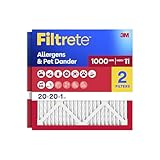
- MAKE YOUR HOME YOUR SANCTUARY: 2-pack of 3-month pleated Filtrete 20x20x1 MERV 11 MPR 1000 AC Furnace Air Filter helps capture unwanted particles from your household air to contribute to a cleaner, fresher home environment
- EXCLUSIVE TECHNOLOGY: Designed with Filtrete 3-in-1 technology to pull in and trap unwanted particles, allowing cleaner air to flow through (Compared to MERV 11 minimum filter requirements; microparticles are 0.3 – 1.0 in size)
- COUNTLESS MICROPARTICLES: With a 1000 MPR and MERV 11 rating, your Filtrete Filter will help capture many microparticles from the air passing through it
- CERTIFIED: This furnace filter is CERTIFIED asthma and allergy-friendly (2) and helps capture dust, lint and other allergens in your household air
- CHANGE YOUR FILTER OFTEN: For optimal performance, make sure to change your filter at least once every 90 days
Open-plan living area
Calculate the full area that is reasonably connected to the unit, account for ceiling height, and consider multiple cleaners or a higher combined CADR. A door-mounted or centrally located unit cannot overcome every open stairway, hallway, or air-leakage path. If a central HVAC system serves the space, investigate a compatible MERV 13 filter and blower operation as a second layer.
Allergies, dust, or pets
Use mechanical particle filtration, control the source through cleaning and housekeeping, and select a unit that can run at a tolerable setting. A portable cleaner near the occupied room can provide more predictable room-level cleaning than an HVAC filter that operates only intermittently.
Wildfire smoke
Prepare a closed cleaner-air room before smoke arrives. Use a high smoke-CADR portable cleaner or a properly built and maintained DIY unit, keep doors and windows closed when advised, and use compatible central HVAC filtration. Keep spare filters available and inspect them frequently.
Cooking odors, solvents, or other VOC concerns
Start with source control and exhaust ventilation. Add a mechanical particle filter if particles are also present and choose activated carbon based on the quantity and configuration of media, not simply the word carbon on the package. For persistent chemical odors or suspected hazardous contamination, identify and remove the source or obtain qualified industrial-hygiene advice instead of relying on a consumer purifier.
New construction or major renovation
Design the filtration path before finishes conceal the equipment. Provide a correctly sized filter rack, minimize bypass, verify access for replacement, select a filter compatible with the blower, and isolate dusty work from occupied areas. During construction, protect the HVAC system from uncontrolled dust and follow the equipment manufacturer’s requirements; a permanent filter is not a substitute for containment and housekeeping.
Commercial, healthcare, or high-occupancy spaces
Use a qualified mechanical engineer or HVAC professional to evaluate outdoor-air rates, recirculation, filtration pressure drop, airflow, acoustics, maintenance, and any GUV application. CDC recognizes portable or built-in HEPA filtration, MERV 13-or-better central filtration where compatible, and GUV as parts of an air-cleanliness strategy, but the correct design depends on the building and occupancy.
Commissioning and maintenance checklist
- Identify the contaminant: particles, smoke, allergens, odors, gases, or a mixed problem.
- Measure the space: record floor area, ceiling height, connected rooms, and expected occupancy.
- Size by performance: compare smoke or particle CADR for portable units; do not rely only on a claimed room-size label.
- Confirm HVAC compatibility: verify filter dimensions, MERV rating, pressure drop, airflow, blower limits, and service access.
- Seal the path: ensure air cannot bypass the filter around the rack, cabinet, or replacement door.
- Keep airflow open: do not obstruct portable-unit intakes, outlets, return grilles, or supply paths.
- Plan the operating schedule: filtration occurs when air moves through the filter.
- Budget for consumables: include main filters, prefilters where permitted, carbon media, UV lamps if applicable, and electricity.
- Inspect loading: shorten replacement intervals for construction dust, pets, heavy occupancy, and wildfire smoke.
- Reject unsafe claims: do not treat ozone generation, ionization, or vague UV marketing as proof of comprehensive air cleaning.
Sources and standards
The principal technical and public-health references for this guide are EPA’s Guide to Air Cleaners in the Home, EPA’s research on DIY air cleaners and wildfire smoke, EPA’s air-cleaner and HVAC-filter guidance, CDC’s air-cleanliness guidance, ASHRAE’s filtration reference, and ENERGY STAR’s room-air-cleaner guidance. EPA does not certify or recommend specific commercial brands or models, so product selection should remain based on performance, compatibility, safety, and ownership cost.
Where product links are provided, they may be affiliate links. That does not replace the need to verify CADR, dimensions, compatibility, filter availability, and safety for the specific installation.
Best Value

- Genuine AprilAire 213 Filters are engineered to the exact specifications of your AprilAire Air Purifier, delivering superior filtration, a perfect airtight fit and seal, and the best overall system protection. To maintain peak performance, always choose certified AprilAire Replacement Filters.
- MERV 13 Filtration – The AprilAire 213 removes up to 97% of common allergens and 92% of viruses* *Virus performance results based on controlled testing in accordance with ASHRAE 52.2 test standard using the MS-2 virus
- Advanced Purification – The AprilAire 213 Replacement Filter removes 15% more harmful particles compared to minimum MERV 13 requirement* *Harmful particles defined as 0.30 to 1.0μm. Testing was verified by 3rd party lab. All results follow ASHRAE 52.2 2017 Testing Method.
- Energy Efficiency – The AprilAire 213 lasts up to 2X longer* for fewer replacements and less strain on your HVAC system, saving you money *Performance results based on controlled testing in accordance with ASHRAE 52.2 2017 test procedure. MERV 11 and 13 Filters only.
- Buy with Confidence – Genuine AprilAire 213 Air Filters are designed and made in the USA by AprilAire, the leader in Indoor Air Quality solutions for the home since 1954
Frequently Asked Questions
Is HEPA better than MERV 13?
They are different types of ratings applied in different contexts. HEPA media are generally more efficient than MERV 16 media and are commonly rated around 99.97% at 0.3 micrometers under the relevant test convention. MERV 13 is a practical HVAC target when the central system can safely accommodate it. A filter’s real-world performance also depends on sealing, airflow, and operating time.
What CADR do I need for a 400-square-foot room?
EPA’s approximate table indicates a minimum CADR of about 260 cfm for 400 square feet with an 8-foot ceiling. Choose more capacity for higher ceilings, open layouts, smoke events, or unusually high particle loads.
Can an air purifier remove odors?
A particle filter alone is not a reliable odor or gas remover. Look for a meaningful amount of activated carbon or another gas-targeted medium, but begin with source control and ventilation. Carbon capacity varies greatly, and particle CADR does not measure gas removal.
Should every home use a MERV 13 filter?
MERV 13 is a useful target for many residential HVAC systems, but it must be compatible with the equipment. Verify the filter dimensions, rack sealing, pressure drop, airflow, and blower limits. If MERV 13 is not safe for the system, use the highest compatible rating and consider a portable cleaner for room-level filtration.
Are ozone generators safe air purifiers?
They should not be used as positive recommendations for occupied residential spaces. EPA says no federal agency has approved ozone generators for occupied spaces and warns that ozone at public-health-standard concentrations has little potential to remove many contaminants. Ionizers can also produce ozone depending on their design and operating conditions.
How often should an air filter be replaced?
Follow the equipment or filter manufacturer’s interval as a starting point, then inspect the filter and replace it sooner when it is heavily loaded. Construction dust and wildfire smoke can load filters rapidly; EPA advises checking DIY filters daily during wildfire-smoke events and replacing them when they become dark, gray, or smell of smoke.
The Bottom Line
For most homes, build the system in layers: control the source, use a properly sized portable mechanical cleaner in the occupied room, install MERV 13 or the highest compatible HVAC filter for recirculated whole-home air, add substantial activated carbon only when gases or odors are a real concern, and maintain every filter. Size by CADR and room volume, verify HVAC compatibility and sealing, and avoid ozone-generating products marketed as universal solutions.
Quick Recap
Product prices and availability are accurate as of the date/time indicated and are subject to change. Any price and availability information displayed on Amazon at the time of purchase will apply.




