A “bench-sized milling machine” can mean a compact trim-router CNC, a rigid benchtop mill, or a manual mill converted to CNC. Choose the architecture from the material you need to cut: a moving-gantry router is accessible for wood, plastics, engraving and light nonferrous work, while serious metal cutting calls for a stiffer bed mill or a suitable manual-mill conversion.
What “bench-sized” actually describes
Bench-sized describes footprint, not capability. Two machines that fit on a workbench can differ radically in rigidity, spindle torque, travel, tooling and safe material-removal rate. Identify the machine architecture before ordering rails, screws or motors.
As an Amazon Associate I earn from qualifying purchases.
Moving-gantry CNC router
The table remains relatively fixed while the gantry carries the cutting head. This is usually the most approachable DIY layout because the structure is simple and the workpiece can be supported on a spoilboard. It suits wood, foam, plastics, engraving and light aluminum or brass when the frame and cutting parameters are conservative. A high-speed trim router is not equivalent to a conventional metal-mill spindle.
Moving-table or bed mill
A heavier column and bed support the work while the table, head, or both provide the axes. The shorter load paths and greater mass can improve rigidity for metal cutting, but fabrication, alignment and machining requirements rise quickly.
#1 Best Overall
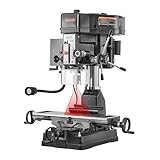
- Powerful Drilling Performance: Deliver reliable power with our mill drill machine featuring a 2 HP motor and a 15.875 in swing distance. Handle woodworking, light metalwork, and home projects with ease.
- 12-Speed Settings: Switch between 150 to 2560 RPM to match your material and application. This milling drill press gives you the flexibility to achieve clean, precise results.
- X-Laser Positioning: Achieve pinpoint accuracy with the X-laser guide on this benchtop mill drill press. It reduces measuring errors and minimizes material waste by helping you drill exactly where you intend.
- High-Precision Spindle: Engineered for stability, this mill drill combo machine features a high-accuracy spindle, ensuring stable holding and accurate drilling.
- Stable & Adjustable Worktable: Built with a reinforced metal worktable, this press drill milling machine provides excellent stability. It also supports height adjustment and 45° tilting left or right for precise positioning on complex drilling angles.
Compact plate mill
Plate, extrusion and linear-rail designs can produce a small machine with a useful envelope. Their performance depends on joint design, section size, bearing spacing and how well the plates are registered and aligned; a parts list alone does not establish milling capability.
Manual benchtop mill converted to CNC
A conversion starts with a mill that already has a column, ways, table and spindle. It can occupy the middle ground between a router-style CNC and an industrial machining center, but brackets and screw mounts must be adapted to the exact machine. The Dr. D-Flo conversion account (updated May 18, 2023) specifically requires a square-column mill with dovetail ways for the project discussed; the author found round-column head movement too loose.
“any recommendation about a bench sized milling machine?”
For wood, plastics, engraving and occasional shallow cuts in aluminum or brass, start with a documented enclosed router design and accept its metal-cutting limits. For regular steel or deeper aluminum cuts, prioritize a heavy bed, short tool overhang, conventional milling spindle and metal-cutting tooling—even if that means converting a manual mill instead of building a lightweight gantry.
Free tools Windows power users keep installed
One-click scans. No signup required.
Compare the documented routes
| Route | What is documented | Best fit | Main limitation |
|---|---|---|---|
| Momus plan-based CNC router | Enclosed three-axis router; stated working envelope of 16 in × 16 in × 5 in. The specifications page also lists a 16 in × 16 in × 5.5 in cutting envelope and explains that Z depends on the router mount, bit length, limit-switch position and spoilboard thickness. | Wood, foam, plastics, engraving and light aluminum/brass work. | High-RPM trim router limits metal depth of cut and feed; the design has no cutting-fluid provision. |
| Hackaday mini-mill project | 3030 aluminum profile, MGN12 rails and carriages, 8 mm trapezoidal screws and nuts, steel plate, a 65 mm router such as Makita RT0700C, and a cement-and-sand base are listed for that build. | Small mild-steel and aluminum parts in a home workshop, subject to that design’s stiffness and setup. | The bill of materials is project-specific; prototype changes and reorders mean drawings and fits must be checked before buying all cut parts. |
| Fixed-bed moving-gantry build | A builder describes 6061-T4 tooling plate, 80×40 and 40×40 extrusion, a cast-iron bed, linear rails, ball screws, belts and stepper motors. Machined registers between extrusion and plate were used to improve rigidity. | A custom machine when you can fabricate and align a substantial frame. | The builder reports that moving gantry was easier to build but less rigid than a bed-mill arrangement; this is a project experience, not an independent test. |
| Manual benchtop mill conversion | Existing mill structure is retained while brackets, screw mounts, motors and controls are added for CNC operation. | Metal work where rigidity and conventional milling tooling matter more than the simplest build. | Fit-up can involve inaccessible fasteners, lengthy adaptation, breakage risk and possible warranty consequences. |
What the Momus-style router provides
Envelope and intended materials
Momus CNC describes a fully enclosed, precision three-axis router intended for construction with common shop tools. Its home page states a 16 in × 16 in × 5 in working envelope and lists wood, foam, plastics, light aluminum and brass. The specifications page gives 16 in × 16 in × 5.5 in as a cutting envelope, with Z clearance dependent on the mount, tool, switches and spoilboard. Treat those as stated design figures, not guaranteed usable travel on every build.
Mechanical and control concept
- Plywood base with aluminum and steel mechanical parts.
- Trim-router spindle and NEMA 23 stepper motors.
- Bearing-on-cold-rolled-steel-rail motion.
- ACME Z screw with an anti-backlash nut.
- Emergency stop and machine-limit switches listed in the specifications.
The described manual is 170 pages with more than 350 photographs and includes a bill of materials, supplier information, part drawings, wiring diagrams and CAD/CAM/control-software guidance. The plans page describes stock dimensions and quantities, exploded views, assembly photographs and an errata list. Momus summarizes its model as: “We supply the plans, you supply the materials.”
Rank #2
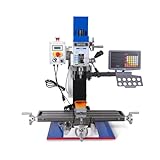
- 1.5 HP DC Brushless Motor: Low maintenance, smooth, and powerful motor for consistent operation.
- R8 Spindle Taper: Offers compatibility with a wide range of accessories, providing flexibility for various cutting tasks.±90° Head Tilt: Allows for versatile angled cutting and precise milling operations.
- Large Table Size: 7" x 27-1/2" for handling larger workpieces and providing ample space for more complex tasks.
- Variable Speed Range: 0-2500 RPM, ensuring optimal performance across a wide variety of materials.Precision Ground Ways: For smooth and accurate movement, ensuring a more reliable machining process.
- Enhanced Safety Features: Chip guard, rubber chip guards, and built-in safety switch to ensure user safety during operation.
Metal-cutting boundary
The trim router’s high RPM is useful for wood and plastics but constrains metal depth of cut and feed rate. The design is not intended for cutting-fluid use. Call this light-duty nonferrous-metal capability, not a general-purpose metal mill.
Historical cost figures
| Figure | What it covered |
|---|---|
| $500 (US estimate on a page carrying a 2012 copyright) | Basic machine materials only; router, stepper motors and electronics, computer and software were excluded. |
| $200–$600 (same 2012 estimate) | Typical stepper-motor and drive-electronics cost at that time. |
These are historical planning figures, not a current all-in project price. A present build also needs to account for controls, enclosure details, workholding, cutters, wiring and any machining or shipping.
What’s actually slowing this PC down?
Pick the symptom - the matching free tool is one click away.
Lessons from the documented mini-mill build
The Hackaday project aimed at small mild-steel and aluminum parts and lists a 3030 aluminum-profile frame, MGN12 rails and carriages, 8 mm trapezoidal screws and nuts, bearing blocks, steel plate, fasteners, a cement-and-sand base and a 65 mm router such as the Makita RT0700C. That combination is evidence of one builder’s design, not a universal recipe or compatibility guarantee.
Its prototype changes and reordered parts are an important design warning: verify every drawing, hole pattern, rail length, screw length, bearing block and router mount against the current model before purchasing a complete set of cut stock.
Why rigidity determines metal performance
Frame and joints
Compare base material, column or gantry geometry, extrusion section, plate thickness, joint access and how loads travel into the bed. A machined register between an extrusion and flat plate can locate the joint more reliably than relying on fastener friction alone, as described by the fixed-bed builder.
Rank #3

- Multiple Application: This milling working cross table machine is great for mounting on drilling machines for precise positioning. It can be used for most types of milling and drilling, ideal for all drill stands, drilling, and milling machines. Table Size: 23 x 13 in / 58 x 33 cm
- Premium Quality Structure: Built by heavy-duty cast iron material, which is anti-corrosion and rust resistance, angle milling table can withstand the tough environment and designed for long service time.
- Highly Polishing & Stiffness: The compound slide table, with great hardness and stiffness, is high ground and not easy deformation. Three precise T-slots can meet different force requirements.
- 2 Axis 4 Ways Move: Handles with trapezoidal thread spindles is easy to adjust the directions. X-axis travel: 8.3 in / 210 mm, Y-axis travel: 4.3 in / 110 mm. With a precise scale on it, you can adjust the optimal working position as you need.
- Tightness Adjustment: Equipped with several quality bolts and nuts, you can easily adjust the tightness of this cross slide table. Convenient for your use.
Moving gantry versus bed mill
A moving gantry can reduce fabrication complexity and make loading convenient. The same builder reports that it was less rigid than a bed-mill layout. Use that statement as a design trade-off, not as a measured performance ranking.
Do these 3 things before closing this tab:
1Repair Windows errors before they cause bigger problems2Fix the driver behind crashes, sound loss and screen glitches3Clear out junk files and repair common Windows errorsTool overhang and workholding
Usable clearance is less than the headline Z travel when the router mount, collet, bit length, spoilboard, vise or fixture consume space. Plan the shortest practical tool projection and a workholding method that resists cutting forces without blocking travel.
Independent reader supportYour contribution helps us test, update, and keep practical guides available for everyone.Design and purchasing checklist
- Material: define whether the machine is for wood and plastics, light nonferrous work, or recurring steel cuts.
- Envelope: specify usable X, Y and Z travel around the actual fixture, tool and spoilboard—not the outside footprint.
- Rigidity: compare bed mass, plate and extrusion sections, column or gantry geometry, joint registration and bearing spacing.
- Spindle: match RPM, torque, collet range and tooling to the material. A 65 mm trim router belongs to the light-router class.
- Motion: check rail type, screw pitch, anti-backlash method, motor torque, belt reductions and the proposed alignment procedure.
- Fabrication: confirm which parts need only sawing and drilling and which require accurate plate machining, tapping or casting.
- Documentation: use drawings with stock dimensions, quantities, hole locations and revision or errata information.
- System scope: budget the structure separately from spindle, motors, drives, controller, computer, software, enclosure, workholding and cutters.
- Chip and safety control: provide guarding, an emergency stop, limit switches where appropriate and a chip-clearance method compatible with the design.
A practical build sequence
- Write the job envelope. Measure the largest stock, fixture and tool combination you expect to use and reserve clearance for clamps and chip removal.
- Choose the architecture. Select a router gantry for accessible light work, a heavier bed or plate mill for rigidity, or a manual conversion when an existing mill supplies the needed ways and spindle.
- Freeze the mechanical design. Resolve rail spans, screw lengths, bearing blocks, motor mounts, router or spindle mount and workholding before ordering stock.
- Match every part to the drawings. Check revision notes, prototype changes, hole patterns and actual vendor dimensions; do not assume that a nominal rail or screw will fit.
- Build the structure and alignment references. Establish flat, square reference surfaces and use registered joints where the design calls for them.
- Install motion and controls. Align rails and screws, set backlash controls, wire limit switches and emergency-stop circuitry, and configure the controller according to the chosen electronics.
- Test without a cutting load. Confirm travel limits, direction, homing, emergency-stop action and clearance before installing a cutter.
- Start with conservative cuts. Secure the work, inspect the tool, use a shallow cut appropriate to spindle and material, and stop if vibration, deflection or tool damage appears.
Operating and safety essentials
The LittleMachineShop mini-mill guide gives basic rules that apply broadly, while the manual for your particular machine remains authoritative:
- Secure the workpiece in a vise or other holding device. The guide states: “Check the workpiece after you secure it in the vise or other work holding device. Be sure it is secure before turning on the mill.”
- Keep loose clothing and jewelry away from the machine.
- Inspect cutting tools for damage before use.
- Stop the spindle before opening shields, reaching into the work area, adjusting tools or work, changing speeds, or clearing chips or coolant.
- Do not attempt a job beyond the mini-mill’s capacity.
- Use the emergency stop and limit switches provided by the design, and verify their operation before cutting.
When a DIY bench mill is the wrong choice
If your work routinely needs deep cuts, high material-removal rates, flood coolant, large tooling, production repeatability or certified guarding, a lightweight router conversion is the wrong capability class. A heavier commercial benchtop mill or a properly sized machining center may cost more initially but avoids designing around deflection and spindle limits.
Source dates and evidence limits
Momus pages cited here carry a 2012 copyright date; their specifications and prices may no longer reflect current availability. Maker Hardware’s MiniMill page was updated May 27, 2024. The Kearley build was made in 2016 and later descriptions were reconstructed from a photo archive. The Hackaday page supplies an authored build account and bill of materials but no reliable publication date in the available material. No current, comparable all-in DIY cost or independently measured performance comparison is established for these designs.
Quick Recap
Product prices and availability are accurate as of the date/time indicated and are subject to change. Any price and availability information displayed on Amazon at the time of purchase will apply.

