Irrigation systems fall into three main delivery methods: surface, sprinkler, and drip (also called microirrigation). The right choice depends on the site, soil, crop or landscape, water supply, budget, and ability to maintain equipment. Controllers and sensors can improve when irrigation runs, but they do not replace a suitable system design or regular inspection.
How the main irrigation methods deliver water
The delivery method determines how water reaches the soil and plants. Each can work well when it matches local conditions; none is best for every site. As the Food and Agriculture Organization of the United Nations puts it, “Unfortunately, in many cases there is no single best solution: all methods have their advantages and disadvantages.” (FAO, Chapter 7: Choosing an Irrigation Method)
As an Amazon Associate I earn from qualifying purchases.
Surface or gravity irrigation
Water flows across the soil surface under gravity. This method may suit sites where the slope, soil’s ability to absorb water, field layout, and available supply support an even flow. It can require less sophisticated equipment than some alternatives in small-scale schemes. It is not inherently wasteful: layout and management affect how evenly water is distributed and how efficiently it is applied. (FAO; USDA Agricultural Research Service, Irrigation Methods (2005))
Sprinkler irrigation
Water travels through pipes and is distributed as droplets or spray from fixed or moving equipment. Sprinklers can adapt to variable water demand and may suit steep or irregular terrain better than surface flow. Their equipment, energy use, and maintenance needs should be assessed for the particular site and system. (FAO)
#1 Best Overall
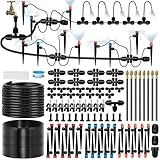
- 【Upgraded Tube Design & Water Saving】 Our garden watering system is upgraded to 1/2” diameter to support high water pressure. The 1/2” tee connector allows seamless splitting into 2 independent zones for customized watering schedules. By delivering moisture directly to root zones, this drip Irrigation system significantly reduces evaporation and runoff—saving more water compared to conventional sprinklers while eliminating the need for manual watering.
- 【Quick Connect & Tool-Free Set Up】 Designed for simplicity with push-to-connect fittings that secure instantly without heating, gluing, or specialized tools. The intuitive 1/2" to 1/4" 4-way connector link 1/2" main lines to 1/4" drip lines in quickly, allowing you to build a custom layout exactly where needed. Connections stay firmly sealed under pressure, preventing leaks and making installation a breeze. This drip irrigation kit saving you time and effort!
- 【Durability & Nozzle Variety】 This drip system features adjustable sprinklers, adjust each sprinkler head by rotating the cap for precise watering. The stake at the bottom of the sprinkler secures firmly into the soil. 3 nozzle types—vortex, stream, and misting—for tailored watering across different plants, plus 8 copper nozzles can be bent and fixed 360 ° to adjust the place where the spray is needed and the spraying direction. This makes gardening less tedious!
- 【Versatility & Wide Application】 Ideal for a wide range of applications, including raised garden beds, greenhouses, vegetable patches, flower borders, patios, and lawns. Flexible tubes, a variety of nozzles, and connection components allow you to easily customize different irrigation methods. Suitable for both above-ground and elevated installations, this quick-connect garden watering system is your all-in-one solution for a thriving and well-maintained garden.
- 【Complete Kit & All You Need】 The irrigation system for garden comes with a variety of components to meet your needs: 10 drip vortex emitters, 10 drip stream emitters, 10 misting nozzles, 8 360° bendable metal spray nozzles, 33 FT 1/2" main line, 197 FT 1/4" drip line, 15 1/4" tee splitter, 8 1/2" to 1/4" 4-way connector and more. Precise and efficient watering is no longer a tedious process, but an easily achievable reality.
Drip or microirrigation
Drip systems deliver water at a low rate through small pipes and emitters, wetting part of the root zone rather than the entire soil profile. They can suit row crops such as vegetables and soft fruit, as well as trees and vines; FAO notes that drip is not suitable for close-growing crops such as rice. A garden or raised-bed kit generally includes tubing and emitters, but the arrangement and flow need to fit the planting pattern, water quality, and system conditions. (FAO, Chapter 6: Drip Irrigation)
EPA says microirrigation systems use 20 to 50 percent less water than conventional sprinkler systems. That is the agency’s stated comparison, not a guaranteed result for every installation. (U.S. EPA WaterSense, Microirrigation)
Rank #2

- Be a Gardening Master with the help of our superior and complete Drip Irrigation Kit: 50ft flexible & durable PVC 5/16" Irrigation Tubing + 50ft 1/4" Drip Distribution Tubing + 2 x Female Thread Water Connectors for 5/16" Mainline + 20 Barbed Drip Emitters Stream + 10 Barbed Drip Emitters Vortex + 4 x 1-Way, 6 x 2-Way and 2 x 4-Way Barbed Splitters from 5/16" to 1/4" + 5 x 1/4" Tubing Tee Splitters + 2 x 5/16" Mainline End Plugs + 5 x 1/4" Distribution Tubing End Plugs
- Make your own garden irrigation system kit easier than ever: run a 3/4 connection from your water source to the watering area. Use the 5/16 irrigation tubing as the mainline. Branch off with the 1/4 drip irrigation tubing and connect a maximum of 30 drip irrigation emitters. Stick the dripper stake into the soil, adjust the desired irrigation spray, and feed your plants with your own drip irrigation system. Designed to work with between 20 - 45 PSI and a maximum output of 60 gallons/hour/emitter
- Enjoy taking care of your garden with high quality adjustable spray emitters and forget about broken irrigation sprayer stakes and clogged drip heads. With a length of 7.5 inch and a sharp bottom, the irrigation bubbler stake can be easily fixed into the ground and stays still even in loose soil. Perfect for long time application, the drip irrigation emitter heads are detachable and easy to clean so you don’t worry about clogging. Make gardening less of a chore!
- Spend less, get more - UV resistant and designed for underground or above-ground installation, the Carpathen 1/4 inch drip irrigation tubing will last year-round in any weather. Use the 4 ways/2 ways/1 way couplers to create the perfect branch for your plants. Season after season the distribution tubing part of the irrigation drip system will keep your plants hydrated with minimal waste from evaporation. Choose to cut down your water bills!
- Save Your Time with Carpathen Garden Irrigation System. Our automatic drip watering system minimizes water loss by directly hydrating the roots of your plants. Easily adjust the drip emitters by rotating the cap for precise hydration. Designed for up to 3 raised garden beds, this irrigation system for the garden is ideal as a garden starter kit for healthy vegetables, an automatic watering system for potted plants, a raised garden bed watering system, or a reliable garden grid watering system
How to choose a method for a site
Compare the options against the conditions that affect performance, installation, and upkeep. FAO cautions that no method is best in every situation and identifies local testing as the soundest basis for choosing. (FAO, Chapter 7: Choosing an Irrigation Method)
What’s actually slowing this PC down?
Pick the symptom - the matching free tool is one click away.
- Crop and planting pattern: Consider whether plants grow in rows, widely spaced groups, or a close-growing stand, and whether the system can deliver water where those plants need it.
- Soil and slope: Soil intake and site topography influence how water moves and whether it can be distributed evenly.
- Climate and water supply: Account for local conditions, the amount and reliability of available water, and any relevant water-quality constraints.
- Uniformity and layout: Consider how evenly the system can serve the whole planting area and whether its layout fits the terrain.
- Lifecycle cost: Compare equipment and installation with continuing energy, labor, and maintenance costs.
- Skills, parts, and upkeep: Factor in the technical capacity to operate the system, inspect it, clean or repair components, and source replacement parts.
Sprinkler or drip systems can have higher application efficiency than surface irrigation in some circumstances, but that depends on design and management. A method should not be selected on an “efficiency” label alone.
Rank #3

- ✔Comprehensive Drip Irrigation Kit:MIXC drip irrigation system, equipped with a versatile range of components, caters to all your garden watering needs.Includes essential parts such as 197ft 1/4'' irrigation tube, 33ft 1/2'' irrigation tube, 1/2‘’ Lock Barbed Tee connectors, drip emitter streams, vortex emitters, Blue Mist Nozzles, Quick connection tees, Faucet Connector, and more.
- ✔Innovative Quick Connector Technology:Featuring a new quick connector design, our plug-and-play irrigation tube ensures a secure fit, preventing leaks and making installation a breeze.Takes only 10 minutes from setup to full operation, saving you time and effort.
- ✔Efficient Water Distribution Setup:Establish a 3/4 connection from your water source to the watering area.Utilize the 1/2-inch irrigation tubing as the mainline, branching off with the 1/4-inch drip irrigation tubing.Connect up to 32 drip irrigation emitters for comprehensive coverage.
- ✔3 Kind Of Irrigation Systems: This irrigation set includes 3 kinds of drip emitters, the drip emitter can adjust different irrigation modes such as microdroplets, sprays, watering, etc. The precise watering system can solve the watering of plants in different locations, each spray The water nozzles can all be individually adjusted for the amount of water according to their settings and needs.
- ✔Versatile Applications for Every Garden:Designed for various outdoor spaces, including lawn irrigation, patios, gardens, vegetable beds, roof cooling, agriculture, flower beds, plant greenhouses, swimming pool mist cooling, and raised beds.This new drip irrigation kit is your all-in-one solution for a thriving and well-maintained garden.
What controllers and sensors change
Irrigation controllers affect when and how much water is applied; they do not change the underlying delivery method. EPA distinguishes two common approaches. (U.S. EPA WaterSense, WaterSense Labeled Controllers)
Weather-based controllers
These controllers use local weather and landscape conditions to adjust watering schedules. Check that a product’s current certification and compatibility meet your needs before choosing a model. (U.S. EPA WaterSense, Weather-Based Irrigation Controllers; WaterSense Labeled Controllers)
Rank #4

- 【Quick Push-to-Connect Installation – No Tools Required】This MIXC drip irrigation system features an easy push-to-connect design for fast setup. Simply insert the tubing and pull back to confirm a secure fit—no heating, glue, or special tools needed. Leak-resistant connections help ensure smooth and reliable watering from the start.
- 【300FT Complete Drip Irrigation Kit for Full Garden Coverage】Includes 100FT 1/2” main tubing and 200FT 1/4” irrigation tubing, three types adjustable drip emitters, and essential accessories to build a customized watering layout. Ideal for raised garden beds, potted plants, greenhouses, flower beds, and lawns of various sizes.
- 【Efficient Water-Saving & Adjustable Drip Irrigation】Designed to deliver water slowly and evenly directly to plant roots, helping reduce runoff and evaporation. Adjustable drip emitters allow you to control water flow for different plants, promoting healthy growth while minimizing water waste.
- 【Timer-Compatible for Automated Watering】Compatible with most standard irrigation timers (not included), allowing you to create an automatic watering schedule with ease. Once connected, the system maintains consistent irrigation for gardens, greenhouses, and potted plants—saving time and daily effort.
- 【DIY-Friendly & Flexible Layout Design】Perfect for beginners and experienced gardeners alike, this drip irrigation system supports flexible routing and easy expansion. Follow the included instructions to set up, adjust, or rearrange the system as your garden grows, keeping maintenance simple and stress-free.
Soil-moisture-based controllers
These controllers monitor soil moisture and can prevent irrigation when the soil does not need more water. EPA estimates that installing a WaterSense-labeled soil-moisture-based controller can save an average U.S. home with automatic landscape irrigation more than 15,000 gallons annually; actual savings at an individual property are not guaranteed. (U.S. EPA WaterSense, Soil Moisture-Based Irrigation Controllers)
EPA also reports that more than 28 million U.S. homes have in-ground sprinkler systems that typically use clock-based controllers. This is context for residential landscape irrigation, not a measure of agricultural systems. (U.S. EPA WaterSense)
Best Value

- Everything in One Box – Everything included: 100FT 1/4" tubing, 24 nozzles, connectors, stakes, ties & end caps. Covers small/medium gardens effortlessly
- Quick Connect in 10 Mins – Tool-free assembly with quick-connect fittings. Includes tee connectors & hose adapter for leak-proof DIY setup
- Bend & Direct Copper Nozzles – Flexible aluminum-core rods (20cm) bend to reach exact plant bases. Durable copper nozzles adjust 360° for drip, spray, jet or mist
- Water Precisely Where Needed – Bend the flexible emitter rods around pots, under foliage, or into tight raised bed corners for targeted root watering
- Features innovative push-to-connect fittings that securely lock in place, preventing leaks and pull-outs. If a connection is made incorrectly, simply detach and reconnect
Operation and maintenance affect performance
Automated schedules still need attention. EPA recommends adjusting schedules as seasons change, keeping sprinkler water on the landscape rather than hard surfaces, and inspecting systems for leaks, broken or clogged heads, and distribution problems. For microirrigation, clean filters as needed. (U.S. EPA WaterSense, Watering Tips)
Quick Recap
- Group plants with similar water needs into irrigation zones; consider sprinkler type, sun exposure, and shade when setting them up.
- Check for leaks, blocked or damaged components, and areas that receive too much or too little water.
- Adjust timing as seasons and landscape conditions change instead of relying on a fixed schedule year-round.
- For system design, installation, maintenance, or an irrigation audit, consider a certified irrigation professional.
Product prices and availability are accurate as of the date/time indicated and are subject to change. Any price and availability information displayed on Amazon at the time of purchase will apply.

