Recommended Free Tools
Yes—but only in a limited sense. Boiling water, household vinegar, rubbing alcohol, and salt can kill or severely injure exposed weed foliage. They are contact treatments, not dependable root-killing solutions, and none is selective: whatever desirable plant they touch may also be damaged.
These methods are most appropriate for a few young weeds in sidewalk joints, driveway cracks, gravel, or other hardscape areas where no desirable plants are nearby. Established perennial weeds, deep-rooted weeds, lawn weeds, and weeds growing beside trees or garden crops usually require repeated mechanical removal, mulch, or a properly labeled herbicide. “Natural” does not automatically mean safe, soil-friendly, organic-certified, or legally exempt from pesticide rules. Penn State Extension warns against many homemade mixtures because they can injure soil, non-target plants, beneficial organisms, and waterways.
As an Amazon Associate I earn from qualifying purchases.
What “really works” means here
A homemade weed killer may produce rapid browning or collapse of the leaves it contacts. That is visible control, not necessarily eradication. Annual weeds with small root systems are more likely to die after their foliage is destroyed. Perennial weeds can draw on energy stored in their roots and regrow, sometimes repeatedly.
Quick wins for a faster PC:
Clear out junk files and repair common Windows errorsFree Scan →Fix the driver behind crashes, sound loss and screen glitchesFind Drivers →None of the four methods below should be described as a universal replacement for a labeled herbicide. Use the narrowest application possible, avoid runoff, and accept that repeat treatment or physical removal may be necessary.
#1 Best Overall

- Chapin Garden Sprayer: Complete lawn care and basic cleaning tasks faster with the 1‑gallon translucent funnel‑top tank that allows quick, easy, spill‑free refills and fluid checks
- Reliable performance: Achieve consistent spray coverage of weeds, pesticides, fertilizers and general spraying. Improved modular design prevents leaks and lets you easily clean, replace seals, and maintain a tight, secure connection
- Comfortable handling: move easily around the yard during garden, cleaning and lawn maintenance jobs thanks to the lightweight poly tank and ergonomic pump handle designed for reduced fatigue
- Versatile spraying: switch between targeted stream or broad spray for weed control, cleaning and lawn care using the adjustable cone nozzle and 34‑inch hose for flexible reach and precision
- Proudly Made in the USA: Expertly designed and manufactured in the USA with global materials, backed by Chapin’s 1-year limited warranty and supported by a dedicated US-based customer service and technical help centre
Quick comparison
| Method | Best target | Likely result | Regrowth risk | Main hazard |
|---|---|---|---|---|
| Boiling water | Tiny weeds in cracks and joints | Rapid contact injury | Medium to high | Scalding and damage to nearby plants |
| Household vinegar | Very young annual weeds in non-crop areas | Foliage burn | High for perennials | Eye or skin irritation and non-target injury |
| Rubbing alcohol | A few exposed, young weeds | Foliage desiccation | High | Flammability |
| Salt | Isolated hardscape cracks where nothing will be planted | Vegetation death plus soil salinization | Lower at the treated spot, but with lasting damage | Persistent runoff and damage to future plantings |
1. Boiling water
Best use: Small annual weeds growing in sidewalk cracks, driveway joints, gravel, or similarly isolated hardscape locations.
Boiling water rapidly damages the green tissue it contacts. It is simple, inexpensive, and leaves no herbicide residue intended to control later growth. However, it usually affects the foliage and crown rather than reliably eliminating an established root system. Illinois Extension notes that boiling water is lethal to contacted green leaves but often provides only temporary or partial control when roots survive.
How to apply it
- Identify a weed that is well away from lawn edges, garden plants, tree roots, and other vegetation you want to keep.
- Boil fresh water and carry it carefully to the treatment area.
- Pour slowly and accurately over the foliage and crown. A narrow-spout or long-spout watering can can make placement more precise, but it does not remove the burn hazard.
- Watch the area for regrowth and repeat only when necessary.
Do not assume boiling water reliably sterilizes soil or kills dormant seeds. The evidence supports contact injury, not universal seed destruction.
Do these 3 things before closing this tab:
1Fix the driver behind crashes, sound loss and screen glitches2Clear out junk files and repair common Windows errors3Scan for outdated or missing drivers - takes under a minuteRisks and limits
- It can scald people and pets.
- It can kill desirable plants whose roots or foliage are reached by the hot water.
- It can injure soil organisms and vegetation beside pavement.
- It is a poor choice near shallow-rooted trees, ornamentals, lawns, and food crops.
2. Household vinegar or acetic-acid spray
Best use: Very young annual weeds in cracks, paths, and other non-crop areas.
Acetic acid burns the foliage it contacts. It works better on small seedlings and annual weeds than on mature plants or perennials because it does not move through the plant to kill established roots. Oregon State University Extension describes vinegar as a contact treatment with limited effectiveness against established perennial weeds.
Household vinegar is not horticultural vinegar
Typical kitchen vinegar contains about 5% acetic acid. It may injure very young seedlings, but it is not a dependable treatment for established perennial weeds. Commercial horticultural-vinegar products can contain substantially higher concentrations. Those products are pesticides and must be used exactly according to their labels; they should not be treated as interchangeable with kitchen vinegar.
Rank #2

- KILLS WEEDS AND GRASSES: Use on driveways and walkways, and around fences, trees, flower beds, shrubs and other listed areas
- ACCUSHOT SPRAYER: Includes continuous power sprayer with extendable wand
- KILLS THE ROOT: Visible results as fast as 3 hours — replant new flowers, trees and shrubs the same weekend
- RAINFAST: Rainfall or watering 15 minutes after application will not wash away effectiveness
Concentration matters. Illinois Extension warns that acetic-acid concentrations above 11% can cause skin burns and severe eye injury, while the EPA explains that acetic acid above 8% is generally not eligible as a minimum-risk ingredient and can cause severe burns and eye damage.
What’s actually slowing this PC down?
Pick the symptom - the matching free tool is one click away.
Safer application principles
- Spray only the weed, not the surrounding soil or desirable vegetation.
- Choose a calm day. Wind can carry droplets onto lawn, flowers, crops, or shrubs.
- Do not use it around edible plants unless the specific product label permits that use.
- Protect your eyes and skin, especially when handling anything stronger than ordinary kitchen vinegar.
- Never mix vinegar with bleach or other cleaners.
Do not add dish detergent to make vinegar “stronger.” Household dish products are detergents, not plant-safe agricultural surfactants. Penn State Extension cautions that they can damage plants, soil, and beneficial organisms. A homemade mixture is not made safer or more reliable simply by adding more ingredients.
3. Rubbing alcohol
Best use: A small number of exposed, young weeds where precise spot treatment is possible.
Alcohol can desiccate contacted foliage. Utah State University Extension lists rubbing alcohol and a diluted vodka-and-water mixture among household remedies that can kill contacted foliage. That practical guidance does not establish a universally validated household recipe or guarantee control of mature or perennial weeds, so there is no responsible one-size-fits-all formula to provide.
Think of alcohol as a contact desiccant, not a systemic herbicide. It may brown the leaves while the roots remain alive, leading to regrowth.
Alcohol safety
- Alcohol is flammable. Keep it away from flames, hot surfaces, sparks, electrical ignition sources, and smoking materials.
- Do not spray during hot, dry, windy conditions, when vapor and overspray are harder to control.
- Avoid inhaling spray and prevent eye contact.
- Keep children and pets away until the treated area is dry.
- Do not apply broadly around edible plants or use it as a general garden spray.
Because the available extension guidance does not establish a universally validated household concentration and application rate, avoid assuming that a stronger mixture is better. Greater concentration can increase injury to people, desirable plants, and nearby surfaces without solving the root problem.
Rank #3

- KILLS & PREVENTS WEEDS: Kills and prevents weeds for up to 5 months
- KILLS THE ROOT: Kills weeds and grasses down to the root
- FAST-ACTING: Visible results same day
- READY TO USE: This 32-oz formula is pre-mixed and ready to use
- RAINPROOF WITHIN 1 HOUR: Rainproof within 1 hour of application
4. Salt—for isolated hardscape cracks only
Best use: At most, a few weeds in pavement cracks or gravel where no future planting is intended and runoff cannot reach beds, trees, lawns, drains, or waterways.
Sodium chloride disrupts plant water uptake and can dehydrate vegetation. It can therefore be effective at killing plants, but that effectiveness is precisely why salt is the most environmentally problematic option on this list. Colorado State University Extension says salt can render soil uninhabitable for months, and Penn State Extension warns that salt persists, moves with runoff, and can injure nearby plants and aquatic ecosystems.
Do not use salt in garden beds, lawns, tree rings, planting borders, or vegetable gardens. Rain and irrigation can move it beyond the original crack, where it may damage roots and make future planting difficult. Do not publish or rely on a salt-and-vinegar recipe as a general-purpose weed killer.
Free tools Windows power users keep installed
One-click scans. No signup required.
If you are considering salt at all
Reserve it for an isolated hardscape location that is already intended to remain unplanted. Check where runoff goes before treating. If water can flow toward a planting bed, storm drain, pond, stream, or neighboring property, choose mechanical removal instead.
What not to add to a homemade weed killer
Combining household products does not turn them into a tested, selective, or soil-safe herbicide.
- Dish detergent: It may help wet foliage, but household detergents are not formulated for plants and can harm soil and beneficial organisms.
- Bleach: It is not labeled for vegetation management, can harm soil organisms, and may create dangerous gases when mixed with other chemicals.
- Borax: “Natural” does not mean harmless; extension guidance warns that borax can harm children and pets. Illinois Extension discusses this risk.
- Baking soda: Concentrated applications may injure plants, but the available guidance does not support presenting it as reliable, selective, or soil-safe weed control. Colorado State University Extension addresses its limitations.
- Epsom salt: There is little scientific evidence that it selectively kills weeds, and it can contribute to nutrient imbalance. Penn State Extension specifically cautions against it.
Choose the method by location, not by the word “natural”
Sidewalk or driveway crack
For one or two small weeds, pull or scrape them first. Boiling water is reasonable when no desirable vegetation is nearby and you can control the pour. Vinegar may burn young annual weeds. Salt should be the last resort because of its persistence and runoff risk.
Rank #4

- PetraTools Garden Sprayer - Perfect for DIYers Seeking Professional Results: Our durable yet lightweight water sprayer, with a 52” hose and 16” wand, ensures comfortable extended use and excellent coverage, making it ideal for versatile liquids such as fertilizers, mulch glue, and pesticides.
- Translucent Tank with Large Ergonomic Handle for Comfortable Use: This weed sprayer features a funnel-shaped opening for easy pouring, a large handle to reduce hand strain during extended use, and a translucent tank with markings to simplify every gardening task.
- Built-in Pressure Release Valve for Safe Operation - Prevent accidental spray bursts with a safety valve that releases excess air pressure. Built with heavy-duty components, our sprayers in lawn and garden offers consistent and leak-free operation when correctly assembled and maintained.
- 1 Gallon Sprayer with 2 Nozzles for Precise Spray Control: The HD101 pressure sprayer features an adjustable nozzle for a gentle mist or powerful jet and a fan tip nozzle for wide coverage, making it perfect for lawn care, pest control, weed killing, fertilizing, watering, and more!
- Clog-Free Performance with Built-In Filters: Our garden sprayer 1 Gallon features high-quality built-in filters that prevent debris from clogging the nozzle, ensuring consistent operation every time. If the nozzle becomes clogged, clean the filters to restore optimal performance.
Garden bed or around an ornamental
Do not use any of the four as a casual broadcast spray. Pull weeds while they are small, scrape seedlings at the soil surface, or mulch around established plants. Contact sprays and hot water cannot distinguish a weed from a flower, vegetable, shrub, or tree root.
Crashes, No Sound, or Screen Glitches?
Random freezes, missing sound and display glitches usually trace back to one bad driver. Find and replace yours safely.Free scan · under a minuteWindows Errors? Fix Them Before They Spread
Repair common Windows errors and clear accumulated junk for a smoother, more stable PC - no reinstall needed.Free scan · no reinstallLawn
None of these methods is selective. They can leave dead spots wherever they touch grass. Hand removal, improved turf density, mowing at the appropriate height, and correction of underlying growing conditions are safer starting points.
Deep-rooted or perennial weed
Expect regrowth after a contact treatment. Remove as much of the root as practical, repeat mechanical control before the plant sets seed, or use a product specifically labeled for the weed and location.
Independent reader supportYour contribution helps us test, update, and keep practical guides available for everyone.More dependable options for established weeds
Near desirable plants, repeated mechanical removal is usually more dependable—and less likely to create lasting soil damage—than a homemade spray.
- Hand weeding: Pull when the soil is slightly moist and remove the crown and as much root as possible. A hand weeder tool or root puller can make isolated weeds easier to remove without spraying nearby plants.
- Shallow hoeing or scraping: Cut small seedlings at or just below the soil surface. Work shallowly so you do not bring buried weed seed to the surface. A garden hand hoe is useful between rows and around established plants when used carefully.
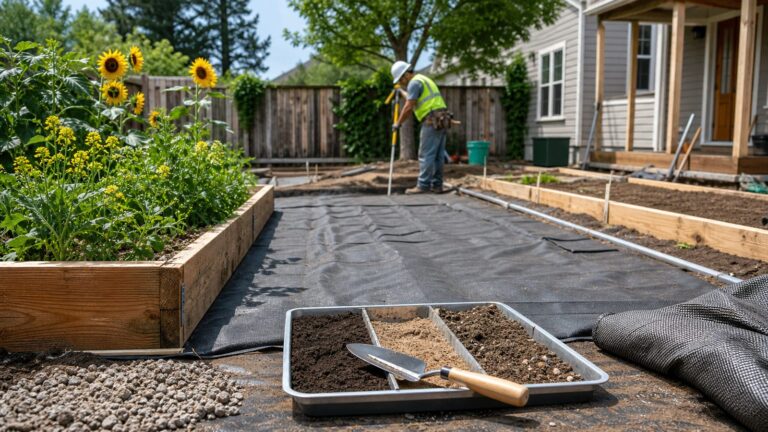
- Covering: Excluding light with cardboard, landscape fabric, or another suitable cover can suppress weeds, although the method must be chosen to avoid harming the plants underneath.
- Mulching: A 3- to 4-inch layer of mulch can suppress many weed seedlings and reduce evaporation. Keep mulch pulled back from trunks and plant crowns, and replenish it as it settles. Mulch suppresses emergence; it does not instantly kill every established root.
- Flame weeding: This is a nonchemical option rather than a homemade mixture. It works best on very small weeds and is less effective against grasses and established perennials. Oregon State University Extension emphasizes its fire risk and limited effectiveness; never use an open flame during dry conditions or near combustible debris.
Safety checklist
- Read the label whenever you use a commercial acetic-acid product or any registered pesticide; do not assume a homemade recipe has been tested for your situation.
- Wear eye protection and suitable gloves when handling vinegar, alcohol, or stronger products.
- Keep people and pets away during application and until the area is dry—or longer if a product label requires it.
- Avoid wind, rain, and runoff. Do not spray toward drains, ponds, streams, beds, or neighboring property.
- Never mix bleach with vinegar, ammonia, or other cleaners.
- Keep alcohol away from ignition sources and do not store mixtures in unmarked containers.
- Use the smallest amount and most targeted application that can solve the problem.
Regulatory note for U.S. readers
In the United States, a substance intended to prevent, destroy, repel, or mitigate a pest can fall under the federal pesticide framework. The EPA explains that pesticides generally must be registered unless they meet minimum-risk criteria, and using a pesticide inconsistently with its label is illegal. State and local rules may also apply.
Homemade mixtures do not come with the testing, directions, protective requirements, or use restrictions associated with registered products. If a weed is difficult, widespread, close to food crops, or threatening a structure or landscaped site, identify the weed and select a method labeled for that location rather than improvising a stronger mixture.
Best Value

- Starts working to kill problem weeds and grass immediately, with visible results in 6 hours
- Kills to the root
- Rainproof in 10 minutes
- Foaming technology lets you see where you've sprayed
- 30 oz spray bottle
Frequently Asked Questions
Which homemade weed killer works fastest?
Boiling water can produce the fastest visible injury because heat damages contacted green tissue immediately. It may not kill the roots, so regrowth is possible.
Will vinegar kill weeds permanently?
Usually not when the weed is mature or perennial. Vinegar is a contact treatment that burns exposed foliage; established roots commonly survive and send up new growth.
Is salt safe for garden beds?
No. Salt can persist, move with runoff, injure nearby plants and aquatic ecosystems, and make soil difficult to plant for months. Restrict it, if used at all, to isolated hardscape cracks where runoff and future planting are not concerns.
The Tool Desk
Outbyte Driver Updater FREEScan for outdated or missing drivers - takes under a minuteDriver Scan →Outbyte PC Repair FREEClear out junk files and repair common Windows errorsFree Scan →Can I mix vinegar with dish soap or bleach?
Do not mix vinegar with bleach or other cleaners. Household dish detergents are also not recommended as plant-safe additives because they can harm soil and beneficial organisms.
What is the safest way to remove weeds near vegetables and flowers?
Pull or dig isolated weeds, scrape small seedlings shallowly, and use a 3- to 4-inch mulch layer to suppress new emergence. These methods avoid spraying a nonselective contact treatment onto desirable plants.
The Bottom Line
For a few tiny weeds in an isolated crack, boiling water, household vinegar, or carefully controlled rubbing alcohol may provide visible contact control. Salt can kill vegetation too, but its persistent soil and runoff damage make it inappropriate for nearly every garden situation. Near lawns, food crops, trees, and ornamentals, hand removal, shallow hoeing, covering, and mulch are the more responsible choices. None of these homemade methods is selective or guaranteed to eliminate established roots.
Quick Recap
Product prices and availability are accurate as of the date/time indicated and are subject to change. Any price and availability information displayed on Amazon at the time of purchase will apply.