Free tools Windows power users keep installed
One-click scans. No signup required.
The best shrub for a shady yard depends on more than the amount of sunlight. A dry site beneath mature trees needs a different plant from a damp rain-garden edge, while a north-facing foundation bed may need an evergreen that can handle deep shade and winter wind. The strongest all-around choices include yew, summersweet, inkberry, winterberry, spicebush, Virginia sweetspire, smooth hydrangea, boxwood, and selected rhododendrons—but only when their mature size, soil, moisture, and climate requirements match the site.
Use this list as a matching guide rather than a universal ranking. First identify your light level, soil moisture, drainage, winter hardiness, and available space. Then choose from the 30 shrubs below.

As an Amazon Associate I earn from qualifying purchases.
Start by identifying your kind of shade
“Shade” describes several different growing conditions:
The Tool Desk
Outbyte Driver Updater FREEFix the driver behind crashes, sound loss and screen glitchesFind Drivers →Outbyte PC Repair FREEClear out junk files and repair common Windows errorsFree Scan →- Full or deep shade: little or no direct sunlight, often on the north side of a building or beneath a dense canopy.
- Dappled shade: sunlight filtered through tree branches. The light may move across the ground during the day.
- Part shade: generally about two to six hours of direct sunlight, often with protection from intense afternoon heat.
- Dry shade: shade combined with competition from mature tree roots, limited rainfall, or fast-draining soil.
- Moist or wet shade: consistently damp soil, such as at a rain-garden edge or near a downspout. Moist does not necessarily mean permanently waterlogged.
A plant tag that says “shade tolerant” does not guarantee success in every shady location. Light, soil moisture, drainage, pH, wind, deer pressure, and mature size all matter.
#1 Best Overall
Quick comparison: 30 shade shrubs
Mature sizes are approximate. Cultivar, climate, pruning, soil, and growing conditions can change the final height and width substantially.
| Shrub | Best shade situation | Approximate mature size | Main appeal |
|---|---|---|---|
| Smooth hydrangea | Part shade; moist, well-drained soil | 3–5 ft tall and wide | Large summer flower clusters |
| Oakleaf hydrangea | Part shade; woodland conditions | Often large; cultivar-dependent | Flowers, fall color, peeling stems |
| Bigleaf hydrangea | Morning sun or bright shade | Cultivar-dependent | Mophead or lacecap flowers |
| Mountain laurel | Dappled shade; acidic, well-drained soil | Medium to large | Broadleaf evergreen foliage and late-spring flowers |
| Rhododendron, including PJM types | Partial shade; moist, acidic, well-drained soil | About 3–6 ft for many PJM types | Evergreen structure and spring flowers |
| Native deciduous azalea | Dappled shade; moist acidic soil | Medium; species-dependent | Spring flowers and naturalistic form |
| Evergreen azalea cultivars | Part or dappled shade; acidic soil | Compact to large | Evergreen foliage and showy flowers |
| Summersweet | Moist shade to sun | About 4–10 ft | Fragrant summer flowers and pollinator value |
| Inkberry | Shade, part shade, or sun; moist acidic soil | Usually medium; cultivar-dependent | Native evergreen foliage and berries |
| Winterberry holly | Deep or partial shade; moist acidic soil | Medium to large | Red berries on winter stems |
| Spicebush | Moist shade or part shade | About 6–12 ft | Fragrant foliage, early flowers, wildlife fruit |
| Virginia sweetspire | Part shade; moist soil | Medium; spreading | Fragrant flowers and brilliant fall color |
| Bush honeysuckle | Shade or part shade; can handle relatively dry shade | Generally compact | Yellow flowers and fall color |
| Strawberry-bush | Shade or part shade; moist soil | Medium | Unusual fruits and woodland form |
| Bottlebrush buckeye | Spacious woodland shade | Large and spreading | Summer flower spikes |
| Japanese kerria | Full or partial shade | Medium; suckering | Yellow spring flowers and green stems |
| Leucothoe | Shade; acidic, moist, well-drained soil | Small to medium | Arching evergreen or semi-evergreen foliage |
| Mountain pieris | Partial to full shade; acidic soil | Compact to medium | Evergreen leaves and spring flowers |
| Japanese yew | Deep shade to sun | Cultivar-dependent | Prunable evergreen structure |
| Anglo-Japanese yew | Shade; hedge or screen locations | Cultivar-dependent | Many upright, spreading, and compact forms |
| Boxwood | Partial or dappled shade | Cultivar-dependent | Dense evergreen foliage and formal shape |
| Mahonia or Oregon grapeholly | Shade or part shade; suitable winter climate | Species- and cultivar-dependent | Evergreen foliage, yellow flowers, blue-purple fruit |
| Aucuba | Deep shade; sheltered mild-winter site | Medium | Glossy green or variegated evergreen leaves |
| Japanese skimmia | Bright shade or part shade; acidic soil | Compact | Fragrant flowers and fruit on female plants |
| Fothergilla | Part shade; moist acidic soil | Small to medium | Bottlebrush flowers and fall color |
| Serviceberry | Part shade; woodland edge | Small shrub to small tree | Spring flowers, fruit, and fall color |
| Arrowwood viburnum | Part shade; average to moist soil | Often large; compact cultivars available | Flowers, fruit, screening, and fall color |
| Nannyberry | Part shade; moist to average soil | Large shrub to small tree | Flowers, bird fruit, and fall color |
| Witch hazel | Part shade; woodland edge | Large shrub to small tree | Fragrant late-season yellow flowers |
| Paperbush | Partial shade; rich, moist, protected soil | Medium; specialty shrub | Silvery buds and fragrant winter-to-spring flowers |
Flowering shrubs for shade and part shade
1. Smooth hydrangea (Hydrangea arborescens)
Smooth hydrangea is one of the most dependable choices for partial shade. It usually reaches about 3 to 5 feet tall and wide and produces large summer flower clusters. It is particularly useful in mass plantings, woodland gardens, rain gardens, and pollinator-friendly landscapes.
Give it moist, well-drained soil. Consistent moisture becomes even more important as the amount of sun increases. It is a better choice than many hydrangeas for a naturally moist border, but it still should not be planted where water remains stagnant around the roots.
2. Oakleaf hydrangea (Hydrangea quercifolia)
Oakleaf hydrangea is a strong part-shade shrub when four-season interest matters. Its oak-shaped leaves, summer flower clusters, fall color, and peeling stems provide more than one short bloom period. Many cultivars become large, so check both mature height and width before placing one near a walkway, wall, window, or property line.
3. Bigleaf hydrangea (Hydrangea macrophylla)
Bigleaf hydrangea performs best in morning sun or bright shade protected from intense afternoon heat. It offers mophead or lacecap flowers, but flower color, winter survival, and reblooming vary considerably by cultivar and climate. Do not assume that every bigleaf hydrangea has the same hardiness or flowering behavior; read the specific nursery tag.
4. Mountain laurel (Kalmia latifolia)
Mountain laurel is a broadleaf evergreen native suited to acidic, well-drained soil and dappled or woodland shade. Its distinctive late-spring flowers make it a good specimen or evergreen screen. It does not belong in a poorly drained planting bed.
Mountain laurel is toxic if eaten. Use extra caution around children and pets that may chew plant material.
Crashes, No Sound, or Screen Glitches?
Random freezes, missing sound and display glitches usually trace back to one bad driver. Find and replace yours safely.Free scan · under a minuteWindows Errors? Fix Them Before They Spread
Repair common Windows errors and clear accumulated junk for a smoother, more stable PC - no reinstall needed.Free scan · no reinstall5. Rhododendron, including PJM types (Rhododendron spp.)
Rhododendrons are classic shade-garden shrubs when the soil is moist, acidic, and well drained. PJM types are compact broadleaf evergreens commonly reaching about 3 to 6 feet tall and wide. They prefer partial shade protected from strong wind, which can desiccate evergreen leaves during winter.
Rhododendrons and azaleas can be toxic if eaten. They are poor choices for a garden where plant-eating pets or young children have unsupervised access.
6. Native deciduous azalea, including pinxterbloom azalea (Rhododendron periclymenoides)
Native deciduous azaleas bring a looser, more naturalistic form to a woodland garden than many clipped evergreen azaleas. Pinxterbloom azalea produces spring flowers and prefers moist, acidic, well-drained soil with dappled shade and protection from hot afternoon sun.
It fits native, butterfly, and pollinator-oriented plantings, although deer may browse it. As with other rhododendrons, confirm the plant’s mature size and local hardiness before buying.
7. Evergreen azalea cultivars (Rhododendron hybrids)
Evergreen azaleas are useful in part shade or dappled shade, particularly in acidic soil that drains well. Compact cultivars can fit foundations and paths, while larger types work in woodland borders. Cultivars differ in mature size, cold tolerance, bloom time, flower form, and sun requirement, so “azalea” is not a sufficient description when choosing a plant.
Do not select an evergreen azalea for a site with heavy, wet clay unless the bed can be corrected or raised sufficiently to provide drainage.
Rank #2

- Protect Your Vegetables and Fruits: LCHUANG Garden Netting is great for orchards, greenhouses, gardens, nurseries, patios, and shrubs. This Bird Netting with a zipper can protect blueberries, tomatoes, trees, fruits, flowers, vegetables, and potted plants from insects, birds, and bugs, which helps the plants grow normally.
- Easy to Use and Adjust: With a new upgraded drawstring design, the sturdy and durable Garden Netting is easy to use and put up. Simply place the Bird Netting over the plant and tighten the rope to securely protect the plant.
- Lightweight and Durable: This transparent Bird Netting plant cover screen is made of PE material, which is super durable for protecting your plants. Additionally, the Garden Netting is lightweight and will not press your tree, which can retard plant growth.
- Perfect Permeability: The ultra-fine 0.8mm x 1mm mesh of the Garden Netting allows air and moisture to pass through, so you don't need to remove the Bird Netting when watering or feeding liquids.
- Lifetime Exchange Service: Please recommend LCHUANG brand bird netting to your family and friends when purchasing. Compared to other brands’ one-year after-sales service, genuine LCHUANG garden netting can be exchanged for life. If there are any product quality problems, we will send you a new one at no cost. You don't need to worry about product damage.
8. Summersweet (Clethra alnifolia)
Summersweet is among the best shrubs for moist shade. It produces fragrant summer flower spikes, attracts pollinators, and can grow in conditions ranging from shade to sun when soil moisture is adequate. Expect roughly 4 to 10 feet depending on cultivar and conditions.
It can spread slowly by suckers. That is helpful for a naturalized border or rain-garden edge but may require removal of new shoots in a tightly confined foundation bed.
16. Japanese kerria (Kerria japonica)
Japanese kerria is a deciduous shrub for full or partial shade, valued for bright yellow spring flowers and green winter stems. It can sucker and spread, so it is better suited to an informal border than to a narrow bed that must remain precisely within bounds. Prune after flowering when necessary.
25. Fothergilla (Fothergilla spp.)
Fothergilla is a North American native for part shade and moist, acidic, well-drained soil. Bottlebrush flowers appear in spring, followed by strong orange, red, and yellow fall color. It generally needs little pruning. Smaller cultivars work near paths; larger species are better in woodland borders.
29. Witch hazel (Hamamelis virginiana)
Witch hazel is a large native shrub or small tree for part shade and woodland edges. Its fragrant yellow flowers appear late in the season, creating an unusual autumn display. Allow generous vertical and horizontal space, and expect fewer flowers in very deep shade.
30. Paperbush (Edgeworthia chrysantha)
Paperbush is a specialty shrub for partial shade, rich moist soil, and a protected location. It develops silvery flower buds in late summer and fall, followed by fragrant yellow flowers in late winter or early spring. Check local winter hardiness and mature size before planting because it is less broadly adaptable than the toughest shrubs on this list.
Evergreen shrubs that bring structure to shade
9. Inkberry (Ilex glabra)
Inkberry is a native evergreen holly that tolerates shade, part shade, or sun when planted in moist, acidic soil. It can serve as a foundation shrub, low screen, or rain-garden planting. Female plants need a compatible male nearby for reliable berries. Without occasional renewal pruning, older plants may become leggy.
17. Leucothoe (Leucothoe fontanesiana and related species)
Leucothoe has arching stems and attractive evergreen or semi-evergreen foliage. It is especially useful beneath trees or in a protected woodland bed with acidic, moist, well-drained soil. Protect it from drying winter wind in colder climates, where foliage can suffer even if the roots survive.
18. Mountain pieris (Pieris floribunda)
Mountain pieris is a compact broadleaf evergreen for partial to full shade and acidic soil. Spring flower clusters and year-round foliage give it value in a foundation or woodland planting. It performs poorly in heavy, poorly drained clay and may be browsed by deer.
19. Japanese yew (Taxus cuspidata)
Japanese yew is one of the most shade-tolerant evergreens for hedges, foundation plantings, and formal structure. It tolerates pruning and a range of exposures, but mature size varies greatly by cultivar. Check the eventual height and width rather than relying on the generic plant name.
Quick wins for a faster PC:
Clear out junk files and repair common Windows errorsFree Scan →Scan for outdated or missing drivers - takes under a minuteDriver Scan →Repair Windows errors before they cause bigger problemsFix Now →All parts except the fleshy covering of the seed contain toxic compounds. Avoid Japanese yew where children or pets may chew plant material.
20. Anglo-Japanese yew (Taxus × media)
Anglo-Japanese yew is a hybrid group with upright, spreading, and compact forms for shade. It is useful for an evergreen screen or clipped hedge, but cultivar selection is critical because the forms can differ dramatically in size and habit.
Like other yews, it is toxic if ingested. Keep trimmings away from animals and children.
Rank #3

- Live 1 gallon frost proof gardenia comes with easy to use plant food and features deep green, spindle leaves with fragrant, White flowers appearing every spring-summer
- This gardenia shrub features a pleasant aroma during blooming season — refreshing and inviting, The frost proof gardenia offers an intoxicating scent to your home landscape or garden
- Frost proof gardenia loves the sun and would prefer a spot in the landscape that receives full sun exposure and partial shade throughout the day — perfect for planting in mulch beds along the front entryway, next to mailboxes or benches, or in fragrant gardens!
- Mature Height: 5 ft | mature width: 4 ft with narrow, shrub-like branching that Sprouts deep green foliage and fragrant, White flowers in spring
- This gardenia is easy to maintain in the landscape — no pruning necessary to keep shape, deer resistant and will rely on rainfall for hydration
21. Boxwood (Buxus spp.)
Boxwoods prefer partial or dappled shade and are valued for dense evergreen foliage, edging, hedges, and topiary. They are adaptable, but they can experience boxwood blight, leaf spot, mites, and root problems when soil drains poorly. Establishing plants also need dependable irrigation during drought.
Recommended Free Tools
Good air circulation, appropriate spacing, sensible mulch, and avoiding chronically wet roots are more useful than simply planting boxwood and expecting it to be maintenance-free.
22. Mahonia or Oregon grapeholly (Mahonia aquifolium and related species)
Mahonia provides holly-like evergreen foliage, yellow flowers, and blue-purple fruit in shade or part shade. Species and cultivars differ in hardiness, size, and habit, so choose one suited to the local winter climate. It can provide strong multi-season structure where it is well adapted.
23. Aucuba (Aucuba japonica)
Aucuba is a dependable evergreen for deep shade in mild-winter climates. Glossy green or variegated leaves brighten sheltered foundation beds and north-facing exposures. Protect it from harsh winter wind and verify local hardiness before planting; it is not a universal choice for exposed cold sites.
24. Japanese skimmia (Skimmia japonica)
Japanese skimmia is a compact evergreen for bright shade or part shade, acidic soil, and good drainage. It offers fragrant flowers and colorful fruit on female plants when a compatible male is nearby. It is best suited to milder climates and sheltered locations.
Native shrubs for wildlife, screening, and naturalized areas
10. Winterberry holly (Ilex verticillata)
Winterberry is a deciduous native holly grown for bright red berries that remain conspicuous on bare branches in fall and winter. It tolerates deep or partial shade and prefers moist, acidic, well-drained soil.
Only female plants produce berries, and fruiting requires a compatible male pollinizer that flowers at the right time. NC State Extension recommends approximately one male for every 10 to 20 females within 50 feet. If berries are the reason for planting winterberry, ask the nursery to identify the sex and compatible cultivars rather than buying several unlabeled plants.
11. Spicebush (Lindera benzoin)
Spicebush is a native woodland shrub that typically reaches about 6 to 12 feet tall. Its foliage is fragrant, early yellow flowers appear before or around leaf emergence, and female plants produce red fruit. It is especially useful in moist shade or part shade and contributes to wildlife habitat.
Plant male and female shrubs if berries are desired. Its loose habit is best suited to a woodland edge, rain-garden margin, or naturalized planting rather than a narrow formal hedge.
What’s actually slowing this PC down?
Pick the symptom - the matching free tool is one click away.
12. Virginia sweetspire (Itea virginica)
Virginia sweetspire is a spreading native shrub with fragrant white flower spikes and excellent red, orange, and gold fall color. It handles part shade and moist soil well and works in rain gardens, naturalized borders, and mass plantings.
Give it room to spread. It should not be confused with unrelated invasive honeysuckles, and its botanical name is worth checking when shopping.
13. Bush honeysuckle (Diervilla lonicera)
Bush honeysuckle is a useful native North American shrub—not one of the invasive shrub honeysuckles that have caused problems in many regions. It is generally compact, produces yellow tubular flowers, develops strong fall color, and can tolerate relatively dry shade once established.
Common names are easily confused. Confirm that the plant is labeled Diervilla lonicera or another appropriate native Diervilla, not an invasive Lonicera shrub.
Do these 3 things before closing this tab:
1Scan for outdated or missing drivers - takes under a minute2Repair Windows errors before they cause bigger problems3Fix the driver behind crashes, sound loss and screen glitchesRank #4

- 【Artificial plant Greenny】 You will get 20 bundles of artificial boxwood shrubs ,Each bunch of boxwood shrubs has 7 soft stems and thick green fresh leaves, which are about 12.99 inches long and 9.05 inches wide 20 bundles of artificial boxwood shrubs are suitable for the size of flowerpots (about 20-30inch long, about 8-12inch wide and about 8-12inch high). You can buy the right number according to your personal preference.
- 【Multi-functional Artificial plant decoration】 it can be put into vases or potted plants with other different Artificial flower plants indoors and outdoors You can try flower arrangement with some ornaments and make your own boxwood wreath. All the DIY you want can be easily realized.
- 【Simple care durable artificial boxwood shrubs】 Made of high-quality PE, they are anti-ultraviolet and not easy to fade. The color is light green, which can wash dust with water or soak in rain for a long time without wilting troubles. Add more natural green to your space, which is especially suitable for you who need green plant decoration.
- 【Free size adjustment】The branches and leaves of each bunch of artificial boxwood shrubs can be adjusted freely after receiving the goods, you can freely adjust and assemble their shapes according to your preferences. Operation makes you very worry-free.
- 【An Artificial shrub that can be placed anywhere Boxwood】The branches and leaves look real and ideal. Artificial plants can be used to decorate farmhouses, front porches, backyards, window boxes, balconies, gardens, terraces, hotels, offices, wedding decorations and other occasions.
14. Strawberry-bush (Euonymus americanus)
Strawberry-bush is a native woodland shrub for shade or part shade and moist soil. Its unusual fruits and naturalistic form—not large showy flowers—are its primary ornamental features. Use it in an informal native planting or wildlife-oriented garden where its understated woodland character fits the design.
15. Bottlebrush buckeye (Aesculus parviflora)
Bottlebrush buckeye is a large, suckering shrub for a spacious woodland garden. Its conspicuous summer flower spikes attract hummingbirds and pollinators. It needs substantial room to spread and is not a small foundation shrub for a narrow bed.
26. Serviceberry (Amelanchier spp.)
Serviceberries provide spring flowers, fruit valued by wildlife, and fall color. Smaller species and multistemmed forms can tolerate part shade, although flowering and fruiting are usually stronger with more light.
Choose the species and form carefully. Some serviceberries remain shrub-sized, while others develop into small trees. This distinction matters near rooflines, overhead utilities, windows, and paved areas.
Recommended Free Tools
27. Arrowwood viburnum (Viburnum dentatum)
Arrowwood viburnum is a native deciduous shrub for part shade and average to moist soil. It can provide flowers, fruit, fall color, and screening, but mature plants may become substantial. Choose a compact cultivar when planting near a house or walkway.
28. Nannyberry (Viburnum lentago)
Nannyberry is a large native shrub or small tree for part shade and moist-to-average soil. Spring flowers, fruit for birds, and fall color give it several seasons of interest. Its eventual size makes it better for a naturalized edge, woodland boundary, or privacy planting than a narrow foundation bed.
Independent reader supportYour contribution helps us test, update, and keep practical guides available for everyone.Specialty choices and difficult site matches
These shrubs can be excellent in the right location, but they need more careful matching than the broadest-use selections.
Dry shade beneath mature trees
Dry shade is challenging because tree roots compete with new shrubs for water and nutrients. Start with bush honeysuckle, boxwood, Japanese yew, Anglo-Japanese yew, mahonia, aucuba in a suitable climate, and selected serviceberries. Even relatively drought-tolerant choices need regular watering while they establish.
Quick wins for a faster PC:
Clear out junk files and repair common Windows errorsFree Scan →Fix the driver behind crashes, sound loss and screen glitchesFind Drivers →Do not make the common mistake of planting a moisture-loving shrub beneath a mature tree and assuming the shade will protect it. A new shrub can wilt in shade when the root zone is dry. Water slowly and deeply, and use a moderate mulch layer to reduce evaporation without piling mulch against the stems or trunk.
A soaker hose is useful for delivering water gradually across the root zone of new shrubs, but it cannot compensate for permanently poor drainage or an unsuitable plant.
Wet or rain-garden shade
For a moist site, begin with summersweet, inkberry, winterberry, spicebush, Virginia sweetspire, smooth hydrangea, and selected viburnums. Confirm that the soil is moist rather than continuously waterlogged. Many shrubs tolerate wet conditions but still need oxygen around their roots between rainfall events.
Before planting near a downspout, confirm where water actually collects after a heavy storm. Correct grading, a properly designed rain garden, or an appropriate drainage system may be necessary if water remains against a foundation. Shrub selection should support—not replace—sound site drainage.
Outdated Drivers Are Slowing You Down
One free scan finds every outdated or missing driver and matches the right update for your exact hardware.Free scan · exact hardware matchWindows Errors? Fix Them Before They Spread
Repair common Windows errors and clear accumulated junk for a smoother, more stable PC - no reinstall needed.Free scan · no reinstallEvergreen structure
For year-round foliage, consider boxwood, Japanese yew, Anglo-Japanese yew, rhododendron, evergreen azalea, mountain laurel, leucothoe, mountain pieris, mahonia, aucuba, or Japanese skimmia. Evergreen performance is affected by winter wind, snow load, summer heat, drought, and cultivar hardiness. A plant that thrives in a sheltered woodland garden may fail in an exposed foundation bed.
Flowers and fragrance
Good choices include summersweet, smooth hydrangea, oakleaf hydrangea, rhododendron, azalea, mountain laurel, Japanese kerria, witch hazel, paperbush, and paperbush’s close specialty-garden role. In very deep shade, foliage, berries, winter stems, and form are usually more dependable than abundant flowers. If heavy flowering is the main goal, a site with at least some filtered or direct light will usually offer more reliable results.
Best Value

- CLEAN CUTS FOR LIVE GROWTH: Bypass blade design is ideal for pruning delicate flower stems and green growth, helping reduce crushing and plant damage while cutting stems and small branches up to 5/8” in diameter
- BLADES STAY SHARP: Precision-ground steel blades are engineered to stay sharp through heavy use, & all-steel construction provides lasting durability, delivering consistent cutting performance for regular garden maintenance & detailed pruning tasks
- SMART BLADE FEATURES: Blade coating helps reduce friction for smoother cuts, minimizes sap buildup & gumming, and enhances resistance to rust for longer-lasting performance in outdoor conditions; sap groove keeps the blades from sticking during use
- COMFORTABLE, CONTROLLED GRIP: Ergonomic, non‑slip handle enhances control and reduces hand fatigue during repetitive cuts; easy‑open safety lock secures the blade for safe transport and compact storage
- INCLUDES: (1) Fiskars Bypass Pruning Shears designed for everyday gardening and plant care and backed by a Lifetime Warranty. Product care tips: Wipe pruners clean after each use to prevent sap build-up and lightly oil blade for longer product life
Wildlife value
Native choices with especially useful wildlife roles include spicebush, winterberry, Virginia sweetspire, serviceberry, arrowwood viburnum, nannyberry, smooth hydrangea, summersweet, and bottlebrush buckeye. Berrying hollies require attention to male and female plants, and the wildlife value of any shrub depends on regional species interactions and whether pesticides are used.
Before you buy: soil, size, and hardiness
Check winter hardiness, but do not stop there
The 2023 USDA Plant Hardiness Zone Map is based on average annual extreme minimum temperatures from 1991–2020. It divides the country into 10-degree zones and 10-degree zones subdivided into 5-degree half-zones. Use the map as a starting point for winter-cold tolerance, not as a guarantee of performance.
The Tool Desk
Outbyte PC Repair FREEClear out junk files and repair common Windows errorsFree Scan →Outbyte Driver Updater FREEFix the driver behind crashes, sound loss and screen glitchesFind Drivers →Hardiness zones do not fully account for summer heat, drainage, wind exposure, snow cover, reflected heat from walls, urban heat islands, unusually severe weather, or small microclimates. A shrub’s cultivar, not merely its species name, may determine whether it succeeds in a particular yard.
Test pH and drainage before choosing acid-loving shrubs
Rhododendrons, azaleas, mountain laurel, pieris, leucothoe, skimmia, and winterberry generally perform best in acidic soil. If you are unsure of the soil reaction, a soil test kit can provide a useful preliminary reading. It does not replace a laboratory soil test, especially when you are correcting a large bed or diagnosing repeated plant failure.
Drainage matters just as much as pH. Acid-loving does not mean tolerant of standing water. If the soil is heavy clay or stays saturated, consider improving the bed’s structure, raising the planting area, or choosing a shrub suited to the actual moisture conditions rather than trying to force an inappropriate plant into place.
Measure mature width, not just the container size
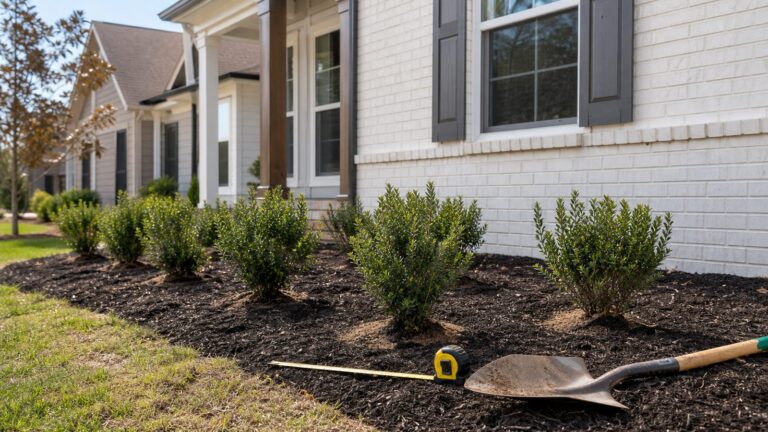
Many shade shrubs are sold in small containers but eventually become much wider. Oakleaf hydrangea, bottlebrush buckeye, spicebush, arrowwood viburnum, nannyberry, witch hazel, serviceberry, and larger rhododendrons can overwhelm a narrow foundation bed if their eventual dimensions are ignored.
Allow room for air circulation, maintenance access, windows, siding, roof overhangs, walkways, utility lines, and future fence or drainage work. Pruning a shrub continually to keep it smaller than its natural habit often produces a stressed or misshapen plant.
Planting and establishment checklist
- Observe the site through the growing season. Light under deciduous trees changes as the canopy develops. Note whether the location receives morning sun, afternoon sun, filtered light, or virtually none.
- Identify moisture patterns. Look for dry root competition beneath trees, damp soil near downspouts, and areas that remain wet after rain. Do not classify a site from one rainy or dry day.
- Check pH when needed. Test before committing to acid-loving shrubs. Amending soil without knowing the existing pH can waste time and create new problems.
- Inspect drainage. Moisture-loving shrubs still need root-zone oxygen. Correct foundation drainage and grading problems separately.
- Choose the cultivar, not just the common name. Record the botanical name, mature height, mature width, bloom timing, hardiness, and pollination requirements.
- Water during establishment. New shrubs need consistent, deep watering while roots grow into surrounding soil. Dry shade often requires more attention than the foliage suggests.
- Mulch moderately. Keep mulch away from stems and trunks. An excessive or constantly wet mulch layer can encourage disease and damage bark.
- Plan for deer and wildlife pressure. Deer may browse native deciduous azaleas and other shrubs. Protection may be more reliable than hoping an unpalatable list will remain untouched.
- Prune according to the plant. Remove dead, damaged, crossing, or weak growth first. Flowering shrubs may need pruning immediately after bloom, while hedging evergreens can have different timing and frequency requirements. A pair of bypass pruning shears is suitable for many small maintenance cuts, but clean tools and plant-specific timing matter more than the tool alone.
Safety and selection cautions
Keep potentially toxic plants away from chewing children and pets
Rhododendrons, azaleas, mountain laurel, yews, boxwoods, and some hollies can pose toxicity concerns if plant material is eaten. Toxicity information is not complete in every database, and risk varies by plant part and amount consumed. If ingestion is suspected, contact a poison-control service, veterinarian, or medical professional rather than relying on an online plant list.
Do not confuse bush honeysuckle with invasive shrub honeysuckle
The common name “honeysuckle” is not enough to identify a plant. The native shade shrub on this list is Diervilla lonicera. Check the botanical name and your state or regional invasive-plant list before purchasing any shrub sold under a honeysuckle name.
Do not assume a shade plant is low maintenance
Hydrangeas may need consistent moisture and support for heavy flower heads. Boxwoods need monitoring for disease, pests, and root problems. Hollies may require correctly matched male and female plants. Kerria, sweetspire, and bottlebrush buckeye can spread by suckers. Evergreens may need protection from winter wind and drought. The right plant reduces maintenance; it does not eliminate it.
Final matching guide
Use this short decision sequence before buying:
- Deep shade: Japanese yew, Anglo-Japanese yew, selected rhododendrons, leucothoe, mountain pieris, inkberry, winterberry, spicebush, or aucuba in a mild climate.
- Dappled woodland shade: mountain laurel, native azalea, oakleaf hydrangea, fothergilla, serviceberry, witch hazel, strawberry-bush, or spicebush.
- Part shade with moist soil: summersweet, smooth hydrangea, Virginia sweetspire, winterberry, inkberry, and viburnums.
- Dry shade beneath trees: bush honeysuckle, Japanese yew, Anglo-Japanese yew, boxwood, mahonia, and carefully selected serviceberries, with irrigation during establishment.
- Evergreen foundation planting: yew, boxwood, rhododendron, azalea, mountain laurel, leucothoe, pieris, mahonia, aucuba, or skimmia, provided the cultivar fits the local climate and mature space.
- Flowers and fragrance: summersweet, smooth or oakleaf hydrangea, rhododendron, azalea, mountain laurel, kerria, witch hazel, or paperbush.
- Native wildlife planting: spicebush, winterberry, sweetspire, serviceberry, viburnums, smooth hydrangea, summersweet, and bottlebrush buckeye.
Research note: Plant and site guidance in this article draws on USDA hardiness guidance, University of Illinois Extension shrub and native-plant selectors, Pennsylvania Extension shade and wet-soil lists, NC State Extension guidance for winterberry pollination, and extension safety resources. Local extension offices and nurseries remain the best sources for cultivar availability, invasive-plant status, and regional performance.
Frequently Asked Questions
What is the best shrub for deep shade?
There is no single best choice for every yard. Japanese yew and Anglo-Japanese yew are among the most adaptable evergreen options. Inkberry, winterberry, spicebush, selected rhododendrons, leucothoe, and mountain pieris can also work when soil moisture, acidity, drainage, and winter exposure match their needs.
Can hydrangeas grow in full shade?
Some hydrangeas tolerate heavy shade, but flowering is usually better with bright or dappled light. Smooth hydrangea and oakleaf hydrangea are good part-shade choices. Bigleaf hydrangea generally performs best with morning sun or bright shade and protection from hot afternoon sun.
Which shade shrubs tolerate wet soil?
Summersweet, inkberry, winterberry, spicebush, Virginia sweetspire, smooth hydrangea, and selected viburnums are useful starting points for moist shade. The site should be damp but not permanently waterlogged unless the species is specifically suited to those conditions.
Do holly shrubs need male and female plants?
Berry production requires female plants and a compatible male pollinizer for inkberry and winterberry. For winterberry, the male must flower at the right time and should be planted nearby; NC State Extension recommends approximately one male for 10 to 20 females within 50 feet.
Are shade shrubs safe around pets?
Not all are. Rhododendrons, azaleas, mountain laurel, yews, boxwoods, and some hollies can pose toxicity concerns if eaten. Check the exact botanical species and contact a veterinarian or poison-control service after suspected ingestion.
The Bottom Line
The best shade shrub is the one that matches your yard’s light, moisture, drainage, soil pH, climate, mature space, and maintenance expectations. For a quick starting point, choose summersweet or sweetspire for moist shade, bush honeysuckle or yew for difficult dry shade, and boxwood, yew, rhododendron, or inkberry for evergreen structure. Verify the cultivar and mature dimensions before planting.
Quick Recap
Product prices and availability are accurate as of the date/time indicated and are subject to change. Any price and availability information displayed on Amazon at the time of purchase will apply.
What’s actually slowing this PC down?
Pick the symptom - the matching free tool is one click away.