To attract butterflies, plant for both parts of their life cycle: nectar flowers for adults and host plants where particular butterflies can lay eggs and caterpillars can feed. The 25 plants below are a region-aware menu, not a universal planting prescription. Before buying, check that each species suits your local climate, soil, light and native-plant guidance.
Why a butterfly garden needs more than nectar flowers
Adult butterflies visit flowers for nectar. Female butterflies lay eggs on host plants, and the leaves become food for caterpillars. A flower bed can bring adult butterflies to the yard, but host plants provide the resources needed for more of the life cycle. Host relationships are often specific to a butterfly species, so choose them for butterflies found in your area.
As an Amazon Associate I earn from qualifying purchases.
The United States Botanic Garden puts the idea simply: “A garden that includes plants for the entire life cycle will attract a variety of native butterflies.” Its detailed plant list is specifically for the Mid-Atlantic, however; the examples below draw on several regional institutional lists and should not be taken as a claim that every plant grows well everywhere.
25 plants to consider
This list includes nectar plants and caterpillar hosts. Some plants can serve both roles in a butterfly garden, but a plant’s role depends on the butterfly and region; the list labels the role supported by the cited guidance. Scientific names help distinguish plants that share a common name.
#1 Best Overall

- EXTRA LARGE PACKET: Embark on a wildflower journey with our generous 1-ounce packet, bursting with over 7,500 pure live seeds! Transform 100 square feet into a vibrant haven for nature.
- THE FRESHEST SEEDS: Elevate your gardening game with our freshest seeds, ensuring high germination rates. Make gardening a joy, where success sprouts effortlessly and blooms into a kaleidoscope of colors.
- PREMIUM PACKAGING: Unwrap gardening delight with our premium seed packaging. Tailored for optimal storage, complete with planting instructions and a reusable zipper – a thoughtful gift for any nature-loving enthusiast.
- GUARANTEED TO GROW: Plant with confidence! We stand by our seeds. If they don't germinate, we'll refund you within 30 days, no questions asked. Sweet Yards guarantees a worry-free and flourishing garden.
- ATTRACT MORE WILDLIFE: Enchant your outdoor space with 23 species of flowers, creating a vibrant tapestry that beckons hummingbirds, butterflies, honey bees, ladybugs, and more. Let your garden buzz with life!
Nectar plants for adult butterflies
- Asters (Symphyotrichum spp. and Eurybia spp.) — nectar plants; several asters also appear among host plants for pearl crescent caterpillars in Iowa State Extension guidance.
- Whorled tickseed (Coreopsis verticillata) — a Mid-Atlantic nectar option.
- Coneflowers (Echinacea spp.) — nectar sources in the Mid-Atlantic list.
- Joe-Pye weed (Eupatorium fistulosum) — a Mid-Atlantic nectar plant.
- Blanket flower (Gaillardia × grandiflora) — a Mid-Atlantic nectar option.
- Lindheimer’s beeblossom (Gaura lindheimeri) — listed as a Mid-Atlantic nectar source.
- Smooth oxeye (Heliopsis helianthoides) — a Mid-Atlantic nectar plant.
- Rose-mallow (Hibiscus moscheutos) — a Mid-Atlantic nectar option.
- Giant catmint (Nepeta × faassenii) — listed as a Mid-Atlantic nectar source.
- Evening primrose (Oenothera spp.) — a Mid-Atlantic nectar plant.
- Thickleaf phlox (Phlox carolina) — one of the Mid-Atlantic nectar options.
- Fall phlox (Phlox paniculata) — a Mid-Atlantic nectar plant.
- American feverfew (Parthenium integrifolium) — listed as a Mid-Atlantic nectar source.
- Black-eyed Susan (Rudbeckia fulgida) — a Mid-Atlantic nectar option.
- Sedum (Sedum spp.) — included among Mid-Atlantic nectar plants.
- Goldenrod (Solidago spp.) — a nectar option in the Missouri Botanical Garden list.
- Bee balm (Monarda fistulosa or Monarda bradburiana) — listed as a nectar plant by the Missouri Botanical Garden.
- Blazing star (Liatris spp.) — a Missouri Botanical Garden nectar option.
Host plants for particular caterpillars
- Willow (Salix spp.) — listed as a host for red-spotted purple caterpillars by the Missouri Botanical Garden. Trees need more room than most perennials.
- Black cherry (Prunus serotina) — a host for tiger swallowtail caterpillars in the Missouri list.
- Pawpaw (Asimina triloba) — a host for zebra swallowtail caterpillars in the Missouri list.
- Spicebush (Lindera benzoin) — listed as a host for spicebush swallowtail caterpillars.
- Fennel (Foeniculum vulgare) — a host plant for black swallowtail caterpillars in the Missouri list.
- Milkweed (Asclepias spp.) — a host for monarch caterpillars in the Missouri list; choose species appropriate to your location.
- Violet (Viola spp.) — Iowa State Extension lists violets as host plants for fritillaries.
Other host examples in regional guidance include river birch, American hornbeam, eastern redbud, flowering dogwood, eastern red cedar, oaks, sumac, arrowwood viburnum, turtlehead, penstemon and switchgrass. Iowa State Extension also lists Zizia, dill and parsley for black swallowtails and sunflowers for painted lady caterpillars. These pairings are not universal: check which butterflies occur locally and verify the plant’s regional suitability.
How to choose plants for your yard
- Provide both roles. Include nectar sources and host plants rather than selecting only showy flowers.
- Match host plants to local butterflies. Caterpillars can be selective; a host plant is useful only if it suits butterflies found in your area.
- Choose for site conditions. Check sun or shade, soil moisture, drainage and available space. A tree or shrub needs a different site than a small perennial.
- Plan for a succession of blooms. Mix plants with different flowering times to make nectar available across more of the growing season.
- Vary flower forms. Different butterflies have different feeding structures and access needs, so a mix of flower shapes and sizes is more useful than relying on one type.
- Buy responsibly. NC State Extension advises choosing nursery-grown native plants or nursery-bred native seeds rather than digging plants from the wild. For a seed mix, inspect the species list and select one intended for your region.
Set up and care for butterfly habitat
A sunny spot is a practical starting point for many butterfly gardens, while some forest-associated species may benefit from shade. Group flowers, vary plant heights, and provide shelter from wind. Flat rocks can offer basking spots, and an accessible water source or damp ground can provide moisture. Adapt these features to the butterflies and conditions in your yard rather than treating one layout as mandatory.
Rank #2

- Pollinator Seed Mix: This Blend Of Wildflower Seeds Will Attract Beautiful Hummingbirds And Butterflies To Your Outdoor Garden And Feed Them All Season Long; Blooms In Spring, Summer, And Fall Until Frost
- Vibrant Wildflowers: Grow A Mix Of Sun-Loving Annual And Perennial Wildflowers; Each Bag Contains 18 Flower Varieties: Butterfly Milkweed, Calendula, Cornflower, Plains Coreopsis, Cosmos, Foxglove, And More
- 25,000 NON-GMO Seeds: Easy-To-Sow Hummingbird And Butterfly Seed Mix Covers Up To 1,000 Square Feet And Is Ideal For Most Soil Types; Select A Sunny Area To Scatter The Seed Outdoors For Planting After Danger Of Heavy Frost
- Burpee Seeds Grow: Burpee Offers The Highest Quality, NON-GMO Seeds Hand-Picked By Expert Horticulturalists For Growing In The Home Garden. Our Germination Rates Are 35% Higher Than Industry Standards. Burpee Has Been Loved By Gardens And Trusted By Gardeners For Over 140 Years.
- Since 1876: Generations Of Customers Have Trusted Burpee To Deliver The Highest Quality Products And Service; Gardeners Rely On Burpee For Accurate Plant Information And How-To Tips That Make Gardening Easier And More Successful; Let’s Grow Together
Avoid pesticides where possible. The United States Botanic Garden warns that pesticides kill butterflies and caterpillars; UF/IFAS notes that all butterfly life stages are very sensitive to pesticides and advises against Bacillus thuringiensis. Expect some chewed leaves on host plants: caterpillar feeding is part of the habitat those plants are meant to provide.
Regional guidance behind the plant choices
The United States Botanic Garden’s detailed list is for the Mid-Atlantic. Missouri Botanical Garden and Iowa State Extension supply additional plant and host examples for their regional contexts. NC State Extension and UF/IFAS provide broader advice on plant selection and garden design. Iowa State’s article is dated March 12, 2021, and notes that its information may not be the most current; treat it as supplementary guidance. No single nationally optimal set of exactly 25 plants is established by these sources, so confirm local ranges and growing requirements before planting.
Quick Recap
Best Value
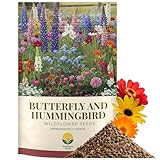
- HIGH-NECTAR FLOWERS FOR BUTTERFLIES AND HUMMINGBIRDS: A focused Wildflower Blend crafted to attract butterflies, hummingbirds, and beneficial pollinators. Each variety is selected for strong nectar production, vibrant color, and reliable garden performance.
- OVER 30,000 NON-GMO SEEDS: Packed with more than 30,000 high-quality, Non-GMO, open-pollinated seeds, providing generous coverage for up to 100 square feet. Ideal for garden beds, borders, pathways, containers, and wildflower meadows.
- LONG BLOOM SEASON FROM SUMMER TO FROST: Designed for continuous color and nectar availability throughout the growing season. Produces waves of blooms in reds, purples, pinks, blues, oranges, and yellows that support pollinators for months.
- EASY TO GROW IN MOST CLIMATES: Simply scatter the seeds, lightly rake, and water. This adaptable mix thrives in full sun and average soils, making it suitable for new gardeners and experienced growers. A simple way to create a vibrant pollinator garden.
- RESEALABLE FOIL-LINED POUCH: Durable, resealable packaging preserves seed freshness, with clear instructions printed on every pouch for easy planting.
Rank #4

- Flower Seeds: Premium bulk package of wildflower seeds to establish a colorful garden filled with red flowers, orange flowers, yellow flowers, blue flowers, pink flowers, purple flowers and more!
- Annual Flower Seeds: Includes varieties like snapdragon seeds, china aster seeds. cosmos seeds, forget me not seeds, larkspur seeds, bird's eyes seeds, treemallow seeds, alyssum seeds, lemon mint seeds and more!
- Perennial Flower Seeds: Our Butterfly Mix contains a few perennial / tender perennial flower seeds, such as butterfly milkweed seeds, giant star columbine seeds, maltese cross seeds, scarlet salvia seeds & four o' clock seeds.
- Butterfly Garden: Attracts a large variety of pollinators to the garden, such as butterflies, bumblebees, honeybees, common bees, ladybugs, hummingbirds and more!
- Large Quantity: Each pouch is packed with thousands of pure live seeds with no added fillers. All packed fresh for the current and following growing seasons.
Rank #3

- Freshest Wildflower Seeds: Our hummingbird and butterfly wildflower mix includes 24 beautiful annual, perennial and biennial plants. We offer the freshest seeds to enhance the quality of your garden, we ensure a high germination rate, 99% pure live seed, no filler
- Attract Pollinators: These flowers will attract pollinators to the garden, such as many beautiful butterflies, bumblebees, bees, ladybugs etc. It can beautify the environment and keep your garden alive!
- High Germination Rate: We meticulously test the germination rates of our seeds to ensure that a high proportion of the seeds you plant will successfully sprout and grow. These wildflowers grow well in spring and summer. They grow to an average height of 12 to 48 inches, covering 194 SQ.FT, about 5-10 days to germination, 35-75 days to flower
- High Quality Packaging: Our seed packs are resealable and provide optimal storage conditions to keeps seeds fresh. Our packaging material is aluminum foil, waterproof and moisture resistant. The planting instructions are displayed on the back of each package, You can also use our online guide to Learn how to grow wildflowers like a professional gardener
- Great Gift Choice: Groundio wildflower seeds make an ideal holiday gift. Perfect for Birthdays, Mothers' and Fathers' Days, Weddings, Thanksgiving Day, Valentine's Day and so on. You can also make the perfect combination of wildflower seeds for kids. Planting hummingbird and butterfly garden seeds is an easy and educational way to do it
Product prices and availability are accurate as of the date/time indicated and are subject to change. Any price and availability information displayed on Amazon at the time of purchase will apply.

