Some links on this page are affiliate links: if you buy through them we may earn a commission, at no extra cost to you.
Wire nuts are only one kind of wire connector. The right choice depends on whether you’re splicing wires, terminating a wire at equipment, or making a specialized connection—and on the connector’s ratings for the conductor, environment, and job. Here are 12 useful connector categories, with the key differences between them.
How to choose a wire connector
Before comparing connector types, identify what the connection needs to do. A wire-to-wire splice is different from a termination at a screw, a grounding or bonding connection, or a lighting connection. Connector names also describe different things: some identify the contact mechanism, such as a spring clamp; others describe the terminal shape, such as a ring.
As an Amazon Associate I earn from qualifying purchases.
Free tools Windows power users keep installed
One-click scans. No signup required.
- Check the conductors: Confirm copper or aluminum, solid or stranded construction, wire gauge, and the number and combination of conductors. Use only combinations accepted by the exact connector model.
- Check the ratings and setting: Match the marked voltage and current limits, enclosure, temperature, and dry, wet, outdoor, or underground conditions to the installation.
- Use the specified method: Follow the product’s instructions for stripping, insertion, twisting, crimping, tightening, and any required tool or die. A connection that looks secure is not a substitute for correct installation.
- Verify suitability: Confirm the product’s listing and approval for the application, and follow applicable local electrical code. Manufacturer product pages describe product families; they do not replace instructions or code requirements.
Wire-to-wire splice connectors
1. Twist-on wire connectors (wire nuts)
A wire nut is a tapered, threaded connector with an internal spring. The installer twists it over prepared conductors; the spring and shell grip the wires. IDEAL describes twist-on connectors as a common North American option in residential and commercial work. Choose a model for the specific conductor combination and listed range, then follow its preparation instructions. IDEAL says it received the first U.S. patent for a “thread-on” wire connector called the Wire-Nut® in 1929; that is the company’s historical claim, not a general measure of connector use. IDEAL Electrical’s connector guide
2. Push-in spring connectors
With a push-in connector, stripped conductors enter spring contacts to make a compact splice; the wires are not twisted together first. Wire acceptance and whether a connector can be reused vary by model. IDEAL states that its push-in connectors are reusable with solid wire but not stranded wire. Treat that as guidance for its products, not a rule for every brand or model. IDEAL Electrical’s connector guide
#1 Best Overall

- Connect any combination of solid, stranded, and flexible copper wires faster and more reliably
- Terminates 24-12 AWG for 221-41x, 20-12 AWG for 221-2401 solid
- Genuine WAGO LEVER NUTS
- Visually inspect for proper strip length and complete wire insertion through its transparent housing
- Includes: 8x 221-2401 (2 conductor inline), 8x 221-412 (2 conductor), 8x 221-413 (3 conductor), 4x 221-415 (5 conductor) with case
3. Lever-operated spring connectors
Lift a lever, insert a compatible conductor, and close the lever to clamp it. WAGO’s 221 and 222 families illustrate this style. IDEAL describes lever connectors as reusable with solid or stranded wire, but the allowable conductor types, sizes, and electrical ratings still depend on the exact model. WAGO’s wire and splicing connectors and IDEAL Electrical’s connector guide
4. Push-wire connectors for solid conductors
Push-wire connectors accept a conductor by pushing it into the connector, without a user-operated lever. That makes “push-wire” distinct from “lever connector,” even though both use spring pressure. WAGO describes its 2773 WALL-NUT family for solid wires; do not assume it accepts stranded wire or that another push-wire model has the same limits. WAGO’s wire and splicing connectors
Rank #2
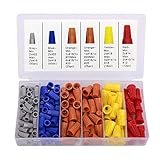
- INSULATION MATERIAL: These electrical wire connectors are made of plastic shell. The nylon shaped shell has thick wall, high hardness and is not easy to aging. It can effectively prevent the unstable connection of leakage box and enhance the safety and insulation.
- STRONG SPRING DESIGN: These Wire Caps are made of metal spring, which is inserted to ensure a stable connection to each application. Preventing the connection from falling off due to instability. Strong wiring, good conductivity.
- COMPACT AND PORTABLE: The electrical wire nuts are a round base with model and specification on the top of the wire connector, compact and portable. The packaging is made of transparent plastic moulded partition storage box to keep different wire connectors separate. There are 5 kinds of nuts with different colors. Special size corresponds to special colors for easy identification and selection. Clear, easy to store and use.
- HIGHT COST PERFORMANCE: Complete specifications, 5 different specifications of wire nuts, special size of special colors. The package includes 50pcs Grey, 50pcs Blue, 50pcs Orange, 18pcs Yellow, 12pcs Red. The most common size can be used for everyday electrical wiring projects and applications.
- WHAT YOU GET:180PCS wire nuts(50pcs Grey, 50pcs Blue, 50pcs Orange, 18pcs Yellow and 12pcs Red), our worry-free 30-days and our 7*24 friendly customer service for peace of mind.
5. Inline splicing connectors
An inline splice joins conductors end-to-end rather than bundling several wires into a branch splice. WAGO describes its 224 family for household and building applications joining solid and fine-stranded conductors. IDEAL describes SpliceLine as a crimp-free, solderless butt splice. These product families differ in design and acceptance; check the exact model’s conductor, enclosure, and application limits. WAGO’s wire and splicing connectors and IDEAL Electrical’s connector guide
6. Crimp butt splices
A crimp butt splice has a tubular barrel that joins two wire ends when compressed with the specified crimp tool. Properly installed crimp splices are generally permanent and suited to applications where a lasting connection is wanted. Match the wire size, terminal, tool, and environment; an incompatible tool or connector can leave an unreliable crimp. TE Connectivity’s terminals and splices
Rank #3

- 【1-Second Connection - No Stripping】Still frustrated with soldering, stripping wires, or messy tape? These quick connect wire connectors solve it all. Just open the lever on our wire quick connectors, push the intact wire straight in, and snap it shut—secure connection in just 1 second. No stripping, no tools, no prep, ultra-simple for anyone.
- 【Premium Flame-Retardant Materials】 Crafted from high-quality PA66 flame-retardant nylon, this quick wire connectors ensures superior thermal stability. Stop worrying about melting or short circuits—even in high-temperature, demanding environments. The modified copper core guarantees optimal conductivity and corrosion resistance for a safe, reliable connection.
- 【Secure Locking - Never Pulls Out】 Innovative locking strip connector + independent clamp ensures wires stay locked firmly even with vibration. Ideal for LED strips, cars, and moving installations—say goodbye to loose connections!
- 【Reusable & Versatile for Any Wire】 Unlike one-time connectors, these double wire plug in connector fully reusable, allowing you to reconfigure wiring projects without wasting resources. Compatible with 22-18 AWG solid and stranded wires. The independent spring-clamp design adapts to various diameters, ensuring secure, stable electrical circuits.
- 【Wide Applications + Clean Wiring】Perfect for LED strip lights, speakers, fans, sockets, switches, motorcycles, cars, model kits, and all household low-voltage projects. The compact design fits easily into tight spaces, reducing wire clutter. Optimized for low-voltage, solderless fine wire connectors, it significantly speeds up projects for both professionals and DIY hobbyists.
Terminals that connect a wire to equipment
The next types are termination shapes or interfaces, not general-purpose splices for joining loose wire ends.
7. Ring terminals
A ring terminal ends in a closed loop secured over a screw or stud. It connects a terminated wire to a compatible equipment connection point; it is not a wire-to-wire splice. Check the terminal, fastener, wire, and equipment ratings together. TE Connectivity’s terminals and splices
Do these 3 things before closing this tab:
1Clear out junk files and repair common Windows errors2Fix the driver behind crashes, sound loss and screen glitches3Repair Windows errors before they cause bigger problemsRank #4
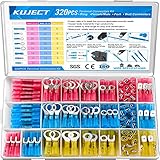
- Multiple Choices: Proper ratio of various types to meet the commonly used types needs. This wiring terminals kit contains ring, fork, spade, and heat shrink butt connectors
- Stronghold and Durability: We adopt premium copper core to ensure good electrical conductivity and durability. Heat shrink crimp connectors provides greater pull strength
- Waterproof: With the adhesive melted when heated, the heat shrink tubing seals all the way to the end of the barrel. The connections were to be outside or inside the vehicles, will perform good water proof
- Straightforward Visual Inspection: Translucent, adhesive-lined polyolefin tubing for straightforward visual inspection, prevents wire corrosion, and provides a waterproof seal
- Wide Applications: Good electrical conductivity and water proof provide connection for your automotive, motorcycle, and marine application. Widely used on multiple projects of your vehicle or ATV lighting, motorcycle stereo, boat electronics, equipment switches
8. Spade or fork terminals
A fork terminal fits under a screw head. Where the terminal and equipment are designed for it, the fork can be removed without fully taking out the screw. It is a device termination, and its fit and rating must match the screw connection. TE Connectivity’s terminals and splices
9. Pin terminals and ferrules
Pin terminals and ferrules provide a pin-shaped or tubular end on stranded wire for a compatible terminal. They can organize strands at a termination, but a ferrule is not suitable for every screw clamp. Confirm that the equipment terminal permits the specific pin or ferrule and use compatible tooling where required. TE Connectivity’s terminals and splices
Best Value

- Connect any combination of solid, stranded, and flexible copper wires faster and more reliably
- Terminates 24-12 AWG for 221-41x, 20-12 AWG for 221-2401 solid
- Genuine WAGO LEVER NUTS
- Visually inspect for proper strip length and complete wire insertion through its transparent housing
- Includes: 25x 221-2401 (2 conductor inline), 25x 221-412 (2 conductor), 25x 221-413 (3 conductor), 15x 221-415 (5 conductor) with case
10. Quick-disconnect terminals
A quick-disconnect uses a blade or tab and a matching receptacle to make a serviceable equipment connection. TE’s FASTON range includes insulated terminals and receptacles. Match the terminal dimensions and electrical ratings; a physically similar connector is not necessarily compatible. TE Connectivity’s terminals and splices
Independent reader supportYour contribution helps us test, update, and keep practical guides available for everyone.Application-specific connectors
11. Compression and mechanical connectors
Lugs and other mechanical or compression connectors attach conductors for power, grounding, or bonding applications. Mechanical products use a specified tightening method; compression products require the compatible tool and die. ABB describes copper and aluminum solutions, including compression products compatible with standard compression tools and dies. These are application-specific products, not substitutes for household wire nuts. ABB’s wire terminals
The Tool Desk
Outbyte Driver Updater FREEScan for outdated or missing drivers - takes under a minuteDriver Scan →Outbyte PC Repair FREEClear out junk files and repair common Windows errorsFree Scan →12. Specialty connectors: grounding, lighting, and more
Some connector families are designed for a particular task rather than general splicing. Grounding and bonding connectors, insulation-piercing connectors, luminaire connectors, terminal blocks, and products for shielded wire have distinct approved uses. WAGO documents luminaire connectors and terminal blocks; IDEAL documents grounding and insulation-piercing products; ABB describes specialized wire-termination products. Do not substitute a general splice connector for a product specifically rated for the application. IDEAL Electrical’s connector guide, WAGO’s wire and splicing connectors, and ABB’s wire terminals
At a glance: which connector does what?
| Type | Connection or mechanism | Key selection point |
|---|---|---|
| Twist-on wire connector | Wire-to-wire splice; twisted onto conductors | Use a model listed for the conductor combination. |
| Push-in spring connector | Wire-to-wire splice; conductors push into spring contacts | Check accepted conductor construction and model-specific reuse guidance. |
| Lever-operated spring connector | Wire-to-wire splice; lever opens and closes a spring clamp | Check exact model’s wire range and ratings. |
| Push-wire connector | Wire-to-wire splice; conductor pushes into a spring contact without a lever | WAGO describes its 2773 family for solid wire; verify the specific model. |
| Inline splicing connector | End-to-end wire splice | Check conductor acceptance and enclosure limits. |
| Crimp butt splice | End-to-end wire splice; barrel is compressed | Use the specified crimp tool and compatible terminal. |
| Ring terminal | Wire-to-equipment termination over a screw or stud | Match the terminal to the connection point and ratings. |
| Spade/fork terminal | Wire-to-equipment termination under a screw head | Confirm the equipment is designed for the terminal. |
| Pin terminal/ferrule | Wire-end termination for a compatible terminal | Do not assume every screw clamp accepts a ferrule. |
| Quick-disconnect terminal | Serviceable blade-and-receptacle equipment connection | Match terminal dimensions and ratings. |
| Compression/mechanical connector | Power, grounding, or bonding connection | Use the specified tightening method or compatible tool and die. |
| Specialty connector | Purpose-specific connection, such as grounding or lighting | Use only for the application and conditions for which it is rated. |
Common selection mistakes to avoid
- Calling every connector a “wire nut”: wire nuts are twist-on connectors, not a catch-all term.
- Assuming push-in, push-wire, and lever connectors accept the same conductors or can all be reused.
- Using a terminal shape such as a ring or fork as if it were a wire-to-wire splice.
- Crimping with an unspecified tool or choosing a crimp terminal without matching it to the wire.
- Using a general-purpose splice connector for aluminum-to-copper, grounding, wet or underground work, or another specialized application without confirming that the exact product is rated for it.
Manufacturer guidance is available from WAGO’s connection technology overview; always consult the exact product instructions and applicable local code for an installation.
Quick Recap
Product prices and availability are accurate as of the date/time indicated and are subject to change. Any price and availability information displayed on Amazon at the time of purchase will apply.

