The Tool Desk
Outbyte Driver Updater FREEFix the driver behind crashes, sound loss and screen glitchesFind Drivers →Outbyte PC Repair FREEClear out junk files and repair common Windows errorsFree Scan →Some links on this page are affiliate links: if you buy through them we may earn a commission, at no extra cost to you.
Capture wood dust where each machine creates it, before it spreads into the shop. Effective dust control depends on suitable hoods, ductwork, a collector matched to the machines, and regular maintenance; cleanup vacuuming and a respirator play different, supporting roles. No single collector, vacuum, respirator, or air cleaner makes every workspace safe.
1. Capture dust at the source
Use exhaust ventilation to collect dust at the point of operation whenever feasible. OSHA describes source capture as the preferred engineering approach: contain and remove dust before it becomes airborne throughout the shop. Room air filtration may help manage remaining airborne dust, but it does not replace extraction at dust-producing machines.
As an Amazon Associate I earn from qualifying purchases.
Quick wins for a faster PC:
Fix the driver behind crashes, sound loss and screen glitchesFind Drivers →Clear out junk files and repair common Windows errorsFree Scan →Scan for outdated or missing drivers - takes under a minuteDriver Scan →OSHA guidance: Woodworking eTool: Dust Collection and Woodworking eTool: Fire and Explosion.
2. Keep each hood close to the dust source
A hood is more effective when it intercepts dust near the point where it is thrown or generated. OSHA advises positioning hoods as close as possible to the source. NIOSH notes that moving a shaper hood nearer the cutting head can improve collection, although the position may limit operator movement. Balance capture with safe, unobstructed operation; do not place a hood where it interferes with the work or guards.
Popular on Amazon
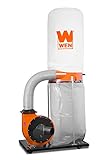
- Circulate up to 1,300 cubic feet of air per minute
- Attach up to two tools at a time with the dual 4-inch air inlets
- Vertical collection bag holds up to 50 gallons of dust
- 14-amp motor rotates the 10-inch steel impeller up to 3450 RPM
- Includes mobile base with four swivel casters for easy mobility
See OSHA wood-dust controls and NIOSH guidance for controlling shaper wood dust.
3. Use collection arrangements suited to the machine
Different machines release dust and chips in different directions, so one hood design is not a universal solution. OSHA gives examples that illustrate how collection can be integrated with the work:
- Circular saw: extraction beneath the saw table, with an upper hood integrated into the guard as an additional control.
- Random-orbit sander: a perforated sanding pad connected to an aspirator.
These are examples, not instructions to retrofit every machine. Follow the machine maker’s requirements and use a suitable design that preserves guarding and safe access. See OSHA machine setup guidance.
Also popular on Amazon

- 5.7-amp brushed motor combined with the 6-inch impeller moves up to 660 cubic feet of air per minute
- 4-inch dust port allows for connection to your favorite woodworking tools
- Compact design includes an onboard carrying handle for easy storage and transportation
- Measures in at 34.25 x 13 x 14.2 inches in size with a weight of 17 pounds
- Features lockable swivel casters, an optional wall mount, a 12-gallon 5-micron zippered collection bag, and a two-year warranty
4. Match the collector and duct system to the work
Choose a dust collector and duct arrangement for the machines it must serve, their hoods, and the airflow the installation requires. A collector’s label or capacity alone does not establish that dust will be captured effectively at every machine: hood position, duct layout, and airflow work together. OSHA calls for a suitable collector and well-designed ducts and hoods, but its guidance does not establish one collector size or duct diameter for every shop. Have the system designed for the actual machines and installation rather than relying on a one-size-fits-all specification.
5. Maintain the entire airflow path
Collection can be undermined by problems anywhere between the hood and collector. Inspect and clean ducts and the collector regularly. Check for loose, broken, or damaged ducts and inspect fan drive belts; repair faults that compromise airflow.
OSHA’s woodworking eTool gives a duct-velocity range of 2,500–4,000 feet per minute for moving light, dry sawdust, heavy chips, and green shavings while limiting plugging. Treat that as the eTool’s guidance for the described material and purpose, not a universal design target for every duct system. See OSHA wood-dust controls.
Also popular on Amazon
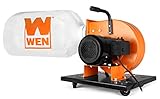
- Powerful 7.4-amp induction motor combined with the 9-inch impeller moves up to 600 cubic feet of air per minute
- 4-inch dust port allows for connection to your favorite woodworking tools
- Mount the unit to the wall of your shop for accessible dust collection whenever you need it
- Features an onboard carrying handle, swivel casters, a 15-gallon 5-micron zippered collection bag, and a two-year warranty
- Measures in at 43.3 x 17.7 x 20.1 inches in size with a weight of 41.1 pounds
6. Use a suitable industrial vacuum for cleanup
Machine extraction and cleanup are separate tasks. For settled wood dust, UK HSE recommends a suitable industrial vacuum meeting at least Class M. That is a cleanup recommendation; it does not replace source extraction at each machine. HSE guidance is UK-specific, so check applicable requirements where you work. See HSE: Wood dust.
7. Do not blow settled dust around with compressed air
Never use compressed air to blow accumulated dust off machinery or surfaces. It disperses dust into a cloud, and OSHA warns that the resulting cloud presents an explosion hazard. Remove settled dust with a suitable vacuum or another appropriate cleaning method instead. See OSHA: Fire and Explosion.
Independent reader supportYour contribution helps us test, update, and keep practical guides available for everyone.8. Treat respirators as supplemental protection
A respirator is not a substitute for controlling dust at its source. OSHA says respirator selection requires knowledge of workplace conditions, contaminants, and concentrations, and respirator use requires a respiratory protection program. Do not assume one mask type or rating is appropriate for every woodworking task; workplace conditions and applicable rules determine the selection. See OSHA: Dust Collection.
Also popular on Amazon

- 【HIGH EFFICIENCY】 Our DEWALT high efficiency dust separator can capture wood chips and other debris before they enter your vacuum cleaner, reducing suction loss due to clogged vacuum filters. Saves you the cost and time of expensive filter and dust bag replacement.
- 【WIDE APPLICATION】 This dust separator applies to most materials: wood chips, drywall dust, concrete dust, clay silica dust, soda water, cooling ash and soot, water, metal shavings, baking powder, grass and leaves, pets hair, drug waste and more.
- 【COMPATIBLE DESIGN】 The four-caster base of the dust collection system makes it very stable and easy to move around the workshop. Our 6 gallon shop vacuum system barrels are easy to empty. With 1-7/8" or 2-1/2" port, it can be used with most vacuum cleaners, such as household vacuum cleaners, industrial vacuum cleaners, sweepers, etc.
- 【PREMIUM MATERIALS】 All included parts are made of durable, high-quality and heat resistant materials with anti-clogging design for optimum efficiency.
- 【WHAT YOU GET】1 x DEWALT dust separator, 1 x 6 gallon poly bucket (vacuum cleaner not included), 2 x Hose Holder, 1xLid, 2 x Lid Sealing Strip, 2 x Lid Latch, 2 x Handle, 1 x 1-7/8" Hose, 1 x Wheel Bracket, 4 x Caster bushing, 4 x Screws (3.9 * 16 F), 4 x Screws (4.8 * 16 F),1 x 3 years limited warranty.
9. Prevent combustible dust buildup
Wood dust accumulation can contribute to fire and explosion hazards. Housekeeping and exhaust ventilation are among OSHA’s key controls. Keep dust from building up on floors, equipment, and other surfaces, and maintain collection so it removes dust rather than allowing it to accumulate. See OSHA: Fire and Explosion.
10. Separate combustible materials from ignition sources
Keep combustible and flammable materials—including lumber and solvents—away from ignition sources. OSHA also calls for equipment appropriately rated for the environment. Workplace dust-collection installations can involve fire and explosion hazards; use applicable standards and qualified design help rather than improvising explosion-protection measures. OSHA’s U.S. workplace guidance is not a substitute for the rules that apply in another jurisdiction.
How the controls fit together
Think of dust management as a sequence: capture dust at the machine, convey it through a properly designed and maintained system, and vacuum what settles during cleanup. A respirator may be part of a workplace protection program, but it does not replace those controls. OSHA’s woodworking references are U.S.-specific; HSE’s Class M vacuum guidance is UK-specific. Follow current local requirements for your workplace.
Quick Recap
Product prices and availability are accurate as of the date/time indicated and are subject to change. Any price and availability information displayed on Amazon at the time of purchase will apply.

