Yes—if the room is occupied and your fan has a reverse function, running it in winter can make the room feel more evenly comfortable. Set the fan to rotate clockwise when viewed from below and use the lowest speed that gently mixes the air.
That setting does not produce heat. It moves warm air that has risen toward the ceiling back into the occupied part of the room, which can be particularly useful in rooms with high, vaulted, or cathedral ceilings. The fan should be off when nobody is using the room.
As an Amazon Associate I earn from qualifying purchases.
What a ceiling fan does in winter
Heating systems add heat to a room. A ceiling fan does not. Its winter job is to redistribute heat that is already present.
Quick wins for a faster PC:
Repair Windows errors before they cause bigger problemsFix Now →Fix the driver behind crashes, sound loss and screen glitchesFind Drivers →Clear out junk files and repair common Windows errorsFree Scan →Warm air is less dense than cool air, so it naturally rises. In a room with a tall ceiling, this can create temperature layers: warmer air collects overhead while the air at floor level feels cooler. A fan running slowly in reverse mixes those layers and sends some of the warmer upper-level air back down without creating the strong breeze associated with summer operation.
#1 Best Overall
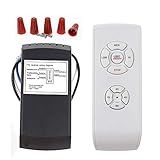
- ☞Easy Installation - Installation of the Universal Ceiling Fan Remote Controls Kit is a breeze, and the looks of the remote are second to none. No need to take off the light kit and blades. Only a 5-wire hookup. All we need to do is loosen the collar at the ceiling, let it slide down to reveal the wires, and access the electrical can. Two wires out of the ceiling connect the remote to electricity, and three wires into the fan control the fan.
- 🛑 STRICT COMPATIBILITY CHECK — AC MOTORS ONLY! DO NOT BUY if your ceiling fan has a DC motor! This universal kit is designed strictly for traditional AC motor fans. How to tell? If your original remote has more than 3 speeds (e.g., 4, 5, 6 speeds) or features a natural wind/reverse button on the remote, it is a DC fan and NOT compatible. Not compatible with Sofucor, CARRO, Merra, Home Decorators Collection, or any DC motor brands.
- 📏 MEASURE BEFORE BUYING — RECEIVER SIZE 4.53"x1.97"x1.06" CRITICAL: Please measure your ceiling fan canopy (top base) space before ordering! The receiver dimensions are 4.53 x 1.97 x 1.06 inches. If your fan is a slimline, hugger, or flush-mount model, this standard-size receiver WILL NOT FIT. *Too tight? If your canopy space is limited, please slide down to our comparison chart below and choose our "Ultra-Small Size Receiver" version instead!
- ☞3-in-1 Replacement Ceiling Fan Remote Control: No more getting up to turn the lights/fan off after reading in bed/sleeping with the replacement remote control. Includes separate buttons for 3 fan speeds, designed to separately ceiling fan remote control speed and light; Includes a wall cradle for a handheld remote control. This kit converts a regular ceiling fan into a remotely controllable one.
- ☞THE PULL-CHAIN RULE: Your fan's original pull chain MUST be pulled to MAXIMUM SPEED and the light turned ON before installing this Ceiling Fan Remote Control, otherwise the remote will not receive power."
The objective is more even temperature distribution, not a higher room temperature. ENERGY STAR explains that ceiling fans affect how people experience the air rather than changing the room’s temperature, and recommends switching them off in unoccupied rooms. See its ceiling-fan installation and usage guidance.
Which direction should a ceiling fan turn in winter?
For most conventional residential ceiling fans, winter mode is:
- Clockwise when viewed from directly underneath the fan
- Low speed
- Slow enough that you feel little or no noticeable downward draft
Summer mode is normally counterclockwise, which pushes air downward and creates a cooling breeze on your skin. That is useful when people are trying to feel cooler, but a high-speed downward breeze can undermine the comfort benefit you want in winter.
Crashes, No Sound, or Screen Glitches?
Random freezes, missing sound and display glitches usually trace back to one bad driver. Find and replace yours safely.Free scan · under a minuteWindows Errors? Fix Them Before They Spread
Repair common Windows errors and clear accumulated junk for a smoother, more stable PC - no reinstall needed.Free scan · no reinstallDo not rely solely on looking at the blades from an angle. Stand directly beneath the fan. In winter mode, you should not feel a strong stream of air blowing onto you. If you do, reduce the speed or check whether the fan is rotating in the correct direction.
How to reverse the fan
The control varies by model. Look for one of these options:
Rank #2

- Universal Ceiling Fan Remote Control Kit:it works well with 95 percent of ceiling fan light,This wireless controller kit converts traditional ceiling fan with lights into a remote controllable one.So please enjoy the convenience of adjusting fan speed and turning on/off without having to struggle out of bed.
- Multi-Fuctions:Designed with separate buttons which can control fan and light on/off separately.4 independent fan control buttons: 3 speed (high/medium/low) and OFF; 4 separate buttons for timing remote setting and control: 1H, 2H, 4H, 8H
- Good Signal:Strong Signal and timely tech support.If you encounter any problems while using this product, please feel free to contact us.This is likely to be an operational issue rather than a product quality issue.
- Package Included:The remote control kit includes a transmitter and a receiver, Batteries are not included.And the size of the receiver is 4.56*2.08*1.06 inches,please confirm in advance whether the ceiling fan canopy CAN ACCOMMODATE the receiver before buying.
- Easy Installation: No need to take off the light kit and blades,only 5 wire hookup. All we need to do is loosen the collar at the ceiling, let it slide down to reveal the wires and access into the electrical can. Two wires out of the ceiling connect the remote to electricity, and three wires into the fan control the fan.
- A manual reverse switch: Turn the fan off and wait for the blades to stop. The switch is often located on the motor housing beneath the blades.
- A remote-control reverse button: Some remotes label the control “Reverse,” “Direction,” or use a seasonal symbol.
- A wall control or smart-home setting: The direction may be changed through a wall switch, app, or fan-control menu.
Use the manufacturer’s manual when its instructions differ from general seasonal guidance. Never reach into a moving fan or try to move the direction switch while the motor is operating unless the manufacturer specifically says that the model permits it.
If your existing fan works but its remote is missing or unreliable, a compatible replacement ceiling-fan remote may be useful—but compatibility is model-specific. Check the fan model, receiver, frequency, pairing procedure, and control system before buying. A generic-looking remote is not automatically compatible.
Do these 3 things before closing this tab:
1Fix the driver behind crashes, sound loss and screen glitches2Repair Windows errors before they cause bigger problems3Scan for outdated or missing drivers - takes under a minuteWhere winter fan operation helps most
The strongest use case is a room with a high, vaulted, or cathedral ceiling. The greater the vertical distance between the occupied zone and the ceiling, the more opportunity there may be for warm air to collect overhead.
An ENERGY STAR installation guide gives a cathedral-ceiling example in which the temperature difference between the floor and ceiling can reach 15°F and says a properly sized fan may reduce that difference to about 2°F. That is an example from the guide—not a performance guarantee for every room, fan, or heating system. Actual results depend on ceiling height, fan size and design, insulation, air leakage, the heat source, and the room layout. The example appears in the ENERGY STAR ceiling-fan guide.
In a standard room with a low ceiling, there may be less temperature stratification to correct. A fan can also feel uncomfortable more quickly because the blades and moving air are closer to occupants. Use the lowest practical speed and stop if the room feels drafty.
Will running a ceiling fan in winter lower heating bills?
It may help in some homes, but there is no honest universal percentage savings figure. Claims that every household will save 15%, 20%, or 30% on heating costs are not supported by the official guidance cited here.
Rank #3

- Will it work with your fan? This universal kit replaces FAN-53T, FAN-35T, L3HFAN35T, L3HFAN35T1, FAN-HD5, FAN-11T and KUJCE9103 remotes on Hampton Bay, Harbor Breeze, Hunter, Westinghouse and Honeywell fans. It is for standard AC motor pull-chain fans and does not support the reverse function.
- Will it fit inside your canopy? The mini receiver measures 2.8 x 2.15 x 1 inches, which is shorter than a standard receiver. Measure the inside of your canopy before ordering. This is the step most buyers skip, and the most common reason these kits do not fit.
- What can you control? Three fan speeds (high, medium, low) plus off, and a light button that dims incandescent bulbs. Dimming does not work on LED or CFL bulbs, which will only turn on and off. This remote has no timer and no reverse function.
- How hard is the install? About 10 minutes and 5 wires. The remote and receiver are matched with four DIP switches, so you set the code once and never pair them again. The kit includes wire nuts, a wall mount holder and a visual guide.
- What if the light turns on by itself? That can happen after a power cut, and the fix takes 10 seconds. Turn the wall switch off and back on to reset the receiver. The remote uses alkaline batteries, which are not included. This kit does not work with DC motor fans.
If the air mixing makes the room feel comfortable at a slightly lower thermostat setting, energy and cost savings may be possible. But the result depends on the building, climate, heating equipment, thermostat behavior, electricity price, fan efficiency, and how long the fan runs. Adjust the thermostat based on actual comfort and how your heating system responds—not on a promised fixed percentage.
Remember that a fan uses electricity. A low setting normally uses less electricity than a high setting, but consumption varies by motor, controls, lighting, and model. If the fan is running in an empty room, it is using energy without making anyone more comfortable.
How long should you run the fan?
Run it while the room is occupied and the air mixing is useful. There is no need to operate it continuously through the winter or leave it on when everyone has gone elsewhere.
A practical routine is:
- Turn the fan on after the heating system has warmed the room.
- Use clockwise rotation at low speed.
- Check whether the room feels more evenly comfortable after the air has mixed.
- Lower the thermostat only if occupants remain comfortable and the heating system behaves normally.
- Turn the fan off when the room is unoccupied.
In a room with a heat pump, furnace, radiant heater, or other system, the fan does not replace the heating equipment. It only moves air. Do not use fan operation as a substitute for correcting an inadequate heat source, blocked vent, poor insulation, or dangerous heating fault.
Recommended Free Tools
Choosing a fan for winter use
If you are buying or replacing a fan, the essential feature is a reliable reverse function. A reversible ceiling fan can normally run clockwise for winter air mixing and counterclockwise for the summer breeze. Choose one that is appropriate for the room’s size and ceiling height, and compare noise, control type, mounting requirements, and lighting separately.
ENERGY STAR-qualified ceiling fans are another option to investigate. ENERGY STAR says qualified models can provide more efficient airflow, and that qualified fan-and-light combinations may be substantially more efficient than conventional units. Check the specific product listing and current certification status rather than assuming that every fan with a light has the same performance. The program’s explanation of the relevant components is available in its ceiling-fan performance guidance.
A certification focused on airflow or lighting efficiency does not guarantee that a particular fan will be ideal for your room. Confirm that it can reverse direction, that the control system suits your installation, and that the manufacturer provides the correct mounting hardware and instructions.
Rank #4

- 【 Universal Ceiling Fan Remote Control Kit 】 This CENMING ceiling fan remote kit works most 120V 3-speed AC ceiling fans, compatible with Harbor Breeze, Hampton Bay, Hunter, Litex and other ceiling fans. This fan remote kit is suitable for replacement or upgrade your ceiling fans, compatible with most downrod style fans, not recommended for use with hugger style fans. It not for wall mounted fans or exhaust-type fans, and also not for DC motor ceiling fans.
- 【 Ceiling Fan Remote Control Replacement 】 This CENMING model FAN-53T ceiling fan remote controller is designed to separately control your ceiling fan speed and light brightness. The fan remote controller have High/Medium/Low 3-speed and OFF for fan speed control, The light button will control the light brightness dimmer and On/Off. This remote NOT has reverse button, but compatible the fans that has reverse switch itself.
- 【 Fan Remote with Light Dimmer 】 Light dimmer compatible with incandescent light bulbs and some dimmable LED lights. Most LED lights and all CFL lamps are non-dimmable, light dimmer only supports the ON/OFF function in that case, and it may cause to flicker when using the dimming function. The green luminous button can help you find the remote in the dark.
- 【 Powerful and Long-lasting Fan Receiver 】 The rated power of the FAN28R receiver is 240W, which far beyond the general carrying power capacity, it allows you to access more light bulbs, greatly increase the life of the receiver. This FAN28R receiver is suitable for Harbor Breeze, Hampton Bay, Hunter and most 110V 3-speed AC ceiling fans.
- 【 Packing 】 Includes Remote Control *1, FAN28R Receiver *1, Wall Mount Holder *1, User Manual *1, Wire Nuts *6, Screws *2. This remote use a 9V battery (NOT INCLUDE) for power supply.
Installation requirements that matter
Keep the blades safely above the floor
ENERGY STAR recommends keeping ceiling-fan blades at least 7 feet above the floor. An installation height of approximately 8 to 9 feet is desirable for airflow where the ceiling allows it. Fans mounted close to the ceiling can be the practical choice in low rooms, but they may move less air than a properly positioned fan.
What’s actually slowing this PC down?
Pick the symptom - the matching free tool is one click away.
Use the right mount for the ceiling
Flat and sloped ceilings may require different mounting hardware. A tall room may need a downrod to position the fan appropriately, while a vaulted or angled ceiling may require an approved angled-ceiling adapter. Use a ceiling-fan downrod or angled-ceiling mount only when it is compatible with the fan model, ceiling angle, electrical box, and manufacturer’s installation instructions.
Do not improvise with ordinary electrical hardware or an unapproved accessory. The fan must be attached to an electrical box and support system rated for ceiling-fan loads, not merely to a standard ceiling-light box unless that box is specifically fan-rated.
Deal with wobble before increasing speed
A wobbling fan should not simply be run faster. Turn it off and check:
- Whether the mounting hardware is tight and the fan is properly attached.
- Whether the blades are aligned and installed at the same angle.
- Whether any blade or blade holder is damaged or bent.
- Whether the fan remains stable at low speed after fastening and alignment checks.
If the installation is sound but the fan still wobbles, a ceiling-fan balancing kit can help identify and correct a blade-balance problem. Follow the kit and fan instructions. Persistent movement, clicking, scraping, loose wiring, or a visibly unstable mount warrants professional inspection.
The Tool Desk
Outbyte PC Repair FREEClear out junk files and repair common Windows errorsFree Scan →Outbyte Driver Updater FREEFix the driver behind crashes, sound loss and screen glitchesFind Drivers →Clean blades can support quieter, more consistent operation, but cleaning alone should not be presented as a guaranteed energy-saving measure. Always switch off power before cleaning or servicing, and do not remove guards or housing components unless the instructions call for it.
Independent reader supportYour contribution helps us test, update, and keep practical guides available for everyone.Common winter mistakes
| Mistake | Why it is a problem | Better approach |
|---|---|---|
| Expecting the fan to create heat | A fan redistributes existing warm air; it does not replace a heater. | Use it to reduce temperature layering and improve comfort. |
| Running counterclockwise at high speed | This usually creates a cooling breeze. | Use clockwise rotation at low speed, viewed from below. |
| Leaving it on in an empty room | The fan consumes electricity without benefiting occupants. | Turn it off when the room is unoccupied. |
| Assuming a fixed heating-cost saving | Results vary too much between buildings and systems for one percentage to apply universally. | Adjust the thermostat only when actual comfort permits. |
| Using an incompatible remote or accessory | Controls and mounting parts are model-specific and may create safety or property risks if mismatched. | Verify the model and use manufacturer-approved parts. |
| Ignoring a wobble | Excess vibration can indicate loose, misaligned, or unbalanced components. | Switch it off, inspect the installation, and balance or repair it. |
Winter ceiling-fan checklist
- ☐ The fan has a reverse function.
- ☐ It rotates clockwise when viewed from below.
- ☐ It is set to the lowest comfortable speed.
- ☐ You feel little or no strong downward draft beneath it.
- ☐ The room is occupied while the fan is running.
- ☐ The blades are at least 7 feet above the floor.
- ☐ The electrical box and mounting hardware are rated and suitable for the fan.
- ☐ A downrod or angled mount is approved for the fan and ceiling.
- ☐ The fan is stable, quiet, and free of abnormal wobble or scraping.
- ☐ Any thermostat adjustment is based on actual comfort rather than a promised savings percentage.
Frequently Asked Questions
Does a ceiling fan make a room warmer in winter?
No. It does not add heat or raise the room’s temperature by itself. A slow clockwise setting can mix warm air near the ceiling with cooler air below, helping occupants feel more evenly comfortable.
Best Value
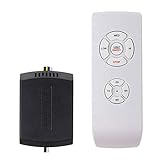
- AC Motor Fans Only – This remote kit is for standard AC motor ceiling fans only. It is not compatible with DC motor fans, smart fans, or fans that require a proprietary control system. This ceiling fan remote can convert traditional ceiling fan lights into wireless control ones. No dimming and no reverse function.
- Check Receiver Space Before Purchase – Receiver size is 2.99 x 2.13 x 0.98 inches. Please measure the canopy space before buying. These ceiling fan remote receivers are a bit smaller than standard receivers and easier to fit in the canopy. Very compact, slimline, hugger, or low-profile fan housings may not have enough room for the receiver.
- Important Installation Setup – Before testing the remote, make sure the wall switch is ON, the fan pull chain is set to HIGH, the light is set to ON, and the receiver wiring is connected correctly. Installation of the ceiling fan remote kit is straightforward and fast, with only 5 wires to be hooked up. Additionally, it comes with wire nuts, an installation guide, and a straightforward remote tray that can be easily attached to the wall.
- ☞Multi-Functions- This universal fan remote converts a regular ceiling fan into a remote-controllable one(NO dimming, NO reverse). The remote control features 4 buttons for fan speed control (High/Medium/Low) and an OFF button, along with a switch for the light ON/OFF control. 4 separate buttons for timing remote setting and control: 1H, 2H, 4H, 8H.
- ☞Compatibility Check Before Buy: For AC Motor Fans Only – Not for DC Motors, please check your ceiling fan light motor type before buying! Receiver Dimensions: 2.99*2.13*0.98 inches – Verify Canopy Space Before Purchase! If your ceiling fan light canopy is very compact, this standard-size fan remote can not fit in!
Should a ceiling fan run clockwise or counterclockwise in winter?
For most conventional residential fans, run it clockwise when viewed from below. Use low speed and confirm beneath the fan that it is not producing a strong cooling draft.
Should I leave my ceiling fan on all day in winter?
Usually not. Run it when the room is occupied and the air mixing is useful. Turn it off when nobody is present because it consumes electricity without changing the room’s temperature.
Free tools Windows power users keep installed
One-click scans. No signup required.
Are ceiling fans useful with low ceilings?
They can be, but the benefit may be smaller because there is less vertical temperature stratification. Since the blades are closer to occupants, use a very low speed and stop if the air feels drafty.
Can I use a normal light switch or universal remote to reverse my fan?
Only if the control is specifically compatible with the fan and approved by its manufacturer. Check the model, receiver, wiring, frequency, and installation instructions before replacing a remote or control.
The Bottom Line
Run your ceiling fan in winter when it can improve comfort in an occupied room—not because it creates heat. Set it to clockwise rotation at low speed, verify that it produces little or no noticeable draft, and switch it off when the room is empty. The payoff is most likely in rooms with high or vaulted ceilings, and any thermostat or cost benefit must be judged from your home’s actual performance.
Quick Recap
Product prices and availability are accurate as of the date/time indicated and are subject to change. Any price and availability information displayed on Amazon at the time of purchase will apply.

