Some links on this page are affiliate links: if you buy through them we may earn a commission, at no extra cost to you.
Concrete cracks when shrinkage, temperature change, settlement, chemical or environmental effects, or applied loads create tensile stress greater than the concrete can carry. Restraint—by reinforcement, foundations, adjoining walls, subgrade friction, or another part of the structure—often turns normal movement into a crack. Good mixture and detailing, prompt curing, protection from rapid evaporation, and correctly planned joints reduce common cracking and help control where it occurs; no practical method guarantees crack-free concrete.
What causes concrete to crack?
Concrete is strong in compression but comparatively weak in tension. It also changes volume as it loses water, heats or cools, settles, reacts chemically, or carries load. If that movement is restrained, tensile stress develops. A crack forms when the stress exceeds the member’s tensile capacity. The same visible line can therefore have very different implications depending on its age, location, direction, movement, depth, and the condition of the surrounding concrete.
As an Amazon Associate I earn from qualifying purchases.
Free tools Windows power users keep installed
One-click scans. No signup required.
The American Concrete Institute (ACI) lists plastic shrinkage, settlement, drying shrinkage, thermal stresses, chemical reactions, weathering, reinforcement corrosion, poor construction, design or detailing errors, and applied loads among the recognized causes of cracking. See ACI’s overview of cracking in concrete. More than one mechanism can operate at the same time, so a crack in a slab should not automatically be labeled “shrinkage.”
| Cause | When it develops | Typical mechanism | Most useful prevention focus |
|---|---|---|---|
| Plastic shrinkage | Before setting | Surface evaporation outpaces bleeding water | Weather control, prompt curing, moisture retention |
| Settlement | While fresh concrete consolidates | Concrete settles around reinforcement or over an unstable base | Proper consolidation, support, placement and detailing |
| Drying shrinkage | After hardening | Moisture loss reduces volume; restraint creates tension | Mixture control, curing, reinforcement and joints |
| Thermal movement | During heating or cooling | Temperature gradients or restrained expansion and contraction | Temperature management, detailing and joint planning |
| Loads and structural distress | During or after service | Applied force exceeds design capacity or causes excessive movement | Sound design, support, load control and professional evaluation |
| Chemical, corrosion or weathering damage | Usually progressive | Expansive reactions, freeze-thaw damage or rusting reinforcement generate internal stress | Durable materials, exposure-appropriate design and maintenance |
Plastic shrinkage: why new concrete cracks before it sets
Fresh concrete contains more water than the cement reaction immediately consumes. Some of that water rises to the surface as bleed water. If the surface loses moisture faster than bleed water can replace it, the surface contracts while the concrete beneath remains relatively stationary. The result can be shallow, irregular cracks that appear while finishing is underway or within the first few hours.
Popular on Amazon

- TRAPS CURING HEAT Fresh concrete gives off heat as it sets, and this insulated concrete curing blanket holds that warmth against the slab so hydration keeps working when jobsite temperatures drop. The foam core puts a thermal barrier between your pour and cold air, wind, and overnight chill, which helps crews place and finish flatwork through late fall, winter, and early spring instead of waiting on the weather to cooperate.
- CLOSED CELL FOAM A coated woven poly tarpaulin wraps a closed-cell PE foam core measuring 3/16 inch thick, giving this curing blanket genuine insulating body instead of the single thin layer you get from an ordinary poly tarp. The outer shell is built on an 8 x 8 weave that stands up to being dragged across gravel, rebar, and rough forms, so the same thermal tarp holds its shape and its insulating value through repeated pours.
- BUILT FOR JOBSITES Double stitched seams and reinforced hems keep the edges together under wind load and repeated folding, and included grommets let you stake, rope, or weight the blanket down so it stays where you put it overnight. The shell is water resistant, tear resistant, and UV resistant, which keeps this insulated tarp serviceable through rain, sun exposure, and the rough handling a working crew gives it.
- EASY TO HANDLE Tarp sizes are listed as cut sizes, the industry standard, so this 6 by 24 foot blanket finishes at 5 feet 10 inches by 23 feet 10 inches and covers long runs of flatwork. At roughly 6.5 pounds it stays light enough for one person to roll out, reposition, and roll back up, and several blankets overlap edge to edge to cover wider slabs, driveways, and sidewalk pours without leaving cold gaps.
- WORKS EVERY SEASON Concrete finishers, masons, general contractors, rental yards, and property crews use this commercial grade construction blanket over slabs, footings, driveways, patios, sidewalks, and block walls, and it doubles as an insulated cover for equipment, materials, and supplies staged outdoors. Roll it up and store it dry between jobs and it goes straight back to work on the next pour.
The Federal Highway Administration (FHWA) states: “Plastic shrinkage cracks occur when the rate of evaporation from the surface of the HCC exceeds the rate of bleeding.” Its Appendix B on causes and prevention of plastic shrinkage cracking identifies severe drying conditions, a delay between placement or finishing and curing, and curing that is not started or maintained as specified as contributing circumstances.
Weather conditions that increase risk
Evaporation rises with higher concrete and air temperature, lower relative humidity, and stronger wind. Bright sun and a dry, exposed slab can lose surface water particularly quickly. A cool, humid day can still produce risk if wind strips moisture from the surface. The relevant question is the combined evaporation environment, not air temperature alone.
Practical steps during placement
- Plan the weather window. Check forecast temperature, humidity, wind and sun exposure before placing. Reschedule, shade, provide wind breaks or adjust the placement plan when rapid evaporation is expected.
- Have curing materials ready before the truck arrives. Curing should begin promptly when the surface sheen disappears and the specified finishing is complete. Waiting for a convenient time leaves the surface unprotected during its most vulnerable period.
- Use an approved moisture-retaining method. Depending on the specification and placement, options include water curing, fogging, damp fabric and moisture-retaining covers. The American Cement Association describes examples at Applications of Cement.
- Reduce direct drying. Shade, fogging and wind protection can slow evaporation while the concrete gains strength. A curing blanket or other cover must be suitable for the surface and installed without damaging the finish.
- Do not sprinkle water onto the surface as a finishing shortcut. Added water can weaken the surface and alter the specified mixture. Follow the project specification and the direction of the responsible contractor or concrete professional.
Curing is not a single application that can be forgotten. Maintain the chosen method for the duration required by the specification, and protect edges and corners as carefully as the middle of the slab.
Drying shrinkage after hardening
“As concrete dries, it contracts or shrinks,” explains ACI’s Control of Cracking in Concrete Structures, Chapter 3. Moisture leaves capillary pores, reducing volume. A slab bonded to a foundation, restrained by reinforcement, connected to walls, or held by friction against its base cannot shorten freely. Tensile stress accumulates until a crack relieves part of the restraint.
ACI’s 2001 chapter gives a typical final shrinkage strain of 600 × 10-6 and notes that concrete tensile-strain capacity can be 150 × 10-6 or less. These are technical context values, not predictions for a particular mix, slab or climate. Actual shrinkage varies with aggregate, mixture composition, ambient humidity, member geometry, curing, and the ratio of exposed surface to volume. A thin member with a large exposed area behaves differently from a thick, well-cured element.
Why restraint matters
Two otherwise similar pours can crack differently because their restraints differ. A long, narrow panel has more opportunity for cumulative movement than a compact panel. A slab tied rigidly to a wall may crack near the junction, while an isolated panel can move more freely. Reinforcement generally does not eliminate shrinkage; it helps distribute movement and limit individual crack width when it is correctly sized, placed and detailed.
Ways to reduce drying-shrinkage problems
- Specify a mixture and aggregate system appropriate to the member and exposure, rather than treating every concrete mix as interchangeable.
- Provide adequate curing so the cement paste develops strength before substantial moisture loss.
- Detail reinforcement and construction breaks to manage restraint and distribute cracks.
- Keep panels reasonably proportioned and coordinate openings, re-entrant corners and changes in thickness.
- Use control joints so expected movement is concentrated at planned locations.
Temperature, settlement and other common causes
Temperature stresses
Concrete expands when heated and contracts when cooled. A large difference between the surface and interior can create a temperature gradient, while a restrained member cannot freely change length. Heat from cement hydration, hot weather, cold nights, or winter freezing can all contribute. Thermal cracking may overlap with drying shrinkage, particularly in thick placements or members exposed to rapid temperature changes.
Also popular on Amazon

- 【High-Quality】: Construction Concrete Curing Blanket is designed with a high-quality PE foam core that offers excellent insulation properties. It effectively maintains a controlled curing environment by minimizing heat loss and temperature fluctuations.
- 【Funtion】: Insulated concrete blankets is widely used on construction sites, highways, self-built houses. It is one of the effective materials for protecting buildings in winter. Use the ball bungee cords to connect the other tarp.
- 【Dimension】: The concrete blanket sie is 6x25Ft, about 72x300inch. And the thinkness is about 3.6mm/0.15inch. The R value of this product is 0.2 approximately(R=D/K). If you found the R is low , you could use two or more to solve.
- 【Features】: The curing blanket is weatherproof and durable in winter. After that, you can continue working next year. Built-in UV protection prevents degradation from sunlight exposure.
- 【Design】: Maintains consistent temperature, promoting uniform concrete curing. We hope that the design of our products will add to your joy of life.
Plastic settlement
Before setting, solid particles can settle. If reinforcement, a deep beam section, a change in thickness or an obstruction interrupts that movement, a crack may form above the obstruction. Inadequate consolidation, excessive bleeding, poor support or congested reinforcement can increase the likelihood. Proper placement and vibration, sound formwork, and detailing that anticipates section changes reduce the risk.
Subgrade movement and settlement
A slab or foundation can crack when the soil or granular base settles unevenly, erodes, heaves with frost, or loses support. Drainage, compaction, uniform bearing and preparation of the subgrade are therefore part of crack prevention. A crack that follows a support transition or is accompanied by a change in level deserves more attention than an isolated, stable surface line.
Chemical reactions and weathering
Some reactions create expansive products inside concrete. Freeze-thaw cycles can break down saturated concrete, while unsuitable materials or exposure can produce internal expansion. These mechanisms are usually progressive and may show scaling, pop-outs, map cracking or loss of surface material in addition to a single line. Exposure-appropriate mixture design, air entrainment where specified, drainage and sound curing are durability measures.
Do these 3 things before closing this tab:
1Scan for outdated or missing drivers - takes under a minute2Clear out junk files and repair common Windows errors3Fix the driver behind crashes, sound loss and screen glitchesReinforcement corrosion
When steel reinforcement corrodes, the rust occupies more volume than the original steel. Internal expansion can create longitudinal cracks, delamination and spalling over the reinforcement. Water and chlorides that reach the steel accelerate the process. Staining, rust-colored deposits, hollow-sounding areas or falling concrete warrant professional assessment rather than cosmetic filling.
Loads, design and construction errors
Overloads, inadequate thickness, misplaced reinforcement, poor joints, premature loading, insufficient consolidation and deviations from the design can all contribute. Cracks that appear after a significant load, pass through a load-bearing member, widen under use, or accompany deflection should be evaluated by a qualified engineer.
Do control joints stop concrete from cracking?
No. Control joints do not make concrete immune to cracking; they make expected cracks more likely to occur at selected locations and help limit random-crack frequency and width. ACI describes joints in slabs-on-ground as a way to limit random cracks caused by volume changes and to reduce slab curling. See ACI 302.1R-15, Chapter 5.
In pavements, joints are commonly formed by sawing. The American Cement Association describes joint applications, while ACI emphasizes that layout and details must be designed for the project. Joint timing is important: a saw cut made too late may allow a random crack first, while a cut made too early can ravel the edges. There is no universal spacing or depth that is safe to prescribe without the applicable design, thickness, reinforcement, mixture and specification.
Recommended Free Tools
Also popular on Amazon
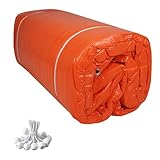
- 【High-Quality】: Construction Concrete Curing Blanket is designed with a high-quality PE foam core that offers excellent insulation properties. It effectively maintains a controlled curing environment by minimizing heat loss and temperature fluctuations.
- 【Funtion】: Insulated concrete blankets is widely used on construction sites, highways, self-built houses. It is one of the effective materials for protecting buildings in winter. Use the ball bungee cords to connect the other tarp.
- 【Dimension】: The concrete blanket sie is 12x24Ft, about 141x288inch. And the thinkness is about 3.6mm/0.15inch. The R value of this product is 0.2 approximately(R=D/K). If you found the R is low , you could use two or more to solve.
- 【Features】: The curing blanket is weatherproof and durable in winter. After that, you can continue working next year. Built-in UV protection prevents degradation from sunlight exposure.
- 【Design】: Maintains consistent temperature, promoting uniform concrete curing. We hope that the design of our products will add to your joy of life.
Joint-planning checklist
- Coordinate joints with the slab’s geometry, openings, columns, walls and changes in thickness.
- Use a layout that creates reasonably proportioned panels instead of long, narrow strips where possible.
- Confirm the specified joint type, dimensions, timing and method with the designer or concrete contractor.
- Keep joints continuous and accessible for the intended sealant or maintenance treatment.
- Do not cut through reinforcement or services unless the approved detail specifically allows it.
A prevention plan for a concrete slab or pour
| Stage | Action | Who should decide | What it addresses |
|---|---|---|---|
| Design | Set thickness, reinforcement, mixture, joints, drainage and panel layout for the use and exposure. | Designer or engineer | Restraint, load, temperature, durability and settlement |
| Before placement | Prepare and compact the base; verify forms, reinforcement, embedded items, weather plan and curing supplies. | Contractor with project team | Support, detailing, construction and evaporation risk |
| During placement | Place and consolidate consistently; finish without adding unauthorized surface water. | Concrete crew | Settlement, weak surface and variability |
| Immediately after finishing | Start curing when surface sheen disappears; protect from wind, sun and rapid drying. | Concrete crew | Plastic shrinkage and early strength loss |
| Early service | Make joints at the specified time and keep heavy or damaging loads off until strength requirements are met. | Contractor or site manager | Random cracking and premature loading |
| After cracking | Record location, direction, movement and associated distress; investigate before selecting a repair. | Owner, contractor or engineer as appropriate | Correct diagnosis and durable repair |
How to assess an existing concrete crack
There is no universal width threshold that separates a harmless crack from a dangerous one. Width alone cannot reveal whether a crack is shallow or through the member, stable or growing, cosmetic or structural. FHWA notes that tight hairline cracks that do not extend through a pavement slab may not require special treatment, but that pavement guidance should not be generalized to every foundation, wall or structural member. See FHWA’s full-depth repair guidance and ACI’s discussion of cracking.
Observations worth recording
- Location and orientation: note whether the crack is in a slab, wall, beam, column, foundation or pavement, and whether it is diagonal, horizontal, vertical, random or aligned with reinforcement.
- Depth and continuity: determine, without damaging the member, whether it appears superficial or passes through a section, joint or edge.
- Movement: record whether it is widening, changing length, opening seasonally, or accompanied by differential displacement.
- Related distress: look for water entry, rust staining, spalling, delamination, scaling, settlement, heave, ponding or visible deflection.
- Timing: connect the first observation with placement, curing, a freeze, a flood, excavation, a new load or another event.
Photographs and dated measurements can help a professional understand change, but they do not replace an inspection. A crack that is significant, changing, load-bearing, associated with water or corrosion, or accompanied by displacement should be evaluated by a qualified engineer or concrete professional.
Choosing a repair approach
Repair is a decision made after evaluation, not simply a product choice. ACI’s Causes, Evaluation, and Repair of Cracks in Concrete Structures treats evaluation as part of selecting a repair method. Filling a crack can improve appearance or reduce water entry, but it does not correct settlement, corrosion, ongoing movement, inadequate support or a design problem.
Questions to answer before filling
- Is the crack dormant, or does it continue to move?
- Is the substrate clean, sound and dry enough for the intended material and exposure?
- Is the goal cosmetic improvement, water control, protection of reinforcement, or structural restoration?
- Will the repair remain compatible with freeze-thaw, sunlight, chemicals, traffic and expected movement?
- Has the cause—such as drainage, settlement, corrosion or uncontrolled restraint—been addressed?
Rigid epoxy or resin systems may suit some clean, stable cracks when the specified performance is appropriate. Flexible sealants or other systems may be more suitable where movement or water management is expected. Product selection, preparation and installation should follow the manufacturer’s technical requirements and, for structural work, the responsible engineer’s repair design. Do not use a surface patch to conceal an active or load-related problem.
What’s actually slowing this PC down?
Pick the symptom - the matching free tool is one click away.
What “normal” cracking means
Some cracking is an expected consequence of concrete’s volume change, even in well-designed work. The objective is to reduce unnecessary cracking, control its location and width, and prevent cracks from becoming a durability or structural problem. A narrow, stable, isolated surface crack in a properly performing slab can be an appearance issue; the same width in a retaining wall with water, displacement or corrosion evidence may require urgent investigation. Context determines significance.
The most reliable general strategy is coordinated: design for the loads and exposure, prepare a uniform support, place and consolidate correctly, cure promptly, manage evaporation and temperature, and construct joints to the approved layout. These actions lower risk without promising a crack-free result.
Quick Recap
Product prices and availability are accurate as of the date/time indicated and are subject to change. Any price and availability information displayed on Amazon at the time of purchase will apply.

