Quick wins for a faster PC:
Clear out junk files and repair common Windows errorsFree Scan →Fix the driver behind crashes, sound loss and screen glitchesFind Drivers →The best drainage solution for clay soil depends on why water remains. If water moves slowly through an otherwise level bed, improve soil structure with mature compost and reduce compaction. If roots need a reliably drier zone, use a raised bed or mound. If runoff arrives from a roof, slope, or paving and collects in a low spot, manage its route with grading, a rain garden, or a swale. A French drain or drain tile is appropriate only when water can enter the system and flow to a suitable lower outlet.
Start by watching the site during and after rain. Ask: Is the problem slow drainage through the bed, compacted soil, or water flowing into a low spot? Matching the fix to that cause prevents wasted digging and avoids sending water toward a neighbor or a building.
As an Amazon Associate I earn from qualifying purchases.
Diagnose the water problem before choosing a fix
Clay itself is not automatically a failed garden soil. Its very small particles can hold water and nutrients, but they create fewer large pores than sandy soil. Compaction, a natural depression, or runoff from a higher surface can make the same clay appear far worse. The first job is to identify where the water comes from and where it should go.
Check the site during rain
- Stand outside during a moderate storm and trace water arriving from roofs, downspouts, paving, driveways, slopes, or neighboring ground.
- After the rain stops, note whether water is spread across the bed, concentrated in tracks, or pooled in one depression.
- Look for evidence of traffic: dense paths, tire marks, or soil that is hard to penetrate except where it has been cultivated.
- Check whether the bed is naturally lower than its surroundings or sits near a foundation, retaining wall, or other place where water cannot escape.
Water near a building, a spring, a high water table, or a large uphill inflow may exceed what a normal garden amendment can solve. Those conditions warrant a local assessment before excavation.
#1 Best Overall

- Low Profile Design. This catch basin can be installed without deep digging. You no need to connect to the downspout. Perfect for underground using. Able to route the water in another direction so the water won’t flood the open patio.
- Pipe Size: Inside Diameter: 2 inches; Outside Diameter: 2.4 inches. Extendable Flexible Pipe from 4.6ft to 16.4ft. The pipe and catch basin are separate, you need to assemble them together.
- Durable Flexible Pipe. The flexible pipe is made of high quality material. Makes it has a long service life under ground. Drains rainwater via this pipe. Reduce damage to foundations from rainwater.
- Flexible Pipe. You can change its shape and length according to your needs. If this length does not meet your needs and you need longer pipe for installation. You can get another 8.2ft pipe(2" ID) from the accessory which sold separately.
- Easy to Assemble and No Leaking. No adapters needed for pipe connections. Just expand the pipe and screw it in the connector.
Run a simple infiltration test
Iowa State University Extension and Outreach describes a practical rate test. Dig a small hole in representative soil, fill it with water, allow the initial wetting to occur, refill it, and measure how much the water level falls in an hour. Repeat in more than one location if the site varies. The categories below are Iowa State’s practical guide, reviewed in May 2024; they are not guarantees for every soil layer or plant.
| Measured fall in water level | Iowa State category | What it suggests |
|---|---|---|
| Less than 1 inch per hour | Poorly drained | Investigate compaction, low elevation, or an external water source before planting moisture-sensitive crops. |
| 1 to 4 inches per hour | Intermediate range | Observe the plant’s needs and the site’s runoff pattern; structure improvements may be sufficient. |
| More than 4 inches per hour | Very well-drained | Persistent ponding is more likely to come from incoming runoff, a shallow restrictive layer, or a low spot than from the tested surface alone. |
A soil test can guide amendment and nutrient decisions, but it does not replace observing water movement. Test the soil and inspect the site after rain before committing to a drain installation.
Match the intervention to the cause
| Option | Best fit | Main consideration |
|---|---|---|
| Compost or another suitable organic amendment | Native bed at a usable elevation with slow-draining clay | Improves aggregation and pore space over time; avoid treating a light layer of sand as a universal remedy. |
| Fork-assisted loosening | Compacted planting area | Opens compacted soil without turning wet subsoil; prevent traffic from re-compacting it. |
| Raised bed or mound | Plants that need a freer-draining root zone | Use suitable fill, adequate height, and a location where water can leave the bed. |
| Regrading, rain garden, or swale | Surface runoff or a defined low spot | Keep water on your property and plan a safe overflow route. |
| French drain or drain tile | A proven collection route with a lower receiving outlet | Requires grade, an outlet, and soil conditions that let water enter the system. |
| Wet-tolerant planting | A site that remains damp and is impractical or undesirable to drain | Select species for your climate, soil, mature size, and the site’s actual moisture. |
Improve clay soil in place with organic matter
For an in-ground bed that is not a flood path, mature compost and other suitable organic matter are the most broadly useful first step. Organic matter helps fine clay particles form stable aggregates. Aggregates create larger connected pores, improving air movement and allowing water to infiltrate more evenly. The improvement is gradual, so treat the whole root zone rather than scattering a thin strip only around individual plants.
Apply amendments without destroying structure
- Use finished, stable compost or another well-decomposed organic amendment appropriate for garden soil.
- Spread it across the bed and incorporate it only when the soil is friable enough to crumble. Aggressive tillage in wet clay can create dense clods and smear the soil into a nearly sealed layer.
- Repeat surface applications over time instead of expecting one treatment to permanently change a heavy profile.
- Consider cover crops where the bed is out of production. Their roots add organic matter and create channels that can persist after the plants are removed.
- Keep traffic off the bed. A permanent path or stepping boards prevent the improvement from being compressed again.
Oregon State University Extension Service recommends surface applications of organic material for clay management, while Purdue Extension describes working organic matter into high-clay soil. The exact quantity and incorporation depth depend on the crop, existing soil, and whether you are amending a shallow bed or a deeper planting area.
Rank #2

- Low-profile Drain System: Dimensions of each channel: 5.9" W x 5.1" H x 39.4" L. Commercial water drainage systems allow safe and efficient drainage for grassed areas, gardens, farms, patio areas, pool sides, office buildings, driveways, or factory interiors. The anti-flotation design prevents floating and doesn’t require staking when setting in concrete.
- Easy & Quick Installation: You can connect these trench drains together for extra length. The interlocking design connects the drains tightly with no potential leak of water. Detachable grate can be manually installed and detached easily, needs no screws or bolts. It also provides a convenient way to clean the drain if it is bunged up.
- Various Outlet Connections: Each trench drain provides a bottom outlet with multiple sizes(3.1 inch/ 3.6 inch), and a side outlet(2.2 inch). You can choose the size you need. No outlet connector is required because it is already built-in; thus, the pipe can be connected directly. Kind Reminder: The 3.1" outlet fits standard 3" pipes. For 3.6" and 2.2" outlets, choose pipes accordingly
- Durability & High Performance: Sturdy HDPE plastic creates a hard and durable structure. The load capacity is A125. The HDPE plastic provides a smooth interior surface, which allows faster water intake.
- Complete Packing List: This trench drain kit comes with six drains with built-in bottom outlets, six plastic grates, and six end caps. Plus, the outlet connector is already built-in. All the accessories that you may need are included.
Why a little sand can backfire
Do not use a light dusting of sand as a general clay fix. Purdue Extension cautions that small amounts may impede drainage, and Oregon State warns that sand particles mixed with clay can create difficult, dense conditions rather than a porous medium. A specialized raised-bed recipe may include coarse sand; that context is different because the entire imported mix is being designed and blended. For native in-ground clay, keep the general recommendation focused on organic matter and compaction control.
Loosen compacted clay without turning it over
Compaction is common where people, carts, vehicles, or repeated mowing cross the future bed. It can seal the surface and create a perched layer even when surrounding soil drains acceptably.
Fork-and-rock method
- Wait until the soil is moist enough to accept a tool but not wet and plastic. If it sticks to the fork in heavy ribbons, wait.
- Push a garden fork or spade straight down into the compacted area.
- Rock the handle back and forth in place to open cracks and loosen the soil.
- Lift the tool, move a few inches, and repeat across the bed, concentrating on traffic lanes and the root zone.
- Leave the soil in place rather than lifting and flipping the subsoil. Maryland Extension specifically recommends this rocking action for high-clay compaction.
- Apply compost or suitable topsoil at the surface after loosening, then establish a path so the same area is not walked on again.
This approach addresses density; it does not remove water arriving from a roof or slope. If puddles reform in the same low point after the bed is loosened, investigate surface drainage separately.
What’s actually slowing this PC down?
Pick the symptom - the matching free tool is one click away.
Use a raised bed or mound for a dependable drier root zone
A raised bed changes the soil profile around the roots instead of trying to make the entire native clay layer drain like a sandy soil. Purdue Extension recommends beds at least 8 inches high for garden plants that need better drainage. Virginia Tech notes that high-clay native soil may remain too wet for species requiring good drainage and recommends importing suitable soil or amending with organic matter.
Rank #3

- 【 Easy to install 】 The Yard Drain Emitter is combined with a 4-inch connector, eliminating the hassle of finding an adapter. This combination is suitable for 4-inch drainage pipes and provides a perfect connection. Please check if your drainage pipe has an inner diameter of 4 inches/outer diameter of 4.5 inches
- 【 Better Quality 】 The overall weight of this combination is 3.2 pounds, with a wall thickness of 0.24 inches providing sufficient support, making your courtyard drainage system more sturdy and durable
- 【 Fix courtyard drainage 】The inclined drainage design seamlessly integrates with the courtyard. The drainage grate can effectively block the entry of organisms, facilitate the smooth discharge of sewage and rainwater, match the color of the grassland, and its pre tilt matches the soil slope
- 【Durable structure】 The grille can be easily disassembled with just two stainless steel screws, making cleaning simple and convenient., made of heavy-duty abs plastic, ensuring long-lasting performance in various weather conditions
- 【Drainage solution】This downspout extension is compatible with French style drainage pipes and is highly suitable for residential and commercial applications. This well made drainage grate can last for a long time. If there are any problems with the drainage device, please contact us and we will correct them
When raised construction is the strongest choice
- The plant is sensitive to saturated roots and needs a consistently freer-draining medium.
- The native grade is low, and improving the whole area would require extensive earthwork.
- You want a defined, controllable root-zone mix for vegetables, herbs, or ornamental plants.
- Surface water can be routed around the bed so the new soil is not simply placed in a basin.
Build and place it so it can drain
Choose a location that does not sit in standing water. Use a suitable, tested growing medium rather than assuming any imported fill will drain. Keep the bed’s sides and base from trapping water; a raised frame does not create an outlet by itself. Mounds can be shaped to shed excess surface water, but their slopes must remain stable and accessible for planting and maintenance.
Height, width, fill, and placement depend on crop root depth, access requirements, local rainfall, and the surrounding grade. A raised bed can solve the root-zone problem while leaving a foundation-threatening runoff problem untouched, so treat those as separate design questions.
Manage runoff, depressions, and low-lying ground
If water is moving across the surface, changing the route is usually more effective than repeatedly adding amendments to the place where it stops.
Correct a small depression or redirect a shallow flow
Iowa State Extension describes changing elevation to remove depressions or redirect runoff. Any regrading must keep water on your property and away from structures. Do not simply push the flow into a neighbor’s yard. Before moving soil, identify where the redirected water will safely spread, infiltrate, or overflow.
Rank #4
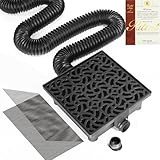
- 🏆【US Patented Design】 Patent No. D1018796.
- 🏆【Material Introduction】Catch basin and "Flexible/ Shapeable Pipe" is made of premium PP To ensure high strength while maintaining high shrinkage, Pipe can extension from 2 .5ft to 8ft. Can be spliced for longer length. Durable, antifreeze explosion proof and no creases, no hole, won't be damaged, andUV resistant to withstand all outdoor elements. Buried underground will not corrode.
- 🏆【NAACOO Unique Design】①Catch basin has double drain holes, improves efficiency. 8Ft Pipe can be cut into two use for drainage on both sides. If you only need one side drain, the other side can be blocked with provided Blockage. ②Catch Basin Special Slope Design - Won't accumulate water and dirt. and Blocked side will not leak water. ③Flexible pipe can be extended and shortened flexibly according to your needs. easily divert rainwater where you want.
- 🏆【Other Advanced Design】①No digging required, Different from traditional catch basin. ②Low profile design can be hidden by covering with mulch. ③Pipe install on catch basin never fall off. ④Debris Catcher Included:GRATE - filter large leaves or some other debris to prevent the block to the pipe, GIFT SCREEN - use for smaller imperities. meet your more needs. ⑤Flexible pipe holds its shape to Adapt more complex environment, and pipe can be spliced for longer length.
- 🏆【Widely Used】High compatibility can be suitable for 2X3 inch, 3x4 inch and 3x3 inch downspout(all standard residential downspouts). This flexible gutter pipe can extension and holds its shape and can be extended from 2.5feet to 8feet. So as to meet any environment needs. prevents foundation damage by diverting rain water around landscaping, Solve difficult irrigating garden and so on.
Install a rain garden
A rain garden is a shallow planted depression that receives runoff and allows it to slow, spread, and infiltrate in an appropriate location. It can accept water from a downspout or paved area when the inflow volume, soil, and overflow route are suitable. The basin should not be placed against a building or where it will remain submerged beyond the tolerance of the selected plants.
Use a vegetated swale
A bioswale is a shallow, gently sloped, vegetated channel that slows and filters surface flow. It is useful when water needs a defined route across a property rather than a single collection point. Plan the inlet, side slopes, planting, erosion protection, and downstream overflow together. N.C. Cooperative Extension presents rain gardens and swales as on-site approaches for low-lying or wet areas, not as automatic solutions for every clay profile.
Plant for a wet location when drainage is impractical
Some sites are naturally damp, and forcing them to become dry can be expensive, disruptive, or ecologically unhelpful. Iowa State lists bald cypress and black gum among wet-tolerant trees; buttonbush and redosier dogwood among shrubs; and rose mallow and queen of the prairie among perennials. Verify regional hardiness, mature size, light requirements, and invasive-plant restrictions before purchasing. A plant that tolerates wet soil still needs the right climate and adequate space.
Free tools Windows power users keep installed
One-click scans. No signup required.
Install a French drain or drain tile only when an outlet exists
A French drain is a gravel- or stone-filled trench, often containing perforated pipe, that collects water and directs it elsewhere. It is not a magic hole that makes water disappear in clay. The system must have a predictable water-entry point, a usable grade, and a legal, practical place to discharge.
Best Value
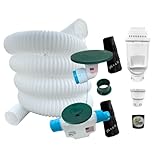
- NO TOOLS NEEDED - Our goal at French Drain Man is to make your underground downspout project as easy as possible. That means you won’t need to dig out any tools. All you need is a shovel to dig your trench.
- EASIEST DOWNSPOUT KIT ON THE MARKET - 3½ pipe is the easiest drainage pipe to install and requires less labor compared to 4 in. pipe. You don’t have to dig as deep of a trench to reach a desired slope and one person can easily handle the pipe and lay it in the trench.
- CONVENIENT ALL IN ONE PACKAGE - No more driving around to multiple stores for different parts that fit. French Drain Man has already done the legwork for you and provide everything you need in one downspout extensions kit.
- KEEPS FOUNDATIONS DRY - Underground downspout extensions transfer roof runoff water far away from the home and protect your foundation, basement and landscape from water damage.
- KIT INCLUDES: 19 ft. Coil of 3½ in. High Octane Extreme Duty Solid Corrugated Pipe in white, Vented Downspout Clean Out Leaf Filter, Pop-Up Emitter & Turf Restrictor Plate with 3 ft x 4 ft of filter fabric, Catch Basin with riser and 3 ft x 4 ft of filter fabric, 1 roll of FDM’s 200 Year Tape – Extra Sticky & Extra Stretchy for making watertight junctions and connections.
Requirements for a functioning system
- Defined source: Identify the surface or subsurface water the trench is meant to intercept.
- Continuous fall: Colorado State University Extension gives a trench-slope guide of 1% to 3% toward the outlet.
- Receiving outlet: Water must be able to leave at a lower point that can accept the flow without damaging a structure or neighboring property.
- Permeable entry zone: Drain tile works only as far as water can move through the surrounding soil into the tile and then flow downhill. A pipe buried in dense clay without a collection path may remain mostly empty.
- Appropriate materials and access: Texas A&M AgriLife Extension describes drain tubing surrounded by coarse stone in a trench aimed toward lower ground. The layout, stone, pipe, and inspection access should suit the site’s soil and expected flow.
Do not install a buried drain until you can demonstrate the route and outlet on paper and on the ground. If the outlet depends on a municipal system, easement, ditch, or public right-of-way, check the applicable requirements first.
When professional or local approval is sensible
Purdue Extension advises checking with city zoning and planning officials before major drainage changes. Seek local drainage or landscape expertise when excavation could affect a foundation, retaining wall, septic system, public drainage, an easement, or a neighbor’s property. A professional can also assess a high water table, spring, or inflow that a garden-scale trench cannot handle.
Prevent the problem from returning
- Keep foot and vehicle traffic on designated paths, especially when clay is wet.
- Maintain a mulch or compost program that adds organic matter without burying plant crowns.
- Inspect downspouts, roof discharge, and paved edges after heavy rain; a disconnected or poorly directed downspout can overwhelm an otherwise workable bed.
- Check swales and rain gardens for erosion, sediment, blocked inlets, and uncontrolled overflow.
- Watch raised beds for settlement, exposed roots, and water collecting at their perimeter.
- Retest infiltration in representative spots if the site changes or a new problem appears.
A practical decision sequence
- Observe the water source. Decide whether water is arriving from above, remaining because the ground is compacted, or collecting because the bed is low.
- Measure and test. Use the infiltration test, inspect soil texture and compaction, and obtain a soil test when amendment or nutrient decisions are uncertain.
- Protect the root zone. Add organic matter and loosen compacted soil for an in-ground bed that has no major external inflow.
- Elevate sensitive plants. Choose a raised bed or mound at least 8 inches high for garden plants that need better drainage, using suitable fill and a drainable location.
- Route surface water. Regrade carefully or use a rain garden or swale when runoff or a depression is the cause.
- Design a drain only with an outlet. Use a French drain or drain tile when the trench can collect water, maintain a 1% to 3% fall, and discharge safely.
- Change the planting palette. Where the site will remain wet, select locally suitable wet-tolerant plants instead of fighting the site’s natural hydrology.
No single method is best for every clay garden. Organic matter and compaction control improve soil in place; raised construction protects roots; surface features manage runoff; and buried drains move water only when a complete route and outlet already exist.
Do these 3 things before closing this tab:
1Repair Windows errors before they cause bigger problems2Scan for outdated or missing drivers - takes under a minute3Clear out junk files and repair common Windows errorsQuick Recap
Product prices and availability are accurate as of the date/time indicated and are subject to change. Any price and availability information displayed on Amazon at the time of purchase will apply.

