Quick wins for a faster PC:
Clear out junk files and repair common Windows errorsFree Scan →Scan for outdated or missing drivers - takes under a minuteDriver Scan →Repair Windows errors before they cause bigger problemsFix Now →Sand is not a universal lawn drainage fix. It can be useful for smoothing minor surface depressions, filling small gaps, or maintaining a lawn that already has a compatible sandy root zone. But spreading a thin layer of sand over heavy clay—or mixing a little sand into clay—can make compaction and drainage worse.
The right choice depends on the problem you are trying to solve. Sand is mainly a surface-management material. Compost, topsoil, aeration, grading, or drainage construction may be better choices when the problem is in the root zone or below it.
As an Amazon Associate I earn from qualifying purchases.
The two situations in which sand makes sense
For most residential lawns, sand is appropriate only in specific circumstances:
The Tool Desk
Outbyte PC Repair FREEClear out junk files and repair common Windows errorsFree Scan →Outbyte Driver Updater FREEFix the driver behind crashes, sound loss and screen glitchesFind Drivers →- Your lawn already has a sandy or sand-based root zone.
- You need to correct minor surface irregularities with a thin topdressing.
Sand may also be part of an aeration and topdressing program on intensively maintained, sand-compatible turf. That includes some sports fields and engineered golf greens, but those systems are designed around specified sand gradations, drainage layers, irrigation, and frequent maintenance. They should not be treated as models for every home lawn.
#1 Best Overall

- OPERATION: Adjustable arm support on this seed, salt and fertilizer spreader helps provide maximum comfort
- HAND-HELD SPREADER: Perfect hand-held fertilizer, salt and seed spreader for small yards
- CAPACITY: A seed, fertilizer and salt spreader that holds up to 1,500 sq. ft. of Scotts lawn products for year-round lawn care
- USAGE: These hand spreaders for lawns are great for year-round use to seed, fertilize, salt and ice melt
- COVERAGE: These salt, fertilizer and seed spreaders for lawns are engineered for smooth, even coverage
When sand is a reasonable lawn topdressing
1. The existing soil is already sandy
Repeatedly applying a material with a different texture can create a boundary, or “layer,” between the topdressing and the native soil. That boundary can interfere with water movement and rooting. For this reason, Clemson Extension recommends sand topdressing for home lawns when the native soil is sandy; on non-sandy native soil, compatible topsoil is generally the safer choice. Compost or other mature organic matter can be useful across a wider range of soil types.
Before choosing material, consider the lawn’s history. A recently installed sandy root zone, a warm-season lawn in a naturally sandy region, and a cool-season lawn growing on dense clay have very different needs. If you are unsure what is beneath the grass, a soil test and a simple texture assessment can prevent an expensive mistake.
2. You are filling small, shallow depressions
A thin topdressing can smooth minor unevenness, fill small gaps, and help correct shallow low or bare spots. The aim is to dust the surface and work material down between the grass blades—not to bury the lawn.
Recommended Free Tools
For an established lawn, Clemson recommends applying no more than 1/2 inch at a time. Lighter applications are preferable for routine work, especially when the grass is dense. A deep depression should be corrected gradually or repaired by addressing the underlying grade. Dumping a thick pile of sand into it can shade and smother the surrounding turf.
3. It follows core aeration on compatible turf
Topdressing is sometimes applied after core aeration. Sand can work into the holes, help preserve a smooth surface, and support a broader program for managing surface compaction or thatch. Cornell and Mississippi State describe this practice mainly in the context of intensively managed turf.
For a home lawn, the topdressing must still be compatible with the existing root zone. A material with substantially different particle sizes can form a restrictive layer instead of improving drainage. Sand is not automatically the correct material simply because aeration has taken place.
Rank #2
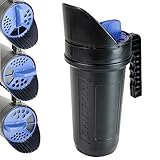
- 64-OUNCE BOTTLE: high-capacity poly bottle with a wide opening and easy screw top, quickly remove the lid to add your preferred seed, salt, fertilizer, etc. and simply screw back into place
- TURF AND SALT: year-round use; for steps, sidewalks and small paths in the winter; grass patches, shaded areas, gardens, and small sections the rest of the year
- 3 OPENINGS IN LID: twist lid to choose small, large and wide openings; each designed to fit different particulates like ice melt, salt, fertilizer, grass seed, sand and most pelletized products
- LARGE HANDLE: easy to grip, scoop and fill; accommodates small and large-sized hands, with or without gloves for use any time of the year
- PORTABLE: keep it on a shelf, in a closet or in the car and pull it out when it’s needed; you can even store it with product inside when not in use
Why sand usually does not fix clay soil
The common advice to “add sand to clay” sounds logical but is usually wrong at lawn scale. Clay soil has very small particles and small pores. A little coarse material mixed into it does not turn the soil into a well-drained sand-based root zone.
Free tools Windows power users keep installed
One-click scans. No signup required.
Penn State notes that meaningful drainage improvement would require roughly a 3- to 4-inch layer of coarse, uniform sand incorporated into about 6 inches of clay. That quantity is generally impractical and too expensive for lawn establishment. Oregon State gives an even stronger warning: adding sand to clay can reduce porosity and increase susceptibility to compaction until the mixture reaches a very high sand content—approximately 80 percent sand by volume.
In other words, a thin layer of sand tilled into clay can produce a denser intermediate mixture. It is not a small-scale version of an engineered athletic field.
If clay is your problem, focus on improving pore space and structure rather than sprinkling sand into it. Core aeration, reducing traffic on wet soil, appropriate irrigation, sound mowing practices, and mature organic matter are usually more relevant interventions.
Sand versus compost versus topsoil
| Material | Best suited to | What it can do | Important limitation |
|---|---|---|---|
| Sand | Sandy or sand-based lawns; minor leveling; compatible intensive-turf programs | Smooth small irregularities and enter aeration holes | Does not supply organic matter and can worsen a clay soil’s physical condition when used in small amounts |
| Mature compost | General soil improvement; post-aeration topdressing on many heavy soils | Add organic matter and support aggregation, water retention, nutrient holding, and biological activity | Quality varies; excessive or nutrient-rich applications can create other problems |
| Compatible screened topsoil | Minor leveling on non-sandy lawns; filling shallow low or bare areas | Add texture that is closer to the existing native soil | Unknown soil can contain weed seeds or unsuitable pH and nutrient levels |
For the average home lawn, Clemson identifies compost as the best general topdressing choice when the goal is improving overall soil structure and quality. Topsoil is generally more appropriate than sand for leveling a non-sandy lawn, provided it is screened and compatible.
Diagnose the problem before buying material
If you have a few shallow low spots
Use a compatible topdressing in thin layers. Sand may be suitable on a sandy lawn; compatible screened topsoil is usually a better match for a lawn on loam or clay. Rake or brush the material between the grass blades, keep the turf exposed, and allow it to recover before repeating.
Rank #3

- NO ASSEMBLY REQUIRED: Scotts spreader comes pre-calibrated and ready-to-use; use it year-round including as an ice melt spreader or salt spreader for snow
- CAPACITY: Broadcast spreader holds up to 15,000 sq. ft. of Scotts lawn products, and can be used as a lawn food, salt, ice melt or grass seed spreader
- OPERATION: These fertilizer spreaders for lawns feature a hopper and agitator designed for smooth product funneling and consistent coverage
- SIDE SHIELD: Scotts exclusive EdgeGuard Technology on these broadcast spreaders for lawns keeps lawn product off landscaping, driveways, and sidewalks
- BROADCAST SPREADER: Use the Scotts Turf Builder EdgeGuard DLX Broadcast Lawn Spreader to apply Scotts lawn care products, like grass fertilizer for lawns
If the soil is compacted
Sand alone does not remove compaction. Compaction reduces pore space, and soil of any texture—sand, silt, or clay—must retain pore space for water and air to move.
Core aerate when the grass is actively growing and soil conditions are appropriate, then consider a thin compost topdressing. Avoid traffic when soil is wet, since walking and equipment can close the pores again. A manual core aerator can suit a small lawn with localized compaction; larger or severely compacted areas may require rented equipment or a professional service.
If water stands after rain
Standing water is a symptom, not a diagnosis. Possible causes include surface compaction, an incorrect grade, an impermeable subsoil, a high water table, or inadequate drainage infrastructure.
Sand spread on the surface is not a substitute for correcting grade or installing drainage. If the subsoil remains saturated, drainage lines, an appropriate outlet, or root-zone reconstruction may be needed. A shallow wet spot and a lawn built over a persistently saturated subsoil require completely different solutions.
If you suspect thatch
Measure or confirm the problem before topdressing. Topdressing is not routinely necessary for every lawn, and the wrong material can do more harm than good. If thatch is excessive, pair the appropriate cultivation or dethatching practice with a compatible topdressing rather than assuming sand is the answer.
If the lawn is thin or nutrient-poor
Sand will not provide the organic matter and nutrient-holding capacity normally needed to improve poor soil. Test the soil first, then address fertility, pH, organic matter, irrigation, mowing, and grass selection as appropriate. A home lawn soil test kit can help with an initial diagnosis, although a laboratory or cooperative-extension test is preferable when results will guide substantial amendment work.
How to apply sand or another topdressing safely
- Identify the grass and soil. Determine whether the turf is warm-season or cool-season, whether the root zone is sandy, and whether the issue is leveling, compaction, thatch, drainage, or fertility.
- Choose a compatible, screened material. Use consistent material from a reputable source. Avoid river-bottom sand or unknown topsoil that may contain weed seeds. Material can also carry nematodes or turf diseases; use weed- and nematode-free material and sterilized material where appropriate.
- Apply during active growth. The grass needs enough time to grow through and recover from the work. Avoid stressing turf during hot, dry conditions.
- Keep the layer thin. Use no more than 1/2 inch on established turf at one time; for routine topdressing, a lighter layer is usually safer.
- Distribute it evenly. Do not leave piles. Uneven piles can block light and air and kill grass beneath them.
- Brush or rake it into the canopy. The grass crowns and growing points should remain exposed. A lawn leveling rake can help spread a thin, compatible layer across minor surface irregularities, but the tool does not make unsuitable sand appropriate for a clay lawn.
- Inspect the result. After irrigation or rainfall, check whether water is moving as expected and whether grass remains visible. Correct the process before applying another layer.
How much is too much?
There is no universal application rate for every grass, soil, climate, and maintenance system. Clemson’s residential guidance sets an upper limit of 1/2 inch at a time on established turf, while sports-field guidance commonly describes approximately 1/4-inch applications as tolerable when they are repeated within a coordinated maintenance program. Applications approaching 1/2 inch can sharply reduce turf quality and surface stability in those settings.
These figures are not permission to copy sports-field practices onto a home lawn. Sports surfaces have compatible construction, equipment, irrigation, cultivation, and follow-up care. For a residential lawn, the safest approach is the thinnest layer that solves the specific surface problem.
Rank #4

- Chapin Garden Spreader: Designed for all your residential lawn and garden seed, pest control and fertilizer spreader needs, this 25 lb. spreader is suitable for small areas and hard to reach places
- How to Use and Convenience: Easily adjust the gate for different materials and control the flow rate for precise spreading. The rear baffle keeps product off your clothes and legs for a cleaner, more comfortable experience
- Comfort and Control: The padded shoulder strap makes carrying easy, even in tight spaces, while simple gate and flow adjustments give you precise control over spreading
- Durable Components: This all-round spreader is waterproof and built to last, with heavy-duty materials and enclosed gears. The zippered bag keeps your seed or fertilizer protected from rain and wind while you work
- Chapin Warranty: This spreader is backed by Chapin's 2-year limited warranty and supported by a dedicated US-based customer service and technical help center
What to check before spreading anything
- Is the problem actually a shallow surface depression?
- Is the existing root zone sandy enough to accept sand without creating a textural layer?
- Could compaction, poor grading, or a saturated subsoil be the real cause?
- Is thatch genuinely excessive?
- Would compost or compatible topsoil better match the goal?
- Has the material been screened and checked for weed seeds, contaminants, and unsuitable texture?
- Can you apply it evenly without covering the grass?
- Is the lawn actively growing and not under heat or drought stress?
For a substantial renovation or an uncertain soil problem, test both the existing soil and the proposed amendment. Soil pH and nutrient concentrations vary considerably, particularly in topsoil and compost.
When a lawn needs renovation instead
Repeated thin applications are not a substitute for correcting a deep depression, widespread drainage failure, severe soil mismatch, or an improperly constructed root zone. If the grade is wrong, repair the grade. If water cannot pass through the subsoil, investigate drainage design. If the entire root zone is compacted or unsuitable, renovation may be more effective than years of surface treatments.
For general soil improvement after aeration, screened compost is often a more defensible choice than sand on a non-sandy home lawn. Choose mature, screened material and consider local bulk sourcing for large areas rather than assuming a bagged product is suitable for every application.
What’s actually slowing this PC down?
Pick the symptom - the matching free tool is one click away.
Frequently Asked Questions
Can I put sand on a clay lawn?
Usually not to improve drainage. A small amount of sand mixed into clay can reduce porosity and increase compaction. Use core aeration, traffic management, mature compost, grading, or a properly designed renovation instead.
Will sand level my lawn?
It can help level minor surface depressions when applied thinly and evenly. It is not suitable for burying deep low spots or covering large areas of living turf in one application.
Is sand better than compost for a lawn?
It depends on the goal and existing soil. Sand can suit a sandy root zone or a compatible leveling program. Compost is generally better for improving organic matter, aggregation, water retention, and nutrient holding on many residential lawns.
Can I use play sand or construction sand?
Do not assume a retail or construction sand is suitable. Particle size, cleanliness, salt content, contaminants, and consistency matter. Use a screened material appropriate for turf and from a reputable supplier.
Windows Errors? Fix Them Before They Spread
Repair common Windows errors and clear accumulated junk for a smoother, more stable PC - no reinstall needed.Free scan · no reinstallCrashes, No Sound, or Screen Glitches?
Random freezes, missing sound and display glitches usually trace back to one bad driver. Find and replace yours safely.Free scan · under a minuteShould I spread sand after aerating?
Only when the sand matches the existing root zone and is part of a suitable topdressing program. On many home lawns, a thin layer of mature compost is a better post-aeration choice.
The Bottom Line
Use sand for a specific, surface-level purpose—not as a cure-all. It can make sense on an already sandy lawn, for minor leveling, or in a coordinated aeration program using compatible turf materials. It is usually the wrong choice for clay improvement, general soil health, or unexplained standing water. Diagnose the cause first, match the material to the existing soil, and apply the thinnest even layer that will do the job.
Quick Recap
Product prices and availability are accurate as of the date/time indicated and are subject to change. Any price and availability information displayed on Amazon at the time of purchase will apply.

