The Tool Desk
Outbyte PC Repair FREEClear out junk files and repair common Windows errorsFree Scan →Outbyte Driver Updater FREEScan for outdated or missing drivers - takes under a minuteDriver Scan →For most roses, wait until late winter or very early spring to do the main cutback. Prune while the plant is dormant, but after the worst freezes have passed and before strong new growth begins. In fall, limit pruning to dead, diseased, or broken wood—and shorten unusually tall, wind-exposed canes only when needed to prevent winter damage.
The exact timing depends on your climate, elevation, rose type, and local frost pattern. A calendar date is less reliable than the plant’s condition and the weather ahead.
As an Amazon Associate I earn from qualifying purchases.
What to do in fall
Winter preparation and structural pruning are not the same job. Fall is mainly the time to clean up disease, remove hazards, and protect the plant. Heavy shaping is usually better left until late winter or early spring.
Quick wins for a faster PC:
Scan for outdated or missing drivers - takes under a minuteDriver Scan →Repair Windows errors before they cause bigger problemsFix Now →Fix the driver behind crashes, sound loss and screen glitchesFind Drivers →- Remove dead, diseased, and broken canes. Cut out wood that is clearly dead, damaged, or infected. Remove diseased leaves and fallen foliage from around the plant as well; fungal pathogens can overwinter in plant debris. Place diseased material in the trash rather than composting it unless your composting system reliably reaches temperatures high enough to destroy pathogens.
- Stop routine deadheading in early fall if appropriate for your climate. Leaving some spent flowers to develop hips can help signal the end of the growing season. This is not essential for every rose or garden, but it can be preferable to continually encouraging fresh growth late in the year. Pennsylvania State University Extension’s winter guidance discusses allowing hips to form as part of preparing roses for winter.
- Reduce wind exposure only when necessary. If hybrid teas, floribundas, or grandifloras have tall, exposed canes that could whip or break in winter winds, shorten them modestly. This is a protective trim, not a full annual haircut. The amount varies with local conditions; some Oregon guidance recommends taking several inches off, while high-desert recommendations may reduce particularly tall canes to about 3 feet.
- Do not make late-season cuts that stimulate tender growth. Pruning too late in the growing season can encourage shoots that do not harden before freezing weather. Colorado State University advises avoiding rose pruning after mid-fall, and late-summer or fall pruning generally carries a greater risk of exposing new growth to winter injury.
In short, fall pruning should be conservative: remove problems, reduce an obvious breakage risk, and leave healthy structural canes intact until the proper spring window.
#1 Best Overall
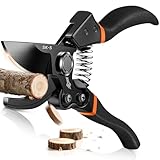
- LONG-LASTING SHARPNESS: Japanese SK5 bypass blade with titanium coating is tested through 5,000 cuts to maintain a sharp edge and deliver clean, consistent cuts on live stems and branches
- BUILT FOR 5X DURABILITY: Heavy-duty 3-layer titanium-coated SK5 blade resists wear and corrosion, while anodized aluminum handles and high-hardness screws reinforce the pruner. Repeated cutting tests show up to 5X the durability of standard pruners
- POWERFUL 4X LEVER CUTTING: The optimized lever-action design multiplies cutting force up to 4X, making thicker branches easier to prune with less hand effort. Cuts branches up to 3/4" with smooth, controlled power for everyday garden pruning
- ARTHRITIS & SENIORS FRIENDLY: Ergonomic non-slip rubber handles cushion pressure and provide a secure, comfortable grip, helping reduce hand and wrist fatigue. A comfortable hand pruner for seniors, arthritis and longer pruning sessions
- ONE-HAND SAFETY LOCK: The easy-access safety lock opens and closes with one hand for faster trimming, then securely holds the blades closed for safer carrying and storage
When to do the main rose pruning
The main pruning is generally done in late winter or early spring, shortly before the rose resumes vigorous growth. Pruning too early may stimulate growth that is then damaged by a hard freeze, forcing you to prune the plant again.
Use local weather and bud development as your guide:
| Location or climate example | Typical pruning signal |
|---|---|
| Western Oregon, lower elevations | Approximately mid-February to early March |
| Higher-elevation Oregon | Often April, after severe freezes have passed |
| Southern Georgia | Roughly mid-February, as buds begin swelling |
| Northern Georgia | Roughly mid-March, as buds begin swelling |
| Cold-winter regions generally | Near the local last-frost window, after the worst winter damage is evident |
These are examples, not universal dates. Oregon State University recommends using the local late-winter window and delaying pruning at higher elevations. University of Georgia guidance uses bud swelling as an important signal, while the Royal Horticultural Society commonly places rose pruning in February or March for its climate.
What’s actually slowing this PC down?
Pick the symptom - the matching free tool is one click away.
A practical timing test
Before making the main cuts, ask:
- Has the plant entered winter dormancy?
- Have the region’s most damaging freezes generally passed?
- Are the buds beginning to swell, but is there not yet substantial leafy growth?
- Can you prune without a forecast of an imminent hard freeze?
If the answer to the last two questions is no, wait. If the plant is already pushing significant spring growth, prune promptly rather than delaying until the season is well advanced.
How much should you cut?
Begin with the three Ds: dead, damaged, and diseased. Then remove weak, crossing, rubbing, or inward-growing canes to improve the plant’s structure and airflow. Preserve strong, healthy canes that form a balanced framework.
Make each final cut just above a healthy, outward-facing bud. The RHS recommends cutting no more than about 5 mm (one-quarter inch) above the bud, with the cut sloping away from it so water does not sit on the bud. A similar recommendation from Colorado State University describes a clean cut at approximately 45 degrees, about one-quarter inch above an outward-facing bud.
Rank #2

- · ULTRA-SHARP SK5 STAINLESS STEEL - Engineered with premium SK5 stainless steel, these heavy duty pruning shears deliver razor-sharp precision and maximum hardness. The rust-resistant blades are designed to stay sharp longer, effortlessly resisting corrosion and sap buildup for smooth, friction-free garden shears performance year after year.
- · CLEAN CUTS FOR 1 INCH THICK BRANCHES - Say goodbye to crushed stems and ragged bark. Our professional bypass pruning shears slice through thick branches up to 1 inch like butter(as the videoes show). By ensuring perfectly clean cuts without leaving debris, it helps your roses, fruit trees, and indoor plants heal faster and stay healthy.
- · ERGONOMIC COMFORT FOR ARTHRITIS & WEAK HANDS - No more hand fatigue or wrist strain! Featuring a non-slip SoftGrip handle with premium cushioning, these garden clippers absorb pressure with every cut. It is the ultimate arthritis friendly hand pruner for seniors or anyone with limited hand strength to enjoy yard work pain-free.
- · 100% LEFT-HANDED FRIENDLY & SAFETY LOCK - Unlike standard garden scissors that flop and crush stems when used left-handed, our uniquely balanced hand pruners work flawlessly for both right and left-handed users. Equipped with a secure, easy-to-operate safety lock to protect your fingers and ensure safe storage.
- · HIGH-VISIBILITY RED & LIFETIME WARRANTY - Never lose your tools in the grass again! The vibrant high-visibility red handle makes these plant shears pop instantly in any backyard setting. We stand behind our industrial-grade quality—enjoy 100% risk-free shopping backed by our ironclad Lifetime Warranty. Perfect gardening gifts for women and men!
Do not reduce every rose to the same height. The correct amount depends on the rose class, age, vigor, climate, and whether you are performing routine maintenance or trying to rejuvenate an overgrown plant.
Useful pruning ranges
As a regional framework, Colorado State University describes:
- Light pruning: remove less than one-third of a young plant.
- Moderate pruning: reduce an older plant to approximately 18–24 inches while retaining about 5–12 healthy canes.
- Severe rejuvenation: retain only 3–5 canes at approximately 6–10 inches.
Severe pruning is not a standard winter instruction for every rose. It is a situational approach for an overgrown or poorly structured plant and may be inappropriate for a climber, rambler, shrub, or cold-hardy rose.
For hybrid teas and grandifloras, Georgia guidance recommends selecting three to five vigorous canes and cutting them to about 15–18 inches after removing winter-damaged wood. Floribundas are generally pruned less severely.
Pruning by rose type
Hybrid teas, grandifloras, and floribundas
These are the roses most often associated with regular structural pruning. In late winter or early spring, remove dead and weak wood, thin crowded growth, and retain a strong, open framework. Hybrid teas and grandifloras can usually tolerate a more deliberate reduction than many shrubs and climbers. Floribundas typically benefit from a lighter treatment.
In fall, only shorten tall canes when exposure to wind or heavy snow creates a credible breakage risk. Avoid cutting them back hard merely because winter is approaching.
Rank #3

- DUAL CUTTING POWER: VERSATILE PRUNING COMBO --- With both Pruning Shears and Pruning Snip, this combo delivers unmatched versatility. Whether you're delicately trimming flowers and shrubs, tackling thicker tree branches, or tending to your vegetable and fruit garden, our combo pack excels in all areas. They're also perfect for landscaping projects and maintaining the health and appearance of indoor plants. With this pack, you have a versatile tool that simplifies your gardening tasks.
- ULTRA SHARP --- Much less effort to cut branches with our combo pack. Our pruning shears are crafted from premium Stainless Steel, and the pruning snip features a stainless steel blade with a titanium coating. Our garden scissors and garden clippers boast exceptional durability and sharpness. A perfect pruning shears for gardening and a must-have garden tool, hedge clippers pruners for gardening.
- RUST PROOF STAINLESS STEEL GARDENING SHEARS --- Our branch cutter tree pruner combo is built to last.
- SENIORS AND ARTHRITIS FRIENDLY --- Our pruners for gardening have comfortable handles that are easy to grip. With a non-slip texture for enhanced control, you can confidently prune in wet conditions. You can work longer without any hand fatigue.
- SAFETY LOCK PREVENTS ACCIDENTS --- Both of our pruning shears and pruning snips come with a built-in safety lock that securely holds the blades closed when not in use, preventing any accidental openings that could lead to injuries. This feature is designed for easy, one-handed activation, offering convenience and peace of mind whether you're storing the combo or carrying them in your pocket or toolkit. Trust in the safety and simplicity of our combo pack for all your gardening needs.
Climbing roses
Do not cut a climbing rose down indiscriminately in fall. Its long canes may be the framework that produces next season’s flowers. The RHS advises particular caution with a climber that has one old, thick basal stem: cutting it hard may leave the plant unable to regenerate. That stem may be shortened by one-third to one-half instead.
On a multi-stemmed climber, renewal is usually more gradual. Remove one or two of the oldest stems close to the base when appropriate, while retaining, tying, and training the younger framework. The rose’s flowering habit matters, so identify whether it flowers on old wood, new wood, or both before making major cuts.
Ramblers
Ramblers are not simply smaller climbing roses. Many flower according to a different cycle, and long canes may be central to their flowering framework. A hard winter reduction can remove the wood that would have flowered. Prune according to the specific rambler’s flowering habit rather than applying hybrid-tea instructions.
Recommended Free Tools
Shrub, species, rugosa, and hardy roses
Many shrub, species, rugosa, and cold-hardy Canadian roses need little winter pruning beyond removing dead, diseased, or damaged branches and correcting obvious structural problems. University of Minnesota guidance specifically cautions against heavy fall pruning of hardy roses.
Some shrubs are best left relatively informal. Removing only the oldest or weakest wood can preserve their natural shape, winter protection, and flowering potential.
Container roses
Container roses require separate winter planning because their roots are more exposed to cold than the roots of roses planted in the ground. The American Rose Society’s container-rose winterizing guidance discusses preparing plants after leaf drop and dormancy, with stronger reductions for some hybrid teas, grandifloras, and floribundas and less severe treatment for climbers and large shrubs.
Rank #4

- AMBIDEXTROUS DESIGN: Pruner shape is designed for both right and left-handed use while pruning indoor & outdoor plants such as shrubs, ornamental trees, vines, & flowers like roses; SoftGrip handle reduces hand fatigue & enhances comfort and control
- CLEAN CUTS ON LIVE GROWTH: Bypass cutting action is ideal for green, living stems and branches up to 5/8” in diameter, helping minimize crushing and damage for healthier pruning results
- SHARP STEEL BLADE PERFORMANCE: Fully hardened, precision ground steel blade stays sharp through heavy use and delivers consistent, clean cuts for routine garden maintenance
- LOW FRICTION RUST RESISTANT COATING: Blade coating allows the pruner to glide smoothly through wood, reduces sap buildup and gumming, and helps resist rust for reliable outdoor performance
- INCLUDES: (1) Fiskars SoftGrip Bypass Pruning Shears with Lifetime Warranty; Fiskars pruning shears are equipped with smart technologies and award-winning, ergonomic features that make it easier and more enjoyable to transform your outdoor space
Do not automatically apply container-winterizing instructions to an in-ground rose. For containers, shelter and root insulation may matter as much as—or more than—reducing the top growth.
Winter protection can matter more than pruning
In cold regions, protecting the roots and graft union is often more useful than cutting the entire top of the plant down. Heavy pruning does not make an otherwise unprotected rose reliably winter-hardy.
Protecting in-ground roses
- Water before the ground freezes. Give the plant a thorough watering after the first frost but before the soil becomes frozen, particularly where winter winds or dry conditions can dehydrate plants.
- Wait for sustained cold before applying insulation. Penn State recommends winter insulation after several killing freezes, when the plant and soil are consistently cold rather than repeatedly cycling through freeze and thaw.
- Mound material around the base. In colder areas, Penn State recommends approximately 12 inches of well-draining material around and over own-root roses. Minnesota guidance similarly recommends an 8–12-inch mound after the ground freezes.
- Add a loose insulating layer. Once the mound has frozen, leaves, evergreen boughs, or bark mulch can help reduce temperature swings. Keep the approach well drained and avoid creating a permanently wet, airless mass against the canes.
Grafted roses deserve particular attention at the graft union, the swollen point near the base where the desired rose is joined to its rootstock. The exact protection method depends on the rose and regional climate, so follow local extension recommendations when temperatures are severe.
Protecting container roses
Move containers to a sheltered location where possible, while still allowing appropriate cold dormancy. Insulate the container itself, not just the branches, because the root ball is vulnerable to rapid temperature changes. Avoid placing a dormant plant in a warm indoor room unless you are following a specific overwintering plan; premature growth is difficult to maintain and can be damaged when the plant returns outdoors.
Independent reader supportYour contribution helps us test, update, and keep practical guides available for everyone.Tools and clean-cut technique
Use sharp bypass pruning shears for ordinary rose canes. Bypass blades make a cleaner cut than crushing-style anvil tools. For larger woody stems, use bypass loppers or a small pruning saw rather than forcing hand pruners beyond their capacity.
Free tools Windows power users keep installed
One-click scans. No signup required.
Clean, sharp blades matter more than a particular brand. Colorado State University’s rose-pruning guidance recommends sharp, clean tools and describes using 70% isopropyl alcohol to clean blades between plants or cuts when disease transmission is a concern.
Before pruning, inspect the cane and locate a healthy bud pointing outward from the center of the plant. Position the blade just above it, make one decisive cut, and angle the cut away from the bud. If the cut splinters or crushes the cane, sharpen the tool and recut cleanly below the damage.
For ordinary rose canes, bypass pruning shears are the most directly useful tool. Larger stems may call for bypass loppers or a small pruning saw. These are generic tool categories, not recommendations for a tested brand or model.
Best Value

- Durable and Rugged: The XFSPYY bypass pruning shears are forged from SK5 alloy steel, and the blade surfaces are treated with a titanium coating to ensure they remain razor-sharp, delivering precise cuts and long-lasting sharpness.
- Ergonomic Design: This pruning tool features a segmented lever and telescoping mechanism, combining stainless steel springs with professional-grade levers to ensure smooth, effortless operation and safe, reliable cutting.
- Easy to use: These pruning shears feature a safety lock that allows for one-handed operation; the handles and components are made of high-strength aluminum alloy, making the tool both lightweight and durable, and ensuring effortless cutting.
- Comfortable Grip: These scissors feature rubberized handles that provide a secure, non-slip grip, ensuring comfort and giving you better control over the tool while trimming.
- Versatile: These pruning shears are ideal for trimming roses, shrubs, hedges, and small branches. They are an essential tool for every home gardener and florist, making them the perfect holiday gift for gardening enthusiasts.
Quick decision tree: prune now, wait, or protect?
Prune now if:
- You are in the late-winter or early-spring window for your area.
- The plant is dormant or just beginning to show bud swelling.
- The worst hard freezes have generally passed.
- You are removing dead, diseased, or broken wood at any time of year.
Wait if:
- It is early or mid-fall and the canes are healthy.
- A hard freeze is expected soon after the proposed pruning.
- You are dealing with a climber or rambler and have not identified its flowering habit.
- You are tempted to cut every rose to a uniform height simply for neatness.
Protect rather than cut if:
- The plant is a hardy shrub, species, rugosa, or Canadian rose with no significant damage.
- The main risk is cold at the roots or graft union rather than cane breakage.
- The rose is in a container and the root ball is exposed to freezing temperatures.
- Wind, snow, or freeze-thaw cycles are the local problem; shelter, mounding, and insulation may solve more than severe pruning.
Common mistakes to avoid
- Using a fixed date for every climate: elevation, frost timing, and bud development are better signals than a holiday or national calendar date.
- Giving every rose hybrid-tea treatment: climbers, ramblers, shrubs, and hardy roses have different growth and flowering habits.
- Performing a severe fall haircut: unnecessary late-season pruning can stimulate tender growth and remove useful winter framework.
- Leaving diseased leaves in place: sanitation reduces the amount of infected material available to overwinter in the bed.
- Confusing pruning with winter protection: a shorter plant is not necessarily a better-protected plant.
- Ignoring wind exposure: tall, loose canes may need a modest protective shortening or temporary support, even when major pruning should wait.
- Pruning without a sharp tool: crushed or ragged cuts heal poorly and make it harder to identify healthy wood.
Frequently Asked Questions
Can I cut my roses back in the fall?
You can remove dead, diseased, or broken wood in fall. Shorten tall, exposed canes modestly if wind or snow could break them, but postpone major structural pruning until late winter or early spring in most climates.
What month is best for pruning roses?
There is no single best month nationwide. In many temperate regions, pruning falls in late February or March; colder or higher-elevation gardens may need to wait until April. Prune after the worst freezes have passed and as buds begin to swell, before strong new growth starts.
Should roses be cut down for winter?
Usually not. Most roses should not be cut down hard just for winter. Protect the root zone and graft union in cold regions, and remove only damaged wood or canes that pose a clear breakage risk.
How far back should I prune a rose bush?
Start by removing dead, damaged, and diseased wood, then thin weak or crossing canes. The final height depends on rose type and condition. Hybrid teas and grandifloras may be reduced substantially in spring, while climbers, ramblers, shrubs, and hardy roses often need a lighter treatment.
Should I deadhead roses before winter?
Stop routine deadheading in early fall if allowing hips to form is appropriate for your rose and climate. Removing diseased foliage and cleaning up fallen debris remains important.
Do these 3 things before closing this tab:
1Fix the driver behind crashes, sound loss and screen glitches2Repair Windows errors before they cause bigger problems3Scan for outdated or missing drivers - takes under a minuteThe Bottom Line
Bottom line: do light sanitation and damage control in fall, but save the main rose cutback for late winter or early spring. Prune after the worst freezes, when buds are beginning to swell, and tailor the cuts to the rose’s type. In cold climates, mounding and insulating the root zone may protect the plant more effectively than cutting its canes shorter.
Quick Recap
Product prices and availability are accurate as of the date/time indicated and are subject to change. Any price and availability information displayed on Amazon at the time of purchase will apply.

