Quick wins for a faster PC:
Fix the driver behind crashes, sound loss and screen glitchesFind Drivers →Clear out junk files and repair common Windows errorsFree Scan →Scan for outdated or missing drivers - takes under a minuteDriver Scan →MDO is medium-density overlay plywood; MDF is medium-density fiberboard. They are not two grades of the same material. MDO combines a plywood core with a resin-impregnated, paintable overlay, making it the usual choice for exterior painted panels and durable fixtures. MDF is a homogeneous wood-fiber panel with a very smooth, grain-free surface, making it the usual choice for dry interior trim, furniture, cabinetry, and routed profiles.
The practical rule is simple: choose MDO when weather, moisture, panel stiffness, fastening, or abuse matters; choose MDF when smooth machining and a uniform interior paint surface matter more. Neither is automatically waterproof, structural, or suitable for every exposure.
As an Amazon Associate I earn from qualifying purchases.
MDO versus MDF at a glance
| Characteristic | MDO | MDF |
|---|---|---|
| Full name | Medium-density overlay | Medium-density fiberboard |
| Construction | Plywood core with a resin-impregnated cellulose-fiber overlay | Pressed wood fibers bonded with resin |
| Best environment | Exterior, damp, high-use, or semi-structural applications | Dry interior applications |
| Surface | Smooth, opaque, paintable; some products may show slight underlying grain or texture | Very smooth, uniform, and grain-free |
| Strength and stiffness | Generally better suited to spanning, fastening, and panel loads because of its plywood core | Uniform through its thickness, but normally used for interior nonstructural work |
| Moisture resistance | Better than standard MDF, but edges, holes, and damaged areas still require sealing | Standard MDF is interior-use; moisture-resistant grades reduce swelling but are not waterproof |
| Weight | Often lighter than standard MDF, depending on species and product | Often heavier at the same nominal thickness |
| Machining | Machines like plywood; veneer direction and overlay chipping matter | Excellent for routing, profiling, CNC work, and intricate millwork |
| Paint performance | Excellent exterior paint base when primed and sealed correctly | Excellent interior paint base; edges need extra preparation |
| Typical uses | Signs, soffits, fascias, exterior cabinets, painted panels, workbenches, and durable fixtures | Trim, mouldings, cabinets, furniture, speaker enclosures, jigs, and decorative panels |
This is a general comparison, not a guarantee for every panel. Thickness, density, plywood species, veneer grade, overlay type, manufacturer, and product classification all affect performance.
What’s actually slowing this PC down?
Pick the symptom - the matching free tool is one click away.
What is MDO?
MDO stands for medium-density overlay. In normal construction use, MDO means plywood faced with a resin-impregnated cellulose-fiber overlay. The overlay creates a smooth, durable, paintable surface while the cross-laminated plywood core provides much of the panel’s stiffness, strength, and screw-holding ability.
#1 Best Overall

- Perfectly Sized & Easy to Work With – Includes 24 pieces of 12” x 12” x 1/8” MDF craft wood panels, ideal for a variety of DIY projects. The smooth, uniform surface allows for effortless sanding, staining, or painting, and they can be cut into different shapes to fit your creative needs.
- Durable & Premium Quality Material – Made from premium-density fiberboard, these 3mm-thick MDF sheets feature precisely cut edges and a smooth, unfinished texture. Strong and structurally sound, they provide excellent reliability for woodworking and artistic projects.
- Versatile for Multiple Applications – A great alternative to plywood, these MDF boards are ideal for picture frame backing, signage, centerpiece bases, wood burning, model making, scrapbooking, and home décor projects.
- Ideal for Painting & Finishing – Highly absorbent and suitable for acrylics, oils, and stains, these MDF sheets require a primer or gesso base for best results. Perfect for stenciling, distressing, antiquing, and whitewashing techniques to achieve a unique artistic finish.
- Easy to Cut & Customize – These unfinished MDF boards can be effortlessly shaped, engraved, or routed using hand tools, power saws, or engraving machines. Easily adaptable for gluing, crafting, and embellishing, making them a must-have for creative projects.
A typical MDO panel looks like this:
MDO: [resin overlay] [face veneer] [cross-laminated plywood core] [back veneer or overlay]
The overlay may be applied to one face or both faces. The plywood species, number of plies, face and back veneer grades, thickness, and performance category can vary substantially. Therefore, “MDO” by itself is not a complete specification.
APA describes MDO as an exterior-type plywood product used for signs, siding, soffits, cabinets, and other applications requiring a durable painted surface. APA’s overlaid-panel guidance provides an overview of the product and its applications.
MDO-General and MDO-Concrete Form
Two important MDO designations are easy to confuse:
- MDO-General: Intended primarily as a paintable panel for signs, siding, soffits, fascias, cabinets, built-ins, and similar applications.
- MDO-Concrete Form: Designed for concrete formwork. It may contain a release treatment and is intended to produce a matte concrete finish. It is not simply interchangeable with MDO-General.
Under the PS 1-22 requirements described in the product standard, both grades have a minimum overlay thickness of 0.30 mm (0.012 inch) after pressing and a minimum overlay weight of 280 g/m², or 58 lb per 1,000 square feet, excluding the bond line. MDO-General specifies a minimum phenolic resin content of 27%; MDO-Concrete Form specifies 34%. See the APA PS 1 publication listing and the PS 1-22 document for the standard’s requirements.
For a painted sign or exterior panel, MDO-General is normally the relevant starting point. For concrete forms, specify MDO-Concrete Form or a suitable HDO form panel.
What is MDF?
MDF stands for medium-density fiberboard. It is made by refining wood into fibers, combining the fibers with resin and additives such as wax or moisture-control agents, and pressing the mat under heat and pressure.
MDF: [compressed wood-fiber and resin material throughout the panel]
Unlike MDO, MDF has no veneer layers or plywood core. Its homogeneous construction gives it a consistent surface without knots, grain direction, veneer gaps, or voids. That uniformity is why MDF is widely used for interior mouldings, millwork, doors, furniture, cabinets, routed profiles, and decorative panels. The Composite Panel Association’s MDF description explains the material’s construction and common applications.
The Tool Desk
Outbyte Driver Updater FREEFix the driver behind crashes, sound loss and screen glitchesFind Drivers →Outbyte PC Repair FREEClear out junk files and repair common Windows errorsFree Scan →The word “medium” appears in both names, but it does not mean MDO and MDF are different density grades of the same board. They are fundamentally different products with different constructions, standards, and intended uses.
Rank #2
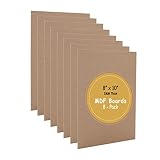
- 1. MEGA PACK MDF BOARDS - This pack is for 8 pieces 8 inches wide by 10 inches long by 2mm thick MDF boards. Get the most out of these exact-cut MDF board sheets.
- 2. HIGH-QUALITY MDF BOARDS - Both sides have machined, smooth unfinished surfaces with precision-cut straight, sanded edges. Each board is sturdy and has some weight to it.
- 3. VERSATILE SHEET BOARD MATERIAL - MDF is a cost-effective alternative to other sheet boards. It’s perfect as a picture frame backing board, signage, centerpieces, pyrography, interior design pieces, scrapbooking, or other hobby crafts.
- 4. SUITABLE FOR PAINTING - Accepts different paints exceptionally well. Since MDF is quite porous, a coat or two of paint primer or gesso primer is a must. These boards are also suitable for stenciling, distressing, whitewashing, antiquing paint techniques.
- 5. HIGHLY CUSTOMIZABLE UNFINISHED BOARD SHEETS - Aside from painting, you can glue or add embellishments to your MDF board. They’re easy to cut by hand saw or power saws ,and are also perfect for routing and engraving.
Moisture and outdoor use
MDO is the better exterior choice
MDO generally performs better than MDF when a panel will experience rain, humidity cycles, or occasional wetting. Its plywood core and exterior-rated adhesive system are better suited to those conditions, while the overlay slows moisture penetration through the broad face.
That does not make MDO waterproof. Moisture can still enter through:
- Cut edges and end grain.
- Screw holes and other penetrations.
- Unsealed cutouts.
- Damaged or chipped overlay.
- Joints that hold water.
For exterior exposure, select a panel with an appropriate Exterior bond classification or equivalent manufacturer specification. Prime and top-coat the faces, and seal exposed edges, cutouts, fastener penetrations, and damaged areas as soon as practical. APA’s HDO/MDO product guide notes that edge sealing improves protection but is not permanent and does not automatically make an edge waterproof.
Free tools Windows power users keep installed
One-click scans. No signup required.
Exterior bond also does not mean the wood is decay-proof, pressure-treated, or suitable for continuous ground contact. For those exposures, use a material specifically designed for the service condition.
Standard MDF should stay indoors
Standard MDF is generally intended for dry interior applications. Water causes fiberboard to swell, soften, and lose dimensional stability, especially at cut edges. Paint can slow water entry, but it cannot convert ordinary MDF into an exterior-rated substrate.
Moisture-resistant MDF products can reduce swelling compared with standard MDF. However, a moisture-resistant product may still be explicitly limited to interior use and may be described by its manufacturer as neither waterproof nor intended for wet-area applications. Always check the product data sheet. For example, see Weyerhaeuser’s MDF specifications.
For a bathroom cabinet in a well-controlled interior environment, moisture-resistant MDF may be suitable if the manufacturer permits that use and all edges are carefully finished. For direct water contact, repeated soaking, exterior exposure, or poor drainage, choose MDO or another exterior-rated material instead.
Which is stronger, stiffer, or lighter?
It is too broad to say that MDO is always stronger than MDF. The useful construction distinction is that MDO has a cross-laminated plywood core, so it is generally the more appropriate choice for panel loads, spanning, repeated fastening, and abuse. MDF’s strength is more uniform through its thickness and is valuable for interior components, but standard MDF is not a substitute for structural plywood.
Rank #3
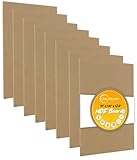
- ●MEGA PACK MDF BOARDS - This pack is for 8 pieces 11 inches wide by 14 inches long by 1/4 inch thick MDF boards. Get the most out of these exact-cut MDF board sheets
- ●HIGH-QUALITY MDF BOARDS - Both sides have machined, smooth unfinished surfaces with precision-cut straight, sanded edges. Each board is sturdy and has some weight to it
- ●VERSATILE SHEET BOARD MATERIAL - MDF is a cost-effective alternative to other sheet boards. It’s perfect as a picture frame backing board, signage, centerpieces, pyrography, interior design pieces, scrapbooking, or other hobby crafts
- ●SUITABLE FOR PAINTING - Accepts different paints exceptionally well. Since MDF is quite porous, a coat or two of paint primer or gesso primer is a must. These boards are also suitable for stenciling, distressing, whitewashing, antiquing paint techniques
- ●HIGHLY CUSTOMIZABLE UNFINISHED BOARD SHEETS - Aside from painting, you can glue or add embellishments to your MDF board. They’re easy to cut by hand saw or power saws ,and are also perfect for routing and engraving
Actual performance depends on thickness, span, support spacing, panel orientation, species group, density, grade, moisture content, and loading direction. A structural PS 1 MDO panel should not be compared with an unspecified MDF sheet and treated as a universal product test.
As an illustration only, a Swanson Guardian MDO technical sheet lists these average values for its 5/8- to 3/4-inch MDO:
- Modulus of rupture: 6,680 psi.
- Modulus of elasticity: 853,565 psi.
- Density: 32.9 lb/ft³.
- Thickness swell: 3.8%.
- Face screw holding: 449 lb.
- Edge screw holding: 408 lb.
For comparison, the CPA’s ANSI A208.2-2022 Grade 155 MDF property table lists minimum values including:
- Modulus of rupture: 4,050 psi.
- Modulus of elasticity: 405,000 psi.
- Face screw holding: 270 lb.
- Edge screw holding: 225 lb.
- Maximum thickness swell: 11%.
These are illustrative figures, not a controlled head-to-head comparison. The products use different grades, densities, test populations, and manufacturing criteria. Use the manufacturer’s technical data and any engineering requirements for a real load decision.
MDO is often lighter than standard MDF at the same nominal thickness, but this is not guaranteed. Plywood species, MDF density, moisture content, and manufacturer all matter.
Which machines better?
Why MDF is preferred for routing
MDF is usually the better material for intricate routing, profiling, CNC machining, and interior millwork. Because it has no grain direction, it cuts consistently in any direction and produces predictable profiles. Its broad faces are smooth and uniform, which reduces the preparation needed before painting.
MDF is especially useful for:
- Raised or routed interior trim.
- Cabinet components and furniture parts.
- Speaker enclosures.
- Decorative wall panels.
- Templates, jigs, and shop fixtures kept dry.
How MDO machines
MDO can be cut, drilled, routed, and edge-planed with ordinary woodworking tools, but it behaves more like plywood. Veneer direction, overlay chipping, and exposed edges require attention. Use sharp, high-speed tooling, support the panel with scrap material, and feed carefully to reduce chipping. The APA/Roseburg guide provides product-specific machining and finishing advice.
Do these 3 things before closing this tab:
1Scan for outdated or missing drivers - takes under a minute2Clear out junk files and repair common Windows errors3Fix the driver behind crashes, sound loss and screen glitchesAfter cutting MDO, treat every newly exposed edge as unfinished, even if the original faces are factory-coated. On both materials, use dust collection and appropriate respiratory protection. MDF creates fine fiber and resin dust; MDO creates wood and overlay/resin dust. OSHA recommends source capture, local exhaust, and other dust controls for woodworking operations. See OSHA’s woodworking wood-dust guidance.
Rank #4

- Perfectly Sized & Easy to Cut – Includes 12 pieces of 12” x 12” x 1/4”MDF wood boards, ideal for various DIY projects. The smooth surface allows for easy sanding, glazing, or dyeing, and you can cut them into different shapes to suit your needs.
- Premium Quality & Durable – Made from quality medium density fiberboard wood, these 1/4-inches (6mm) thick MDF boards feature smooth, unfinished surfaces with precision-cut edges. Sturdy and evenly structured, they offer excellent durability for crafting and woodworking.
- Versatile Sheet Board Material – MDF is an excellent alternative to other sheet boards, making it perfect for picture frame backing, signage, centerpieces, pyrography, interior design, scrapbooking, and other hobby crafts.
- Suitable for Painting – Accepts different types of paint exceptionally well. Since MDF is porous, applying a primer or gesso is recommended before painting. Also great for stenciling, distressing, whitewashing, and antiquing techniques.
- Highly Customizable Unfinished Boards – In addition to painting, you can glue or add embellishments to these MDF boards. They are easy to cut with an engraving tool, hand saw, or power saw, and work well for routing and engraving.
Which takes paint better?
Painting MDO for exterior service
MDO-General is specifically designed to provide a paintable face. The overlay masks most plywood grain and provides a more consistent surface than ordinary exterior plywood.
- Inspect the face and lightly prepare it according to the panel manufacturer’s instructions.
- Apply a compatible primer.
- Apply compatible exterior topcoats.
- Seal exposed edges, cutouts, holes, and damaged overlay areas.
- Pay particular attention to joints and horizontal surfaces that can hold water.
Do not assume that every MDO panel is factory-primed or that every overlay accepts the same coating system. Check the technical data sheet and paint manufacturer’s requirements.
Painting MDF indoors
MDF’s broad face is an excellent interior paint base because it is smooth and grain-free. Its edges are more absorbent than its faces and commonly require extra filling, sealing, sanding, and priming to prevent a rough or uneven finish.
There is no single edge-treatment product that is correct for every MDF panel and coating system. Follow the panel manufacturer’s recommendations and test the complete primer-and-paint system on a scrap piece before production work.
How to choose for common construction projects
| Project | Usually the better starting point | Reason |
|---|---|---|
| Painted outdoor sign | MDO-General | Paintable overlay, plywood stiffness, and better exterior suitability |
| Interior trim or routed profile | MDF | Uniform, grain-free machining and smooth interior paint surface |
| Exterior soffit, fascia, or painted cabinet component | Exterior-rated MDO | Better suited to humidity and weather cycles when properly finished |
| Dry interior cabinet or furniture component | MDF | Consistent machining and finishing |
| Shop workbench or fixture | MDO when abuse, moisture, or screw holding matters; MDF when a smooth replaceable surface is the priority | The use condition determines the better trade-off |
| Bathroom cabinet | Moisture-resistant MDF for suitable dry interior conditions; MDO or another exterior-rated panel where water contact is expected | Moisture-resistant does not mean waterproof |
| Concrete form | MDO-Concrete Form or HDO | Designed for formwork and release characteristics |
How to buy the correct MDO panel
Do not select a sheet based only on the words “MDO” or “exterior.” Before buying, check the panel stamp, end label, or technical data sheet for:
- MDO-General or MDO-Concrete Form designation.
- Exterior bond classification where applicable.
- PS 1-22 or the relevant current product standard.
- Performance category and nominal thickness.
- Face and back veneer grades.
- Species group.
- APA or another qualified certification mark.
- One-sided or two-sided overlay.
- Factory primer, texture, grooves, or release treatment.
- Manufacturer and product number.
APA identifies PS 1-22 as the current revised U.S. structural plywood standard, revised in November 2023, in its publication listing. Verify the exact mark on the sheet you are purchasing, particularly for specialty, imported, or sign-grade products.
A one-sided panel can be economical when only one face is visible. It is not equivalent to two-sided MDO for a freestanding sign, partition, or reversible panel. If both faces will be exposed, specify two working faces.
Windows Errors? Fix Them Before They Spread
Repair common Windows errors and clear accumulated junk for a smoother, more stable PC - no reinstall needed.Free scan · no reinstallCrashes, No Sound, or Screen Glitches?
Random freezes, missing sound and display glitches usually trace back to one bad driver. Find and replace yours safely.Free scan · under a minuteCompare more than the ticket price. Consider nominal versus actual thickness, overlay count, face and back grades, factory primer, edge treatment, exterior classification, replacement availability, paint and sealing labor, and the expected service conditions.
Best Value
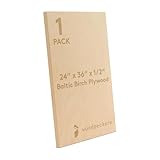
- STRONG, DURABLE, HEAVY-DUTY - These craft wood pieces of multi-coated Baltic Birch plywood offer exceptional durability, rigidity, and stability for all your woodworking needs. The surfaces provide excellent holding power for glue and screws and the birch edges create cleaner joinery.
- BEAUTIFUL WOOD, BEAUTIFUL PROJECT- Baltics-grown birch plywood is prized by woodworkers everywhere. Manufactured using the latest methods in wood production, this hardwood from the snowy forests of the north is extremely durable and creep resistant. It has a beautiful lengthwise grain and takes stain well. TRUE SIZE: 23-7/8" x 35-7/8".
- CHOOSE LASER CUTTER WOOD - The layers of the Baltic Birch sheets of thick plywood are designed to smoothly glide through laser cutters and scroll saws, making it the ideal wood sheets for efficient woodcutting. Are you looking for wood for wood burning projects? Woodpeckers has the perfect wood boards for crafts.
- GRADE B/BB - Graded as B/BB, this hardwood has a single piece face and a back veneer. The face veneer has a smooth surface with a light uniform color while the back surface typically has 1-2 Small color-matched patches. The thick face veneer provides a smoother surface for CNC routers or engraving machines to glide on the birch wood.
- WOOD SHELF BOARD FOR DIY FURNITURE DESIGN - ½” thick wood planks create strong shelving & cabinetry. Use these wooden boards for classroom cubbies, cabinet making, or wooden shelves for walls. Custom closets and storage start with our pre-cut boards.
Formaldehyde emissions and workshop safety
MDF is one of the composite wood products regulated in the United States under EPA TSCA Title VI. The federal emission limit for MDF panels thicker than 8 mm is 0.11 ppm; thin MDF has a 0.13 ppm limit. Regulated panels manufactured or imported after March 22, 2019 generally must be certified and labeled as TSCA Title VI compliant, subject to the rule’s details and exemptions. See the EPA formaldehyde standards page.
Do not assume that all MDO is formaldehyde-free or automatically safer. Structural plywood manufactured to the applicable PS 1 standard is among the products excluded from the federal TSCA Title VI composite-wood regulation, but that classification matters more than the word “MDO.” Imported, laminated, decorative, and non-PS 1 products may have different treatment. When emissions matter, check the panel mark, manufacturer’s documentation, and safety data sheet.
EPA proposed technical updates to its formaldehyde standards and voluntary consensus references on February 6, 2026. Those proposals should not be described as a completed final rule without confirmation of a later final action. Check the EPA proposal page for status.
For either product, use dust collection, local exhaust, ventilation, suitable respiratory protection where required, and the manufacturer’s SDS. Avoid dry sweeping and prevent dust from accumulating near machinery.
Common mistakes to avoid
- Calling MDO “MDF with a coating”: MDO has a plywood core; MDF is a homogeneous fiber panel.
- Calling MDO waterproof: Edges, holes, joints, and damaged areas still need protection.
- Using painted MDF outdoors: Paint does not replace an exterior-rated substrate.
- Assuming all MDO is structural: The core grade, thickness, species, performance category, and standard determine the classification.
- Assuming all MDO weighs less: Actual density varies by product.
- Calling MDF useless because it is not structural plywood: Its uniform routing and smooth finish make it excellent for many interior applications.
- Buying MDO-Concrete Form for a painted sign: Release treatments and finish characteristics may make it unsuitable.
- Ignoring the back face: One-sided and two-sided MDO panels serve different purposes.
- Comparing old price claims: Cost varies by region, thickness, supplier, grade, priming, and availability.
When neither MDO nor MDF is the right choice
Choose another panel when the exposure or performance requirement exceeds what these products are designed to provide.
- For continuous wet exposure or ground contact, consider properly specified exterior plywood, marine plywood, pressure-treated plywood, PVC sheet, HDPE, fiberglass, or another material designed for that service.
- For maximum face durability and abrasion resistance, consider HDO.
- For visible wood grain or high-end cabinetry, consider hardwood plywood or veneer-core plywood.
- For fine indoor routing at lower weight, consider lightweight MDF or an appropriate LDF product.
- For structural framing, roofing, or sheathing, specify a structural panel based on engineering requirements rather than choosing MDF or MDO by name alone.
A simple decision tree
- Will the panel face weather, liquid water, or repeated humidity cycles?
Start with MDO or another exterior-rated panel. Do not rely on paint alone. - If it will stay indoors, do you need very smooth routing, profiles, or grain-free machining?
MDF is usually the better starting point. - If it will stay indoors, do you need better panel stiffness, screw holding, lighter weight, or abuse resistance?
Consider MDO or another plywood product. - If none of those factors dominates?
Compare the exact grade, actual thickness, overlay sides, finish requirements, availability, and total installed cost.
For a construction project, the safest specification is based on the exposure and performance requirement first, then the material name. “MDO” and “MDF” describe broad product families; the panel’s grade, standard, marking, and finishing system determine whether the sheet is suitable for the job.
Frequently Asked Questions
Is MDO or MDF better for an outdoor sign?
MDO is usually better for outdoor signs because it combines a paintable overlay with a plywood core. Specify MDO-General, confirm the exterior classification, and seal all edges, holes, and cutouts.
Recommended Free Tools
Is MDO waterproof?
No. MDO offers better moisture performance, but exposed edges, penetrations, joints, and damaged areas can still absorb water. It must be primed, painted, and sealed for exterior service.
Can moisture-resistant MDF be used in a bathroom?
Moisture-resistant MDF reduces swelling compared with standard MDF, but it may still be limited to interior use. It is not automatically waterproof or suitable for direct wet exposure.
Which is easier to route, MDO or MDF?
MDF is generally better for detailed interior routing because its homogeneous, grain-free structure machines predictably in every direction. MDO is better when plywood-like stiffness and exterior durability are more important.
The Bottom Line
Use MDO-General for a painted panel that must handle weather, humidity, handling, or greater panel loads. Use MDF for a dry interior project where smooth, uniform routing and a flawless paint base matter most. Seal every exposed MDO edge and penetration, finish MDF edges separately from its faces, and verify the full panel designation before buying.
PC Slower Than It Used to Be?
A free scan shows the junk files, broken settings and background clutter dragging Windows down - then fixes them in one click.Free scan · Windows 10 & 11Outdated Drivers Are Slowing You Down
One free scan finds every outdated or missing driver and matches the right update for your exact hardware.Free scan · exact hardware matchQuick Recap
Product prices and availability are accurate as of the date/time indicated and are subject to change. Any price and availability information displayed on Amazon at the time of purchase will apply.

