What to do with the red wire when installing a light depends on the circuit layout, the existing device connections, and the new fixture or switch’s instructions. A red conductor may be the switched hot, a traveler in a three-way circuit, or another energized conductor. Turn off and test the circuit before disconnecting anything.
Color is a clue, not proof. The safest installation identifies every conductor, verifies that the point of work is de-energized, and follows the exact manufacturer diagram. Local electrical codes, permit rules, and product instructions may impose additional requirements.
As an Amazon Associate I earn from qualifying purchases.
Key takeaways
- A red wire can be a switched hot/load conductor, a three-way traveler, or another energized conductor; color alone does not identify its job.
- A three-way circuit controls one light from two locations, so a red wire may run between switches instead of connecting directly to the fixture.
- Turn off the breaker and verify all conductors at the point of work; a breaker position or wall-switch position alone does not prove that wiring is de-energized.
- Cap an unused red wire individually with an approved wire connector only after you have positively identified it as unused.
- Stop and contact a licensed electrician when the wiring does not match the manufacturer’s diagram, the circuit remains energized, or the box shows damage, overheating, multiple circuits, or previous alterations.
What do you do with the red wire when installing a light?
What to do with the red wire when installing a light depends on the circuit layout, the existing device connections, and the new fixture or switch’s instructions. A red conductor may be the switched hot, a traveler in a three-way circuit, or another energized conductor. Turn off and test the circuit before disconnecting anything.
Do not connect a red wire to a fixture’s black, white, or bare/green wire simply because of its color. Photograph and label the existing connections, identify line, load, neutral, traveler, and ground conductors, and use the wiring diagram supplied with the new device.
#1 Best Overall

- Connect any combination of solid, stranded, and flexible copper wires faster and more reliably
- Terminates 24-12 AWG for 221-41x, 20-12 AWG for 221-2401 solid
- Genuine WAGO LEVER NUTS
- Visually inspect for proper strip length and complete wire insertion through its transparent housing
- Includes: 8x 221-2401 (2 conductor inline), 8x 221-412 (2 conductor), 8x 221-413 (3 conductor), 4x 221-415 (5 conductor) with case
What can a red wire mean in a light circuit?
A red wire has no single universal function in residential lighting. The red conductor’s role must be established from the circuit topology, cable routing, existing connections, device instructions, and test results.
| Possible red-wire role | Where it commonly appears | What that means | Do not assume |
|---|---|---|---|
| Switched hot or load | Some single-pole lighting installations | The red conductor carries power from the switch to the light or connects to a device’s load lead. | Every red wire connects to the fixture’s black wire. |
| Traveler | Three-way or multi-location lighting circuits | The red conductor may run between switches and change function depending on which switch box is being examined. | The red wire connects directly to the light. |
| Another energized conductor | Multi-wire branch circuits, switched receptacles, second lighting functions, altered wiring, or backfeed situations | The conductor may belong to a different function or remain energized when another part of the circuit is switched off. | Capping the wire without identifying it makes the box safe. |
Red as a switched hot or load wire
In one common single-pole arrangement, a red conductor carries power from the wall switch to the light. A manufacturer-specific example from Lutron’s Caséta installation guidance identifies a device’s black lead as line/hot and its red lead as load or switched-leg. That example explains a possible connection; it is not a universal residential wiring rule.
Red as a traveler in a three-way circuit
A three-way circuit controls one light from two switch locations. The two switches use traveler conductors between the boxes; one switch’s common terminal connects to line/hot, while the other switch’s common terminal connects to the switched leg. In that arrangement, a red wire may be a traveler rather than the switched wire leading to the fixture.
Do these 3 things before closing this tab:
1Repair Windows errors before they cause bigger problems2Fix the driver behind crashes, sound loss and screen glitches3Clear out junk files and repair common Windows errorsLutron’s three-way documentation describes the line-side common, load-side common, and traveler arrangement. Leviton’s three-way switch guidance also treats the circuit as a two-location control and advises consulting an electrician when the wall-box configuration differs from the diagram.
Red as another energized conductor
A red wire may be part of a multi-wire branch circuit, a switched receptacle arrangement, a second lighting function, an older alteration, or a circuit with backfeed. More conductors than expected, multiple cables entering the box, unusual splices, or voltage that remains after the presumed breaker is off are reasons to stop rather than guess.
Rank #2
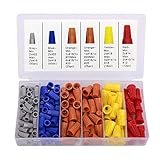
- INSULATION MATERIAL: These electrical wire connectors are made of plastic shell. The nylon shaped shell has thick wall, high hardness and is not easy to aging. It can effectively prevent the unstable connection of leakage box and enhance the safety and insulation.
- STRONG SPRING DESIGN: These Wire Caps are made of metal spring, which is inserted to ensure a stable connection to each application. Preventing the connection from falling off due to instability. Strong wiring, good conductivity.
- COMPACT AND PORTABLE: The electrical wire nuts are a round base with model and specification on the top of the wire connector, compact and portable. The packaging is made of transparent plastic moulded partition storage box to keep different wire connectors separate. There are 5 kinds of nuts with different colors. Special size corresponds to special colors for easy identification and selection. Clear, easy to store and use.
- HIGHT COST PERFORMANCE: Complete specifications, 5 different specifications of wire nuts, special size of special colors. The package includes 50pcs Grey, 50pcs Blue, 50pcs Orange, 18pcs Yellow, 12pcs Red. The most common size can be used for everyday electrical wiring projects and applications.
- WHAT YOU GET:180PCS wire nuts(50pcs Grey, 50pcs Blue, 50pcs Orange, 18pcs Yellow and 12pcs Red), our worry-free 30-days and our 7*24 friendly customer service for peace of mind.
How do you safely identify the red wire?
Identify the red wire only after de-energizing and testing the point of work. The safe sequence is more important than the wire color.
- Turn off the suspected breaker. Do not rely on the wall switch being off. Keep other people away from the switch or fixture while work is in progress, and use a lockout/tag or another practical method to prevent accidental re-energization where appropriate.
- Verify the circuit at the work location. Test the conductors that could be energized, including the red, black, white, and any other relevant conductors. Test the tester on a known energized source before and after the check when appropriate for the instrument and procedure.
- Consider backfeed and unrelated voltage. A portion of a circuit can be off while another portion remains live. OSHA’s hazardous-energy guidance explains that backfeed and induced voltage can create dangerous conditions even when a circuit is presumed de-energized.
- Record the original arrangement. Photograph each connection, label conductors by their observed terminal or function, and note which wires were connected together before removing anything.
- Match the new device diagram. Follow the exact instructions for the replacement fixture, basic switch, dimmer, smart switch, or integrated LED fixture. Device leads and terminal labels vary.
- Stop if the evidence conflicts. If the wire function is unexplained, the diagram does not match the box, or the circuit remains energized, close the box safely if possible and call a qualified electrician.
“A qualified person shall use test equipment to test the circuit elements and electrical parts of equipment to which employees will be exposed and shall verify that the circuit elements and equipment parts are deenergized.”
Special offer. See more information about Outbyte and uninstall instructions. Please review EULA and Privacy policy.
That statement comes from OSHA’s 1910.333 electrical-safety standard. The cited rule is a workplace safety standard, not a substitute for training or a license. The practical lesson for a homeowner is that a breaker being off is not, by itself, proof that exposed conductors are safe.
Can a non-contact voltage tester prove that the red wire is safe?
A non-contact voltage pen can serve as a preliminary warning device, but it should not be the sole proof that a conductor is de-energized. OSHA’s official interpretation of LED-type voltage-alerting devices says such an alerting device is not the required test equipment for verifying de-energization under the cited electrical-safety standard.
A properly rated digital multimeter or two-pole voltage tester can help verify voltage when used correctly. A meter does not replace training, the correct measurement category and rating, safe probe technique, or an electrician. Do not use a meter if you do not know how to select the correct function, range, terminals, and test procedure.
Rank #3

- 【Safety】 Terminates 28-12 AWG;Rated Voltage: 250V/4KV; Rated Current: 32A.Long life, no corrosion, aging resistance, pressure resistance, high temperature and normal work. There is a test hole on the back of the connector. Test holes can be used to check if the wires are energized.
- 【Efficient】 No tools required in use, one plug can be used, greatly reducing the wiring work time. In fact, for home decoration, after the vertical connection terminal technology, each wire connection will save the wire length of about 500px , saving more than 80% of working hours, the comprehensive cost is greatly reduced.
- 【Universal compatibility】 Suitable for soft and hard single-strand and multi-strand. Widely used in lightings, fans, automatic doors and all small appliances.
- 【Practical】 The wire connectors s is a reusable and innovative connector. If you need to replace other wires, simply pull up on the small levers, pull out what you need and replace them. The XHF wire connectors features a special scientific design that saves space. When you combine wires, you don't need to worry about the distortion between the wires. The XHF cable connector will help you create a clean and beautiful house.
- 【Convenience】 You can connect wires without any tools with your hands. Push the orange handle to 90° and plug in the wire (peel the wire case to 0.35-0.47 inches and make sure the wire is inserted into the end. Do not open the wire case for too long) and place the back of the wire clip. When you make an electrical connection, you only need a little power to push the lever up.
Where does the red wire connect on a new light?
The red wire connects wherever the new fixture’s or control’s diagram says the identified conductor belongs; there is no safe color-only answer. The following decision table shows how the connection question changes with the situation.
Quick wins for a faster PC:
Scan for outdated or missing drivers - takes under a minuteDriver Scan →Clear out junk files and repair common Windows errorsFree Scan →| Situation | Likely role of red wire | What to do | When to stop |
|---|---|---|---|
| Single-pole switch and light, with connections clearly documented | Possibly switched load | Verify the conductor and connect it according to the new device’s line/load diagram. | Stop if the old connections or test results do not support that identification. |
| Two switches control one light | Possibly a traveler | Use the manufacturer’s three-way or multi-location diagram and identify the common and traveler conductors. | Stop if the box has a different number or arrangement of conductors than the diagram. |
| Red, black, white, and ground are present | Undetermined from color alone | Identify each conductor by connection, circuit role, and testing; follow the fixture instructions. | Stop if the white is not clearly neutral, more than one circuit is present, or any conductor is energized unexpectedly. |
| The new fixture has no red-wire terminal | Possibly unused, but not confirmed | Cap the red wire individually only after confirming that it is not required by the circuit or device. | Stop if the red wire’s purpose is unknown. |
Can you cap an unused red wire?
You can cap a red wire only when testing and circuit tracing establish that the conductor is not needed by the new installation. Turn off and verify the circuit, place an approved wire connector on the red conductor by itself, and fold the capped conductor safely into the electrical box.
Do not connect an unused red wire to neutral or ground. A wire connector isolates a known-unused conductor; it does not identify an unknown wire or make an energized conductor safe to touch. Leviton’s installation instructions provide a manufacturer example in which a yellow/red traveler used in a three-way application receives a wire connector when that traveler is not used by the particular device. The same instructions direct users to contact technical support or consult an electrician when the wall-box configuration differs from the diagram.
What should you do if the red wire does not match the diagram?
Stop the installation and do not improvise a connection. A mismatched diagram may indicate a three-way circuit, another energized circuit, a prior alteration, a multi-wire branch circuit, a switched receptacle, or an incorrectly wired box.
- Do not use color as a substitute for circuit identification.
- Do not connect unknown conductors together to see whether the light works.
- Do not assume a white wire is neutral if its connections and markings do not establish that function.
- Do not work on a box that remains energized after the suspected breaker is off.
- Do not remove grounding or bonding connections to simplify the installation.
When should you call a licensed electrician?
Call a licensed electrician when you cannot positively identify the red wire, the wiring does not match the new device’s instructions, or the circuit cannot be verified as de-energized. Professional help is also the right choice for damaged, obsolete, crowded, or previously altered wiring.
Recommended Free Tools
Rank #4

- 【1-Second Connection - No Stripping】Still frustrated with soldering, stripping wires, or messy tape? These quick connect wire connectors solve it all. Just open the lever on our wire quick connectors, push the intact wire straight in, and snap it shut—secure connection in just 1 second. No stripping, no tools, no prep, ultra-simple for anyone.
- 【Premium Flame-Retardant Materials】 Crafted from high-quality PA66 flame-retardant nylon, this quick wire connectors ensures superior thermal stability. Stop worrying about melting or short circuits—even in high-temperature, demanding environments. The modified copper core guarantees optimal conductivity and corrosion resistance for a safe, reliable connection.
- 【Secure Locking - Never Pulls Out】 Innovative locking strip connector + independent clamp ensures wires stay locked firmly even with vibration. Ideal for LED strips, cars, and moving installations—say goodbye to loose connections!
- 【Reusable & Versatile for Any Wire】 Unlike one-time connectors, these double wire plug in connector fully reusable, allowing you to reconfigure wiring projects without wasting resources. Compatible with 22-18 AWG solid and stranded wires. The independent spring-clamp design adapts to various diameters, ensuring secure, stable electrical circuits.
- 【Wide Applications + Clean Wiring】Perfect for LED strip lights, speakers, fans, sockets, switches, motorcycles, cars, model kits, and all household low-voltage projects. The compact design fits easily into tight spaces, reducing wire clutter. Optimized for low-voltage, solderless fine wire connectors, it significantly speeds up projects for both professionals and DIY hobbyists.
Escalate immediately if you find cracked, cut, brittle, scorched, or overheated insulation; aluminum or knob-and-tube wiring; multiple circuits in one box; repeated breaker trips; arcs, sparks, buzzing, sizzling, shocks, discoloration, or flickering. ESFI’s home wiring safety guidance identifies these conditions as electrical-warning signs and advises homeowners to call a licensed electrician.
A residential electrical inspection is particularly appropriate when the red conductor remains unexplained or the box contains evidence of unsafe alterations. A professional can trace the circuit, check for backfeed, assess the box and conductors, and determine whether local code, permit, or equipment requirements affect the installation.
Independent reader supportYour contribution helps us test, update, and keep practical guides available for everyone.How do line, load, neutral, traveler, and ground differ?
These terms describe electrical roles, not guaranteed wire colors. Understanding the roles helps explain why a red wire cannot be connected safely by color alone.
| Term | Meaning in a typical lighting circuit | Why it matters |
|---|---|---|
| Line or hot | The conductor supplying power from the panel toward the device. | A device’s line terminal must receive the supply conductor specified by its instructions. |
| Load or switched leg | The conductor carrying switched power from the control toward the light or other load. | A red wire may serve this role in some single-pole arrangements. |
| Traveler | A conductor between switches in a three-way or multi-location circuit. | A red traveler may not connect directly to the fixture. |
| Neutral | The current-return conductor in a typical residential circuit. | Do not connect an unidentified red conductor to neutral. |
| Grounding conductor | The safety path intended to carry fault current. | Do not use a red conductor as a substitute for the grounding conductor. |
ESFI’s explanation of the basic residential electrical system describes hot as the power-delivery conductor, neutral as the current-return conductor, and grounding as a safety path during a fault. Actual installations can be more complex than that basic model.
Crashes, No Sound, or Screen Glitches?
Random freezes, missing sound and display glitches usually trace back to one bad driver. Find and replace yours safely.Free scan · under a minutePC Slower Than It Used to Be?
A free scan shows the junk files, broken settings and background clutter dragging Windows down - then fixes them in one click.Free scan · Windows 10 & 11A practical red-wire checklist
- Breaker off and protected against accidental re-energization where practical.
- Tester checked on a known energized source before and after testing when appropriate.
- All conductors at the point of work tested, not only the red conductor.
- Existing connections photographed and labeled.
- Circuit identified as single-pole, three-way/multi-location, or another arrangement.
- New fixture or device diagram read and matched to the identified conductors.
- Unused red conductor capped individually only after its function is known.
- No damaged insulation, overheating, repeated trips, sparks, shocks, or unexplained voltage.
- Licensed electrician contacted if any answer remains uncertain.
Frequently Asked Questions
Is the red wire always the hot wire for a light?
No. A red wire does not have one universal function in residential lighting. The red conductor may be a switched hot/load, a traveler in a three-way circuit, or another energized conductor, so identify it from the circuit, existing connections, testing, and the device diagram.
Best Value
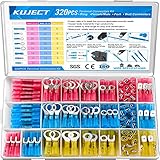
- Multiple Choices: Proper ratio of various types to meet the commonly used types needs. This wiring terminals kit contains ring, fork, spade, and heat shrink butt connectors
- Stronghold and Durability: We adopt premium copper core to ensure good electrical conductivity and durability. Heat shrink crimp connectors provides greater pull strength
- Waterproof: With the adhesive melted when heated, the heat shrink tubing seals all the way to the end of the barrel. The connections were to be outside or inside the vehicles, will perform good water proof
- Straightforward Visual Inspection: Translucent, adhesive-lined polyolefin tubing for straightforward visual inspection, prevents wire corrosion, and provides a waterproof seal
- Wide Applications: Good electrical conductivity and water proof provide connection for your automotive, motorcycle, and marine application. Widely used on multiple projects of your vehicle or ATV lighting, motorcycle stereo, boat electronics, equipment switches
Does the red wire go to black or white when installing a light?
Do not connect the red wire by color alone. Turn off and verify the circuit, determine whether the red conductor is line, load, or a traveler, and follow the new fixture’s exact wiring instructions. If the function is unclear, call a licensed electrician.
Can I cap the red wire if my new light does not use it?
You may cap the red wire only after confirming that it is not needed by the circuit or new device. Cap it individually with an approved wire connector and fold it into the box; never connect an unidentified red wire to neutral or ground.
Why is there a red wire in my three-way switch box?
A red wire in a three-way switch box may be one of the travelers connecting the two switch locations. A traveler is not necessarily the switched conductor that connects directly to the light, so use the manufacturer’s three-way diagram and identify the common and traveler conductors.
The Bottom Line
The red wire is not automatically the hot wire, the fixture wire, or a wire to cap. It may be a switched load, a three-way traveler, or another energized conductor. Turn off and verify the circuit, identify the conductor from the actual wiring and manufacturer diagram, and use a licensed electrician when the configuration or test results are unclear.
Quick Recap
Product prices and availability are accurate as of the date/time indicated and are subject to change. Any price and availability information displayed on Amazon at the time of purchase will apply.

