Free tools Windows power users keep installed
One-click scans. No signup required.
Some links on this page are affiliate links: if you buy through them we may earn a commission, at no extra cost to you.
When construction equipment breaks down, stop the affected work, keep workers away from the machine and any related hazard, and notify the supervisor or designated competent person. Do not keep using equipment that may be unsafe, make repeated restart attempts, or improvise a repair. Under OSHA 29 CFR 1926.20(b)(3), equipment that does not comply with an applicable construction requirement is prohibited from use and must be identified as unsafe by tagging or locking its controls to make it inoperable, or by physically removing it from its operating location. See the full rule at OSHA 29 CFR 1926.20.
1. Make the area safe before troubleshooting
A failed machine can create hazards beyond the original symptom: unexpected movement, suspended or raised loads, stored hydraulic or electrical energy, loss of braking or steering, falling material, fire, or a struck-by exposure. Treat the event as a potential safety incident first and a production problem second.
As an Amazon Associate I earn from qualifying purchases.
Crashes, No Sound, or Screen Glitches?
Random freezes, missing sound and display glitches usually trace back to one bad driver. Find and replace yours safely.Free scan · under a minutePC Slower Than It Used to Be?
A free scan shows the junk files, broken settings and background clutter dragging Windows down - then fixes them in one click.Free scan · Windows 10 & 11- Stop the affected operation. If a machine is moving, lifting, cutting, mixing, compacting, or supporting a load, follow the site emergency procedure and the operator’s instructions for bringing the activity to a safe condition. Do not create a second hazard by rushing to reach controls or entering a danger zone.
- Keep people clear. Establish a safe boundary around the equipment and any load, trench edge, traffic lane, swing radius, energized component, leaking fluid, or unstable material. Warn nearby crews and direct them to a safe location.
- Escalate an immediate danger. Alert the designated supervisor, competent person, or site emergency contact without delay. Call emergency services under the project’s emergency plan when there is an injury, fire, electrical danger, uncontrolled movement, collapse risk, or other imminent threat.
- Preserve the scene when appropriate. Do not move failed equipment or disturb controls, guards, components, or materials more than necessary to protect people. The supervisor can decide what must be preserved for an incident review or regulatory notification.
This is a practical site-response sequence, not a universal OSHA restart or shutdown procedure. The correct control actions depend on the machine, its condition, the operator’s manual, and the employer’s written procedures.
2. Report the failure with useful facts
Give the site lead enough information to make a safe decision without guessing at a diagnosis. Report:
Popular on Amazon

- LOCKOUT TAGOUT KIT: Lockout pouch is made of heavy duty nylon with metal belt loops for convenient tagging on the go, Compliant with OSHA's Lockout Standard
- SAFETY PADLOCKS: The personal lockout kit contains two keyed different padlocks for reliable lockout safety, the key is one use one spare.
- LOCKOUT DEVICES: Kit contains 3 clamp-on circuit breaker lockout, 3 Universal Multi- Pole Breaker ,3 different size lockout hasps,15 heavy duty lockout tags,4 keyed-different safety padlocks:Stainless Steel Lock Beam, with PA Shell ,Vertical Clearance: 1-1/2”, 38mm,Horizontal Clearance: 4/5”, 20mm ,Shackle Dia.: 1/5”, 6mm ,Body Size: 1-4/5” x 1-2/5”, 45 x 37mm
- OSHA COMPLIANT LOCKOUT KIT: Compliant with OSHA's Lockout Standard designed to address risk and safety tagging in any facility
- We have confidence in our product. If you are not satisfied with our products, please contact us and we will reply to you within 24 hours.
- Equipment identification, location, and the operator’s name.
- What the machine was doing immediately before the failure.
- What changed: unusual noise, smoke, odor, warning light, leak, loss of power, loss of braking, movement, or a damaged guard.
- Whether a load is raised, attached, suspended, or otherwise unstable.
- Who is inside, on, or near the equipment and whether anyone is injured.
- Any controls already used and whether the machine stopped, partially responded, or continued to move.
Avoid repeated attempts to start or operate a machine that has shown a dangerous symptom. Do not bypass an interlock, remove a guard, bridge a fuse, defeat an alarm, or use an improvised securing method. Refer the operator and supervisor to the equipment manual and the employer’s procedure for that machine.
3. Decide whether the equipment must be removed from service
The responsible supervisor or designated competent person should determine whether the defect makes the equipment unsafe or noncompliant. OSHA requires employers to maintain programs for frequent and regular inspections of jobsites, materials, and equipment by designated competent persons. The rule also says only employees qualified by training or experience may operate machinery and equipment. These duties are described in 29 CFR 1926.20.
If the equipment is not in compliance with an applicable Part 1926 requirement, OSHA’s wording is explicit: “The use of any machinery, tool, material, or equipment which is not in compliance with any applicable requirement of this part is prohibited.” The same paragraph requires the unsafe item to be identified by tagging or locking the controls to render it inoperable, or to be physically removed from its place of operation.
What an out-of-service control must accomplish
- Tag or lock the controls so the equipment cannot be operated, using the employer’s established method and authorized personnel.
- Physically remove the equipment from its operating location when that is the selected control.
- Prevent informal return to use. Tell all affected crews that the machine is unavailable and identify the person who controls its release.
An ordinary caution sign is not automatically enough. The construction rule specifies tagging or locking controls to make the equipment inoperable, or physical removal. The exact method must fit the machine and the applicable procedure.
Also popular on Amazon

- LOCKOUT TAGOUT KIT: Lockout pouch is made of heavy duty nylon with metal belt loops for convenient tagging on the go, Compliant with OSHA's Lockout Standard
- SAFETY PADLOCKS: The personal lockout kit contains two keyed different padlocks for reliable lockout safety, the key is one use one spare.
- LOCKOUT DEVICES: Kit contain 3 Safety Padlocks with number 1-3, 2 Lockout Hasp ,1 Nylon hasp ,15 Loto Tags, 20 Nylon ties , 1 Lockout Tool Bag
- OSHA COMPLIANT LOCKOUT KIT: Compliant with OSHA's Lockout Standard designed to address risk and safety tagging in any facility
- We have confidence in our product. If you are not satisfied with our products, please contact us and we will reply to you within 24 hours..
4. Control hazardous energy before repair
Repair work can expose people to electrical, hydraulic, pneumatic, mechanical, thermal, gravitational, chemical, or other stored energy. The energy-control method must be specific to the equipment and task; there is no single shutdown sequence that is safe for every excavator, aerial lift, crane, pump, saw, mixer, or vehicle.
Concrete and masonry equipment
For the equipment and work covered by 29 CFR 1926.702(j), maintenance or repair is prohibited where inadvertent operation could cause injury unless all potentially hazardous energy sources have been locked out and tagged. The regulation requires tags to read “Do Not Start” or similar language indicating that the equipment is not to be operated. Read the construction requirement at OSHA 29 CFR 1926.702.
Do these 3 things before closing this tab:
1Clear out junk files and repair common Windows errors2Fix the driver behind crashes, sound loss and screen glitches3Repair Windows errors before they cause bigger problemsOnly trained and authorized personnel using the employer’s equipment-specific energy-control procedure should identify energy sources, isolate them, apply locks and tags, release or restrain stored energy, and verify that the machine cannot operate. A commercial “lockout tagout kit” can supply physical devices, but owning a kit does not establish compliance or replace training, an energy-control procedure, or verification.
Do not apply the wrong OSHA standard
OSHA’s general-industry hazardous-energy standard, 29 CFR 1910.147, expressly excludes construction employment. It should not be presented as the governing construction lockout/tagout rule. The text is available at OSHA 29 CFR 1910.147. OSHA’s Lockout-Tagout Tutorial can explain hazardous-energy concepts, but it is guidance for the general-industry standard, not a substitute for applicable construction requirements, employer procedures, or manufacturer instructions.
Also popular on Amazon
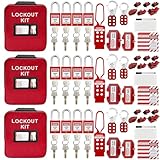
- 1、 What You Get. 3 x Complete LOTO Kits (Each Contains): 4 Safety Padlocks、2 Steel Hasps、1 Nylon Hasp、15 LOTO Tags、20 Cable Ties、1 Big Nylon Pouch、4 clamp-on circuit breaker lockout, 3 Universal Multi- Pole Breaker, 2 Electrical Plug Lockout + SAFBY's 2-Year Support。
- 2、OSHA-Compliant Safety:Meets all lockout/tagout (LOTO) standards for electrical, mechanical and industrial safety,Complete 3-Kit Set Perfect for teams or multiple workstations。Each kit is self-contained with all essential LOTO devices。
- 3、Superior Durability:Reinforced steel hasps withstand tough environments,Weather-resistant tags and nylon components。
- 4、 Clear Hazard Communication:Bright red safety tags with bold warnings,Numbered padlocks for easy identification。
- 5、Convenient Portability:Compact nylon pouch with metal belt loops,Keeps all devices organized and accessible。
5. Assign the right people to inspect and repair
Supervisor or site lead
- Stop conflicting work and control access to the hazard area.
- Notify the designated competent person and coordinate emergency response when needed.
- Confirm that the equipment is tagged, locked, or removed when required.
- Arrange a qualified repair resource and communicate the machine’s status to every affected crew.
Competent or qualified person
The designated competent person evaluates the condition under the employer’s inspection program and applicable construction requirements. A competent person’s role is not a blanket authorization to repair every machine; the person must have the knowledge, training, and authority appropriate to the equipment and hazard.
Operator
An operator may report symptoms and secure the work area within the limits of training and the manual. OSHA requires machinery and equipment operators to be qualified by training or experience. Qualification to operate does not automatically qualify someone to diagnose, bypass safeguards, or repair the machine.
Quick wins for a faster PC:
Clear out junk files and repair common Windows errorsFree Scan →Fix the driver behind crashes, sound loss and screen glitchesFind Drivers →Repair Windows errors before they cause bigger problemsFix Now →Repair technician or mechanic
Repair should be limited to personnel authorized and qualified for the equipment and task. They should follow the machine manual, employer procedures, energy-control steps, and any manufacturer or regulatory requirements. If the site cannot safely perform the repair, remove the equipment from service and use an appropriately qualified outside resource or replacement equipment.
6. Apply the crane rule separately
Cranes have a specific inspection and out-of-service provision. Under 29 CFR 1926.1412, when a qualified person determines that a deficiency is a safety hazard, the crane equipment must be taken out of service until the deficiency is corrected, except for specified temporary alternative measures in the rule.
Also popular on Amazon

- COMPLETE ELECTRICAL LOCKOUT KIT: Designed for electricians, maintenance teams, and industrial facilities, this complete LOTO kit includes safety padlocks, breaker lockouts, hasps, tags, ties, and storage bag to manage hazardous energy safely and efficiently.
- 4 KEYED-DIFFERENT SAFETY PADLOCKS: Each lock has a unique key configuration for personal lock control. Durable safety locks help prevent unauthorized equipment operation during maintenance and service procedures.
- UNIVERSAL CIRCUIT BREAKER LOCKOUTS: Includes clamp-on and multi-pole breaker lockout devices designed to fit a wide range of electrical panels, helping technicians handle different lockout applications with one kit.
- MORE COMPLETE LOCKOUT OPTIONS: Includes plug lockout, lockout hasps, safety tags, and nylon ties for electrical equipment isolation, group lockout procedures, and daily maintenance tasks.
- READY FOR INDUSTRIAL USE: Store and organize all LOTO devices in the durable portable bag. Ideal for factories, workshops, electrical rooms, machinery maintenance, and facility safety programs.
This crane requirement should not be generalized to every equipment class. Other machines may be governed by different Part 1926 provisions, manufacturer instructions, employer procedures, or state-plan rules. For any crane deficiency, document the qualified person’s determination, control the crane against operation, and follow the applicable correction and inspection process before release.
Independent reader supportYour contribution helps us test, update, and keep practical guides available for everyone.7. Choose repair, removal, or replacement based on the hazard
Once the machine is controlled, the site lead can choose the next operational step. Use these decision questions rather than a one-size-fits-all towing or restart rule:
| Decision question | If the answer is yes | Operational implication |
|---|---|---|
| Does the defect create a safety hazard or violate an applicable requirement? | Keep the equipment out of service and make it inoperable by the required method, or remove it from operation. | Do not assign another operator or continue production with the defect. |
| Is the equipment subject to a specific construction rule? | Apply that rule in addition to site and manufacturer procedures. | Examples include the covered concrete/masonry energy-control requirement and crane inspection provisions. |
| Are trained, authorized personnel and an applicable procedure available? | They may perform the assessment or repair within their qualifications. | Do not improvise when the required competence or procedure is absent. |
| Can the repair be completed safely at the site? | Control energy, perform the authorized repair, and verify correction. | Keep the machine unavailable until the responsible person releases it. |
| Is safe repair impractical or delayed? | Physically remove the equipment or arrange suitable replacement equipment. | Re-plan the work rather than exposing people to an uncontrolled machine. |
Rental or replacement-equipment providers may help maintain the schedule, but replacement does not eliminate the need to control the failed machine or investigate why the failure occurred.
8. Verify correction before returning equipment to work
Do not invent a generic restart checklist for every machine. The responsible qualified person should confirm that the identified deficiency was addressed and that the equipment meets applicable requirements before it returns to service. The verification should follow the machine’s manual, the employer’s procedure, and any equipment-specific construction rule.
Also popular on Amazon

- LOCKOUT TAGOUT KIT: Lockout box is made of 304 steel with PP which is heavy duty and portability, Compliant with OSHA's Lockout Standard
- SAFETY PADLOCKS: The personal lockout kit contains two keyed different padlocks for reliable lockout safety, the key is one use one spare.
- LOCKOUT DEVICES: Kit contains 9 clamp-on circuit breaker lockout, 3 Universal Multi- Pole Breaker ,6 different size lockout hasps, 20 heavy duty lockout tags, 5 keyed-different safety padlocks, 1 plug lock, 1 cable lock, 1 gas valve lockout, 1 ball valve lockout
- OSHA COMPLIANT LOCKOUT KIT: Compliant with OSHA's Lockout Standard designed to address risk and safety tagging in any facility
- We have confidence in our product. If you are not satisfied with our products, please contact us and we will reply to you within 24 hours.
- Confirm that the repair or correction was completed by authorized personnel.
- Ensure guards, interlocks, alarms, brakes, controls, and other protective features required for that machine are restored as specified by the applicable procedure.
- Remove locks and tags only through the employer’s authorized process and only after affected workers are clear.
- Communicate the release to operators and nearby crews; identify any operating limits or follow-up inspections.
- Record the inspection, defect, corrective action, and release decision when the site’s program requires documentation.
If the responsible person cannot establish that the deficiency is corrected, leave the equipment out of service. A schedule pressure, a different operator, or a temporary warning does not substitute for the required determination.
9. Plan for the next breakdown
After the immediate hazard is controlled, use the event to strengthen the site’s inspection and communication program. Review whether the machine was inspected as required, whether operators knew how to report symptoms, whether the out-of-service control was visible and effective, and whether the work plan provided a safe fallback when equipment became unavailable.
What’s actually slowing this PC down?
Pick the symptom - the matching free tool is one click away.
Keep current copies of operator manuals, employer energy-control procedures, emergency contacts, and equipment-specific inspection forms where crews can access them. Train workers on who has authority to stop work, who can apply or remove an out-of-service control, and how to report a failure without entering the hazard zone.
10. Understand the legal boundaries
The cited requirements are U.S. federal OSHA regulations. A state with an OSHA-approved state plan may impose additional or different requirements, and contracts, local laws, project rules, and manufacturer instructions may add duties. Confirm which rules govern the specific site and equipment.
The safest consistent principle is narrow but reliable: stop exposing people to the hazard, alert the responsible site lead, keep unsafe equipment from being operated, and let qualified personnel determine the applicable control, repair, inspection, and release process.
Quick Recap
Product prices and availability are accurate as of the date/time indicated and are subject to change. Any price and availability information displayed on Amazon at the time of purchase will apply.

