Free tools Windows power users keep installed
One-click scans. No signup required.
When a power outage stops production, protect people before equipment, restrict access until the facility is judged safe, stabilize or shut down processes using your written procedures, and prevent unexpected energization. Utility power returning is not permission to restart. A qualified, authorized team must inspect affected systems, complete required energy-control steps, and follow the plant’s process-specific startup procedure. This guidance is U.S.-focused and supplements—not replaces—your emergency action plan, hazardous-energy program, local requirements, and equipment instructions.
First priorities when the factory loses power
An outage can remove lighting, ventilation, controls, pumps, alarms, refrigeration, compressed air, and other services at the same time. The correct response depends on the process, outage cause, building condition, and hazards on site. Use this order as a decision framework, then apply the facility’s emergency action plan and operating procedures.
As an Amazon Associate I earn from qualifying purchases.
- Account for people and control access. Send only essential, critical-operations personnel into restricted areas until the area has been assessed. Keep visitors, contractors, and nonessential employees away from dark, flooded, contaminated, pressurized, or otherwise uncertain spaces.
- Activate the incident structure. Notify the designated incident lead, control room, emergency coordinator, or other role named in the emergency action plan. Establish one person responsible for decisions and one reliable channel for updates.
- Check whether the building is safe to occupy. Look for fire, smoke, gas odor, chemical release, structural damage, flooding, abnormal temperature, loss of ventilation, and failed alarms or suppression systems. Contact emergency services when the situation requires it. Where appropriate, seek guidance from local or state health authorities about building safety.
- Determine the outage boundary and source through established channels. Confirm whether the loss is limited to one line, the facility, the site, or the utility network. Coordinate with the utility and local emergency services when necessary; do not promise a restoration time that has not been confirmed.
- Stabilize or shut down the process using site procedures. A sudden loss of power may create process-specific hazards. For work covered by hazardous-energy rules, OSHA requires an orderly shutdown that avoids creating additional hazards; it is not a universal shutdown checklist for every industry.
- Keep people clear of stored and returning energy. Equipment can retain electrical, hydraulic, pneumatic, thermal, chemical, gravitational, or mechanical energy after the lights go out. Treat automatic restart on power restoration as a foreseeable hazard.
Use the emergency action plan to organize the response
OSHA advises advance planning and an emergency action plan to guide workplace response. The plan should identify who can order an evacuation, shelter-in-place, process shutdown, utility notification, emergency call, and re-entry. During the outage, record decisions, times, alarms, injuries, releases, and equipment status so the next shift does not rely on assumptions.
Windows Errors? Fix Them Before They Spread
Repair common Windows errors and clear accumulated junk for a smoother, more stable PC - no reinstall needed.Free scan · no reinstallCrashes, No Sound, or Screen Glitches?
Random freezes, missing sound and display glitches usually trace back to one bad driver. Find and replace yours safely.Free scan · under a minuteAssign essential roles
- Incident lead: authorizes protective actions and communicates with management, emergency services, and the utility.
- Operations lead: applies the approved process-stabilization or shutdown sequence and tracks critical parameters.
- Maintenance or energy-control lead: controls isolation, lockout/tagout, stored energy, and verification for covered work.
- Safety or emergency lead: evaluates access, evacuation, fire protection, air quality, chemical hazards, and accountability.
- Communications lead: issues consistent instructions to affected employees, contractors, suppliers, and the next shift.
Set an access rule that can change
“Essential personnel only” is an initial control, not a blanket permission for anyone with a key or technical title. Expand access only after the incident lead and competent personnel have assessed lighting, floors, machinery, utilities, egress, alarms, and atmospheric or process hazards. Revoke access if conditions change, such as a generator transfer, pressure change, fire-system impairment, or utility crew activity.
#1 Best Overall

- LOCKOUT TAGOUT KIT: Lockout pouch is made of heavy duty nylon with metal belt loops for convenient tagging on the go, Compliant with OSHA's Lockout Standard
- SAFETY PADLOCKS: The personal lockout kit contains two keyed different padlocks for reliable lockout safety, the key is one use one spare.
- LOCKOUT DEVICES: Kit contains 3 clamp-on circuit breaker lockout, 3 Universal Multi- Pole Breaker ,3 different size lockout hasps,15 heavy duty lockout tags,4 keyed-different safety padlocks:Stainless Steel Lock Beam, with PA Shell ,Vertical Clearance: 1-1/2”, 38mm,Horizontal Clearance: 4/5”, 20mm ,Shackle Dia.: 1/5”, 6mm ,Body Size: 1-4/5” x 1-2/5”, 45 x 37mm
- OSHA COMPLIANT LOCKOUT KIT: Compliant with OSHA's Lockout Standard designed to address risk and safety tagging in any facility
- We have confidence in our product. If you are not satisfied with our products, please contact us and we will reply to you within 24 hours.
Stabilize production without creating a second emergency
Do not improvise a plant-wide shutdown sequence. Use the approved operating instructions for each process, line, boiler, furnace, reactor, storage system, conveyor, robot, and utility. The safest action for one process—such as maintaining circulation—may be unsafe for another.
Questions for the operations lead
- Which reactions, temperatures, pressures, levels, or concentrations can become unsafe without power?
- Which pumps, fans, cooling systems, agitators, controls, alarms, or interlocks are required to keep the process stable?
- What happens if power returns briefly, cycles, or arrives out of phase?
- Which valves, brakes, doors, hoists, robots, or moving assemblies can move when control power returns?
- Which materials require temperature control, ventilation, containment, or time-limited handling?
Use manual actions only when the written procedure authorizes them and the worker has the required training. A flashlight, radio, or portable meter does not make an unplanned intervention safe. If a procedure does not address the condition, pause and escalate to the responsible engineer, process owner, or incident lead rather than inventing a sequence.
Why an outage does not make machinery safe
Loss of utility power is not proof that a machine is de-energized. Capacitors, elevated loads, rotating components, pressure, hot surfaces, chemicals, counterweights, and gravity can remain hazardous. Some equipment is designed to restart automatically when power is restored; other equipment may move when a valve, brake, or control circuit changes state.
Rank #2

- LOCKOUT TAGOUT KIT: Lockout pouch is made of heavy duty nylon with metal belt loops for convenient tagging on the go, Compliant with OSHA's Lockout Standard
- SAFETY PADLOCKS: The personal lockout kit contains two keyed different padlocks for reliable lockout safety, the key is one use one spare.
- LOCKOUT DEVICES: Kit contain 3 Safety Padlocks with number 1-3, 2 Lockout Hasp ,1 Nylon hasp ,15 Loto Tags, 20 Nylon ties , 1 Lockout Tool Bag
- OSHA COMPLIANT LOCKOUT KIT: Compliant with OSHA's Lockout Standard designed to address risk and safety tagging in any facility
- We have confidence in our product. If you are not satisfied with our products, please contact us and we will reply to you within 24 hours..
OSHA’s hazardous-energy guidance applies to covered servicing and maintenance. Employees who work in an area where energy-control procedures are used must be instructed not to restart or re-energize machines or equipment that are locked or tagged out. An outage cannot be used as a shortcut around that program.
Lockout/tagout during outage maintenance
When someone must enter, service, adjust, clear, or maintain equipment in work covered by the applicable hazardous-energy rules, use the facility’s written energy-control procedure and authorized personnel. The procedure must address every relevant energy source, not only the electrical disconnect.
Core controls for covered work
- Prepare. Identify the machine, work scope, energy sources, isolation points, stored-energy hazards, affected employees, and the authorized employee responsible for the procedure.
- Notify affected employees. Tell operators and other people in the area that the equipment will be shut down and controlled.
- Perform an orderly shutdown. Use the established stop sequence so the shutdown itself does not create additional hazards.
- Isolate every energy source. Open, block, disconnect, or otherwise isolate electrical, hydraulic, pneumatic, steam, gas, chemical, mechanical, thermal, gravitational, and other applicable sources.
- Apply locks and tags. Use the site’s devices and identification rules. Affected employees must not remove, bypass, or defeat another person’s lock or tag.
- Release or restrain stored energy. Bleed pressure, discharge capacitors, block movement, lower or secure elevated parts, cool hot equipment, and otherwise make residual energy safe.
- Verify isolation. Attempt a start using the normal control, test for absence of energy with suitable instruments, and return controls to the off or neutral position as required by the procedure.
- Perform the work under the authorized program. Maintain control of the isolation for the entire task and reassess if the scope or conditions change.
A lockout/tagout kit may provide locks, tags, hasps, or related hardware, but it is not an energy-control program. It does not replace equipment-specific procedures, training, verification, or competent authorized employees. CDC/NIOSH manufacturing guidance likewise treats hazardous-energy control as protection against unexpected energizing, startup, or release of stored energy—not merely the presence of a lock.
Rank #3
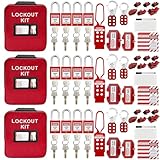
- 1、 What You Get. 3 x Complete LOTO Kits (Each Contains): 4 Safety Padlocks、2 Steel Hasps、1 Nylon Hasp、15 LOTO Tags、20 Cable Ties、1 Big Nylon Pouch、4 clamp-on circuit breaker lockout, 3 Universal Multi- Pole Breaker, 2 Electrical Plug Lockout + SAFBY's 2-Year Support。
- 2、OSHA-Compliant Safety:Meets all lockout/tagout (LOTO) standards for electrical, mechanical and industrial safety,Complete 3-Kit Set Perfect for teams or multiple workstations。Each kit is self-contained with all essential LOTO devices。
- 3、Superior Durability:Reinforced steel hasps withstand tough environments,Weather-resistant tags and nylon components。
- 4、 Clear Hazard Communication:Bright red safety tags with bold warnings,Numbered padlocks for easy identification。
- 5、Convenient Portability:Compact nylon pouch with metal belt loops,Keeps all devices organized and accessible。
Deciding whether backup power should run
Backup power is a planned, site-specific engineering decision. DOE guidance recommends identifying vital systems, estimating their required power, evaluating generator options, and checking fuel supply and supplier access. Do not connect a generator simply because it is available, and do not assume a portable unit can safely support industrial loads.
What’s actually slowing this PC down?
Pick the symptom - the matching free tool is one click away.
| Decision axis | What to establish before transfer or connection |
|---|---|
| Vital loads | Which life-safety, fire-protection, control, cooling, ventilation, communications, security, or process systems must remain powered, and what are their starting and running loads? |
| Fuel and runtime | What fuel is required, how long must the system run, how will fuel be delivered, and can the supplier reach and operate at the facility during the emergency? |
| Transfer and compatibility | Is the generator compatible with the facility’s transfer equipment, grounding, protection, voltage, frequency, phase, and utility specifications? |
| Installation and codes | Does the installation follow the manufacturer’s instructions, utility requirements, building safety codes, fire rules, and applicable permits or inspections? |
| Purpose | Is the system intended for emergency power, standby service, or support of a particular process? The purpose determines design, controls, testing, and which loads may be connected. |
Using DOE’s 24-hour planning prompt correctly
DOE business guidance refers to considering whether backup power should be activated and checking the likely restoration period, including a 24-hour consideration for protecting assets. Treat that as a planning prompt, not a universal technical threshold. Life safety, process safety, environmental protection, and critical equipment needs may require immediate action regardless of the estimated restoration time.
Fuel and gas precautions
Confirm fuel arrangements before an outage, including delivery access, storage limits, contracts, testing, and who is authorized to operate the system. If utility gas service has been shut off, DOE says a professional technician must turn it back on. Do not relight, reconnect, or restore gas service by improvisation.
Rank #4

- COMPLETE ELECTRICAL LOCKOUT KIT: Designed for electricians, maintenance teams, and industrial facilities, this complete LOTO kit includes safety padlocks, breaker lockouts, hasps, tags, ties, and storage bag to manage hazardous energy safely and efficiently.
- 4 KEYED-DIFFERENT SAFETY PADLOCKS: Each lock has a unique key configuration for personal lock control. Durable safety locks help prevent unauthorized equipment operation during maintenance and service procedures.
- UNIVERSAL CIRCUIT BREAKER LOCKOUTS: Includes clamp-on and multi-pole breaker lockout devices designed to fit a wide range of electrical panels, helping technicians handle different lockout applications with one kit.
- MORE COMPLETE LOCKOUT OPTIONS: Includes plug lockout, lockout hasps, safety tags, and nylon ties for electrical equipment isolation, group lockout procedures, and daily maintenance tasks.
- READY FOR INDUSTRIAL USE: Store and organize all LOTO devices in the durable portable bag. Ideal for factories, workshops, electrical rooms, machinery maintenance, and facility safety programs.
Communicate while the outage continues
Use a written status board, log, or electronic record that remains available if the normal network is down. Record the outage start, affected areas, process state, equipment isolated, people accounted for, backup systems operating, alarms, releases, utility updates, and the person who authorized each change.
Tell affected employees what they need to know before conditions change: which areas are closed, whether evacuation or sheltering applies, which equipment is locked or tagged out, where to report, and who can authorize re-entry. OSHA’s hazardous-energy rules specifically require affected employees to be notified before equipment is restarted after lockout or tagout release.
Restarting production after power returns
Restoration of utility power is only one input to a restart decision. Follow the facility’s process-specific startup and emergency procedures, and have qualified personnel assess systems affected by the outage. A production startup and the release of a maintenance lockout are related but distinct decisions.
Best Value

- LOCKOUT TAGOUT KIT: Lockout box is made of 304 steel with PP which is heavy duty and portability, Compliant with OSHA's Lockout Standard
- SAFETY PADLOCKS: The personal lockout kit contains two keyed different padlocks for reliable lockout safety, the key is one use one spare.
- LOCKOUT DEVICES: Kit contains 9 clamp-on circuit breaker lockout, 3 Universal Multi- Pole Breaker ,6 different size lockout hasps, 20 heavy duty lockout tags, 5 keyed-different safety padlocks, 1 plug lock, 1 cable lock, 1 gas valve lockout, 1 ball valve lockout
- OSHA COMPLIANT LOCKOUT KIT: Compliant with OSHA's Lockout Standard designed to address risk and safety tagging in any facility
- We have confidence in our product. If you are not satisfied with our products, please contact us and we will reply to you within 24 hours.
Pre-start inspection
- Confirm the outage cause has been addressed or controlled and that utility, generator, and transfer equipment are stable.
- Inspect work areas, guards, interlocks, barriers, egress, lighting, ventilation, fire protection, alarms, and housekeeping.
- Check tanks, vessels, lines, electrical rooms, compressed-air systems, boilers, refrigeration, and other utilities for leaks, pressure, temperature, contamination, or damage.
- Verify that components are operationally intact and that temporary repairs, jumpers, bypasses, or disabled safeguards are identified and authorized.
- Account for employees, contractors, tools, materials, and access equipment before any movement begins.
Releasing a maintenance lockout or tagout
For work covered by the applicable energy-control program, OSHA’s release provisions require an inspection of the work area, confirmation that components are operationally intact, safe positioning or removal of employees, and notification of affected employees after devices are removed and before equipment starts. Only the authorized employee or person permitted by the site’s procedure may apply or remove an energy-control device. Never cut, bypass, or remove an active lock or tag because production is waiting.
Controlled production startup
- Confirm the startup authorization, responsible supervisor, communications channel, and stop-work authority.
- Restore utilities and controls in the sequence specified by the process procedure, not merely in the order they became available.
- Start one system or line at a time where the procedure calls for staged startup; monitor temperatures, pressures, flows, levels, vibration, alarms, and emissions.
- Keep personnel outside danger zones and maintain guards, interlocks, exclusion zones, and emergency-stop access.
- Hold production at the first safe verification point. Escalate abnormal readings, nuisance trips, leaks, unusual noise, or failed alarms instead of repeatedly resetting them.
- Document the inspection, authorization, readings, deviations, and handoff to normal operations.
Common mistakes and the safer correction
| Mistake | Why it fails | Safer correction |
|---|---|---|
| Sending the whole workforce back in to “check things” | Darkness, failed ventilation, stored energy, and damaged equipment can increase exposure. | Restrict access to essential personnel until the building and process hazards are assessed. |
| Assuming every machine is safe because the lights are off | Stored energy and automatic restart remain possible. | Apply the written energy-control procedure for covered servicing and verify isolation. |
| Using a generator on the largest available loads | Overload, incompatible transfer, backfeed, fuel failure, or code violations can create new hazards. | Use an engineered load list, compatible transfer equipment, approved installation, and trained operators. |
| Treating the utility restoration estimate as a restart schedule | Power quality, damaged components, unresolved hazards, or locked-out equipment may still prevent startup. | Make restart conditional on inspection, authorization, and the process startup procedure. |
| Removing another worker’s lock or tag to meet a production target | It defeats personal protection and can expose someone to unexpected energization. | Follow the site’s authorized removal process and notify affected employees before restart. |
| Resetting trips until the line runs | A trip may indicate a dangerous fault, damaged safeguard, or unstable process. | Stop, investigate, and have qualified personnel approve any reset or repair. |
Prepare before the next outage
The most effective outage response is designed while the plant is operating normally. Review the emergency action plan and energy-control procedures with operations, maintenance, engineering, safety, security, the utility, and emergency services as appropriate.
- Map critical loads and identify the minimum systems needed for life safety, environmental protection, controlled shutdown, and safe restart.
- Document generator capacity, starting loads, transfer arrangements, grounding, fuel runtime, inspection, testing, maintenance, and supplier access.
- Keep current one-line diagrams, isolation-point lists, equipment-specific lockout procedures, process shutdown instructions, and restart checklists where authorized workers can access them during a network outage.
- Train affected employees not to restart locked or tagged equipment and train authorized employees in the full energy-control program, including verification and stored-energy control.
- Exercise communications, accountability, evacuation, sheltering, generator transfer, fuel delivery, and shift handoff without creating a live hazard.
- Define how temporary bypasses, disabled alarms, impaired fire protection, and unfinished maintenance are recorded and cleared.
- After every outage, conduct a documented review of injuries, near misses, equipment damage, delays, communication failures, and procedure gaps; assign corrective actions with owners and due dates.
A concise decision rule for the incident lead
If you cannot confirm that people are accounted for, the area is safe to enter, the process is stable, energy is controlled for covered work, and the startup procedure authorizes the next action, do not advance the operation. Escalate to the designated qualified authority, emergency services, utility, or process owner as appropriate. Production can resume only after the conditions that make it safe to resume have been demonstrated and recorded.
Quick Recap
Product prices and availability are accurate as of the date/time indicated and are subject to change. Any price and availability information displayed on Amazon at the time of purchase will apply.

