Quick wins for a faster PC:
Repair Windows errors before they cause bigger problemsFix Now →Scan for outdated or missing drivers - takes under a minuteDriver Scan →Do not judge a canning seal immediately after removing the jars from the canner. Leave the jars upright and undisturbed at room temperature for 12–24 hours, then remove the screw band and test each lid. If a jar is still unsealed after proper processing, refrigerate it and use it promptly, freeze the food, or—only under specific conditions—reprocess it within 24 hours of the original processing.
If the original recipe or canning method was wrong or unknown, or if a jar sealed at first and later became unsealed in storage, do not try to save it by replacing the lid. Do not taste questionable food. Discard it safely.
As an Amazon Associate I earn from qualifying purchases.
First, determine whether the jar really failed to seal
A missing “pop” does not prove that a jar failed. Some lids seal without an audible ping, and food touching the underside of the lid can muffle the sound. The physical condition of the lid after the jar has cooled is more important than what you heard.
Free tools Windows power users keep installed
One-click scans. No signup required.
- Wait 12–24 hours. Keep the jars upright at room temperature. Do not press the lids, tighten the bands, tip the jars, stack them, or move them unnecessarily while they cool. The vacuum is forming during this period. See the National Center for Home Food Preservation’s seal-testing guidance.
- Remove the screw band. The band can hide a weak or broken seal. Sealed jars should generally be stored without their bands.
- Press the center of the lid. A sealed lid is usually slightly concave and should not move or click when pressed. If the center flexes up and down, springs back, or makes a clicking sound, treat the jar as unsealed.
- Look across the lid at eye level. The center should curve slightly downward. A flat or bulging center is a warning sign.
- Gently test the lid after removing the band. The lid should remain attached to the jar. Some manufacturers recommend gently lifting the jar by the lid as a check. Do not use the screw band to hold down a questionable lid.
A spoon-tap test can be used as a secondary check, but it is less reliable when food is touching the underside of the lid. When in doubt, treat the jar as unsealed.
#1 Best Overall

- 🥒 72 Pcs Regular Mouth Canning Lids fit ball and kerr brand preserving jars (bands not included).
- 🍓 Food grade metal lids with bpa free silicone seals. Lids are for one-time use only.
- 🍒 100% Fit & Airtight for regular mouth mason jars for canning food, jams, fruits, etc.
- 🍅 Write the date, time. Enjoy freshly made foods tonight or tomorrow.
- 🥭 100% SATISFACTION - If you receive a damaged product or have any other dissatisfaction, contact us and we will do our best to offer a satisfactory solution for you within 24 hours.
Do not test a hot jar by pressing the lid
Pressing or tightening the lid during cooling can interfere with normal venting and may create a false impression of a seal. Wait the full cooling period, remove the band, and then test the lid.
What to do next: the decision table
| Situation | What to do |
|---|---|
| Jar is unsealed after cooling, and you followed a current tested recipe and the correct method | Refrigerate and use promptly, freeze the food, or consider reprocessing within 24 hours of the original processing if a tested hot-pack process exists. |
| Recipe, ingredients, processing time, pressure, altitude adjustment, or method was wrong or unknown | Do not treat this as merely a lid problem. The food may be unsafe even if the lid sealed. Discard the batch unless qualified local extension guidance specifically evaluates the deviation. |
| Jar sealed initially but is unsealed later in pantry storage | Discard it. Do not replace the lid or reprocess it for shelf storage. |
| Jar is cracked, leaking, spurting, bulging, moldy, foul-smelling, badly discolored, or otherwise abnormal | Do not taste it. Discard it using appropriate precautions. |
| Jar lost liquid but the lid remains properly sealed | Do not open the jar to add liquid. It may be a quality problem rather than an automatic safety failure, but substantial liquid loss calls for refrigeration and prompt use. |
The three options for a jar that failed immediately
Option 1: Refrigerate and use it promptly
Put the unsealed jar in the refrigerator as soon as you identify the problem. It is now refrigerated food, not shelf-stable home-canned food. Do not leave it on the counter while deciding what to do.
For a simple, conservative safety rule, use the refrigerated food within three days. Current guidance is not completely uniform: the NCHFP Newsflash says that a correctly processed jar discovered unsealed within 24 hours may be refrigerated and used within one week, while Penn State Extension and Ball guidance use “a few days” or approximately three days. If you do not have a reason to follow the longer NCHFP window, the three-day limit is the more cautious choice.
The Tool Desk
Outbyte PC Repair FREERepair Windows errors before they cause bigger problemsFix Now →Outbyte Driver Updater FREEFix the driver behind crashes, sound loss and screen glitchesFind Drivers →If the food was incorrectly processed or you do not know how it was processed, refrigeration does not correct that problem. Follow the discard guidance below.
Option 2: Freeze the food
Freezing is useful when you cannot eat the food promptly. When practical, transfer it from the canning jar to a freezer-safe container designed for the food. Do not assume that every Mason-style jar is suitable for freezing; use the container manufacturer’s instructions.
- Leave room for expansion. Foods containing liquid expand when frozen.
- Use the headspace specified for the freezer container and the particular food.
- Expect possible texture changes, especially with fruits, vegetables, and thick foods.
- Label the container with the food and date.
NCHFP’s current reprocessing guidance mentions adjusting headspace to 1 inch for freezing an unsealed jar, while the general USDA guide refers to 1½ inches in its reprocessing discussion. These figures should not be treated as universal. Container shape, food, and manufacturer instructions matter, so follow the NCHFP freezing guidance and the freezer-container instructions rather than forcing one measurement onto every food.
Option 3: Reprocess it within 24 hours—only if it qualifies
Reprocessing is an option, not the automatic answer. It can soften food, break down texture, and reduce quality. More importantly, it is not a safe fix for an incorrectly canned product.
Crashes, No Sound, or Screen Glitches?
Random freezes, missing sound and display glitches usually trace back to one bad driver. Find and replace yours safely.Free scan · under a minuteWindows Errors? Fix Them Before They Spread
Repair common Windows errors and clear accumulated junk for a smoother, more stable PC - no reinstall needed.Free scan · no reinstallUse reprocessing only when all of these conditions apply:
- The food was prepared using a current, research-tested recipe.
- The correct canning method was used for that food.
- The correct time, pressure, jar size, pack style, and altitude adjustment were used.
- The jar was discovered unsealed within 24 hours of the original processing. The 24-hour clock starts when the jar was originally processed—not when you happen to notice the failed seal.
- The food has not been left at room temperature beyond the applicable safety window.
- A tested hot-pack procedure exists for that food.
- The jar is intact and its rim and sealing surface are undamaged.
The current NCHFP guidance is more qualified than the often-repeated instruction to “put on a new lid and process for the same time.” The USDA Complete Guide uses that general shorthand, but NCHFP specifies that a tested hot-pack process must exist. If there is no tested hot-pack process for the food, do not improvise a reprocessing method.
How to reprocess an eligible unsealed jar
Use the exact current tested recipe for the food. The following is the general sequence; the recipe’s instructions take priority.
Rank #2
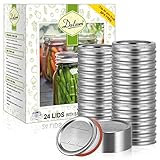
- 🥒 48Pcs/24Sets Regular Mouth Canning Lids with Ring fit ball and kerr brand preserving jars. (24Lids + 24Rings for Regular Mouth Jar)
- 🍓 Food grade metal mason jar lids with BPA-free silicone seals. Rings are reusable, lids are for one-time use only.
- 🍒 100% Fit & Airtight for regular mouth mason jars for canning food, jams, fruits, etc.
- 🍅 Write the date, time. Enjoy freshly made foods tonight or tomorrow.
- 🥭 100% SATISFACTION - If you receive a damaged product or have any other dissatisfaction, contact us and we will do our best to offer a satisfactory solution for you within 24 hours.
- Remove the band and failed lid. Do not reuse the flat lid that failed to seal. Use a new, compatible lid.
- Inspect the jar. Check the rim and sealing surface for chips, cracks, nicks, dips, scratches, or uneven areas. Replace the jar if the glass is damaged.
- Inspect the food and rim. Food, seeds, pulp, grease, syrup, or seasoning on the sealing surface can prevent an airtight seal. Remove any residue.
- Empty the contents into a clean pot. Heat the food to boiling as directed by the current tested hot-pack procedure. Do not invent a hot-pack method for a food that has not been tested that way.
- Prepare a clean, hot jar. Follow the recipe’s jar-preparation instructions and use the correct jar size.
- Fill the jar. Use the tested hot-pack instructions and the recipe’s exact headspace.
- Remove air bubbles if the recipe calls for it. Use a nonmetallic bubble remover or plastic spatula. Do not use a knife or other sharp metal object that could damage the jar or sealing surface.
- Wipe the rim clean. Use a clean, damp cloth or paper towel. Vinegar can help cut grease when canning greasy foods such as meat, but do not make vinegar a universal substitute for the recipe or manufacturer’s instructions.
- Apply the new flat lid. Prepare it according to the lid manufacturer’s current instructions. Lid preparation is manufacturer-specific; for example, Ball currently says not to preheat its lids.
- Apply a sound screw band. Tighten it fingertip-tight. Do not use a tool or your full hand strength.
- Process the jar using the complete tested procedure. Follow the correct method, time, pressure, jar size, pack style, and altitude adjustment. Do not simply repeat a generic time or put a low-acid food into a boiling-water canner.
- Cool and retest. Leave the jar upright and undisturbed for 12–24 hours, then remove the band and test the seal again.
For the current qualifications and procedure, consult NCHFP’s reprocessing guidance and the specific tested recipe.
What’s actually slowing this PC down?
Pick the symptom - the matching free tool is one click away.
Do not reprocess an incorrectly canned jar
If a low-acid food was processed in a boiling-water canner, a pressure-canning time or pressure was wrong, a pressure canner was not properly vented, the recipe was untested, or the ingredients were changed in a safety-relevant way, replacing the lid and processing again does not make the food safe. A vacuum seal is not proof that the food received a safe process.
Why canning jars fail to seal
One failed jar may result from a local problem such as a dirty rim or defective lid. Several failed jars usually point to a batch-wide or procedural problem. Check these causes before attempting another batch.
1. Food or grease on the rim
Seeds, pulp, syrup, grease, seasoning, or small food particles can interfere with contact between the lid’s sealing compound and the glass. Wipe the rim immediately before applying the lid. For greasy foods, follow the recipe’s cleaning instructions; Penn State notes that vinegar may help cut grease, but it is not necessary for every jar.
2. A damaged jar or uneven sealing surface
Chips, cracks, nicks, scratches, dips, or an uneven rim can prevent the lid from making full contact. Inspect every jar before filling and again if a seal fails. Never reprocess in a jar with a damaged sealing surface.
3. A defective, damaged, or reused flat lid
A flat metal canning lid is intended for one-time canning use. A lid that is scratched, dented, warped, or incompletely coated may not seal. Use a new flat lid for reprocessing. Screw bands, by contrast, can generally be reused when they are clean, straight, and free of rust, dents, and corrosion.
Follow the instructions for the brand of lid you are using. Do not assume that instructions for one manufacturer apply to another. Ball’s current guidance is available in its Fresh Preserving FAQ.
4. The wrong headspace
Headspace is the distance between the food and the top of the jar. It is specific to the food, jar size, pack style, and tested recipe.
- Too little headspace can cause food to boil or siphon out during processing. Particles left beneath the lid may prevent a seal.
- Too much headspace leaves more air in the jar and may produce a weak vacuum.
Measure headspace rather than estimating it. Do not substitute a generic measurement for the tested recipe. See the Penn State explanation of headspace and the recipe’s own instructions.
Recommended Free Tools
5. The band was too tight or too loose
Apply the screw band fingertip-tight. Over-tightening can prevent air from venting, buckle the lid, or cut the sealing compound. Under-tightening can allow liquid to escape and weaken the developing vacuum.
Rank #3

- 72 REGULAR MOUTH LIDS TOTAL – Includes 6 packs of 12 Ball Regular Mouth Mason Jar lids, providing 72 lids total for canning, preserving, and food storage needs.
- FITS REGULAR MOUTH MASON JARS – Designed to fit Ball Regular Mouth glass mason jars, making them a convenient replacement option for your home canning supplies.
- IDEAL FOR CANNING & PRESERVING – Great for preserving homemade jams, jellies, pickles, fruits, vegetables, sauces, juices, and other seasonal favorites.
- DEPENDABLE SEALING PERFORMANCE – Designed to create a secure seal when used according to proper home canning instructions, helping keep properly prepared foods preserved for storage.
- CONVENIENT BULK 6-PACK – Keep plenty of replacement lids on hand with this 72-count supply, ideal for large canning batches, seasonal preserving, and homemade food gifts.
Do not tighten bands during or after processing. The seal forms as the jar cools, and tightening a band afterward can conceal a weak seal instead of fixing it.
6. Air bubbles, siphoning, or rapid cooling
Trapped air, overpacking, incorrect headspace, sudden pressure changes, unstable pressure, or removing jars too quickly can cause siphoning. Escaping liquid can carry food particles into the sealing area.
Remove bubbles as directed by the recipe. In a boiling-water canner, keep the water level and boil stable. In a pressure canner, follow the recipe’s venting, pressure, cooling, and unloading instructions. Allow the recommended cooling period in the canner before removing jars; do not force-cool a pressure canner.
7. Incorrect processing
A lid can seal even when the food did not receive a safe process. Safety-critical errors include:
- Using the wrong canning method.
- Using an incorrect processing time or pressure.
- Failing to adjust for altitude.
- Allowing pressure to fall below the recipe requirement without following the recipe’s correction procedure.
- Failing to vent a pressure canner correctly.
- Failing to keep jars covered by water in a boiling-water canner.
- Allowing the boil to stop without restarting the required processing time.
- Using an untested recipe or changing ingredients, proportions, jar sizes, or pack styles.
- Processing low-acid foods in a boiling-water canner.
- Using an oven, open-kettle method, microwave, dishwasher, pressure cooker, or unsupported electric multicooker method.
Use the NCHFP troubleshooting guide and CDC home-canning guidance when reviewing a problem.
8. An unsuitable commercial jar
Standard Mason-style canning jars are designed for home canning. Commercial mayonnaise, sauce, and similar single-use jars are more prone to breakage and seal failure. Mayonnaise-type jars are not recommended for pressure canning. Do not assume that a commercial jar is interchangeable with a tested Mason jar simply because a lid fits it.
Food type and method are part of the safety decision
The action to take depends not only on the lid, but also on what is in the jar and how it was processed.
Do these 3 things before closing this tab:
1Repair Windows errors before they cause bigger problems2Scan for outdated or missing drivers - takes under a minute3Clear out junk files and repair common Windows errors- Low-acid foods include most fresh vegetables, meats, poultry, fish, and seafood. They require pressure canning under a tested process. A boiling-water canner does not control the botulism risk in these foods.
- Acid foods and properly acidified foods may be processed in a boiling-water canner or another specifically tested method.
- Tomatoes are not automatically safe to water-bath without acidification. Some varieties can be above pH 4.6, so follow a current tested tomato recipe and its acidification instructions.
The safe process depends on food type, acidity, jar size, pack style, altitude, time, and—when pressure canning—pressure. A sealed lid indicates a vacuum; it does not verify any of those factors. The USDA Complete Guide to Home Canning provides the underlying process guidance.
If a jar sealed initially but later became unsealed
This is different from finding a failed seal during the normal 12–24-hour cooling check. A jar that becomes unsealed in pantry storage may have had a false seal, developed spoilage organisms that produced gas, suffered a crack or lid defect, experienced corrosion, or frozen and thawed. You usually cannot know how long the seal has been broken.
Discard a jar that was sealed and later becomes unsealed. Do not taste it, replace the lid, or reprocess it for shelf storage. Discard it even if the food looks and smells normal. Botulinum toxin cannot reliably be seen, smelled, or tasted, and ordinary sensory checks cannot establish safety. Follow the Penn State guidance on jars that become unsealed and NCHFP’s storage and disposal guidance.
Rank #4

- 96 LIDS TOTAL – Includes 8 packs of 12 Ball Regular Mouth Mason Jar lids, providing 96 lids total for canning, preserving, and storing a variety of homemade foods.
- DESIGNED FOR REGULAR MOUTH JARS – Made to fit Ball Regular Mouth glass mason jars, providing a secure fit for dependable home canning and everyday food storage.
- IDEAL FOR CANNING & PRESERVING – Great for preserving homemade jams, jellies, pickles, fruits, vegetables, sauces, juices, and other pantry favorites.
- DEPENDABLE SEALING PERFORMANCE – Designed to create a secure seal during the canning process, helping protect and preserve properly prepared foods for convenient storage.
- STOCK UP FOR CANNING SEASON – The convenient 96-count bulk pack keeps plenty of replacement lids on hand for large canning batches, seasonal preserving, meal prep, and homemade gifts.
Safe handling of a suspect open or leaking low-acid jar
For suspect low-acid foods in open, leaking, or unsealed jars, NCHFP recommends wearing disposable rubber or heavy plastic gloves, placing the container in a pot, covering it with at least 1 inch of water, boiling for 30 minutes, cooling, and then discarding the food and container. This is a disposal precaution for potentially contaminated food—not a way to make incorrectly canned food suitable for storage or eating. Follow local public-health guidance if the jar has leaked substantially or contaminated surrounding surfaces.
Special cases
The jar lost liquid but the lid still sealed
Liquid loss, sometimes called siphoning, is not automatically spoilage. If the jar was correctly processed and the lid remains properly sealed, the food may still be safe, although exposed food may darken or lose quality. Do not open the jar to replace the liquid.
If a substantial amount of liquid was lost, NCHFP advises refrigeration and prompt use rather than long-term pantry storage. If the lid later becomes unsealed, treat that as a separate safety problem and discard the jar.
The lid is buckled but appears sealed
A lid that buckles immediately after processing may result from over-tightening or failure to vent correctly. If it has sealed and the buckling occurred during processing, mark the jar and use it first because it has a greater chance of losing its seal in storage. Do not force the lid flat or tighten the band.
If buckling appears later during storage, treat it as a possible spoilage warning. Do not eat the food. See Penn State’s guidance on buckled lids.
Jam or jelly is soft or runny
A jam or jelly that did not set is not necessarily a jar-seal failure. Some properly processed jams and jellies can take days or, in some cases, weeks to set. Check the vacuum seal separately: remove the band after cooling and test whether the lid is concave and firmly attached. A soft gel does not make an unsealed jar shelf-stable, and a good seal does not guarantee that the recipe will set.
For setting problems, consult Penn State’s jam and jelly guidance and the NCHFP troubleshooting information.
Only one jar failed
One failed jar may point to a damaged rim, residue on that jar, an individual defective lid, or a local filling problem. Examine it carefully, then review the remaining jars.
If several or all jars failed, suspect a systematic issue: reused or defective lids, incorrect band tension, wrong headspace, an unsuitable jar, an incorrect water level, interrupted boiling, incorrect pressure, or a faulty recipe or procedure. Do not simply replace every lid and reprocess the batch until you have confirmed that the original food, recipe, and process were safe.
Preventing seal failures in the next batch
- Use a current, research-tested recipe from NCHFP, USDA, or a trusted university extension service.
- Match the processing method to the food. Use pressure canning for low-acid foods under a tested process.
- Use standard Mason-style jars intended for canning and inspect them for chips and cracks.
- Use a new, compatible flat lid. Follow that manufacturer’s preparation instructions; do not assume all lids should be preheated.
- Reuse screw bands only when they are clean, straight, and free of rust, dents, and corrosion.
- Measure the recipe’s exact headspace.
- Remove air bubbles as directed.
- Wipe the rim clean immediately before applying the lid.
- Apply bands fingertip-tight—not loose, but not heavily tightened.
- Maintain the required water level, boiling temperature, pressure, and processing time.
- Make the recipe’s altitude adjustment.
- For pressure canning, vent and cool the canner exactly as directed. Do not force cooling.
- Observe any recipe-specific post-processing rest, including a five-minute rest when the method or recipe specifies one.
- Remove jars carefully, keep them upright, and leave them undisturbed for 12–24 hours.
- Remove the screw bands after cooling and testing.
- Store sealed jars in a cool, dry, dark place and check periodically for broken seals, leakage, bulging, corrosion, or other changes.
Scope of this guidance
This advice is for home-canned foods in standard Mason-style jars with two-piece metal lids, primarily under U.S. USDA and NCHFP guidance. Commercial jars, one-piece closures, antique jars, vacuum-storage lids, freezer preserves, and some jams and jellies have different instructions. Use the directions for the specific container, closure, recipe, and preservation method rather than applying this guidance automatically.
Best Value

- 【Secure Airtight Freshness Lock】Each BPA-free 70mm canning lid comes with a built-in silicone seal ring, locking air out to keep jams, pickles and dry goods fresh longer. Ideal for home canning, fermenting and daily food storage.
- 【Sturdy Rust-Resistant Construction】Made of premium food-grade tinplate with reinforced edges, these lids resist rust, bending and warping. Durable enough for repeated seasonal use or long-term pantry storage without losing reliability.
- 【Perfect Fit for Regular Mouth Jars】Precisely sized at 70mm for standard regular-mouth mason jars, compatible with top brands like Ball and Kerr. Twist on easily for a snug, leak-free seal—not suitable for wide-mouth jars.
- 【Multi-Purpose Label-Friendly Design】Beyond canning, these lids work great for DIY gifting and meal prep organization. The smooth surface lets you write dates, contents or labels, making it easy to identify jar items at a glance.
- 【48-Pack Bulk Value for Home Canners】Get 48 counts of 70mm regular mouth lids to stock up for all your canning batches. Perfect for home preservers, meal preppers and anyone who loves homemade jams, sauces and pickled treats.
Frequently Asked Questions
Can I just tighten the ring on a jar that did not seal?
No. Remove the band before testing the lid. Tightening it can conceal a failed seal and may interfere with venting or damage the lid compound. If the jar is eligible for reprocessing, use a new flat lid and a tested procedure.
Does a missing popping sound mean my jar failed?
No. A lid can seal without an audible pop, and food touching the lid can muffle the sound. Wait 12–24 hours, remove the band, and check whether the lid is concave, does not flex, and remains attached when gently tested.
Can I reuse the lid that failed?
No. Flat metal canning lids are intended for one-time use. Use a new compatible lid if the jar qualifies for reprocessing. Screw bands may generally be reused if they are clean, straight, and undamaged.
Can I reprocess a jar the next day?
Only if the jar was discovered unsealed within 24 hours of the original processing, the original tested recipe and method were followed correctly, the jar is intact, and a tested hot-pack process exists for that food. The 24-hour period begins at the original processing time.
Can I reprocess a jar that was canned incorrectly?
No. Reprocessing is not a reliable correction for an unsafe recipe or method. If the food was processed at the wrong time or pressure, at the wrong altitude setting, in the wrong type of canner, with an untested recipe, or by an unsupported method, discard it—even if the lid sealed.
How long can an unsealed jar stay in the refrigerator?
Refrigerate it immediately and use it within three days as a conservative rule. NCHFP’s current Newsflash permits up to one week for a correctly processed jar discovered unsealed within 24 hours, but other current extension and manufacturer guidance is more conservative.
Can I freeze food in the canning jar?
Do not assume every canning jar is freezer-safe. Transfer the food to a suitable freezer container when practical, leave expansion room according to the container and food instructions, and expect possible texture changes.
Quick wins for a faster PC:
Fix the driver behind crashes, sound loss and screen glitchesFind Drivers →Clear out junk files and repair common Windows errorsFree Scan →Scan for outdated or missing drivers - takes under a minuteDriver Scan →What if the jar sealed and then popped open months later?
Discard it. A later broken seal has an unknown duration and may indicate spoilage, gas production, a damaged jar, or a false seal. Do not taste it, replace the lid, or reprocess it.
What if the jar lost liquid but stayed sealed?
Do not open it to add liquid. Liquid loss is not automatically spoilage if the jar was correctly processed and remains properly sealed, although quality may suffer. If a substantial amount was lost, refrigerate and use it promptly rather than storing it long-term.
What if the lid is buckled but appears sealed?
If it buckled immediately after processing but remains sealed, mark the jar and use it first because it may be more likely to lose its seal. If buckling develops during storage, treat it as a possible spoilage warning and discard the food.
Are jams and jellies different?
Yes. A jam or jelly may be soft or runny even when properly sealed; some take days or weeks to set. Evaluate the vacuum seal separately from the gel texture.
Can I use an oven, pressure cooker, or multicooker to fix an unsealed jar?
No. Do not use an oven, open-kettle method, microwave, dishwasher, pressure cooker, or unsupported electric multicooker method for home canning. Use only a current tested process for the specific food and equipment.
The Bottom Line
A failed seal after correct processing does not automatically ruin the food, but it does mean the jar is not shelf-stable. Wait 12–24 hours before testing, then refrigerate and use it within three days, freeze it in a suitable container, or reprocess it within 24 hours of the original processing only with a new lid and a tested hot-pack procedure. If the process was wrong or unknown, or the jar became unsealed during storage, do not taste it—discard it.
Quick Recap
Product prices and availability are accurate as of the date/time indicated and are subject to change. Any price and availability information displayed on Amazon at the time of purchase will apply.




