What’s actually slowing this PC down?
Pick the symptom - the matching free tool is one click away.
Concrete strength is governed chiefly by its water-to-cementitious-material ratio (w/cm), but no universal recipe guarantees a particular result. Lowering w/cm generally increases strength and durability only when the selected materials are proportioned correctly, the fresh concrete can be placed and consolidated, and curing protects hydration. Aggregate quality, cement and supplementary cementitious materials, air, admixtures, water quality, placement, and curing can all change the strength reached at the same w/cm.
The practical answer to “What makes concrete strong?” is therefore a coordinated mix and construction process: set the required strength and exposure performance, choose compatible materials, establish the w/cm from performance records or trial batches, preserve workability without adding unplanned water, and cure the placed concrete under suitable moisture and temperature conditions.
As an Amazon Associate I earn from qualifying purchases.
What the water-to-cementitious-material ratio means
W/cm is the mass of mixing water available to the cementitious materials, divided by the mass of those materials. Water absorbed inside aggregate particles is excluded from the numerator. The cementitious total can include portland cement and supplementary materials such as fly ash, silica fume, or slag cement.
Quick wins for a faster PC:
Fix the driver behind crashes, sound loss and screen glitchesFind Drivers →Clear out junk files and repair common Windows errorsFree Scan →This distinction matters because a mix containing supplementary materials is not described accurately by a simple water-to-cement ratio. Aggregate moisture corrections also matter: surface water on aggregate contributes to mixing water, while water held in absorption does not. An incorrect moisture calculation can change the effective w/cm even when the batch ticket appears unchanged.
#1 Best Overall

- COLD WEATHER CURING: Hold in the heat your slab generates so hydration keeps working when temperatures drop. The closed-cell foam core traps warmth against fresh concrete and slows moisture loss, helping late-season pours, footings, and repairs develop strength instead of stalling out. Roll it over the surface once finishing is done, leave it in place through the cure window, then lift it, shake it off, and roll it back up for the next placement.
- FOAM CORE CONSTRUCTION: A coated woven poly tarpaulin wraps a closed-cell PE foam core measuring 3/16 inch thick, giving you real insulating mass rather than a thin plastic sheet. The 8 x 8 weave outer shell sheds dirt and shrugs off the grit of a working jobsite, and the sealed foam will not soak up water the way a batt or a moving pad does. The result is an insulated tarp light enough at 14 pounds for one person to handle.
- DURABLE BUILD: Double-stitched seams and reinforced hems keep the edges from fraying after repeated drag-and-drop handling, and factory grommets let you stake, tie, or weight the blanket down so wind does not peel it off the work overnight. The outer shell is water resistant, tear resistant, and UV resistant, so it keeps performing through rain, snow, and long hours of sun instead of going brittle after a single season.
- TRUE JOBSITE SIZE: Covers a generous footprint for driveways, sidewalks, pads, and stem walls, and lays flat enough to overlap with a second blanket on larger placements. Tarp dimensions are industry-standard cut sizes, so the finished blanket measures roughly 11 feet 10 inches by 23 feet 10 inches; plan your overlap accordingly. It folds down small enough to store on a shelf or in a truck box between jobs.
- MORE THAN CONCRETE: Contractors and rental yards reach for these insulated blankets well beyond the pour, covering stockpiled aggregate, shielding pipes and equipment from freeze, screening off a work area, or keeping ground workable ahead of excavation. Commercial grade construction and a plain, no-frills design make it an easy addition to the stack of jobsite tarps you pull out every winter.
For a particular combination of materials and construction conditions, ACI identifies w/cm as the primary strength variable. A lower ratio usually leaves less capillary pore space in the hardened cement paste, provided the concrete remains properly consolidated and cured. That trend is a design relationship, not a promise that every mix at a given ratio will achieve the same strength.
Why a lower w/cm usually produces stronger concrete
Concrete gains strength as cement hydrates and develops a connected internal structure. Excess water that is not required for hydration or workability can leave additional void space as the concrete hardens. More connected pore space generally means a weaker, more permeable paste.
Reducing w/cm can therefore improve both compressive strength and durability. The reduction must be practical, however. If a mix becomes too stiff to place, consolidate, or finish, entrapped voids and poor homogeneity can offset the theoretical benefit of the lower ratio. A low-w/cm mixture may require chemical admixtures, adjusted aggregate grading, or a different placement method rather than simply less water.
Outdated Drivers Are Slowing You Down
One free scan finds every outdated or missing driver and matches the right update for your exact hardware.Free scan · exact hardware matchWindows Errors? Fix Them Before They Spread
Repair common Windows errors and clear accumulated junk for a smoother, more stable PC - no reinstall needed.Free scan · no reinstallACI summarizes the relationship this way: “Strength primarily depends on the w/cm, regardless of changes in proportions of aggregate or the quantity of cement, provided that the aggregates are clean and structurally sound, and the mixture is plastic and workable.” The conditions in that statement are essential. The ratio cannot compensate for unsound aggregate, inadequate consolidation, or poor curing.
Does adding more cement make concrete stronger?
Not automatically. Adding cement while holding the batch water constant can lower w/cm, but adding cement and water together may leave the ratio unchanged. More cement can also increase paste volume, heat generation, shrinkage risk, or cost without solving a workability or aggregate problem.
ACI’s guidance places the emphasis on w/cm when aggregates are clean and sound and the mixture is plastic and workable. Increasing fine aggregate, for example, can increase surface area and water demand. If the extra water is added without adjusting the cementitious content or using an admixture, w/cm rises and strength may fall. The useful question is not “How much cement can be added?” but “What cementitious content and w/cm produce the required strength, workability, durability, and volume stability with these materials?”
Rank #2

- Maximum Concrete Strength: this concrete curing blanket slows water evaporation, allowing even curing and full compressive strength development; The fabric retains water and blocks rapid drying, preventing cracks, shrinkage, and surface defects
- Heavy Duty Burlene: made with sturdy burlene fabric and a waterproof polyethylene backing, this heavy duty insulated concrete blanket withstands harsh weather, UV exposure, and heavy construction use; The rugged material resists tearing, stretching, and degradation for long term performance on demanding sites
- Good Size: this concrete curing blanket roll measures about 6 x 50 ft (1.8 x 15 m), providing 300 sq ft of coverage for highways, bridge decks, retaining walls, foundations, and flatwork; Easy to unroll and position over fresh concrete, reducing installation time and labor costs on any construction site
- Job Site Durability: engineered for commercial construction demands, this blanket is reusable and easy to clean; The strong burlene outer layer protects the PE backing from punctures, while the waterproof inner layer keeps water in and rain out for consistent curing conditions across multiple uses
- Practical Note: each concrete curing blanket roll is hand cut, so minor dimensional variations may occur; This allows flexible trimming to fit custom project layouts, making it suitable for standard and irregular concrete surfaces
When additional cementitious material can help
A higher cementitious content may be appropriate when the specified w/cm, paste volume, finishing requirements, or supplementary-material replacement level requires it. It should be selected through established proportioning methods and verified with the actual aggregate, water, cement, and admixtures. More binder is not a substitute for a suitable grading, adequate consolidation, or a curing plan.
Variables that change strength at the same w/cm
Aggregate size, grading, shape, and quality
Aggregates make up most of concrete’s volume and affect packing, paste demand, workability, stiffness, and the quality of the bond zone around particles. Maximum size, grading, angularity, surface texture, strength, and stiffness can all change the strength obtained at a given w/cm. Clean, structurally sound aggregate is a prerequisite for the ACI relationship between w/cm and strength.
A well-graded combination can reduce voids and paste demand, while excessive fines or rough, angular particles can increase water demand. Aggregate moisture must be measured and used to correct batch water; otherwise the effective w/cm will differ from the design value.
Cement type and supplementary cementitious materials
The cement source and type affect hydration rate and strength development. Fly ash, silica fume, and slag cement can alter early-age behavior, later-age strength, permeability, heat generation, and water demand. The replacement material and dosage must be treated as part of the cementitious system, not as an interchangeable additive. A strength relationship established with one cement or replacement level should not be assumed to apply unchanged to another.
Entrained and entrapped air
Air occupies volume that would otherwise be filled by paste or aggregate. Entrained air is intentionally introduced for exposure conditions that require it; accidental or excessive air can reduce measured compressive strength. Air content must therefore be included in proportioning and checked in trial batches and field concrete where specified.
Recommended Free Tools
Chemical admixtures
Water-reducing admixtures can improve workability without increasing mixing water, helping a mixture meet a low w/cm while remaining placeable. Other admixtures can affect setting, air, or early-age behavior. Their compatibility with the cementitious materials and job conditions should be confirmed in trial batches rather than assumed from a different project.
Rank #3
- TRAPS CURING HEAT Fresh concrete gives off heat as it sets, and this insulated concrete curing blanket holds that warmth against the slab so hydration keeps working when jobsite temperatures drop. The foam core puts a thermal barrier between your pour and cold air, wind, and overnight chill, which helps crews place and finish flatwork through late fall, winter, and early spring instead of waiting on the weather to cooperate.
- CLOSED CELL FOAM A coated woven poly tarpaulin wraps a closed-cell PE foam core measuring 3/16 inch thick, giving this curing blanket genuine insulating body instead of the single thin layer you get from an ordinary poly tarp. The outer shell is built on an 8 x 8 weave that stands up to being dragged across gravel, rebar, and rough forms, so the same thermal tarp holds its shape and its insulating value through repeated pours.
- BUILT FOR JOBSITES Double stitched seams and reinforced hems keep the edges together under wind load and repeated folding, and included grommets let you stake, rope, or weight the blanket down so it stays where you put it overnight. The shell is water resistant, tear resistant, and UV resistant, which keeps this insulated tarp serviceable through rain, sun exposure, and the rough handling a working crew gives it.
- EASY TO HANDLE Tarp sizes are listed as cut sizes, the industry standard, so this 6 by 24 foot blanket finishes at 5 feet 10 inches by 23 feet 10 inches and covers long runs of flatwork. At roughly 6.5 pounds it stays light enough for one person to roll out, reposition, and roll back up, and several blankets overlap edge to edge to cover wider slabs, driveways, and sidewalk pours without leaving cold gaps.
- WORKS EVERY SEASON Concrete finishers, masons, general contractors, rental yards, and property crews use this commercial grade construction blanket over slabs, footings, driveways, patios, sidewalks, and block walls, and it doubles as an insulated cover for equipment, materials, and supplies staged outdoors. Roll it up and store it dry between jobs and it goes straight back to work on the next pour.
Mixing water quality
Potable water is acceptable for mixing. Some non-potable water can also be suitable when testing shows that it delivers the required performance. Impurities may change setting, strength, appearance, or resistance to degradation. Salt water should not be used as mixing water in steel-reinforced concrete because of corrosion risk.
How to design a strength-focused concrete mix
A project mix should satisfy strength, exposure, workability, and production requirements simultaneously. Use the following sequence with the actual materials and the project’s specification.
- Define the performance requirements. Record the specified compressive strength, required test age, exposure conditions, air-entrainment requirement, placement method, finishing needs, and any limits on temperature, permeability, or shrinkage.
- Characterize the materials. Document cement and supplementary-material types, aggregate source, maximum size, grading, shape, absorption, moisture, and quality. Confirm the proposed mixing water and admixtures.
- Set a candidate w/cm. If reliable performance records exist for the same or demonstrably equivalent materials, use a ratio shown to meet the requirement with an appropriate safety margin. Do not transfer a ratio from unrelated materials without verification.
- Account for aggregate moisture. Separate absorbed water from free surface moisture and adjust batch water so the effective w/cm matches the design value.
- Proportion aggregate and paste for workability. Select grading and proportions that can be mixed, placed, consolidated, and finished into a homogeneous material. Do not solve a harsh mix by adding uncontrolled water.
- Select air and admixture quantities. Include required air entrainment and use admixtures that provide the needed consistency at the selected w/cm. Their effects should be checked with the proposed cementitious system.
- Run trial batches or use documented performance data. ACI proportioning guidance calls for direct testing when project records are unavailable. Trial batches should use the actual aggregates, cement types, supplementary materials, admixtures, and required air entrainment.
- Verify fresh and hardened properties. Check consistency, air, temperature, density, and the specified compressive-strength test results. Confirm that the mix can be discharged, placed, consolidated, and finished within the available time.
- Finalize field controls. Establish limits for added water, aggregate moisture updates, delivery time, consolidation, finishing, testing, and curing. A mix that works in a laboratory can lose performance if field controls are different.
Workability is part of strength design
Workability is the ease with which fresh concrete can be mixed, placed, consolidated, and finished into a homogeneous condition. It depends on water, aggregate grading and particle shape, aggregate proportions, cementitious materials, chemical admixtures, and entrained air.
Slump measures consistency; it is not a direct measurement of compressive strength. Two concretes can have the same slump but different w/cm, air content, aggregate systems, or strength. Conversely, a low-slump concrete that is not adequately consolidated can contain voids and perform worse than a properly placed mix with greater consistency.
When concrete is difficult to handle, first identify the cause. Aggregate moisture, grading, temperature, admixture dosage, air, and elapsed delivery time may have changed. Adding water at the site changes w/cm and can invalidate the established strength relationship unless the batch is recalculated and permitted by the project requirements.
Curing allows strength to develop
Curing is not simply waiting for concrete to dry. It is the action taken to maintain moisture and temperature so hydraulic cement hydration and, where applicable, pozzolanic reactions can proceed and the mixture can develop its potential properties. Curing also limits adverse volume changes that can contribute to cracking.
Rank #4

- 【High-Quality】: Construction Concrete Curing Blanket is designed with a high-quality PE foam core that offers excellent insulation properties. It effectively maintains a controlled curing environment by minimizing heat loss and temperature fluctuations.
- 【Funtion】: Insulated concrete blankets is widely used on construction sites, highways, self-built houses. It is one of the effective materials for protecting buildings in winter. Use the ball bungee cords to connect the other tarp.
- 【Dimension】: The concrete blanket sie is 6x25Ft, about 72x300inch. And the thinkness is about 3.6mm/0.15inch. The R value of this product is 0.2 approximately(R=D/K). If you found the R is low , you could use two or more to solve.
- 【Features】: The curing blanket is weatherproof and durable in winter. After that, you can continue working next year. Built-in UV protection prevents degradation from sunlight exposure.
- 【Design】: Maintains consistent temperature, promoting uniform concrete curing. We hope that the design of our products will add to your joy of life.
Moisture and temperature targets
American Concrete Institute guidance, citing ACI 308R-16, states that continued strength-related reactions require internal relative humidity above 80% and a favorable temperature above 10°C (50°F). These are guidance values, not a replacement for the project specification or a climate-specific curing plan.
Low-w/cm mixtures need special attention
For mixtures with w/cm greater than 0.4, retaining existing moisture may be sufficient in some circumstances. For mixtures below 0.4, the available internal water can be consumed rapidly, so added water during curing may be necessary. ACI advises that water curing for such mixtures should begin as soon as possible.
Practical temperature protection
Protect the concrete from conditions that remove moisture too quickly or drive its temperature outside the intended range. A curing blanket can be used as part of a temperature-protection approach, but it does not alter w/cm and cannot guarantee strength. Its suitability depends on the project’s curing procedure, weather, surface condition, and required temperature control.
Independent reader supportYour contribution helps us test, update, and keep practical guides available for everyone.How compressive strength is measured
A compressive-strength value is meaningful only with its specimen, curing history, test age, and test procedure. ACI PRC-211.1-22 describes the conventional value as the average of test results from either two 6-by-12-inch cylinders or three 4-by-8-inch cylinders. The cylinders are fabricated, cured, and tested at 28 days in accordance with ASTM C39/C39M.
| Element | Conventional ACI description |
|---|---|
| Test age | 28 days |
| Specimen option 1 | Average of two 6-by-12-inch cylinders |
| Specimen option 2 | Average of three 4-by-8-inch cylinders |
| Test method | ASTM C39/C39M |
This result supports structural design, mixture proportioning, and evaluation. It is not a claim that every point in an in-place member has exactly that strength. Field placement, consolidation, temperature, curing, specimen handling, and the location represented by the samples all affect how a test result should be interpreted.
Do these 3 things before closing this tab:
1Repair Windows errors before they cause bigger problems2Fix the driver behind crashes, sound loss and screen glitches3Clear out junk files and repair common Windows errorsHow to compare two proposed mixes
Cement quantity alone is a poor basis for choosing between mixes. Compare the alternatives on the same project-specific axes:
Best Value
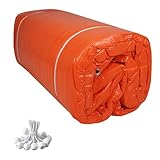
- 【High-Quality】: Construction Concrete Curing Blanket is designed with a high-quality PE foam core that offers excellent insulation properties. It effectively maintains a controlled curing environment by minimizing heat loss and temperature fluctuations.
- 【Funtion】: Insulated concrete blankets is widely used on construction sites, highways, self-built houses. It is one of the effective materials for protecting buildings in winter. Use the ball bungee cords to connect the other tarp.
- 【Dimension】: The concrete blanket sie is 12x24Ft, about 141x288inch. And the thinkness is about 3.6mm/0.15inch. The R value of this product is 0.2 approximately(R=D/K). If you found the R is low , you could use two or more to solve.
- 【Features】: The curing blanket is weatherproof and durable in winter. After that, you can continue working next year. Built-in UV protection prevents degradation from sunlight exposure.
- 【Design】: Maintains consistent temperature, promoting uniform concrete curing. We hope that the design of our products will add to your joy of life.
- Specified compressive strength and the required test age.
- Effective w/cm after aggregate moisture corrections.
- Consistency needed for the placement and consolidation method.
- Aggregate grading, maximum size, shape, strength, stiffness, and cleanliness.
- Required air entrainment and exposure conditions.
- Curing moisture and temperature controls, including the plan for low-w/cm concrete.
- Trial-batch results or prior performance using the actual materials.
The better mix is the one that meets all requirements with demonstrated performance and manageable field controls. A mix with a lower nominal water content is not automatically better if it cannot be consolidated or cured properly.
Common strength problems and the design response
The measured strength is lower than expected
Check the effective w/cm first, including aggregate surface moisture and any water added after batching. Then review air content, aggregate quality, cementitious-material identity, specimen fabrication and curing, placement consolidation, and the curing temperature and moisture history. A single low result should be interpreted with the applicable testing and acceptance requirements rather than attributed to cement quantity alone.
The mix is too stiff to place
Do not assume that extra water is harmless. Recheck aggregate grading and moisture, admixture compatibility and dosage, air content, temperature, and delivery time. Adjust the approved proportions or admixture system while preserving the required w/cm and verifying the revised mix with testing.
Early strength is adequate but later performance is poor
Review curing duration and conditions, supplementary-material proportions, drying, cracking, and exposure requirements. Early-age compressive strength does not by itself establish long-term durability or confirm that the concrete was cured under the required moisture and temperature conditions.
Key takeaway
Strong concrete comes from a verified w/cm working with sound aggregates, compatible cementitious materials, controlled air and admixtures, suitable workability, thorough consolidation, and effective curing. Use project-specific records or trial batches instead of a universal recipe, and treat the 28-day cylinder result as a defined test value rather than a guarantee that every location in the structure has identical strength.
Quick Recap
Product prices and availability are accurate as of the date/time indicated and are subject to change. Any price and availability information displayed on Amazon at the time of purchase will apply.

