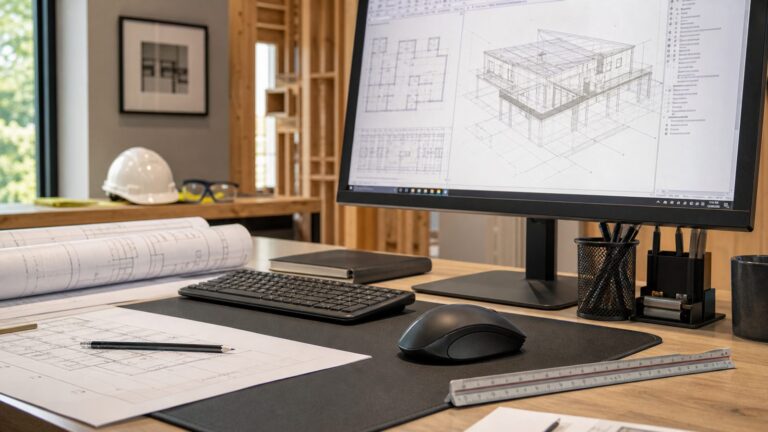
Intelligent construction for a data center means connecting its digital model, project records and observations from the job site so teams can coordinate work and see what is happening. Sensors and automation can support that process, while a digital twin can connect design and construction information with later operations. The term is a practical description, not a universally standardized method—and a 3D model alone is not a digital twin.
What “intelligent construction” means for a data center
Data-center projects bring together a building, technical systems, specialist equipment, contractors and a demanding sequence of installation and verification work. A connected approach makes information about that work easier to share and use. It can bring together a building information model (BIM), schedules and other project records, site observations, and information from building systems. Automation and analytics can then help teams coordinate tasks, monitor progress or quality, and prepare a usable record of what was built.
As an Amazon Associate I earn from qualifying purchases.
There is no single accepted definition of “intelligent construction” that makes every project follow the same technology stack or workflow. It is more useful to ask what information is connected, who relies on it, and which decisions it supports. A dashboard that displays a model may help people understand a project, but it does not by itself show that site data are connected to the model or that the model is being used to analyze changing conditions.
What’s actually slowing this PC down?
Pick the symptom - the matching free tool is one click away.
Digital twins are also described in different ways. In the practical sense used here, a twin is a digital representation connected to project or operational data and used for analysis or management. A model used only as a static visualization is not doing that job. NIST’s building-twin framework addresses machine-readable metadata across design and operation, while IEEE’s modular-data-center project spans design, deployment, operation and maintenance.
#1 Best Overall

- Valued Carpenter Pencil Set: You will get 2 pcs solid carpenter pencils with 26 piece 2.8 mm refills, 1 replaceable sharpener, 1 plastic storage box.The complete carpenter pencils combination allows you to finish your work faster and more easily
- Deep Hole Marker Pencil: The deep-hole construction pencils adopts 45mm elongated tip design, which is more convenient to mark in the small hole or in other tight areas that other carpenter markers cannot reach
- Carpenter Pencils with Sharpener: The sharpener is screwed into the top of the work pencil, which won't get lost either. Built-in pencil sharpener that keep the lead with pointed and smooth to Improves line of sight in fine work
- Stronger Solid Lead: This work pencil is matched with a 2.8 mm thick lead , which is much thicker and stronger during the drawing process of construction work, it will not break or damage easily
- Marks on Various Surfaces: 3 colors solid construction pencil can marks on various surfaces,such as metal, plastic, wood, paper etc. Ideals for woodworkers, contractors, craftsmen, builders, merchants and masons
How sensors, data integration and automation fit together
Site observations capture what is happening
Construction metrology and other site sensors can provide observations that teams may use in project records or models. Depending on the project, observations might relate to location, movement, environmental conditions or the state of installed work. Their value depends on whether they can be associated with the right place, asset, time and project activity—not simply on whether a sensor produces a reading.
NIST’s 2017 report on data exchange standards at construction job sites examined the challenge of exchanging sensor data across varied sources and reporting requirements. That is a practical warning: do not assume every sensor feeds every project tool automatically. Data formats, identifiers, ownership and exchange arrangements need to be agreed, and the project needs a way to check that incoming information is relevant and usable.
Integration gives data a shared meaning
A project may hold design information, sensor observations, construction records and building-system data in separate applications. Connecting those sources requires more than moving files. Teams need consistent identifiers and relationships so that a data point can be understood in context—for example, which system, space, component or control point it refers to.
NIST’s Building Digitization and Semantic Interoperability project describes semantic models for representing systems, relationships, data and control points in machine-readable form. The goal is to make information easier to integrate across applications and use for analytics and automation. This is a building-sector framework, not a documented data-center deployment case study; it provides a useful interoperability concept rather than proof of a particular project outcome.
Rank #2

- Ergonomically Designed: Work in tight areas with a compact design that gets into tough spots
- Compact and Lightweight: Both tools are designed to fit into difficult to reach spaces. The 1/4" impact driver has a length of 5.55 in. and weighs just 2.8 lbs, while the 1/2" drill/driver measures only 7.5 in. and weighs 3.6 lbs
- Both the DEWALT impact driver and electric drill driver feature integrated LED work lights with a convenient 20-second delay, ensuring enhanced visibility in dimly lit or challenging work areas
- One-Handed Loading - Keep one hand free with a 1/4 in. hex chuck that accepts 1 in. bit tips
- Power drill cordless with 1/2" single sleeve ratcheting chuck provides tight bit gripping strength, making bit changes faster and more secure
Automation and visualization support decisions
Once data are connected, software can help present status, compare information or route a defined workflow. The European Commission’s ASHVIN project materials describe construction digital-twin dashboards for management, control and risk management; data-fusion pipelines; comparison of as-designed and as-built information; and sensor-based geomonitoring. These are research-project deliverables and use cases, not guarantees that every twin performs those functions or produces a particular saving.
Automation should be understood as a way to carry out a defined data or coordination task, not as a substitute for engineering judgment. A workflow can flag a discrepancy or make a status visible, but the project still needs clear responsibility for checking the information and deciding what action to take.
Model versus digital twin: what is the difference?
The distinction is about how a digital representation is connected and used, not whether it looks detailed. A model can be valuable for design coordination or visualization without being a twin. A twin adds a link to project or operational information and a purpose for using that information.
| Approach | What it represents | How connected data are used |
|---|---|---|
| Static digital model | A digital representation of the design or an agreed project state. | It can support visualization and coordination; it need not be updated with site or operational data. |
| Data-connected digital twin | A digital representation linked to project or operational data. | It can support analysis and management across relevant phases; the usefulness depends on data quality, connection and intended decisions. |
The boundary is not a universal certification test. A project should describe what data update the representation, how often they do so, what parts of the facility they cover, and what decisions the twin supports. Avoid calling a visualization “real-time” unless the project can establish the update path and timing for the data in question.
Rank #3

- 【Great Compatibility】This Katerk 1/4 inch hex shank bit holder is specifically designed for 1/4 inch hex shank drill bits. It's compatible with most 1/4 fast hex handles, hex sockets, various electric screwdrivers, and handheld screwdrivers. The bit holder makes it a valuable addition for any handyman.
- 【Secure and Safe】Built with a secure backup nut design, each drill bit holder securely locks onto your bits, ensuring they stay firmly in place. Additionally, our bit holder incorporates a high-quality steel ball rolling design that holds up to several kilograms of weight, ensuring your various drill bits don't fall off.
- 【Easy One-Handed Operation】The bit holder for impact driver allows you to change bits single-handedly, simplifying your workflow. Its multi-color design further allows for quick identification of the drill bit you need.
- 【Compact and Convenient】Thanks to its compact size, this 1/4 inch bit holder is easy to carry around. The bit holder allows for easy attachment to various tools, making this a convenient addition to your construction accessories. The Katerk bit holder is cast from high-quality alloy material, promising a long product lifespan. Despite its rugged strength, the bit holder remains lightweight, making it portable.
- 【Cool Christmas Gift For Men Stocking Stuffers】 This screwdriver bit holder, driver bit holder, impact bit holder, can be given as a gift to your loved one, especially for anyone involved in construction or electrical work. It's a must-have for stocking stuffers for men and women, tools gifts for dad, tech gadgets for men, gifts for dad, gifts for him, gifts for husband, gifts for boyfriend, cool gadgets for men, and cool gifts for dad.
Where a connected approach can help across the lifecycle
Design and planning
A shared digital representation can help teams understand the proposed facility and coordinate information before work is complete. In a lifecycle approach, the project also considers what metadata and identifiers will remain useful during deployment, commissioning and operation. NIST’s building-twin framework addresses design-through-operation metadata, and IEEE P3973’s stated scope covers the modular data-center lifecycle from design through maintenance.
Construction progress and quality
Site observations and project information can be compared with the intended design or planned work to make progress and potential discrepancies visible. ASHVIN describes comparison of as-designed and as-built data and sensor-based geomonitoring. Huawei’s 2024 vendor white paper frames digital twins as a way to monitor data-center construction progress, quality and security. These examples describe capabilities and vendor or research perspectives; they do not establish a standard result, a guaranteed level of accuracy or a quantified benefit.
Coordination, commissioning and handover
Connected records can give teams a way to bring construction information forward into later checks and operations. For a data center, this makes continuity of information important: a representation that is useful during construction should not lose the context needed by the people responsible for commissioning or operating the facility. The cited lifecycle frameworks support that ambition, but a project still has to define what information is handed over, who validates it and how it will be maintained.
Operations and maintenance
A twin intended to continue into operations needs a relationship to operational data, not just a record of the design. IEEE P3973’s project scope explicitly includes operation and maintenance, with safety, energy efficiency, reliability, resource utilization and maintenance convenience among its focus areas. Those are project priorities, not proof that any specific digital-twin implementation will deliver a measured improvement.
Rank #4

- Long Nib and Deep Hole Marker: Our mechanical carpenter pencil with 45mm nib is designed for easy marking of deep holes or narrow areas. These construction pencils are the great choice for woodworking tools, construction tools, carpenter tools, contractor tools, wood carpentry tools and architect tools
- Extra Refills in 2 Colors for Versatile Marking: The construction mechanical pencil comes with 12 extra 2.8mm refills, including 6 red and 6 black refills. The black refill is suitable for light surfaces, while the red wax is perfect for dark surfaces. Our carpenter mechanical pencil makes sure that you'll have an ample supply for extended use
- Built-in Sharpener: Our construction pencil comes with a built-in sharpener to ensure the mechanical pencil tip is always sharp and ready for use. Never buy an extra pencil sharpener again. A great tool for any woodworker pencil, contractor pencils. The refill can easily be extended or retracted with a simple click of the pencils mechanical, allowing you to work more efficiently and accurately
- Portable Clip Design: Our deep hole construction pencil features a portable clip design, easy to carry and attach to your pocket or tool box, so that you can keep the carpenter pencils mechanical close at hand, making it a convenient tool to have on the go. Great gifts choice for carpenters
- Stronger Pencil Lead: The black refills are made of lead, sturdy and smooth. The red refills are made of wax, clear and light. These marking pencils are much thicker and stronger than normal pencils during the marking process of construction work, suitable for various surfaces, such as glasses, metal, boards, floors, walls, furniture, etc. The written marks can be easily wiped with a wet paper towel when needed
Standards: what they cover and what they do not
ISO/IEC 22237-2:2024 covers the physical facility
ISO/IEC 22237-2:2024, first edition published in February 2024, is the direct construction reference in this area. It gives requirements and recommendations for buildings and structures that house data centers. Its subject matter includes site selection, environmental risks, building construction and configuration, access, physical intrusion and fire protection, water damage, and construction quality. The ISO page says safety and electromagnetic compatibility requirements are outside this part’s scope.
This standard addresses data-center facilities and infrastructure; it does not itself prescribe a digital-twin system. A project can use a digital model or twin to manage information about its work, but that does not replace the standard’s facility requirements.
IEEE P3973 is a project, not a published standard
IEEE Standards Association lists P3973 as an active project for a “Guide for Functional Requirements of Digital-Twin-Enabled Modular Data Centers.” Its PAR approval is listed as February 12, 2026, and its stated scope covers design, deployment, operation and maintenance. The project page status checked October 11, 2026, identified it as active, not an approved published standard. Do not treat its proposed scope as an already published requirement.
Recommended Free Tools
NIST and ASHRAE 223P address semantic models
NIST’s Building Digitization and Semantic Interoperability page, updated February 19, 2026, describes work on semantic data models for building analytics and automation. At that update, the draft had completed an initial public review and was awaiting a committee vote on a second public review. That status can change; it is work in development, not a final standard. Its relevance is the data-integration problem, rather than a data-center-specific deployment requirement.
Best Value

- Milwaukee Ink all Fine Point Marker, Black, 4 Per Pack
- 4 per pack Features Clog Resistant Marker Tip Writes through Dusty, Wet and Oily Surfaces Durable Marker Tip for Writing on Concrete, OSB and Rough Surfaces
- Clog resistant tip writes on dusty, wet and oily surfaces and is optimized for rough surfaces such as OSB, cinderblock and concrete
- Hard hat clip- attaches for easy access
- Quick dry time with reduced smearing and marking
How to plan an intelligent-construction workflow
- Start with decisions, not devices. Identify the project decisions or handoffs that need better information: for example, how teams will monitor progress, verify quality, coordinate resources or prepare commissioning records. This keeps the technology tied to a defined need.
- Define the scope of the digital representation. Decide which design, construction or operational information it should represent and which project phases it needs to serve. State whether the representation is a model for visualization or a data-connected twin used for analysis.
- Agree on identifiers and exchange rules. Establish how systems, spaces, components, control points and observations will be identified, and how information will move between applications. Semantic models and agreed exchange mechanisms help reduce the risk that data arrive without usable context.
- Choose site data for a specific purpose. Determine what observations are needed, where they come from, how they will be associated with project information, and who checks them. Do not assume a sensor reading is automatically reliable, correctly located or available to every tool.
- Connect and validate a bounded workflow. Test a defined path from the source of information through its exchange and display to the decision it is meant to support. Check that the information is understandable, current enough for that use and connected to the correct project object or activity.
- Assign ownership for review and action. Specify who validates data, who responds when a discrepancy appears, and who is responsible for approving a change or closing an issue. A dashboard without an accountable response process can make information visible without improving coordination.
- Plan handover and maintenance. Decide what information will be retained for commissioning and operations, who will maintain identifiers and data connections, and how the representation will be kept useful as the facility changes. A twin’s lifecycle value depends on sustained ownership, not just its initial setup.
How to assess a platform or delivery approach
When comparing tools or project approaches, evaluate the full workflow rather than a product label. The following questions synthesize lifecycle considerations in IEEE P3973, NIST’s work on interoperability and trust, and the construction workflows described by ASHVIN:
- Lifecycle coverage: Can the approach support the phases the project actually needs, from design and deployment to commissioning, operations or maintenance?
- Connection to project information: Can it connect the relevant BIM information, site observations and building-system data without losing their context?
- Interoperability: Are data identifiers and exchange methods clear enough for information to move between the applications involved?
- Construction workflows: Does it support the project’s intended uses for progress, quality, safety, commissioning or as-built verification?
- Cybersecurity and governance: Who can access data, who owns or maintains it, and how are changes and responsibilities controlled?
- Verification and workforce readiness: How will the team check that the model and data are dependable, understand uncertainty, maintain the workflow and train the people expected to use it?
NISTIR 8620, a 2026 summary of manufacturing-focused digital-twin workshops, identifies interoperability, verification, validation and uncertainty quantification, cybersecurity, and workforce readiness as persistent challenges. Those are cross-sector cautions, not data-center-specific measured findings. They are still useful questions to bring into a project evaluation.
Limits, risks and realistic expectations
- Disconnected data can defeat the twin. If observations, models and project records use incompatible formats or identifiers, a visual interface may conceal rather than solve the integration problem. Agree on exchange and semantic conventions early.
- Data quality and uncertainty need attention. A connected feed is not automatically correct. Establish how information is checked and how users can judge whether it is suitable for a particular decision.
- “Real-time” needs a defined meaning. A sensor may report at one interval, while another source updates differently. Describe the timing and scope of updates instead of implying continuous synchronization without project-specific evidence.
- Cybersecurity and governance are part of the design. Connecting project and building information raises questions about access, maintenance and responsibility. NIST’s manufacturing workshops identify cybersecurity and verification challenges as cross-sector issues; they do not quantify data-center construction risk.
- Automation is not an outcome by itself. A dashboard, alert or comparison workflow is useful only when it supports a decision or a defined action. Specify the person or team responsible for review and response.
- Do not assume a quantified return. The cited materials describe frameworks, standards, research deliverables and vendor perspectives, but they do not establish a data-center-construction-specific figure for return on investment, time saved or safety improvement. Set project-specific measures before implementation and assess results against them rather than relying on a generic promise.
What to take away
For a data center, intelligent construction is best understood as a coordinated information practice: connect the model, project records and site observations; give data shared meaning; and use automation or analytics for decisions across the phases that matter. The twin is only as useful as its data connections, validation, governance and maintenance. Standards for the physical facility remain distinct from digital-twin frameworks, and an active standards project should not be mistaken for a published requirement.
Quick Recap
Product prices and availability are accurate as of the date/time indicated and are subject to change. Any price and availability information displayed on Amazon at the time of purchase will apply.