Quick wins for a faster PC:
Repair Windows errors before they cause bigger problemsFix Now →Scan for outdated or missing drivers - takes under a minuteDriver Scan →Contractors should control construction dust at the point where it is created, then verify that the controls match the material, tool, task, location and work duration. For work that can generate respirable crystalline silica, the U.S. federal OSHA construction rule requires either full implementation of the task-specific controls in Table 1 or use of an alternative exposure-control method with exposure assessment and other required protections. Water delivery, tool shrouds connected to suitable dust collectors, machine ventilation, enclosed cabs, housekeeping controls and task-specific respirators may all be required.
This guide focuses on federal OSHA requirements for respirable crystalline silica in construction. It is not a substitute for checking a state-plan rule, local nuisance-dust ordinance, contract requirement or a site-specific industrial-hygiene assessment. Non-silica dusts can create additional hazards that are not covered by the silica standard.
As an Amazon Associate I earn from qualifying purchases.
Start by identifying the dust, task and applicable rule
Dust control is not a single piece of equipment. Begin by listing the materials being disturbed—such as concrete, mortar, brick, block, stone or other products that may contain crystalline silica—and the operations that create airborne particles. Cutting, grinding, drilling, chipping, demolition, grading, excavation and cleanup can produce different exposure profiles.
Recommended Free Tools
Then confirm the governing jurisdiction. The requirements described here come from OSHA’s federal construction standard, 29 CFR 1926.1153. State-plan OSHA programs may have requirements that differ, and environmental agencies or project specifications may impose separate dust limits.
#1 Best Overall

- Dual-mode Operation for Versatile Cleaning: This wet/dry shop vacuum switches between standard vacuum mode for everyday messes and dust extractor mode for connecting to power tools during woodworking
- Power Tool Activation (PTA): The shop vac automatically starts when the connected power tool turns on—ideal for sanders, saws, planers, and more—helping capture debris as you work for a cleaner workspace
- Hands-Free Filter Cleaning: Featuring semi-automatic filter cleaning, a dust-full indicator and a HEPA filter, this shop vac helps resolve clogging and maintain strong suction for tough job
- Safety and Durability: The anti-static hose helps reduce electrostatic buildup, while the sturdy 8-gallon stainless steel tank ensures long-lasting durability and portability. A built-in drain port makes it easy to empty liquids and debris
- Accessories Included: 10 ft anti-static hose (1), extension wands (2), floor nozzle (1), universal adapter (1), crevice nozzle (1), round brush (1), disposable filter bags (3), HEPA filter (1), utility nozzle (1), foam filter (1)
Know the silica exposure limits
For the alternative exposure-control method under the federal construction silica standard, the permissible exposure limit (PEL) is 50 micrograms per cubic meter (50 μg/m³) as an 8-hour time-weighted average. The action level is 25 μg/m³ as an 8-hour time-weighted average. These values apply to respirable crystalline silica, not to every type of construction dust.
OSHA’s construction overview and compliance information explain the standard’s scope and employer duties: OSHA Silica, Crystalline—Construction and OSHA Construction Silica Compliance Information.
Choose the correct OSHA compliance path
For a task covered by the silica standard, an employer generally chooses between the two approaches below. The choice must be made before work begins and reflected in the exposure-control plan.
Do these 3 things before closing this tab:
1Repair Windows errors before they cause bigger problems2Fix the driver behind crashes, sound loss and screen glitches3Clear out junk files and repair common Windows errors| Question | Table 1 approach | Alternative exposure-control method |
|---|---|---|
| Is the task listed in OSHA Table 1? | Yes. Use the row that matches the tool and operation. | May be used for unlisted tasks or when Table 1 cannot be fully implemented. |
| What controls are required? | Every engineering, work-practice and respiratory-protection provision in the applicable row must be followed. | Use feasible engineering and work-practice controls, perform exposure assessment and meet the silica PEL. |
| How are exposures demonstrated? | Correct implementation of the listed controls provides the specified compliance path. | Exposure assessment and, where required, monitoring establish whether controls achieve compliance. |
| What changes the requirements? | Task, equipment, work duration and indoor or enclosed setting can change the row’s requirements. | Results of exposure assessment, feasibility of controls and the work conditions determine additional measures. |
Table 1 can simplify compliance for a listed operation, but only when the complete row is followed. Substituting a different vacuum, omitting water, changing the work location or ignoring a respirator requirement can mean the listed method is no longer being implemented fully.
Rank #2
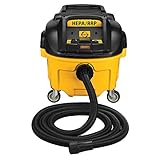
- Automatic Filter Clean of the dust extractor pulses every 30 seconds for continuous operation without stopping to clean filter
- 15-amp motor of DEWALT dust extractor delivers 150 CFM of airflow
- Power Tool Actuation controls the On/Off operations of the vacuum with a power tool
- Meets the EPA Lead Related Renovations, Repair and Painting (RRP) Rule for Hepa Vacuums only when DWV9330 Filters are used
- Universal hose connector provides a secure connection with swivel capability
Use engineering controls at the dust source
Controls are most effective when they prevent dust from becoming airborne or capture it immediately. The applicable Table 1 row specifies the arrangement; there is no universal setup for every saw, grinder, drill or excavator.
Cutting concrete, masonry and other silica-containing materials
For listed cutting tasks, use the integrated water-delivery system or other setup specified for the tool and material. Direct water to the cutting point and maintain flow sufficient to minimize visible dust. Keep the system operating for the full cutting activity, and inspect and maintain it according to the equipment manufacturer’s instructions.
Where the row calls for a dust-collection shroud instead of water, use a close-fitting shroud connected to a compatible collector. A general shop vacuum or a unit selected only because it carries a “HEPA” label does not, by itself, demonstrate that the airflow, filter efficiency and filter-cleaning mechanism required for the particular task are present.
Drilling, grinding and chipping
Use a close-fitting shroud or local capture hood where Table 1 requires it. Connect the tool to a dust collector with the airflow, filtration and filter-cleaning features specified for that operation. Keep hoses, seals and shrouds in good condition so leaks do not release dust at the operator’s breathing zone.
Rank #3

- POWER: With strong airflow and suction power, the BOSCH VAC090AH dust collector delivers a maximum 150 cubic feet of air per minute rate (CFM), with a sustainable maximum 97 in. static water lift
- COMPATIBLE: With power tool activations, these vacuum cleaners let users utilize the power tool's switch to turn vacuum on and off; the Power Broker dial will match the suction force to application
- OSHA COMPLIANT: Featuring BOSCH PRO plus GUARD, an end to end dust collection system to help users move toward OSHA Silica Table 1 dust compliance
- AUTO CLEANING: With automatic filter cleaning, the BOSCH dust extractor VAC090AH cleans the filter every 15 seconds to help maintain maximum suction power
- PERFORMANCE: This vacuum includes a HEPA filter that captures 99.97 percent of particles at 0.3 microns or larger, while the included fleece filter bag helps to protect the filter and provides the optimal containment of dry dust and debris
For certain indoor operations, the standard calls for a HEPA-filtered vacuum to remove loose dust between passes. Vacuuming is a control measure, not permission to let dust accumulate and then sweep it dry. Match the collector to the tool manufacturer’s recommendations and the applicable OSHA row.
Demolition, grading and excavation
Heavy equipment operations can expose both operators and nearby workers. Table 1 includes water or dust-suppressant provisions and enclosed-cab options for certain tasks. When an enclosed cab is the specified control, keep the cab sealed, maintain positive pressure where required and use the intake filtration addressed by the standard. Apply the exact row for the machine and operation rather than assuming that any cab provides equivalent protection.
Indoor and enclosed work areas
Indoor or enclosed work can allow airborne dust to accumulate. When implementing Table 1 indoors or in an enclosed area, provide exhaust as needed to minimize visible airborne-dust accumulation. Plan air movement so exhaust does not carry contamination into occupied areas or toward other workers.
Make water and dust-collection systems work in practice
Engineering controls fail when they are installed but not operating. Before each shift, supervisors should verify that water reaches the impact or cutting point, hoses and fittings are intact, shrouds fit the tool, collectors are connected and filters or cleaning systems are functioning. Replace damaged components and correct blocked lines before production work resumes.
Rank #4

- HEPA Certified: HEPA filtration, adjustable high performance turbine. Capture dust without interruptions due to generous capacity of the 3.96 gallon (15L) container.
- Cleaning Tools Included: For the CT 15, the crevice and upholstery nozzle cleaning accessories are included and stored within the mobile dust extractor. The flat top of the storage means that work materials and other tools are always within reach.
- High quality: Robust design for a long service life, compact and stable footprint and a chassis with steel axles. Supported by the Festool 3 year comprehensive warranty including wear and tear.
- Ideal for use on the go thanks to compact dimensions, low weight, and robust chassis.
- Touch operation for intuitive control of the mobile dust extractor.
- Use the manufacturer’s specified connection, airflow and operating procedure for the tool and collector.
- Keep water flow steady enough to suppress visible dust without creating an uncontrolled slip, electrical or runoff hazard.
- Position workers so the remaining dust plume does not pass through their breathing zone.
- Separate dusty work from nearby crews when practical and restrict access where high exposures may occur.
- Stop and reassess when a control is bypassed, a shroud no longer seals, a vacuum loses suction or visible dust increases.
Control dust during cleanup and housekeeping
Cleanup can recreate the exposure that the cutting or grinding control prevented. OSHA’s construction silica standard states: “The employer shall not allow dry sweeping or dry brushing where such activity could contribute to employee exposure to respirable crystalline silica unless wet sweeping, HEPA-filtered vacuuming or other methods that minimize the likelihood of exposure are not feasible.”
Use wet sweeping, HEPA-filtered vacuuming or another method that minimizes exposure whenever feasible. Do not treat a leaf blower, broom or compressed-air nozzle as a routine replacement for source capture. Compressed air is restricted unless an effective ventilation system captures the resulting dust cloud or no alternative method is feasible.
Do not blow dust from clothing with compressed air where it could contribute to exposure. Have workers use an appropriate vacuuming or changing procedure instead, and keep contaminated clothing from spreading dust into break areas, vehicles or offices.
Decide when respirators are required
Respirators are task-specific protections, not a blanket substitute for engineering controls. Table 1 identifies when respirators are required for particular operations and can distinguish between outdoor, indoor or enclosed work and different work durations. A task that needs no respirator under one listed condition may require one under another.
Best Value

- Dual-mode Operation for Versatile Cleaning: This shop vac switches between standard vacuum mode for everyday messes and dust extractor mode for connecting to power tools during woodworking.
- Power Tool Activation (PTA): The vacuum automatically starts when the connected power tool turns on—ideal for sanders, saws, planers, and more—helping capture debris as you work for a cleaner workspace.
- Hands-Free Filter Cleaning: Featuring semi-automatic filter cleaning, a dust-full indicator and a HEPA filter, this shop vac helps prevent clogging and maintain strong suction for tough job
- Safety and Durability: The anti-static hose helps reduce electrostatic buildup, while the sturdy 8-gallon polymer tank ensures long-lasting durability and portability. A built-in drain port makes it easy to empty liquids and debris.
- Accessories Included: 10 ft anti-static hose (1), extension wands (2), floor nozzle (1), universal adapter (1), crevice nozzle (1), round brush (1), disposable filter bags (3), HEPA filter (1), utility nozzle (1), foam filter (1)
When OSHA requires respirators, the employer must follow the applicable respiratory-protection program requirements. That includes selecting an appropriate respirator for the exposure, ensuring a proper fit and providing the program elements required by the respiratory-protection rule. NIOSH’s construction bulletin, A Guide to Respirators Used for Dust in Construction, provides background on respirator use; it does not replace the OSHA task requirements.
Under the alternative method, exposure assessment determines whether additional respiratory protection is needed after feasible engineering and work-practice controls are applied. Do not assign a generic disposable mask without evaluating the task, exposure and regulatory requirements.
Independent reader supportYour contribution helps us test, update, and keep practical guides available for everyone.Write and communicate the exposure-control plan
Covered employers need a written exposure-control plan describing the silica-generating tasks at the site and the methods used to protect workers. The plan should identify the responsible person, the controls for each operation, procedures for restricting access to high-exposure areas, housekeeping methods, and the process for correcting failed controls.
Crashes, No Sound, or Screen Glitches?
Random freezes, missing sound and display glitches usually trace back to one bad driver. Find and replace yours safely.Free scan · under a minuteWindows Errors? Fix Them Before They Spread
Repair common Windows errors and clear accumulated junk for a smoother, more stable PC - no reinstall needed.Free scan · no reinstallTrain workers on the actual controls they will use, not only on the hazards in general. A useful briefing explains which Table 1 row applies, where water or capture equipment connects, how to recognize a failed control, which areas are restricted, how cleanup must be performed and when a respirator is required. Coordinate subcontractors so one crew does not defeat another crew’s dust controls.
A practical pre-task implementation sequence
- Inventory the work. List materials, tools, locations, expected durations and whether each operation is outdoors, indoors or enclosed.
- Check the applicable standard. Determine whether the operation is covered by federal OSHA, a state plan or another requirement, and locate the matching Table 1 row if applicable.
- Select the control method. Choose the complete Table 1 setup or document the alternative method, including exposure assessment and feasible controls.
- Install and test source controls. Verify water delivery, shroud fit, collector connection, airflow, filter condition, exhaust and cab integrity before exposing workers.
- Set boundaries and workflow. Restrict access where high exposures may occur, position workers away from dust plumes and coordinate simultaneous operations.
- Provide task-specific respiratory protection. Follow the respirator provisions in the applicable row or the results of the alternative-method assessment.
- Clean without re-aerosolizing dust. Use wet methods or HEPA-filtered vacuuming when feasible, and control or eliminate compressed-air cleanup.
- Document and correct. Record the plan, training, inspections and exposure information required for the chosen method; stop work to repair failed controls.
Common failures and corrective actions
| Observed problem | Why it matters | Corrective action |
|---|---|---|
| Visible dust escapes from a saw or grinder | The source control may be missing, poorly fitted or ineffective. | Stop the task, restore the specified water or shroud-and-collector setup, and check seals, hoses and airflow. |
| A HEPA vacuum is connected without checking task requirements | HEPA labeling alone does not establish the airflow, filtration and cleaning features required by a Table 1 row. | Verify the collector against the tool manufacturer’s instructions and the applicable OSHA requirements. |
| Workers dry sweep after cutting | Dry sweeping can re-aerosolize respirable silica. | Use wet sweeping, HEPA-filtered vacuuming or another feasible exposure-minimizing method. |
| Compressed air is used to clean floors or clothing | The resulting dust cloud can expose the operator and nearby workers. | Use a feasible alternative; use compressed air only under OSHA’s stated ventilation or infeasibility exceptions. |
| Indoor work is treated like outdoor work | Dust can accumulate, and Table 1 respirator or exhaust provisions may change. | Apply the indoor or enclosed conditions in the applicable row and provide exhaust as needed. |
| A subcontractor changes the process | A different tool, duration or location can invalidate the planned control method. | Reassess the task, update coordination and revise the written plan before proceeding. |
What contractors should verify before adopting a plan
- Whether the material actually contains or may contain crystalline silica.
- Whether the operation appears in OSHA Table 1 and which exact row applies.
- Whether every listed control and respirator condition can be implemented for the entire task.
- Whether the work is indoor, enclosed or outdoor and whether duration changes the requirements.
- Whether the project is governed by a state-plan OSHA program or additional local rules.
- Whether equipment manufacturers’ instructions are compatible with the selected water-delivery, shroud, collector, exhaust and cab controls.
- Whether the written plan, worker training, access restrictions, inspections and housekeeping procedures reflect actual site conditions.
For the full legal text, consult 29 CFR 1926.1153. The OSHA construction guidance at osha.gov/silica-crystalline/construction-info and the construction overview at osha.gov/silica-crystalline/construction should be read alongside the standard when developing a site-specific program.
Quick Recap
Product prices and availability are accurate as of the date/time indicated and are subject to change. Any price and availability information displayed on Amazon at the time of purchase will apply.

