Recommended Free Tools
Road construction signs and signals tell you how the roadway is changing and what to do next. In the United States, orange temporary-traffic-control signs generally warn of work, a closed lane, a detour, a shared lane, workers, or a person controlling traffic. Cones, drums and other channelizing devices then move vehicles through the changed path, while a temporary signal or flagger assigns who may proceed.
This guide uses the Federal Highway Administration’s Manual on Uniform Traffic Control Devices (MUTCD) as its national baseline, specifically the 11th Edition, Part 6, dated December 2023. States and local agencies can adopt supplemental rules and site-specific layouts, so the sign, signal indication and flagger direction actually displayed at the work zone always control.
As an Amazon Associate I earn from qualifying purchases.
What orange road-work signs tell you
Temporary work-zone warning signs are normally orange and use words, symbols or plaques to describe a condition ahead. They are advance information: seeing a sign does not by itself authorize a maneuver. Read the complete message, look for the next device and adjust only as the roadway directs.
| Sign or plaque | Meaning | What to do |
|---|---|---|
| ROAD WORK AHEAD | Work activity is ahead. | Reduce speed as appropriate, scan for the next sign or channelizing device, and be prepared for a changed lane path. |
| ROAD WORK with a distance | Work is expected the stated distance ahead. The plaque gives the approximate point at which the condition begins. | Use the distance to plan your response; do not wait until the work area to merge or turn. |
| DETOUR | Traffic must follow a marked alternate route. A supplemental message can identify where the detour starts or how far it extends. | Follow the detour signs continuously. Do not improvise a route through a closure. |
| ROAD CLOSED | The route is closed ahead. | Take the marked detour or another route that is permitted and signed. |
| ONE LANE ROAD | Both directions may have to use one open lane. | Expect opposing traffic or an explicit right-of-way control. Obey the signal or flagger and be ready to stop. |
| RIGHT LANE CLOSED or another lane-closure message | The named lane or lanes are unavailable farther ahead. | Merge where the devices and markings direct you, checking for vehicles already in the remaining lane. |
| FLAGGER or FLAGGER AHEAD | A person may be controlling traffic ahead. | Slow and prepare to stop. The warning sign is not permission to continue; the flagger’s displayed direction is the instruction. |
| WORKER or WORKERS symbol | Workers may be close to the travel way. | Stay alert, maintain the path indicated by the devices and leave room for people and equipment. |
These are the MUTCD’s common examples, not a promise that every project will use identical wording. A project can add a distance plaque, lane arrows or other temporary devices, and the number of lanes or the point of a merge can change from day to day. The MUTCD 11th Edition, Part 6 illustrates the sign designs and applications.
#1 Best Overall
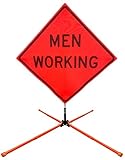
- Complete Kit Included: Comes with one 36” x 36” fluorescent orange roll-up mesh safety sign, one 4-leg steel sign stand, and one pair of durable orange fiberglass cross ribs
- High-Visibility Mesh Material: Sign is constructed from premium 15 oz fluorescent orange tightly woven mesh for enhanced visibility in work zones and roadside applications
- Durable Corner Pocket Construction: Signs are equipped with reinforced corner pockets for secure cross rib support
- Stand & Sign Compatibility: Includes an universal bracket steel stand paired with sturdy corner pockets for secure sign attachment and dependable jobsite performance
- Compact & Portable Design: Lightweight waterproof steel stand folds down compactly for convenient transport, storage, and quick deployment
What does a ONE LANE ROAD sign mean?
A ONE LANE ROAD sign warns that traffic in both directions may need to share a single open lane through the work area. The sign does not tell you which direction has priority. That decision is made by the control used at that location: a temporary traffic signal, a flagger, or another clearly posted arrangement.
When you approach the shared lane
- Read any additional plaque or signal ahead and identify whether you are approaching a stop point.
- Reduce speed enough to stop before the line, stop sign or flagger if required.
- Do not enter the single lane merely because you cannot see an opposing vehicle. Sight distance can be limited by a curve, work equipment or the work itself.
- Proceed only on a green indication or a flagger’s explicit instruction, and remain in the channelized path until the opposing movement has been released.
If a lane-closure sign names a particular lane instead, the issue may be a merge into a continuing lane rather than two-way sharing. Follow the arrows, cones and markings that appear after the warning sign.
How a work zone is laid out
The MUTCD describes a temporary traffic-control zone as a sequence of areas. Understanding the sequence explains why several devices appear before and after the visible work.
What’s actually slowing this PC down?
Pick the symptom - the matching free tool is one click away.
Advance warning area
This is where drivers first learn that a condition ahead will change. Signs can identify road work, a lane closure, a one-lane section, a flagger or a detour. A distance plaque may place the condition farther ahead. Use this space to look for the next instruction and make a legal, controlled adjustment.
Rank #2

- Reflective Visibility: Engineer grade reflective surface helps the sign stay easy to notice in daylight, low light, and rainy conditions, making warnings clearer for approaching drivers and visitors.
- 24 x 24 Inch Size: The large square format gives the ROAD WORK AHEAD message a clear, easy-to-read presentation for driveways, facility entrances, work areas, and private access roads.
- Durable Aluminum Construction: Made from 40 mil aluminum with a laminated surface to help resist rust, water, sun exposure, and everyday outdoor wear for dependable use in changing weather.
- Easy To Mount: Two pre-drilled holes for quick installation on virtually any surface including fences, utility poles and walls. 5 minutes to hang, instantly guarding road work areas.
- Wide Application: Suitable for job sites, warehouses, factories, businesses, garages, parking areas, and private properties where temporary road work or caution guidance should be clearly marked.
Transition area
The transition moves traffic out of its normal path. Cones, drums, barricades, pavement markings or arrow displays can taper a lane into a merge, shift traffic sideways or direct vehicles around a closed section. Stay between the devices; crossing a taper or driving through a barricade defeats the intended path.
Buffer space
A buffer separates moving traffic from the work space or provides protection within the temporary layout. It is not a travel lane, a passing area or a place to stop for convenience. Treat an empty-looking buffer as part of the protection system.
Activity area
The activity area contains the work space and the traffic space that remains open. Workers, vehicles, materials and changing operations may be present. Keep your attention on the channelizing devices and any instruction that changes at the edge of this area.
Termination area
The termination area lets traffic return to normal operation. You may see an end-of-work-zone message or the last temporary traffic-control device. Do not accelerate or change lanes until the final device and normal markings show that the restriction has ended.
Rank #3

- Made in the USA with durable 15oz fluorescent safety orange woven mesh
- Includes standard orange fiberglass roll-up sign cross ribs for a 48” sign
- Sturdy corner pockets to fit cross ribs
- Easy to setup and take down for maximum portability and effectiveness
- Compatible with sign mounts and universal sign and roll-up brackets (sold separately)
How to read the sequence as you drive
- Identify the first warning. Determine whether the issue is general work, a lane closure, a detour, a one-lane section or a person controlling traffic.
- Find the distance and direction information. A plaque can tell you how far ahead the condition is; arrows and lane names identify the side affected.
- Scan for the transition. Look beyond the sign for cones, drums, barricades, pavement arrows or a taper. The physical devices, not an old lane habit, define the current path.
- Choose your response early. Merge as directed, take the signed detour or prepare to stop. Keep your movement predictable for vehicles in the remaining lane.
- Obey the active control. At a signal, follow the displayed indication. At a flagger station, follow the flagger’s position and hand or paddle instruction, even when it differs from what you expected.
- Remain in the controlled path. Continue through the activity and buffer areas without entering closed space or stopping in a buffer.
- Wait for termination. Resume ordinary lane choices only after the work-zone devices and markings indicate that the restriction has ended.
Temporary traffic signals in work zones
Temporary signals can control movements through a work zone, including a one-lane, two-way roadway section or a temporary haul-road crossing. Their timing and placement are designed for that site; a familiar permanent signal pattern does not necessarily apply.
Federal guidance requires these devices to follow applicable traffic-signal provisions. Section 6L.01 of the MUTCD 11th Edition states: “Temporary traffic control signals (see Section 4D.11) used to control road user movements through TTC zones and in other TTC situations shall comply with the applicable provisions of Part 4.” Read the full requirements in the official Part 6 PDF.
At a temporary signal
- Stop at the marked stop line or before the signal when the indication is red.
- Do not enter on red simply because the lane appears empty; the opposing direction may be released next.
- On green, check the lane ahead and proceed only through the open, channelized path.
- On yellow, stop if you can do so safely; do not speed up to beat the change.
- If a flagger is also present, follow the flagger’s direction and any site-specific sign in addition to the signal. A person controlling traffic can be managing equipment, an intersection or a temporary change that the signal alone does not explain.
Flaggers: the person’s direction controls
An orange FLAGGER or FLAGGER AHEAD sign means that a person may control traffic farther ahead. The sign is an advance warning, not an instruction to proceed. When you reach the flagger, stop when directed, wait through the halt indication and move only when the flagger clearly releases your approach.
Never infer permission from the absence of an opposing vehicle. A flagger may be holding traffic for workers, trucks entering the roadway or vehicles that are out of your sight. Keep watching while moving because the control can change between trips through the same project.
Rank #4

- Complete Kit Included: Comes with one 36” x 36” fluorescent orange roll-up mesh safety sign, one 4-leg steel sign stand, and one pair of durable orange fiberglass cross ribs
- High-Visibility Mesh Material: Sign is constructed from premium 15 oz fluorescent orange tightly woven mesh for enhanced visibility in work zones and roadside applications
- Durable Corner Pocket Construction: Signs are equipped with reinforced corner pockets for secure cross rib support
- Stand & Sign Compatibility: Includes an universal bracket steel stand paired with sturdy corner pockets for secure sign attachment and dependable jobsite performance
- Compact & Portable Design: Lightweight waterproof steel stand folds down compactly for convenient transport, storage, and quick deployment
Detours, closures and lane merges
DETOUR
A detour sign places you on an alternate route around the affected roadway. Continue looking for successive detour signs at turns and junctions. If a supplemental message identifies a start point or distance, use it to determine where the alternate route begins; do not turn early onto an unmarked side street.
ROAD CLOSED
ROAD CLOSED means the route is closed ahead, not merely slowed. Stop following the through route and use the marked detour or another permitted route. A closure can be beyond the point where you first see the sign, so do not drive past barriers on the assumption that a gap will open.
Lane-closure signs
A RIGHT LANE CLOSED or multiple-lane message identifies which part of the roadway will be unavailable. The warning can appear well before the taper. Maintain awareness of vehicles already in the open lane, merge only where the temporary devices and markings allow, and avoid creating a second merge at the last device.
When signs, signals and markings seem inconsistent
Work zones can change between shifts, and an older lane line may remain visible while temporary devices establish a new path. Give priority to the current temporary-control arrangement: the displayed signal, an active flagger and the signed route. If two instructions genuinely conflict, slow or stop where safe and follow the instruction that is most immediate and clearly directed at your movement; do not weave around devices to resolve the conflict yourself.
Local agencies can supplement the national MUTCD baseline. The exact sign text, distance, lane arrangement and additional pedestrian or bicycle routing therefore depend on the project and jurisdiction. Use every applicable sign and marked crossing or path at that site rather than assuming a layout from another state.
A quick driver checklist
- Read the entire orange sign and any distance or direction plaque.
- Look beyond the sign for the taper, cones, drums, barricades or signal.
- Slow early and leave enough space to stop before a flagger or red signal.
- Stay out of buffers, work spaces and closed lanes.
- Follow a marked detour all the way through its turns.
- Yield or proceed only as the temporary signal, flagger or other active control indicates.
- Keep scanning until the termination area and final device show that normal operation has resumed.
Official reference
The FHWA MUTCD overview explains the manual’s role as the national compilation of standards for traffic-control devices, including signs, markings and signals. For work-zone layouts, sign examples and temporary-signal provisions, consult MUTCD 11th Edition, Part 6 (December 2023). Ordinary drivers do not need to read the entire manual, but these references explain why a work zone combines advance warnings, transitions, buffers, activity controls and a termination area.
Quick Recap
Product prices and availability are accurate as of the date/time indicated and are subject to change. Any price and availability information displayed on Amazon at the time of purchase will apply.

