Some links on this page are affiliate links: if you buy through them we may earn a commission, at no extra cost to you.
The short answer: compare volts (V) for compatibility, watt-hours (Wh) for stored energy and runtime, and current or C-rate ratings for how much power a battery can deliver. Amp-hours (Ah) and milliamp-hours (mAh) measure electrical charge, but they are not meaningful energy comparisons unless the voltage is also known.
That distinction matters on a construction site. A battery may have plenty of capacity on paper yet fail to run a saw, mixer, pump, laser, inverter or other demanding load if its voltage, peak-current capability, connector, charger or battery-management system is unsuitable.
As an Amazon Associate I earn from qualifying purchases.
Recommended Free Tools
The five battery numbers that matter most
| Rating | What it tells you | What it does not tell you |
|---|---|---|
| Voltage (V) | Electrical pressure and system compatibility | Runtime by itself |
| Amp-hours (Ah) | Charge capacity under specified test conditions | Total energy without voltage |
| Milliamp-hours (mAh) | The same capacity measurement at a smaller scale | Which battery will last longer across different voltages |
| Watt-hours (Wh) | Approximate stored energy | Maximum current or peak power |
| Maximum current or C-rate | How quickly the battery can deliver current | How long it will run a load |
Automotive batteries add other ratings, including cold-cranking amps (CCA) and reserve capacity (RC). Those describe starting performance and specified backup duration—not the same thing as general-purpose battery capacity.
Capacity is not the same as energy
Amp-hours measure electrical charge. A nominal 5-Ah battery can be thought of as supplying 5 amps for about one hour, 1 amp for about five hours, or 10 amps for roughly 30 minutes. This is an introductory approximation, not a guarantee. Capacity is measured at a particular discharge rate, temperature, cutoff voltage and battery condition.
#1 Best Overall
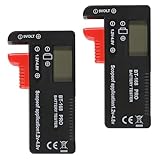
- Universal battery tester: the battery tester is suitable for AAA, AA, C, D, 18650, 9V alkaline, dry batteries or rechargeable batteries; Battery power tester can display battery power instantly
- COMPACT SIZE: ABS material makes this battery tester volt checker is small and exquisite, Portable battery tester is easy to use, small batteries button cell, compact size and lightweight, convenient to carry
- Simple but effective battery tester checker for home (BT-168);Test multiple sizes of batteries in one unit. (1.5V: AAA, HP16, MN2400, R03, AA, HP7, MN1500, UM3, C, HP11, MN1400, SP11, LR14, UM2, D, HP2, MN1300, SP2, R20, UM1; 9V: PP3, MN1604, 6F22, 006P)
- No batteries required, Easy-to-read ,the analog display needle moves on a color-coded, calibrated scale to quickly identify "good" (green), "low" (yellow), and "replace/recharge" (red) battery status.
- you will get 2 Pack Battery Tester, Universal Battery Checker for AA/AAA/C/D / 9V / 1.5V Button Cell Batteries Household Battery Life Level Testers Power Monitor Meter (Requires No Battery for Operation)
The most useful conversion is:
Wh ≈ volts × amp-hours
For milliamp-hours:
Wh ≈ volts × mAh ÷ 1,000
The U.S. Department of Energy defines nameplate energy using voltage multiplied by charge capacity, and the FAA uses the same calculation for lithium-battery transport information. See the DOE battery definitions and FAA lithium-battery guidance.
Why Ah alone can mislead you
Two batteries rated at 5 Ah can contain very different amounts of energy:
- 5 V × 5 Ah = 25 Wh
- 12 V × 5 Ah = 60 Wh
- 20 V × 5 Ah = 100 Wh
- 48 V × 5 Ah = 240 Wh
A 20-V, 5-Ah power-tool battery therefore has approximately twice the nominal energy of a 10-V, 5-Ah battery, assuming comparable test conditions. When comparing different-voltage packs, compare Wh—not just Ah.
Series and parallel connections
With identical batteries:
- Series: voltage adds while Ah remains approximately the same.
- Parallel: Ah adds while voltage remains approximately the same.
Real packs also include wiring losses, cell matching, balancing, protection circuits and battery-management limits. The resulting output will not always equal a simple multiplication of individual cell ratings. The DOE explains the series and parallel distinction in its battery terminology and test-procedure material.
Voltage: compatibility, power and nominal values
Voltage has three practical implications.
Compatibility
Use the voltage, connector, polarity and pinout specified by the equipment manufacturer. Supplying the wrong voltage can prevent operation or damage the tool, charger, controller or other equipment. Similar-looking battery packs are not automatically interchangeable.
Power
Electrical power is approximately:
Watts ≈ volts × amps
For a given current, a higher-voltage system can deliver more power. For a given power demand, it can also use less current, potentially reducing resistive losses in wiring. That does not make higher voltage universally better: the equipment must be designed for it.
What’s actually slowing this PC down?
Pick the symptom - the matching free tool is one click away.
Nominal voltage is not constant voltage
A “12-V” lead-acid battery is not exactly 12 V throughout its discharge. Lithium-ion cells described as 3.6 or 3.7 V also operate across a voltage range. A battery label may refer to:
Rank #2

- Catch Battery Problems Early: Featured in two videos by Project Farm, a popular YouTube channel with millions of subscribers, the ANCEL BA101 helps you quickly spot battery issues before they leave you stranded. It provides easy-to-understand readings for State of Health (SOH), State of Charge (SOC), voltage, current, CCA, plus cranking and charging system tests, so you can better understand your battery and help avoid unexpected breakdowns
- Know the Real Condition: Don’t let inaccurate readings lead to costly surprises. Built with high-quality copper crocodile clips and a precision smart chip, this battery tester is designed to deliver dependable results. For the most accurate test, enter the correct battery type, rating value (such as CCA/Ah), and temperature exactly as shown on your battery label, so you get a clearer picture of your battery’s true condition
- Fast, Clear, Hassle-Free Testing: The classic black-and-white screen, adjustable contrast, and white backlight make results easy to read in bright sunlight or low-light conditions. One-handed operation keeps testing simple, while direct power from your vehicle’s battery means no charging and no internal batteries to deal with. Multi-language support makes it easier for more users to test with confidence
- Protection When Mistakes Happen: Built-in 4-in-1 protection helps guard against reverse polarity, short circuits, overcurrent, and overvoltage for safer testing, especially in tight spaces where clamp slips or wiring mistakes can happen. The 3x reinforced ABS housing adds extra durability and helps protect both the tester and your battery during everyday use
- Built for More 12V Batteries: Supporting global standards including JIS, EN, DIN, SAE, BCI, GB, CA, MCA, and IEC, this tester works with 12V batteries used in cars, trucks, boats, RVs, ATVs, lawnmowers, golf carts, and motorbikes over 30Ah. Compatible with Flooded, AGM, GEL, and EFB batteries. Not for lithium batteries, non-12V batteries (6V/8V/24V), or motorcycles below 30Ah. For 6V testing, choose BA101 Plus. For 24V testing, choose BA101 PRO
- Nominal voltage: a representative value used for comparison.
- Fully charged voltage: higher than nominal for many chemistries.
- Loaded voltage: the voltage while current is being drawn.
- Cutoff voltage: the minimum voltage allowed by the equipment or battery-management system.
Wh calculations normally use nominal voltage, so they provide a rated-energy estimate rather than a measurement of every watt-hour available at the output terminals.
Wh is usually the fairest energy comparison
Examples:
- A 5,000-mAh phone battery at 3.8 V is approximately 19 Wh.
- An 18-V, 5-Ah tool battery is approximately 90 Wh.
- A 12-V, 100-Ah battery is approximately 1,200 Wh, or 1.2 kWh.
The actual usable energy can be lower because of voltage variation, conversion losses, temperature, aging, battery-management reserves, discharge rate and the equipment’s cutoff point.
For an inverter:
Usable AC energy ≈ rated battery Wh × usable fraction × inverter efficiency
Free tools Windows power users keep installed
One-click scans. No signup required.
For example, a 1,000-Wh battery used to 80% of its rated energy through an inverter operating at 90% efficiency provides an estimated:
1,000 × 0.8 × 0.9 = 720 Wh
At a 100-W load, that is approximately 7.2 hours. It remains an estimate because the load, battery voltage, temperature and inverter behavior vary.
How to estimate runtime
For a direct-current load
When the battery and load operate at roughly the same voltage and the current is reasonably constant:
Runtime ≈ usable Ah ÷ load amps
Example: a 12-V, 100-Ah battery with 80% treated as usable and a 5-A load:
Rank #3
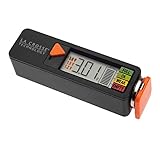
- Test rechargeable and alkaline batteries
- Works for all: AAA, AA, C, D, N, 9V batteries and Lithium Ion button cell
- Simple Operation in 3 easy steps: 1) Select Voltage range (1.5V, 1.2V, or 3.0V depending on battery type used, 2) Pull orange tray outward and insert one battery into the tester correct direction of polarity, 3) Slide tray closed for positive connection and LED will display voltage and strength levels. Remove battery when test is complete.
- Multiple types: Select 1.5V for alkaline AA, AAA, C, D, & N batteries; Select 1.2V for rechargeable AA, AAA, C, D & N batteries; Select 3V for lithium button cell battery
- Touch contacts on left side of tester for 9V battery
100 Ah × 0.8 ÷ 5 A = 16 hours
For a load specified in watts
Runtime ≈ usable Wh ÷ load watts
Example: a 240-Wh battery, 85% usable, supplying a 60-W load:
240 × 0.85 ÷ 60 ≈ 3.4 hours
For tools, motors and inverters
Use the equipment’s actual or expected wattage where possible. Starting a motor or saw can require substantially more power than its running rating. A battery and inverter may have enough Wh for the job but still shut down because they cannot supply the startup surge or continuous current.
High current also causes voltage sag and heat. The device may hit its low-voltage cutoff early, making the practical runtime shorter than the simple calculation suggests.
Energy capacity versus power delivery
Keep these questions separate:
| Question | Relevant specification |
|---|---|
| How much work can the battery provide overall? | Wh or kWh |
| How long will it run a known load? | Usable Wh, load watts and efficiency |
| Can it start or run a demanding tool? | Continuous and peak current, C-rate, voltage sag and inverter output |
Continuous current, peak current and C-rate
Continuous discharge current is the current the battery is intended to deliver continuously under stated conditions. Peak or maximum current may apply only for a few seconds and may depend on temperature, state of charge and the battery-management system.
Quick wins for a faster PC:
Clear out junk files and repair common Windows errorsFree Scan →Scan for outdated or missing drivers - takes under a minuteDriver Scan →Repair Windows errors before they cause bigger problemsFix Now →C-rate normalizes current against capacity:
C-rate = discharge current in amps ÷ capacity in Ah
For a 5-Ah battery, 1C is 5 A and 2C is 10 A. Always check whether a C-rate is continuous or short-term. A high-capacity battery is not automatically a high-output battery.
Automotive ratings: CCA, CA, MCA, RC and Ah
- CCA (cold-cranking amps): starting-current capability under a standardized cold-temperature test. It is relevant to engine starting, not accessory runtime.
- CA (cranking amps): a cranking rating measured under warmer conditions than CCA.
- MCA (marine cranking amps): a marine starting rating measured under conditions that differ from CCA.
- Reserve capacity (RC): the time a battery can support a specified load under a defined test. It is not a universal measure of total energy.
- Ah: useful for deep-cycle and accessory applications, but starter batteries must also match the vehicle’s size, terminals, chemistry and required starting performance.
For an example of automotive CCA and reserve-capacity terminology, see this vehicle manual reference.
Rank #4

- [Car Battery Tester] You can easily test and inspect your 12V lead-acid battery with this TOPDON car battery tester. The SOH (State of Health), SOC (State of Charge), Voltage, Current, Rating, and numerous other understandable analytical data are provided by this battery tester. It is compatible with 100-2000CCA regular flooded, AGM flat plate/spiral, EFB, and GEL for their optimum performance.
- [Wide Application] This 12V battery load tester can only be powered on once it is properly attached thanks to a safe passive testing approach. You may test the batteries of a number of vehicles, including cars, motorbikes, trucks, RVs, ATVs, SUVs, boats, yachts, lawnmowers, and even golf carts, without needing to charge the device first.
- [3 Testing Function] A battery health test will determine whether or not the battery is in excellent operating order. A cranking test will determine whether or not the electrical system has sufficient power to start the engine. Check to see that the charging current, rectifier diode, and generator are all functioning normally. This handy auto battery analyzer makes sure your summer road trips won’t end on a flat.
- [Ergonomic Features] To help you rapidly determine the health of the battery, this load battery tester is built with three different colors of LEDs. It's easy to use because it operates through a menu system. Additionally, for a reliable and secure connection during the testing process, premium-quality copper clamps have polarity reverse prevention and spark proof features.
- [Great Choice] The TOPDON BT100 is small and compact, making it simple to keep in a glove box or center console. This battery load tester's rapid and precise results will enable you to decide whether your car battery needs to be replaced or jump-started making it an excellent choice for auto shops, garages, and DIY users who frequently check batteries.
How chemistry changes the meaning of a rating
Lead-acid
Lead-acid batteries are commonly described with CCA, RC and sometimes Ah. Voltage can sag substantially under load, capacity is affected by discharge rate, and deep discharge can shorten service life. Flooded, AGM and gel batteries also have different charging and maintenance requirements.
Do these 3 things before closing this tab:
1Fix the driver behind crashes, sound loss and screen glitches2Clear out junk files and repair common Windows errors3Scan for outdated or missing drivers - takes under a minuteLithium-ion
Lithium-ion packs offer high energy density but require protection and battery-management electronics. Cell, module and complete-pack ratings may differ. Electronics can limit charging, current, temperature and usable capacity.
LiFePO4
LiFePO4 is used in some RV, marine, portable-power and stationary-storage systems. It needs a compatible charging profile and battery-management system. A nominal “12-V” LiFePO4 pack does not charge or behave exactly like a 12-V lead-acid battery.
NiMH and alkaline
mAh can be useful for low-power consumer devices, but actual capacity still depends strongly on discharge rate and cutoff conditions. Ratings from different chemistries should not be compared without considering the application and test method.
Rated, nominal, typical, usable and maximum
These words are not interchangeable:
- Rated capacity: the manufacturer’s stated result under defined or implied conditions.
- Nominal: a representative voltage, capacity or energy value.
- Typical: an expected value that may not be the guaranteed minimum.
- Minimum: a conservative guaranteed threshold when provided.
- Usable: the portion available after reserves, cutoff limits and control-system rules.
- Maximum: an ambiguous term that may mean maximum charge, energy, output current or a temporary peak.
Ask: rated under what current, temperature, cutoff voltage and end-of-life definition? DOE battery terminology distinguishes rated capacity from available or deliverable capacity and notes the effects of rate, temperature, age, stand time and cutoff criteria.
Crashes, No Sound, or Screen Glitches?
Random freezes, missing sound and display glitches usually trace back to one bad driver. Find and replace yours safely.Free scan · under a minuteWindows Errors? Fix Them Before They Spread
Repair common Windows errors and clear accumulated junk for a smoother, more stable PC - no reinstall needed.Free scan · no reinstallWhy real batteries deliver less than the label suggests
- Discharge rate: heavy loads can reduce available capacity and increase voltage sag.
- Temperature: cold reduces available power and capacity temporarily; heat accelerates degradation and can increase safety risks.
- Age and storage: capacity and output capability decline with use and calendar age.
- Cutoff voltage: equipment may stop before the cells are chemically empty.
- Conversion losses: regulators and inverters consume energy.
- Battery-management reserves: lithium packs may reserve energy to protect cells.
- Variable loads: saws, drills, pumps and compressors do not draw a constant amount of power.
State of charge means how full the battery is now. State of health means how much capacity or performance remains compared with when it was new. A worn battery may retain reasonable runtime but no longer supply the current needed by a heavy load. The U.S. Department of Energy’s battery explainer describes how repeated charging and discharging change battery chemistry and structure over time.
Independent reader supportYour contribution helps us test, update, and keep practical guides available for everyone.Cell, battery, pack and system ratings
A specification may refer to different levels of equipment:
Best Value

- HIGH COMPATIBILITY: It is not only suitable for AA, AAA, C, CR123A, D, 9V, N, CR2, CRV3, 2CR5, CR-P2 cylindrical battery testing, but also good for checking a wide variety of button cell batteries
- CRISP LCD SCREEN: Easy to use analyzer shows what you need to know about your battery’s health, it will accurately shows whether the battery is in poor, weak, or good condition of voltage
- QUICK RESULTS: Simply place a battery into the decent battery detector, it will shows you quickly the status of your batteries’ health by the using bars, helps you avoid battery damage from unnecessary recharges. DON'T POWERED BY RECHARGEABLE BATTERY NOR TEST RECHARGEABLE BATTERIES
- REMARKABLY COMPACT: One of the smallest and lightest portable battery checker. A pocket-friendly compact chassis with an anti-slip finish enables a firm grip in your hand for battery checking
- WHAT YOU GET: Dlyfull Universal Battery Tester(1x AAA battery included), welcome guide, & our worry-free 18-month warranty and friendly customer service. A living assistant helps you save money as well as prolong the lifespan of all your batteries
- Cell: one electrochemical unit.
- Battery: one or more cells.
- Pack: cells plus wiring, enclosure, protection and often a battery-management system.
- System: the pack plus charger, inverter, controller, cooling and other electronics.
A cell’s Ah rating is not automatically the usable Wh rating of a complete pack. Series/parallel configuration, cell matching, thermal limits, software restrictions and conversion efficiency all affect what reaches the tool or outlet.
Choosing a battery for construction and site work
Power tools
- Confirm the manufacturer’s voltage system and physical compatibility.
- Compare Wh for expected runtime.
- Check continuous and peak discharge capability for motors and high-load tools.
- Use the correct charger and confirm battery-management compatibility.
- Consider weight, balance, replacement cost and availability.
A higher-Ah pack generally provides more runtime when voltage and conditions are comparable, but it may be heavier and larger. Similar voltage or Ah markings do not establish cross-brand compatibility.
The Tool Desk
Outbyte PC Repair FREERepair Windows errors before they cause bigger problemsFix Now →Outbyte Driver Updater FREEScan for outdated or missing drivers - takes under a minuteDriver Scan →Portable power stations, inverters and site backup
Check usable Wh, continuous AC output, surge output, inverter efficiency, recharge time, solar-input limits, chemistry, operating temperature, warranty and replaceability. A high-Wh unit may still fail to start a refrigerator, pump, heater or other motor if its inverter cannot handle startup surge.
Vehicle and equipment starting batteries
Check the required group size, terminal layout, chemistry, CCA and reserve capacity. Do not select a starter battery solely by Ah or CCA without confirming the equipment manufacturer’s requirements.
A practical battery-label checklist
Before buying a replacement battery, charger or power station, verify:
- Is the voltage correct for the equipment?
- Is the stated voltage nominal, maximum or fully charged?
- Is the capacity given in Ah, mAh, Wh or kWh?
- If it is Ah or mAh, what voltage should be used for conversion?
- Is the energy figure gross, rated, nominal or usable?
- What current can it deliver continuously?
- What is the peak current, and for how long?
- What were the capacity test’s current, temperature and cutoff conditions?
- Does the chemistry require a specific charger or charging profile?
- Does the pack require communication with the tool or controller?
- Do the connector, polarity, terminals and physical dimensions match?
- Are the cycle-life conditions and end-of-life definition stated?
Safety, labeling and air travel
Performance figures are different from safety and compliance markings. A certification symbol does not mean a battery has greater capacity or longer runtime. Useful label information can include chemistry, voltage, capacity, model number, polarity, manufacturer details, warnings, recycling information and production details. See the EPA battery-labeling guidance and its label-field reference.
Use the charger specified for the battery chemistry. Do not use damaged, swollen, leaking or overheated packs. Follow the manufacturer’s handling and storage instructions, protect terminals and recycle batteries through an appropriate service.
For U.S. air travel, FAA guidance generally uses Wh thresholds for lithium batteries: lithium-ion batteries up to 100 Wh are treated differently from 101–160-Wh spare batteries, which may require airline approval. Rules depend on whether the battery is installed or spare, carry-on or checked baggage, the airline and the applicable jurisdiction. Check the current FAA guidance and your airline before traveling. The relevant U.S. federal rule is available at 49 CFR § 173.185.
For recycling or transport to a recycling facility, the EPA advises insulating lithium-battery terminals with nonconductive tape or placing each battery in its own bag. See the EPA lithium-ion battery safety and recycling guidance.
Quick Recap
Product prices and availability are accurate as of the date/time indicated and are subject to change. Any price and availability information displayed on Amazon at the time of purchase will apply.

