Some links on this page are affiliate links: if you buy through them we may earn a commission, at no extra cost to you.
The most reliable way to keep gravel nearly weed-free is a maintenance system, not a single treatment: remove existing weeds before they seed, clear organic debris, disturb or heat small seedlings, and use landscape fabric or a correctly labeled herbicide when the site and timing justify it.
Gravel suppresses weeds, but it is not naturally weed-proof. Dust, leaves, compost-like debris, and seeds blown or carried in from nearby areas eventually create a shallow growing medium between the stones. The problem is usually worse when gravel is thin, mixed with fines, compacted, or bordered by unmanaged vegetation. The realistic goal is substantially less weed growth and easier maintenance—not a permanent guarantee of zero weeds.
As an Amazon Associate I earn from qualifying purchases.
Choose the method that fits your gravel area
| Situation | Best starting point | Important limitation |
|---|---|---|
| A few young weeds | Hand-pull, dig, use a narrow hoe, or rake | Remove the crown and as much root as practical; deep-rooted perennials may return. |
| A broad area with loose surface gravel | landscape rake, hoe, or harrow | Most effective on small, young weeds—not established perennial roots. |
| An open path or driveway with no nearby desirable foliage | Propane flame weeding | Requires repeated treatments for some perennials and careful fire control. |
| A new installation or complete renovation | Prepare the base and install geotextile fabric beneath the gravel | Fabric reduces germination from below but is not maintenance-free. |
| Recurring annual weeds | A properly labeled preemergence herbicide after existing weeds are removed | It prevents new seedlings from establishing; it does not kill mature weeds. |
| Existing weeds in cracks or around hardscape | Shielded spot treatment with a labeled postemergence product | Nonselective products can injure any green plant they contact. |
Why weeds grow in gravel
Gravel is an inorganic mulch, so it does not decompose in the same way as bark or compost. That makes it relatively stable, but the spaces between stones collect fine soil, airborne dust, leaf fragments, and other organic material. Weed seeds can arrive in that material or blow in from lawns, beds, roadsides, and vacant areas.
According to UC Integrated Pest Management guidance, gravel and pebbles can be difficult to keep weed-free even though they are stable mulch materials. Thin gravel, compacted surfaces, and edges where vegetation is allowed to mature all increase the maintenance burden.
Popular on Amazon

- 【How do we ensure product safety】We crafted our blow torch out of professional-grade materials, providing you with a safe and easy-to-use tool. Premium Weed Torch with Security. Double-sealed barrels design ensure product safety.
- 【High Safety and Double Guarantees】100% passed high standard leak test before shipping. This propane weed torch also contains internal safety mechanisms that restricts 99% of propane flow, in case of leakage. All steel parts are built with heat-stable steel, enhanced anti-corrosion eliminated risk of leakage in long time.
- 【Precision-Adjusted Control】Featuring a wide, heavy-duty flame outlet, this 30" detachable torch head delivers a powerful and robust flame. Engineered for efficiency, it's the perfect tool to expedite any task with superior results.
- 【No Chemical Weeding Solution】This is a Environmentally Friendly way to solve the weeds between hard to reach crevice efficiently. With the help of this efficient assistant, you can easily and efficiently complete many things. Burn weeds and stumps, melt snow/ice, sear meat or fish, light fires, solder, do wood grain burning, soften asphalt, remove paint from non-flammable surfaces and more with this propane torch,it's ideal for home, garden, farm, industrial and construction use.
- 【Customer Satisfaction】 This propane torch burner comes with 36-month, replace a new set directly once it has any quality problems.Whether you're purchasing this Sondiko Weed burner for your own home, or as a thoughtful gift for a loved one, our support team is ready to assist!
Before choosing a treatment, check whether the weeds are annuals or perennials. Annuals are often controlled when they are small. Perennials with crowns, rhizomes, or deep roots generally require repeated removal or treatment.
1. Hand-pull or dig weeds while they are small
For a small garden strip, a few weeds near an entrance, or gravel surrounding desirable plants, manual removal is usually the safest first option. Work after rain or irrigation has softened the soil, grip the weed close to its crown, and pull slowly to avoid snapping the stem away from the root.
Quick wins for a faster PC:
Repair Windows errors before they cause bigger problemsFix Now →Fix the driver behind crashes, sound loss and screen glitchesFind Drivers →- Remove mature weeds and seed heads first so they cannot reseed the gravel.
- Loosen the gravel around the crown with a narrow weeder, cultivator, or hoe.
- Lift out the crown and as much root as practical.
- Collect the weeds rather than leaving them on the gravel, especially if they carry seed.
- Backfill exposed holes and return displaced gravel to the surface.
Manual removal is especially useful beside ornamental plants, lawns, drainage areas, and other places where spray drift or flame could cause damage. A hand weeder for gravel paths or narrow garden hoe can make work easier in tight spaces; choose a tool narrow enough to reach the crown without disturbing desirable roots.
Hand-weeding is not necessarily a one-time cure. If a perennial root breaks, or new seeds continue arriving, inspect the area again in one to two weeks and remove regrowth while it is still small.
2. Rake, hoe, or harrow the loose gravel surface
Mechanical disturbance works well where the gravel has a loose surface layer over a reasonably firm or compact base. A landscape rake, hoe, or harrow can uproot and desiccate small annual weeds before they establish.
Use short, controlled strokes rather than aggressively turning over the entire bed. The objective is to disturb the shallow root zone and bring weeds to the surface, not to mix more soil and organic matter into the gravel. Rake the loosened weeds out and remove them from the site.
The Tool Desk
Outbyte PC Repair FREERepair Windows errors before they cause bigger problemsFix Now →Outbyte Driver Updater FREEFix the driver behind crashes, sound loss and screen glitchesFind Drivers →When this method works best
- Young weeds with shallow roots
- Open gravel paths, drives, and service areas
- Surfaces with enough loose stone for a rake or harrow to move through
- Routine maintenance before weeds flower or produce seed
When to use another method
Do not expect raking to eliminate deep-rooted perennial weeds. It can cut or spread roots, leaving the weed to regrow. It is also a poor choice immediately beside shallow-rooted ornamentals or where aggressive raking would expose the underlying soil and create a better seedbed.
Also popular on Amazon
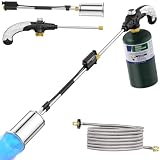
- Note: Gas canister not included due to shipping rules.
- 【How do we ensure product safety】We crafted our blow torch out of professional-grade materials, providing you with a safe and easy-to-use tool. Premium Weed Torch with Security. Double-sealed barrels design ensure product safety.
- 【High Safety and Double Guarantees】100% passed high standard leak test before shipping. This propane weed torch also contains internal safety mechanisms that restricts 99% of propane flow, in case of leakage. All steel parts are built with heat-stable steel, enhanced anti-corrosion eliminated risk of leakage in long time.
- 【Adjustable Control with MAX 1800°C】30" Detachable Flame heat of our snow torch can reach up to 1800°C to perfectly suited for most applications. The wider and heavier flame outlet can strongly output powerful flame. Handheld Propane Torch Head is perfect for finishing your work in a hurry.
- 【No Chemical Weeding Solution】This is a Environmentally Friendly way to solve the weeds between hard to reach crevice efficiently. With the help of this efficient assistant, you can easily and efficiently complete many things. Burn weeds and stumps, melt snow/ice, sear meat or fish, light fires, solder, do wood grain burning, soften asphalt, remove paint from non-flammable surfaces and more with this propane torch,it's ideal for home, garden, farm, industrial and construction use.
3. Flame-weed with a propane torch
Flame weeding uses heat to wilt and kill susceptible foliage. It is particularly useful on open gravel paths and driveways, where there is little desirable vegetation close to the treatment area. Cornell guidance identifies flame weeding as suitable for gravel and notes that it is most effective on small annual broadleaf weeds; perennial weeds may require repeated applications.
Pass the flame over the foliage briefly until it wilts or shows a change in color. The goal is to heat the plant, not to burn the whole area, char the gravel, or create a sustained fire. A propane weed torch for gravel is the relevant equipment category for this job, but use only equipment designed and labeled for outdoor weed control.
Flame-weeding safety checklist
- Check local fire restrictions and any rules governing open-flame equipment before starting.
- Do not use a torch during drought, high fire danger, or windy conditions.
- Clear dry leaves, mulch, grass, cardboard, wood, fuel, and other combustible material from the treatment route.
- Keep the flame away from fences, buildings, vehicles, utility lines, dry vegetation, and landscape fabric.
- Have water or another suitable fire-control method immediately available.
- Wear appropriate protective clothing and follow the torch manufacturer’s instructions.
- Inspect the area after treatment for smoldering material.
Flame weeding is not a good choice where desirable plants overhang the gravel, where dry vegetation borders the path, or where wind could carry heat or flame. It also does not prevent new seeds from arriving, so plan on inspecting the area again after rain and during the main germination period.
Recommended Free Tools
4. Install landscape fabric during a new build or full renovation
Landscape fabric, also called geotextile fabric, can block light and reduce weed emergence when it is installed beneath gravel. It is most useful during a new installation or when you are removing and rebuilding the entire gravel surface. It is not a practical shortcut for an established bed full of gravel: installing it properly usually requires removing the stone, preparing the base, laying the fabric, and replacing the gravel.
How to install it more effectively
- Remove existing weeds, including crowns and large roots where practical.
- Clear leaves, roots, and organic debris from the prepared area.
- Level and compact the base according to the needs of the path, bed, or driveway.
- Lay a geotextile suitable for the application, overlapping seams as directed by the manufacturer.
- Secure seams, edges, and transitions with appropriate landscape fabric and landscape fabric pins.
- Cover the fabric with enough gravel to prevent exposure, movement, and damage from traffic or maintenance.
Fabric should be viewed as a preventive layer, not a permanent promise. Organic debris accumulates on top of it, and weeds can eventually germinate in that material. Some weeds may root through openings, seams, or the fabric itself, making later removal more difficult and potentially interfering with nearby plants. Keep the surface reasonably clear of leaves and remove seedlings before their roots become established.
Fabric is also not appropriate for every planting situation. It can restrict the natural movement of organic matter into soil and make future planting or bed changes more difficult. Select a product and installation method suited to the intended use rather than treating all landscape fabric as interchangeable.
5. Prevent new seedlings with a labeled preemergence herbicide
Preemergence herbicides are preventive products. They act during the germination and establishment process, usually requiring correct timing and activation by rainfall or irrigation. They generally do not kill existing mature weeds, and applying a preemergence product to a large weed will not make that weed disappear.
Also popular on Amazon

- 【Propane Torch with Dual Scene Modes】Our weed torch is a detachable design with a ergonomic handle, extension pole and nozzle, allowing you to customize it for a variety of scenarios. Use it as a short torch for quick jobs like grilling and starting fires. Or connect all three sections together as a long torch for longer jobs like weeding, asphalt melting, removing road markings or melting snow/ice.
- 【Propane Torch with Two Working Mode】Our propane torch weed burner includes a 12.5FT high pressure multi-layer hose. Three layer PVC coated rubber hose is both oil and scratch proof. Compatible with 1 lb propane cylinders and any 5LB-100LB propane tank (Fuel not include). So you have different choices.
- 【Powerful and Efficient Propane Weed Torch】Our propane weed torch reaches temperatures of up to 3600°F with ease, making it suitable for a wide range of high-heat applications. The large nozzle design produces a strong, even flame, saving you significant time and effort.
- 【Advanced Ignition and Flame Control】This weed torch is equipped with an igniter for quick and safe flame starting. With the gas valve and turbocharger trigger, you can easily adjust the flame intensity with one hand. The ergonomic handle increases comfort during use.
- 【cCSAus Certified】Our propane torches come with CSA certified igniter and hose for safe ignition and durability.
Consider this option only when the current product label specifically permits use on the type of gravel area involved—such as an ornamental landscape, driveway, walkway, or other listed site—and when it covers the target weeds. Product availability, permitted sites, timing, rates, and restrictions vary by country, state, and product. In the United States, the current pesticide label is the controlling instruction.
A safer sequence for preemergence control
- Remove or spot-treat existing weeds using an appropriate method.
- Clear leaves and other organic debris from the gravel.
- Read the entire current label, including site restrictions, protective-equipment requirements, water precautions, reentry directions, and disposal instructions.
- Apply only at the labeled timing and rate for the target weeds and site.
- Provide the label-required rainfall or irrigation activation, if applicable.
- Keep monitoring; preemergence treatment does not stop seeds from arriving on top of the gravel later.
Do not substitute a homemade salt or vinegar mixture for a labeled product and assume it is safe, permanent, or harmless to surrounding soil and plants. Broad household remedies can damage desirable vegetation, soil, drainage areas, and hardscape, and they do not provide the same site-specific directions and legal controls as a registered product.
6. Spot-treat existing weeds with a labeled postemergence product
Postemergence herbicides are designed to act on weeds that are already growing. A nonselective product may kill or injure any green vegetation it contacts, including lawn, ornamentals, groundcovers, and plants whose roots extend into the treatment area. Some products may be labeled for driveways, sidewalks, brick walks, or gravel paths, but that does not mean every product is legal or suitable for every site.
Use chemical treatment only when the current label allows the location and target weed. Apply to actively growing weeds with a shielded, targeted method, and avoid spraying in wind or when rain could move the product into desirable plants, drains, ponds, streams, or other sensitive areas. A pump sprayer for weed treatment can provide controlled application, but the sprayer itself does not make an unsuitable herbicide appropriate.
Do these 3 things before closing this tab:
1Scan for outdated or missing drivers - takes under a minute2Repair Windows errors before they cause bigger problems3Fix the driver behind crashes, sound loss and screen glitchesBefore spraying
- Confirm that the product is labeled for the exact site and intended weed-control use.
- Read the current label rather than relying on an old online recommendation.
- Protect nearby plants with distance, shielding, or another label-compliant method.
- Check wind, rain, temperature, water, and reentry restrictions.
- Use the labeled rate and required personal protective equipment.
- Store and dispose of the product and container exactly as directed.
Spot treatment is usually more sensible than blanket spraying when weeds are scattered. It should be part of an integrated program: remove large weeds, prevent seed production, clean accumulated debris, and correct gravel-depth or edge problems that keep recreating the growing medium.
The maintenance sequence that keeps gravel cleaner
Whichever method you choose, use this sequence to reduce repeat work:
- Identify the site risks. Note whether weeds are annual or perennial, whether desirable plants are nearby, and whether the area is exposed to traffic, runoff, wind, or fire restrictions.
- Remove seed heads and mature weeds first. Prevention is less effective if existing weeds are allowed to reseed.
- Clear organic debris. Rake out leaves, dead vegetation, and accumulated fines where practical.
- Select the least hazardous effective method. Start with hand removal or surface disturbance near desirable plants; reserve flame or herbicide for sites where their risks can be controlled.
- Recheck after rain. Rain reveals new germination and makes hand-pulling easier.
- Maintain the gravel and its edges. Keep borders trimmed, remove encroaching vegetation, repair thin spots, and prevent weeds from reaching flowering or seed-producing maturity.
What not to expect from gravel weed control
- No method is permanently weed-proof. Seeds can continue to arrive from the surrounding landscape.
- Preemergence is not a weed killer. It is for preventing establishment of new seedlings, not removing existing plants.
- Fabric is not maintenance-free. Debris can accumulate above it and support new weeds.
- Raking is not root eradication. Deep-rooted perennials can regrow.
- Flame is not automatically safer than herbicide. It removes chemical drift concerns but introduces burn and fire hazards.
- Nonselective spray is not selective. It can damage any desirable green foliage it touches.
- Salt, vinegar, and boiling water are not universal solutions. They may injure plants or soil, be ineffective against established roots, or create runoff concerns.
A practical decision guide
Choose hand removal when the area is small or desirable plants are close. Choose raking or hoeing when weeds are young and the surface layer is loose. Choose flame weeding for suitable open gravel where fire precautions can be followed. Choose fabric when installing or completely renovating the area. Consider preemergence control when annual weeds recur and the product label permits the site. Consider targeted postemergence treatment when established weeds remain and a correctly labeled product can be applied without contacting desirable plants or water.
Also popular on Amazon

- 🔥Please Note : Propane Tanks are Not Included.(.( This propane weed torch might be misclassified as non-returnable items. If you encounter any issues with returns, please contact us directly using the information on the case. We will assist immediately you with processing a replacement or refund.)
- 🔥【Powerful Propane Weed Torch】Our Weed flame Torch delivers up to 360,000 BTU and heats-up over 2000 ºF with ease; and the large nozzle of GasBRUH propane weed torch produces strong large flame up to 30 inches . You may save hours for the hard work. (NOTE:This torch is rated for a maximum output of 360,000 BTU, which is a theoretical design value based on ideal lab conditions. Actual performance may differ depending on the gas cylinder type, gas pressure, and environmental factors.)
- 🔥【Weed Burner with Two Working Mode 】GasBRUH propane torch weed burner includes a 8.8ft high pressure multi-layer hose. Compatible with 1 lb propane cylinders and any 5LB--40LB propane tank. So you have multiple choices. You can connect this propane torch weed burner with a small 1LB propane bottles directly or connect with 5LB--40lb standard big propane tank by our high pressure hose when working outdoors on big projects..
- 🔥【 Safe Propane Weed Burner torch】Our propane weed burner torch with igniter is designed with rubber O-rings at every connection point to ensure a secure and gas-tight seal. These features prevent gas leaks and ensure safety during use.
- 🔥【Upgrade Ignition and Flame Control Torch】The propane weed burner torch with igniter features advanced piezo technology for easy and safe ignition. The gas valve and handle boost trigger allow you to burst the flame with one hand. It also comes with an ergonomic handle to enhance comfort during use.
Frequently Asked Questions
What is the fastest way to remove weeds from gravel?
For a few weeds, hand-pulling or digging is usually fastest. On a broad, open gravel surface, raking or hoeing small weeds can be efficient. A propane torch may save time on suitable open areas, but it requires careful fire precautions and may need repeated treatments.
Does landscape fabric stop weeds permanently?
No. It can reduce weed emergence from below the gravel when properly installed, but dust, leaves, and other organic debris accumulate above the fabric and can support new weeds. Weeds may also establish at seams, edges, openings, or through the material.
Will preemergence herbicide kill weeds already growing in gravel?
Usually not. Preemergence products are intended to prevent germinated seedlings from becoming established. Remove or appropriately spot-treat existing weeds first, and follow the current label for the exact product and site.
Is it safe to use a propane torch on a gravel driveway?
It can be appropriate on some open gravel areas, but gravel does not eliminate the fire risk. Do not torch during windy or high-fire-danger conditions, remove nearby combustible material, check local rules, keep water available, and follow the equipment label.
The Bottom Line
For most gravel areas, start by removing existing weeds and accumulated debris, then repeat light maintenance before weeds set seed. Use a rake or hoe for young weeds, a propane torch only where fire conditions are controlled, landscape fabric during a new installation or full renovation, and herbicides only when the current label permits the product and site. The result is not permanently sterile gravel—but it can be a cleaner, lower-maintenance path, bed, or driveway.
Quick Recap
Product prices and availability are accurate as of the date/time indicated and are subject to change. Any price and availability information displayed on Amazon at the time of purchase will apply.

