Some links on this page are affiliate links: if you buy through them we may earn a commission, at no extra cost to you.
Short answer: In the U.S. Department of Energy’s first-quarter 2025 modeled benchmark, a representative utility-scale photovoltaic (PV) system costs less to install per unit of DC capacity than a representative residential rooftop system: $1.81/Wdc versus $4.59/Wdc in 2024 U.S. dollars. Utility projects use dedicated ground sites, while rooftop systems use existing building roofs. Utility PV output is modeled with 19.4% to 31.5% first-year AC capacity factors across U.S. solar-resource classes, but no single rooftop-to-farm annual-generation ratio is valid without matching location, orientation, shading, equipment, and capacity definitions.
Those figures are benchmarks, not universal bids or guarantees. The comparison below keeps the cost, output, and land measures separate so a builder, property owner, developer, or facilities manager can make a defensible decision.
As an Amazon Associate I earn from qualifying purchases.
What is being compared?
Utility-scale solar means a large, ground-mounted PV plant that sells electricity to the grid or serves a large contracted load. Rooftop solar is a smaller PV system mounted on a home or other building, normally to reduce that building’s electricity purchases or export surplus power. They are different project types, not simply two versions of the same installation.
The DOE benchmark uses a 100 MWdc utility PV system with one-axis tracking and a 76 MWac inverter-side rating, compared with an 8 kWdc residential rooftop system and a 7 kWac rating. DC describes the array’s direct-current module capacity; AC describes the usable alternating-current capacity after inverters. A cost or production number is incomplete unless its DC or AC basis is stated.
#1 Best Overall
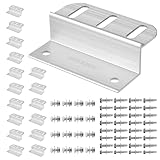
- Durable & Wind-Resistant Build: Crafted from corrosion-resistant aluminum alloy, these heavy-duty Z brackets provide long-lasting, stable performance and withstand high winds for outdoor solar installations.
- Adjustable Multi-Slot Design: The multi-slot structure allows flexible positioning and precise alignment during installation, making setup straightforward and hassle-free.
- Complete 16-Pack Kit with All Hardware: Includes 16 Z brackets, all necessary mounting hardware, and clear installation guidance for quick, secure mounting right out of the box.
- Versatile Application: Suitable for solar panel installations on RVs, boats, roofs, and off-grid systems, offering universal compatibility for diverse outdoor setups.
- Reliable Hold-Down Performance: Sturdy construction ensures your solar panels stay securely mounted in various conditions, giving you peace of mind for long-term use.
Utility development is driven by land control, transmission or distribution interconnection, engineering, permitting, financing, construction logistics, and long-term operations. Rooftop work is constrained by the building’s roof condition, usable area, structural capacity, electrical service, local permitting, and the owner’s load profile. A lower utility-scale price per watt does not automatically mean it is the cheaper choice for a particular building.
Is utility-scale solar cheaper than rooftop solar?
On DOE’s Q1 2025 modeled benchmark basis, yes: the representative utility-scale system has the lower installed PV price per DC watt. The benchmark is expressed in 2024 U.S. dollars and excludes subsidies payable to the system owner.
Quick wins for a faster PC:
Repair Windows errors before they cause bigger problemsFix Now →Fix the driver behind crashes, sound loss and screen glitchesFind Drivers →| Benchmark item | Utility-scale PV | Residential rooftop PV |
|---|---|---|
| Representative array | 100 MWdc, one-axis tracking | 8 kWdc, fixed south-facing roof |
| Representative AC rating | About 76 MWac (the detailed model is 75.8 MWac) | 7 kWac |
| Minimum sustainable price | $1.71/Wdc | $4.33/Wdc |
| Modeled market price | $1.81/Wdc | $4.59/Wdc |
| Dollar basis | 2024 U.S. dollars; DOE modeled benchmark, not a project bid | |
| Owner subsidies | Excluded from the benchmark | |
The modeled market-price difference is $2.78 per DC watt. Applying the benchmark arithmetically to the representative sizes gives approximately $181 million for 100 MWdc at $1.81/Wdc and $36,720 for 8 kWdc at $4.59/Wdc. These are scale-model calculations, not quotes for a specific farm or home. Actual prices change with labor, equipment, site conditions, roof work, interconnection, procurement timing, financing, taxes, and the cost boundary used by the estimator.
Why the per-watt gap exists
Large projects spread design, procurement, mobilization, controls, and construction overhead across far more capacity. They can purchase modules, inverters, racking, and electrical equipment in volume and use specialized installation crews. A residence has a small array, more labor per watt, customer-specific design, roof access and safety requirements, electrical upgrades, inspection, and sales or project-management costs that do not scale down proportionally.
Those advantages do not remove utility-specific costs. A farm may require land acquisition or leases, geotechnical work, roads, drainage, fencing, security, collector systems, a substation, transmission upgrades, environmental studies, and years of development before construction. A rooftop owner may avoid a separate solar site and can use existing electrical infrastructure, but may need roof replacement, structural reinforcement, or service-panel work.
PV-only and storage-inclusive numbers must not be mixed
DOE’s benchmark also lists representative PV-plus-storage configurations: 100 MWdc of utility PV paired with 240 MWh of storage, and 8 kWdc of residential PV paired with 13.5 kWh of storage. The published minimum sustainable and modeled market headline values for those configurations are $1.71/$1.81 per Wdc for utility and $4.33/$4.59 per Wdc for residential, the same headline figures shown in DOE’s no-storage comparison. That coincidence does not prove that a battery is included in every PV-only number. When preparing a budget, identify whether the table is PV-only or PV-plus-storage, the storage energy rating, and whether storage costs are allocated to the PV watt denominator.
Outdated Drivers Are Slowing You Down
One free scan finds every outdated or missing driver and matches the right update for your exact hardware.Free scan · exact hardware matchWindows Errors? Fix Them Before They Spread
Repair common Windows errors and clear accumulated junk for a smoother, more stable PC - no reinstall needed.Free scan · no reinstallRank #2

- Reliable & Multi-Functional: Torsion-resistant and corrosion-resistant, these solar panel mounting brackets provide high stability and precise manufacturing, making them ideal for secure attachment of photovoltaic and solar modules. The tilt angle can be adjusted from 0-90° without tools
- Sturdy & Versatile: Crafted from high-strength aluminum rails and sold in packs of 4, our solar panel mounting kit ensures fast, easy, and secure installation for balcony power plants, mini PV systems, and off-grid solar setups
- Wide Application Range: The 45 inch long solar panel mounting rails are suitable for modules up to approximately 115 cm and 100-400 watts. Panels can be attached horizontally or vertically, and for solar panels, two can be installed horizontally
- Universal Use: Quickly and easily mount your PV or solar system on flat roofs, garage roofs, balconies, balcony railings, walls, facades, boats, campers, and caravans. They can also be placed on the ground in gardens, balconies, and terraces
- Package Includes: 8 x 1140mm/45in Aluminum Mounting Rails, 4 x rails for angle adjustment, 12 x knurled screws and wing nuts, 8 x M6 hex screws and nuts, 12 x self-tapping screws
What the benchmark does not tell you
- It is not a levelized cost of electricity (LCOE), retail bill-savings estimate, payback period, or homeowner contract price.
- It does not establish that every utility project costs a fixed multiple less than every rooftop installation.
- It does not include owner subsidies, so a project’s after-incentive economics may differ.
- It does not resolve the value of exported electricity, demand charges, capacity payments, renewable-energy certificates, or tax treatment.
- It does not make a DC-watt price directly comparable with an AC-watt price or an annual-dollar energy cost.
Which produces more electricity: a solar farm or rooftop panels?
There is no honest universal answer based only on the words “farm” and “rooftop.” A utility plant is usually much larger, so it produces more total kilowatt-hours. Output per installed watt depends on solar resource, array orientation, tilt, tracking, shading, inverter loading, losses, curtailment, availability, and degradation. A well-oriented, unshaded roof can perform strongly; a shaded or poorly oriented roof can perform poorly. A utility plant’s tracking and site selection can raise production, but its result still varies by region and design.
What the 2025 utility model reports
The National Laboratory of the Rockies’ 2025 Annual Technology Baseline (ATB) models a 100 MWdc/75.8 MWac utility system using single-axis tracking. Its modeled 2023 first-year AC capacity factors range from 19.4% to 31.5% across U.S. solar-resource classes. Capacity factor is average generation relative to operating continuously at the rated capacity; it is not the percentage of daylight hours when panels are producing.
The ATB’s baseline annual-average calculation includes 0.7% annual degradation. The resource-class range is therefore a modeled performance envelope for the stated system and assumptions, not a forecast for every operating plant. Solar resource, tracker behavior, inverter loading ratio, module and inverter losses, availability, clipping, weather, and curtailment can move actual results outside a simple expectation based on the range.
Why DC and AC production figures differ
Modules are rated under DC conditions. Inverters convert that output to AC, and the plant may intentionally install more DC module capacity than inverter capacity. The ATB utility example uses 100 MWdc and 75.8 MWac; its cost methodology uses an inverter loading ratio to translate between those ratings. Comparing a rooftop’s annual kWh per kWdc with a farm’s kWh per MWac can make one option appear better simply because the denominators differ.
The Tool Desk
Outbyte PC Repair FREEClear out junk files and repair common Windows errorsFree Scan →Outbyte Driver Updater FREEFix the driver behind crashes, sound loss and screen glitchesFind Drivers →What can be said about rooftop output
Rooftop production depends on the building’s latitude and weather, roof azimuth and tilt, usable area, obstructions, module efficiency, inverter configuration, wiring and other system losses, snow or soiling, and the owner’s maintenance practices. DOE’s representative residential design is a fixed, south-facing roof installation using roof mounts, rails, clamps, and microinverters. That model is an archetype, not a description of every house.
The retrieved ATB material for commercial PV describes modeling by location, azimuth, tilt, and resource data, but commercial rooftop modeling is not a direct substitute for a residential estimate. A commercial roof may have different scale, equipment, operating voltage, shading, and maintenance assumptions. Do not publish a single rooftop-versus-farm annual-kWh ratio from the benchmark values alone.
Rank #3

- 【SUPERIOR QUALITY】 Anodized Aluminum Z brackets, Stainless Steel Hex Bolts and Screws, service life up to 25 years, perfectly supporting solar panels in off-grid installations.
- 【MULTIPLE APPLICABILITY】 Z Brackets are ideally designed to install single solar panels from 50w~150w on RVs, Trailers, Boats, Motorhome,Yachts, Wall, Cabins, Sheds, Garages and Other Off Gird Roofs.
- 【EACH SET CONTAINS】 16 units per set, each set includes 16pcs Z brackets, 16pcs Bolts, 16pcs Flange Nuts, 32pcs Self-Tapping screws.
- 【HIGH PERFORMANCE】 Light weight in quality construction, rust free and excellent corrosion resistance performance. We ensure our Z brackets performs well in all weather conditions!.
- 【CONSIDERATE AFTER-SALES SERVICE】 If you have any questions about product itself or about installation, please feel free to contact with us, we will have our professional technical team to help.
How to make a fair output comparison
- Match the location. Use the same weather or solar-resource data for the roof and the proposed farm, or clearly explain why locations differ.
- State the array design. Record fixed or tracking mounting, tilt, azimuth, module technology, inverter type, and any planned storage or clipping.
- Use one capacity basis at a time. Compare kWh/kWdc with kWh/kWdc, or kWh/kWac with kWh/kWac. Show both ratings when the system has a DC-to-AC ratio.
- Include physical losses. Account for shading, temperature, wiring, inverter, mismatch, availability, curtailment, and soiling assumptions.
- State the year and degradation treatment. A first-year estimate is not the same as a year-20 estimate; the ATB baseline uses 0.7% annual degradation.
- Separate generation from value. Annual kWh does not by itself determine bill savings, wholesale revenue, demand-charge reduction, or payback.
How much land does each option use?
Rooftop solar occupies part of an existing building roof. A utility farm requires a dedicated ground site, although the amount that is unavailable for other uses depends on how the boundary is measured. “Land use” is therefore not one number.
| Land question | Utility-scale PV | Residential rooftop PV |
|---|---|---|
| Primary surface | Ground-mounted arrays and associated infrastructure | Existing roof surface on a building |
| Separate solar site required? | Normally yes | No separate solar-farm parcel; usable roof area is occupied |
| Comparable acreage metric | Can be total site area or direct occupied/disturbed area | No comparable dedicated-ground acreage value was established |
| Main physical constraints | Land availability, slope, drainage, access, setbacks, environmental limits, and interconnection | Roof condition, structural capacity, orientation, shading, access, fire setbacks, and electrical service |
Historical utility land figures
A National Renewable Energy Laboratory analysis published in 2013 reviewed U.S. projects representing 72% of installed and under-construction utility PV and concentrating solar power capacity as of the third quarter of 2012. For large PV projects above 20 MW, the capacity-weighted averages were 7.9 acres per MWac of total site area and 7.2 acres per MWac of direct area.
Total area means all land inside the project boundary. Direct area means land occupied by arrays, roads, substations, service buildings, and other infrastructure. The difference matters: a fenced parcel may include spacing, setbacks, drainage areas, buffers, and other land that is inside the boundary but not directly covered by equipment.
These figures are historical observed averages, not a current siting rule. Tracker geometry, module efficiency, row spacing, terrain, stormwater requirements, vegetation management, wildlife protections, local setbacks, and development practices have changed. A current project should use a site-specific layout and disclose whether its acreage is total, direct, leased, fenced, or otherwise defined.
What rooftop land use really means
Rooftop PV does not require a new ground parcel for the array, but it does use roof area. The usable portion can be much smaller than the roof’s gross plan area because of parapets, HVAC equipment, vents, skylights, roof edges, fire access paths, structural zones, shading, and required setbacks. Roof age also matters: installing panels shortly before a replacement can create removal and reinstallation costs.
DOE’s representative residential design uses roof mounts, rails, clamps, and microinverters on a fixed south-facing roof. Actual hardware and layout must match the module, roof covering, structural attachment, wind and snow loads, electrical design, fire code, and permitting requirements. A generic mounting kit cannot establish compatibility with a particular building.
What’s actually slowing this PC down?
Pick the symptom - the matching free tool is one click away.
Rank #4

- Robustness: The ECO-WORTHY Z solar panel mounting brackets are made of aluminum alloy bracket and stainless steel M6 screws, which are strong enough to support any size solar panel
- Easy Installation: Maintenance-free and easy to install, includes all the parts needed to mount the solar panels on the roof/wall,solar cables can be easily threaded into the back of the panels, just loosen the screws and the solar panels can be easily removed from the brackets
- Waterproof: Installation can be used properly even on uneven surfaces; The panel can be lifted 20 mm off the roof on rainy days to prevent water leakage
- Multiple Adaptability: Widely used for the installation of flat roofs, RVs, boat decks, and camping houses
Land trade-offs beyond acreage
- Existing surface versus new disturbance: A roof can add generation without converting an undeveloped parcel, while a farm may occupy land that has competing agricultural, ecological, recreational, or development value.
- Access and maintenance: Ground plants need internal roads, equipment access, vegetation control, security, and drainage planning. Roof systems need safe roof access and periodic electrical and attachment inspections.
- Future flexibility: A roof installation can affect reroofing, future additions, skylights, and mechanical equipment. A ground site can reserve expansion areas but may face interconnection or land-boundary limits.
- Site boundary transparency: Two projects can report different acres per MW while both are accurate if one uses total fenced acreage and the other uses direct array and infrastructure area.
Cost, output, and land: an apples-to-apples checklist
Before comparing a developer proposal with a rooftop proposal, place the following items on the same worksheet.
| Item | Questions to answer |
|---|---|
| Capacity | Is the rating DC or AC? What is the DC-to-AC inverter loading ratio? |
| System boundary | Does the price include modules, inverters, racking, collection equipment, substation, interconnection, engineering, permitting, construction, commissioning, and owner costs? |
| Storage | Is the comparison PV-only or does it include batteries? If storage is included, what is its MW power and MWh energy rating? |
| Price basis | Are dollars nominal or inflation-adjusted? Are subsidies excluded? Is the value a modeled benchmark, an estimate, or a signed bid? |
| Generation | What location, weather year, orientation, tracking mode, loss assumptions, degradation rate, availability, and curtailment assumptions were used? |
| Land | Does acreage mean total site boundary, directly occupied area, fenced area, or only the array field? |
| Value | Are you evaluating installed price, LCOE, avoided retail purchases, export revenue, demand reduction, resilience, or another objective? |
NLR notes that published capital expenditure can vary with the cost boundary and whether capacity is expressed on a DC or AC basis. Two apparently conflicting prices may be measuring different boundaries rather than disagreeing about the equipment itself.
What a utility-scale project requires
Early site and grid work
Developers first screen solar resource, topography, drainage, geotechnical conditions, environmental constraints, land rights, setbacks, access, and proximity to a viable interconnection point. A favorable solar resource is not enough if the grid connection is constrained or the site cannot accommodate roads, drainage, collector circuits, setbacks, and equipment.
Design and construction
Engineering establishes pile or foundation design, tracker rows, module layout, DC collection, inverters, medium-voltage collection, substation equipment, communications, grounding, fencing, stormwater controls, and operations access. Construction sequencing must coordinate civil work, deliveries, electrical installation, testing, and utility requirements. The 100 MWdc benchmark is a standardized archetype; a real plant may use a different module count, tracker arrangement, inverter block size, or AC export limit.
Recommended Free Tools
Operations and long-term performance
Operations include vegetation and site maintenance, tracker and inverter service, module cleaning where justified, security, inspections, spare parts, monitoring, and corrective work. Generation forecasts should show degradation and availability assumptions rather than treating the nameplate rating as constant annual output.
Independent reader supportYour contribution helps us test, update, and keep practical guides available for everyone.What a rooftop project requires
Building assessment
An installer or engineer should verify roof age and warranty, structural capacity, attachment zones, wind and snow loads, shading, fire access, electrical service, meter configuration, and the owner’s load profile. If the roof is near replacement, coordinate panel removal and reinstallation costs before signing a contract.
Best Value

- 𝐀𝐧𝐨𝐝𝐢𝐳𝐢𝐧𝐠 𝐏𝐫𝐨𝐜𝐞𝐬𝐬: Rvpozwer solar panel bracket adopts the most advanced anodizing process, which significantly improves corrosion and abrasion resistance and enhances surface hardness. And it is more environmentally friendly and does not produce harmful substances.
- 𝐄𝐚𝐬𝐲 𝐈𝐧𝐬𝐭𝐚𝐥𝐥𝐚𝐭𝐢𝐨𝐧:This solar panel mount bracket supports both horizontal and vertical installation. It features precision pre-drilled holes and includes practical accessories such as M8 knob screws and M8 wing nuts... Ensuring a quick and easy installation process.You don't even need additional tools that. You can install this solar panel mount with your bare hands.
- 𝐌𝐮𝐥𝐭𝐢𝐩𝐥𝐞 𝐀𝐩𝐩𝐥𝐢𝐜𝐚𝐭𝐢𝐨𝐧 𝐒𝐜𝐞𝐧𝐚𝐫𝐢𝐨𝐬:Our solar panel mounting kits are perfect for a variety of off-grid systems including RVs, boats, motorhomes, sheds, ground level and open space. All scenarios this portable solar panel mount can be applied and remain stable.
- 𝐅𝐥𝐞𝐱𝐢𝐛𝐥𝐞 𝐀𝐝𝐣𝐮𝐬𝐭𝐦𝐞𝐧𝐭:Solar panel mounts with 0-90° adjustable angles make it easy to set solar panels in the optimal position to maximize sunlight exposure and improve overall energy efficiency.
- 𝐎𝐮𝐭𝐬𝐭𝐚𝐧𝐝𝐢𝐧𝐠 𝐋𝐨𝐚𝐝-𝐁𝐞𝐚𝐫𝐢𝐧𝐠 𝐂𝐚𝐩𝐚𝐜𝐢𝐭𝐲: The new multi-layer aluminum-faced solar panel tilt mounting bracket can support the weight of an adult male (120KG/264LB).
System design
The design should state module DC capacity, inverter AC capacity, orientation, tilt, shading losses, expected annual generation, monitoring, rapid-shutdown equipment, attachment method, and any service-panel or transformer work. The DOE representative residential design uses fixed south-facing modules and microinverters, but a real roof may require a different orientation or inverter architecture.
Construction and commissioning
Roof work must protect the membrane or shingles, preserve drainage, maintain required fire pathways, and coordinate electrical inspections. Commissioning should verify polarity, grounding, inverter operation, monitoring, labeling, and utility permission to operate. The owner should receive as-built drawings, equipment records, warranty documents, and a maintenance plan.
Common comparison mistakes and how to correct them
- Using a utility AC capacity against a rooftop DC capacity. Correct it by showing both ratings and comparing like denominators.
- Calling a modeled benchmark a quote. Label DOE’s values as a 2025Q1 modeled benchmark in 2024 dollars and obtain project-specific bids for decisions.
- Turning $/W into electricity cost. Installed price per watt is not LCOE, bill savings, or payback. Add production, financing, operating costs, tariff treatment, and project life for those analyses.
- Assuming the utility range predicts every farm. The 19.4%–31.5% ATB capacity factors are modeled 2023 first-year values by resource class for a specified tracking design.
- Publishing one rooftop output ratio. Replace it with a matched-location model that states orientation, shading, losses, DC/AC basis, and degradation.
- Quoting 7.9 acres/MWac as a permanent rule. Identify it as the NREL 2013 historical average for large PV projects above 20 MW and define total site area.
- Treating rooftop solar as land-free. It avoids a separate ground parcel but occupies usable roof area and can affect reroofing, access, structure, and fire clearances.
- Comparing PV-only with storage-inclusive pricing. Name the configuration and storage rating; do not infer battery inclusion from identical headline values.
- Ignoring cost boundaries. Check whether interconnection, owner development costs, site civil work, taxes, financing, and contingency are included.
Which option fits which decision?
Choose rooftop first when the objective is building-level supply
Rooftop solar is the natural starting point when a building owner controls a suitable roof, wants to offset on-site consumption, and can accept the roof’s orientation, shading, structural, and electrical constraints. The analysis should focus on the property’s load, tariff, roof life, usable area, and an installer’s site-specific generation and price proposal.
Choose utility-scale development when the objective is bulk grid supply
Utility-scale PV fits a procurement or development decision involving large electricity volumes, available land, transmission or distribution interconnection, and a project team able to manage permitting, construction, financing, and long-term operations. The relevant questions include deliverable AC capacity, interconnection limits, contracted energy value, curtailment, site boundary, and total project cost.
Use a portfolio approach when neither option solves the whole problem
A company may combine rooftop generation at facilities with contracted utility-scale power for additional volume. In that case, evaluate each resource using its own correct cost, capacity, land, and production definitions, then compare the combined portfolio against the organization’s energy, resilience, emissions, and budget objectives.
Bottom line for builders and property owners
Utility-scale PV is cheaper per installed DC watt in DOE’s Q1 2025 modeled U.S. benchmark, but the systems are radically different in size and delivery context. A utility plant’s modeled first-year AC capacity factor ranges from 19.4% to 31.5% by U.S. resource class in the 2025 ATB, while rooftop output must be calculated for the actual building. Rooftops use existing roof surfaces; large ground-mounted projects require a defined site boundary, with the historical NREL average for projects above 20 MW reported as 7.9 acres/MWac total area and 7.2 acres/MWac direct area. The reliable comparison is therefore not a single winner: it is a like-for-like worksheet that states DC versus AC, PV-only versus storage, modeled versus quoted cost, matched output assumptions, and total-site versus direct land area.
Quick Recap
Product prices and availability are accurate as of the date/time indicated and are subject to change. Any price and availability information displayed on Amazon at the time of purchase will apply.

