What’s actually slowing this PC down?
Pick the symptom - the matching free tool is one click away.
Wood grain is the direction of the wood’s fibers. That direction affects how a board looks, how strong it is, how much it moves with moisture, and how easily it can be cut or planed without tearout.
For construction and woodworking, the most useful approach is to read the grain in three ways: inspect the board’s end grain, trace the fibers along each face and edge, and consider how the selected grain will behave in the finished part. Attractive figure is valuable for appearance, but straight, continuous fiber is usually more important for load-bearing components, handles, legs, rails, and other narrow structural parts.
As an Amazon Associate I earn from qualifying purchases.
What wood grain actually means
Technically, grain is the orientation of wood-cell fibers. The fibers are primarily aligned along the tree’s length, but their direction can vary because of growth patterns, branches, reaction wood, and the way the log was sawn.
Recommended Free Tools
Several terms are often used interchangeably even though they describe different things:
#1 Best Overall

- Various Patterns: Can be used to simulate a variety of different wood patterns, including cathedral oak, pine & cedar
- Easy to Use: After applying a glaze or stain to a dry base coat, for example, drag the teeth of the comb tool over the surface, then go back over the surface with the curved tool, dragging it and occasionally rocking it to create the appearance of knots
- Suitable for any Flat Surface: Makes it easy to elevate the appearance of furniture, cabinets, craft projects, and more
- Triangular Comb: Gives you more control over the wood grain effect; each side lets you create different patterns
- Reusable: These tools can be washed and reused for multiple projects
- Grain direction: the direction in which the fibers run.
- Figure: the visible pattern produced by grain direction, growth irregularities, sawing, rays, knots, and other anatomical features.
- Texture: the apparent or tactile coarseness created by the size and distribution of pores, cells, rays, and other surface structures.
- End grain: the cut ends of the fibers, where growth rings and the board’s sawing orientation are often easiest to inspect.
- Face or long grain: the broad or narrow longitudinal surfaces of a board.
A board may have dramatic figure without having favorable structural grain. Conversely, a relatively plain-looking board may contain exceptionally straight, strong, and easy-to-machine fibers.
How to read a board before using it
Start with the end grain rather than judging the board from its face alone. Look for the direction of the growth rings, then compare that angle with the visible pattern on the board’s face.
- Inspect the end grain. Identify the approximate angle of the growth rings relative to the board’s face.
- Compare the face pattern. Arcing or cathedral-shaped patterns commonly indicate a flatsawn or plainsawn board. Straighter, more uniform lines often indicate quartersawn or riftsawn material.
- Trace the fibers. Follow the grain on both faces, the edges, and around knots or areas of figure. The direction can change abruptly within a short distance.
- Look for defects. Check for knots, checks, splits, twist, local slope of grain, reaction wood, and damaged edges.
- Consider the finished part. A board suitable for a decorative panel may be unsuitable for a load-bearing leg or handle.
Labels such as “quartersawn” and “riftsawn” are useful, but commercial terminology is not perfectly consistent. The visible growth-ring angle and the board’s actual behavior matter more than the label by itself.
Free tools Windows power users keep installed
One-click scans. No signup required.
Flatsawn, quartersawn, and riftsawn lumber
Flatsawn or plainsawn wood
Flatsawn boards are cut with the growth rings more nearly parallel to the board’s face. This method commonly produces wide boards and prominent cathedral-shaped patterns.
Flatsawn material is often chosen for panels, cabinet parts, and furniture where a broad, expressive pattern is desirable. It is also frequently more economical and efficient to produce. The trade-off is that flatsawn boards generally experience more width movement than quartersawn stock because tangential movement is greater than radial movement.
Flatsawn is not automatically inferior. It can be an excellent choice when the appearance is wanted and the design allows for seasonal movement.
Quartersawn wood
True quartersawing begins by dividing the log into quarters and cutting boards so the growth rings are approximately perpendicular to the face. Quartersawn boards usually show straighter, more uniform grain and generally offer improved dimensional stability across their width.
In species with prominent rays, especially oak, quartersawn cuts can expose a conspicuous fleck or ray figure. This visual effect is one reason quartersawn oak is associated with traditional furniture and architectural woodwork.
Quartersawn lumber requires additional handling and often creates more waste than flatsawn lumber, so it is commonly more expensive. It is also not movement-proof. It still expands and contracts as its moisture content changes; it simply tends to move less across the width than comparable flatsawn stock.
Riftsawn wood
Riftsawn boards generally have growth rings at an intermediate angle, often near 45 degrees to the face. The result can be a relatively straight appearance on multiple faces of square stock, making it useful for legs, rails, stiles, and other parts where consistent grain on all sides is valuable.
Rank #2

- 【SET OF 5 WOOD GRAIN TOOL】Our wood graining painting tool set contains 5 different types of rollers. Specially designed for decorative wood grain applications. Transform plain surfaces into realistic wood-inspired masterpieces effortlessly and efficiently
- 【FINE WOOD GRAIN PATTERN】 The clear fine lines on the Wood Grain Roller Tool allow you to draw a variety of beautiful wood grain patterns revealing a unique and realistic wood grain effect for walls and floors.
- 【LONG-LASTING PERFORMANCE】Enhance your DIY projects with the wood grain tool, a must-have for achieving authentic wood textures effortlessly. Made of premium rubber, this durable tool ensures long-lasting performance in wood graining applications
- 【WIDE APPLICATIONS】You can use the rubber wood grain roller to decorate your wall, floor, furniture, fence, deck and other places. DIY wood grain decoration with it will be more convenient and quick, makes your wall look brand fresh. Suitable for textured and water-based paints
- 【SOFT DURABLE MATERIAL】The DIY wood grain tools are made of rubber which has good elasticity but non-deforming, safe and odorless, wear-resistant and long service life. The soft material will not damage the surface you want to paint, but also protects you not be injured by tools
Riftsawn material can approach the stability of quartersawn material while producing less prominent ray figure. In commercial practice, “riftsawn” may describe the resulting ring angle even when the log was not cut using a dedicated riftsawing sequence.
Common grain directions and figures
Straight grain
Straight grain follows the long axis of the board. It is generally the easiest grain to machine and is often the preferred choice for structural parts, handles, legs, rails, and narrow members where continuous fiber is important.
Cross grain
Cross grain occurs when fibers deviate from the board’s long axis or from its edges. Spiral and diagonal grain are important forms of cross grain. Wavy, dipped, interlocked, and curly grain can also create machining and strength concerns.
Cross grain is not always obvious. A board may appear straight on its face while its fibers slope substantially through the thickness or change direction around a knot. For structural work, do not rely on surface appearance alone.
Curly grain
Curly grain creates alternating light and dark bands or a rippled appearance. It can be visually striking, but the fibers may rise and fall across the surface, making the board prone to tearout during planing, routing, or jointing.
The Tool Desk
Outbyte Driver Updater FREEScan for outdated or missing drivers - takes under a minuteDriver Scan →Outbyte PC Repair FREEClear out junk files and repair common Windows errorsFree Scan →Quilted or wavy figure
Quilted and wavy figure can produce a three-dimensional-looking surface whose appearance changes as the viewing angle changes. The grain may change direction repeatedly, so ordinary “cut with the grain” guidance may not be enough to prevent tearout.
Interlocked grain
In interlocked wood, the fibers alternate direction as the tree grows. Quartersawn surfaces may reveal ribbon-stripe effects, but the changing fiber direction can make machining difficult. Interlocked grain is a common reason a cutter produces clean results in one area and severe tearout only a few inches later.
Crotch, feather, and burl figure
Crotch or feather figure forms near major branches or forks, where the fibers become irregular. Burl figure is associated with abnormal growth and highly distorted grain. Both can produce valuable decorative patterns, but neither should be assumed to provide superior strength.
Ray or fleck figure
Rays are anatomical structures that run across the tree’s growth rings. In suitable species, quartersawn cutting exposes them more clearly and can produce a flecked appearance.
Why grain matters for strength
Wood is anisotropic, meaning its properties differ according to direction. Wood is generally strongest and stiffest along the fibers and weaker across them. Grain slope reduces mechanical performance, and localized cross grain can be difficult to detect visually.
Rank #3

- Compatible with 10+ Compact Router Models: Direct bolt-on fit for Makita RT0701C, Makita 3709, DeWalt DWP611, Bosch PR20EVS Colt, Milwaukee 18V Router, RYOBI PCL424, RIDGID R2401, WORKPRO 6.5 Amp, AVID POWER 6.5 Amp 1.25HP, and THINKWORK 6.5 Amp 1.2HP. No adapter or drilling required—the base plate uses your router's existing mounting holes for a stable, aligned setup.
- Cuts Circles from 5.5" to 30": The adjustable radius guide creates accurate circles and arcs for speaker boxes, tabletops, cabinet cutouts, signs, and trim work. Pair it with a compatible positioner for grooving and straight-line routing, expanding the jig beyond circle cutting.
- Quick Setup & Easy Portability: Designed for quick installation and removal on compatible compact trim routers. Align the base plate, tighten the screws, set your cutting radius, and you're ready to route. Its lightweight, detachable design makes it easy to store or carry from the workshop to the job site.
- One-Piece Die-Cast Aluminum Construction: The rigid aluminum body helps minimize flex while routing, keeping the router on the intended radius for cleaner edges and more consistent circle diameters.
- Check Compatibility Before Ordering: If your router is listed above, it is designed for direct mounting. For other models, confirm that the diagonal mounting-hole spacing on your router base is between 2.36" and 3.94" (6–10 cm) before ordering.
A knot or branch can disturb fiber direction around it even if the visible knot is later cut away. This matters when choosing material for:
- load-bearing framing or built-in components;
- tool handles and other impact-prone parts;
- legs, rails, stiles, and narrow structural members;
- cleats, brackets, and other parts relying on screw or fastener holding;
- long parts that may split along a sloping grain line.
For these uses, favor straight grain that runs continuously along the part. Avoid severe diagonal grain, large knots, checks, splits, and abrupt changes in fiber direction.
Important: attractive figure is not evidence of structural quality. A highly figured board may contain slope of grain, reaction wood, juvenile wood, knots, or other conditions that affect strength and machining.
Wood grain and movement
Wood exchanges moisture with the surrounding air. Below the fiber-saturation range, changes in moisture content cause the cell walls to gain or lose bound water, producing dimensional change.
Movement is not equal in every direction:
- Tangential movement—generally around the growth rings—is usually the greatest.
- Radial movement—across the growth rings—is generally about half as great as tangential movement.
- Longitudinal movement—along the grain—is comparatively small in ordinary clear wood.
Because flatsawn boards expose more tangential movement across their width, they commonly cup or change width more than quartersawn boards. Quartersawn lumber reduces this tendency but does not eliminate it. Reaction wood and juvenile wood can behave differently from ordinary clear wood.
Unequal movement can cause cupping, bowing, checking, splitting, open joints, cracked finishes, and stress around rigid fasteners. A wide solid-wood panel attached across its grain to a rigid base must have a fastening or joinery method that allows seasonal expansion and contraction. Screwing or gluing every point across the panel can restrict movement and cause failure.
Finishes do not stop wood movement. They can slow moisture exchange, and a balanced finish on all sides may help reduce uneven moisture uptake, but the wood will still respond to changes in its environment.
Windows Errors? Fix Them Before They Spread
Repair common Windows errors and clear accumulated junk for a smoother, more stable PC - no reinstall needed.Free scan · no reinstallCrashes, No Sound, or Screen Glitches?
Random freezes, missing sound and display glitches usually trace back to one bad driver. Find and replace yours safely.Free scan · under a minuteMoisture content and acclimation
Wood reaches an equilibrium moisture content when its moisture level balances with the surrounding temperature and relative humidity. There is no single correct moisture percentage for every project or location.
For many indoor woodworking situations, a practical rule of thumb is approximately 6–11% moisture content, but that range is not a guarantee. The appropriate target depends on the building’s climate, interior conditions, project location, season, and expected service environment.
Before milling or installation:
- Store the boards in the environment where they will be used whenever practical.
- Stack them with spacers so air can circulate around the faces.
- Keep them supported and protected from direct water, sun, and rapid temperature changes.
- Measure multiple locations rather than trusting one reading from one board.
- Allow the readings to stabilize before final sizing or assembly.
A wood moisture meter can help compare boards and identify variation before milling, installation, or finishing. Pin meters penetrate the wood and leave small holes; pinless meters scan beneath the surface without puncturing it. Readings depend on species, temperature, meter type, surface condition, measurement orientation, and the instrument’s calibration. Use the meter according to its species and depth instructions rather than treating the displayed number as absolute.
Machining with the grain
The basic machining rule is to cut with the grain wherever possible. A useful comparison is stroking fur in the direction it lies: moving against it tends to lift fibers. On a planer, jointer, router, or hand plane, the cutter should support and slice the fibers rather than pry them upward.
Rank #4
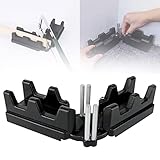
- 🔧 2-IN-1 MEASURING & CUTTING TOOL – Combines angle measurement and cutting in a single device. Eliminates the need for multiple tools and avoids errors when transferring angles to the saw. A must-have for efficient woodworking.
- 📐 PRECISE ANGLE MEASUREMENT – Features 2 moving arms that measure angles from 85° to 180°. The intuitive design ensures accurate readings for both inside and outside corners, making it ideal for crown molding, baseboards, and trim work.
- 📏ACCURATE CUTTING WITH INTEGRATED GUIDE – Includes a built-in guide pin for the saw. Place your baseboard on the guide plate and saw with precision for error-free miter cuts. Achieve professional results on every project.
- 🔩 DURABLE & CORROSION-RESISTANT MATERIAL – Crafted from a robust blend of ABS, PC, and stainless steel. Built to last for years in home workshops and job sites, resisting wear and corrosion.
- 🛠️ VERSATILE TOOL FOR MULTIPLE APPLICATIONS – Perfect for carpentry, home improvement, pipeline installation, and DIY projects. Solves the problem of cutting corners in skirtings, recesses, and other challenging angles. Practical tool that makes any woodworking project easier.
Start with the following controls:
- Use sharp cutters and properly adjusted blades.
- Take light cuts, especially near knots, end grain, and areas where the grain changes direction.
- Control the feed rate instead of forcing the stock through the machine.
- Support fibers at exit points with sacrificial stock.
- Test the setup on an offcut from the same board.
- Inspect the surface under raking light before proceeding to the next operation.
Reducing tearout in figured or interlocked wood
Highly figured grain can reverse direction within a few inches. When conventional cutting produces tearout, try reducing the depth of cut, increasing the effective cutting angle, or using a shear cut. A sharp hand plane with a suitable blade setup can provide more control than a heavy power cut.
On board ends, routing the end grain first can help because a later long-grain cut may remove breakout at the corner. Sacrificial backing is also useful when a cutter is likely to break out the exit fibers.
Climb cuts can reduce localized tearout, but they also increase the risk of losing control because the cutter can pull the tool forward. Use them only when the operation is understood, the work is secure, and the cut is extremely small. They are not a substitute for safe machine technique.
For final leveling of difficult figure, a card scraper or cabinet scraper can take thin curls without aggressively lifting the fibers. Scraping is most useful after the surface is reasonably flat; it is not a replacement for rough milling or flattening.
Quick wins for a faster PC:
Scan for outdated or missing drivers - takes under a minuteDriver Scan →Clear out junk files and repair common Windows errorsFree Scan →A scraping plane is a more specialized option for intermediate or advanced woodworkers working with figured and interlocked surfaces. It is intended for controlled, thin shavings after the stock is substantially flattened, not for removing large amounts of material.
Independent reader supportYour contribution helps us test, update, and keep practical guides available for everyone.Choosing grain for different construction and woodworking projects
| Project part | Useful grain choice | What to prioritize |
|---|---|---|
| Wide raised panel | Flatsawn or compatible bookmatched stock | Broad figure, visual symmetry, and a joinery plan that permits movement |
| Rails, stiles, and legs | Straight or riftsawn grain | Continuous fibers, consistent appearance, and limited cross grain |
| Wide tabletop | Dry, stable flatsawn, riftsawn, or quartersawn stock | Moisture condition, board layout, and movement-tolerant attachment |
| Cabinet or drawer fronts | Consistent or deliberately arranged figure | Grain direction, color matching, and intentional placement |
| Bookmatched panel | Consecutive or compatible boards | Thickness, color, ring orientation, and a mirrored pattern that reads as intentional |
| Handle or structural part | Straight grain running along the part | Fiber continuity and avoidance of severe slope, knots, and splits |
| Highly figured feature board | Curly, quilted, crotch, burl, or interlocked figure | Extra material for test cuts and additional hand-finishing |
Grain and finishing
Surface preparation must account for both grain direction and pore structure. Plane marks, torn fibers, and uneven figure may become more visible after finish is applied, so inspect the surface carefully before coating it. Raking light is useful for revealing shallow defects. Wiping the surface with an appropriate temporary solvent may also reveal unevenness or highlight figure, but it must be compatible with the wood, work area, safety requirements, and intended finish system.
Open-pored hardwoods may benefit from wood grain filler when the desired result is a flat, glass-like surface. Grain filler is optional, not a universal requirement. The appropriate choice depends on the species, pore size, finish schedule, and whether the desired appearance leaves the pores visible.
Filler and finish can change the color and emphasize figure, but neither can correct poor grain selection, deep tearout, inadequate preparation, or movement-related failure.
Do these 3 things before closing this tab:
1Fix the driver behind crashes, sound loss and screen glitches2Clear out junk files and repair common Windows errors3Scan for outdated or missing drivers - takes under a minuteA practical wood-grain inspection workflow
- Identify the species if possible. Pore structure, rays, color, and figure can provide clues, but visual identification alone is not definitive.
- Inspect the end grain. Estimate the growth-ring angle and note whether the board appears primarily flatsawn, riftsawn, or quartersawn.
- Trace the grain on every surface. Mark changes in direction around knots, figure, and areas of suspected cross grain.
- Match the grain to the job. Reserve the straightest, most continuous stock for structural or movement-sensitive parts.
- Check moisture. Compare several boards and several locations on each board using a suitable, correctly calibrated meter.
- Acclimate the lumber. Bring it toward the moisture condition of its intended environment before final sizing.
- Plan for movement. Decide how panels, tabletops, trim, and other wide parts will be fastened while still being allowed to expand and contract.
- Test the machining setup. Use an offcut to establish feed direction, cutter height, depth of cut, and support at exits.
- Mill conservatively. Use sharp tooling, light passes, and slower controlled cuts where the grain reverses.
- Inspect before finishing. Use raking light and correct tearout, plane marks, and unevenness before applying the finish.
Common mistakes to avoid
- Assuming figure equals strength. Decorative irregularity can mean less predictable fiber direction.
- Trusting the board label without checking it. Ring angle and actual grain behavior are more reliable than inconsistent commercial terminology.
- Ignoring end grain. The face pattern alone may hide a movement-prone cut or steep grain slope.
- Expecting quartersawn lumber not to move. It generally reduces width movement but still responds to moisture.
- Fastening wide solid wood rigidly across the grain. The panel needs a movement-tolerant design.
- Using a heavy cut on figured stock. Test first and reduce the cut when the fibers change direction.
- Treating a moisture-meter reading as exact. Species, temperature, calibration, depth, and surface condition affect readings.
- Using filler to hide tearout. Filler may close pores; it does not repair lifted or missing fibers.
Frequently Asked Questions
Is quartersawn wood always better than flatsawn wood?
No. Quartersawn wood generally offers lower width movement and a straighter appearance, but it costs more and is not movement-proof. Flatsawn wood can be the better choice for broad cathedral figure, wide panels, or projects whose design accommodates seasonal movement.
Which grain is best for a structural wood part?
Favor straight, continuous grain running along the part. Avoid severe diagonal or cross grain, large knots, checks, splits, and abrupt changes in fiber direction. Decorative figure should not be used as a substitute for evaluating structural quality.
How can I tell whether a board is quartersawn?
Inspect the end grain and estimate the angle of the growth rings to the face. Quartersawn boards generally have rings close to perpendicular to the face and often show straighter face grain. The label may not be precise, so use the visible ring angle and the board’s actual surfaces as the final guide.
Does finish prevent wood movement?
No. Finish slows moisture exchange but does not stop the wood from expanding and contracting. Wide solid-wood components still need movement-tolerant joinery or fastening.
Free tools Windows power users keep installed
One-click scans. No signup required.
Why does my planer or router tear out the wood?
The cutter may be lifting fibers because it is working against the local grain direction. Grain may reverse around knots or in figured and interlocked wood. Try sharper tooling, lighter cuts, controlled feed, better exit support, a shear cut, or final scraping.
What moisture content should lumber have before indoor installation?
Many indoor woodworking situations fall roughly in the 6–11% range, but the correct target depends on the project’s climate and service conditions. Use that range only as a practical guide, compare multiple readings, and acclimate the lumber to its intended environment.
The Bottom Line
Read the end grain, follow the fibers across every surface, and choose the cut according to the part’s job. Use straight continuous grain for strength, quartersawn or riftsawn stock when reduced width movement is valuable, and flatsawn or figured stock when appearance is the priority and the design accommodates movement. Check moisture, test your machining setup, and remember that neither finish nor attractive figure can compensate for poor grain selection.
Quick Recap
Product prices and availability are accurate as of the date/time indicated and are subject to change. Any price and availability information displayed on Amazon at the time of purchase will apply.
Recommended Free Tools

