There is no single “best” full-range driver. The right choice depends on whether you want a compact desktop speaker, an efficient low-power system, a bass-oriented nearfield design, or a premium cabinet project. For most small point-source builds, the Dayton Audio PS95-8 is the best-balanced starting point. Choose the FaitalPRO 3FE25-8 for sensitivity, the Tang Band W3-2141 for a compact paper-cone design with a lower published resonance, the Markaudio Alpair 5.3 for a specialist premium build, or the Dayton Audio DMA105-4 for an inexpensive 4-inch aluminum-cone project.
A full-range driver is not automatically a complete loudspeaker. Small cones have limited deep-bass output, while larger cones become more directional at treble frequencies. Cabinet design, baffle width, amplifier compatibility, listening distance and a realistic playback level matter as much as the driver’s advertised frequency range.
As an Amazon Associate I earn from qualifying purchases.
Quick comparison
The figures below are manufacturer- or retailer-published specifications. Frequency limits are not necessarily measured to a stated tolerance such as ±3 dB, and sensitivity figures may use different test conventions.
Free tools Windows power users keep installed
One-click scans. No signup required.
| Driver | Best for | Size | Impedance | Published range | Sensitivity | Power rating | Main limitation |
|---|---|---|---|---|---|---|---|
| Dayton Audio PS95-8 | Balanced small point-source speaker | 3.5 in | 8 Ω | 110–20,000 Hz | 85.56 dB at 2.83 V/1 m | 10 W RMS / 20 W maximum | Limited deep-bass and high-SPL capability |
| FaitalPRO 3FE25-8 | Efficient, low-power systems | 3 in | 8 Ω | 100–20,000 Hz | 91 dB | 20 W AES / 40 W maximum | Not a deep-bass specialist |
| Tang Band W3-2141 | Compact paper-cone hi-fi projects | 3 in | 8 Ω | 75–20,000 Hz | 87 dB at 2.83 V/1 m | 25 W RMS / 50 W maximum | Excursion limits bass output |
| Markaudio Alpair 5.3 | Premium specialist wideband builds | 6 cm class | Check current datasheet | Check current datasheet | Check current datasheet | Check current datasheet | Requires a carefully designed cabinet |
| Dayton Audio DMA105-4 | Budget 4-inch aluminum-cone systems | 4 in | 4 Ω | Check current datasheet | Check current datasheet | Check current datasheet | Amplifier and treble response need care |
Retail prices and stock change by country and date. A retrieved U.S. price signal was $29.98 each for the PS95-8 and $42.16 each for the W3-2141; Dayton listed a $25.99 MSRP for the DMA105-4. Treat these as dated reference points, not guaranteed current prices. Buy two drivers for a stereo pair.
#1 Best Overall

- Coated paper cone with foam surround for clear sound
- Pincushion-shape frame with front gasket
- Economical ferrite magnet assembly
- Quality GRS construction and 1-year warranty
What is a full-range speaker driver?
A full-range driver is designed to reproduce most of a speaker’s midrange and treble from one diaphragm, normally without a separate tweeter. That simplicity can produce a coherent point source and eliminates the woofer-to-tweeter crossover, but it involves compromises.
Common designs include conventional single cones, whizzer-cone drivers, phase-plug drivers, balanced-mode radiators and bending-wave drivers. Professional full-range units generally prioritize efficiency and durability, while audiophile wideband drivers often prioritize a carefully controlled response in a dedicated cabinet. A full-range driver can also be used with a subwoofer, a high-pass filter or, in some designs, a supertweeter.
Can one driver really reproduce bass and treble?
Yes, but “full range” does not mean flat 20 Hz–20 kHz output at high volume. A small cone has limited radiating area and excursion, so deep bass quickly becomes excursion-limited. A larger cone moves more air but becomes increasingly directional as frequency rises. The same diaphragm must act like a piston at low frequencies while reproducing treble without excessive breakup.
Published ranges such as 75–20,000 Hz or 100–20,000 Hz do not reveal the response tolerance, enclosure, output level or off-axis behavior. Look for response plots and, where possible, measurements at 15°, 30° and 45° as well as on axis.
1. Dayton Audio PS95-8: best balanced small point-source driver
Best for: desktop speakers, small bookshelf speakers, narrow towers and compact tweeterless projects.
The PS95-8 is a 3.5-inch, 8-ohm driver with a published usable range of 110–20,000 Hz, 85.56 dB sensitivity at 2.83 V/1 m, 10 W RMS handling, 20 W maximum handling and 2.5 mm Xmax. Its paper cone, copper-anodized aluminum phase plug, copper pole cap, rubber surround and cast-aluminum frame make it a practical general-purpose choice. Dayton and Parts Express list approximately 0.04 ft³ sealed and 0.12 ft³ vented starting alignments on the product page: see the current listing.
Rank #2
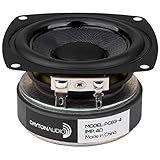
- Copper cap to keep inductance under control and extend high frequency response
- Poly damped woven glass fiber cone controls cone break-up and provides a smooth roll-off
- Smooth response with true full-range reproduction for simple speaker designs
- High energy ferrite magnet increases BL for higher efficiency and more output
- Great for MTM bookshelves, car audio, or line arrays
Its strongest advantage is the amount of accessible design information in a compact format. It is suitable for nearfield listening and moderate-power amplifiers, but its 85.56 dB sensitivity is ordinary rather than high-efficiency. Do not expect large-room, party-level output or deep bass without a subwoofer.
Do these 3 things before closing this tab:
1Scan for outdated or missing drivers - takes under a minute2Clear out junk files and repair common Windows errors3Fix the driver behind crashes, sound loss and screen glitchesEnclosure note: Use Dayton’s volumes only as starting points. Baffle width, stuffing, port tuning and equalization can materially change the result.
2. FaitalPRO 3FE25-8: best for efficiency
Best for: low-powered tube or Class-A amplifiers, battery systems, efficient compact speakers and vocal-focused applications.
The 3FE25-8 is a 3-inch professional full-range driver rated at 91 dB sensitivity, 20 W AES and 40 W maximum, with a published 100–20,000 Hz range. Its listed parameters include Fs 110 Hz, Qts 0.66, Vas 1.3 dm³ and Xmax 1.83 mm. It uses a ferrite magnet, steel basket, Kapton former, aluminum winding, copper cap and EPDM surround. Specifications are available from FaitalPRO and its datasheet.
The published sensitivity is roughly 5 dB higher than the PS95-8, which can significantly reduce amplifier demand. The comparison is not perfectly apples-to-apples because manufacturers may use different averaging and test methods. The driver’s high Qts and modest Xmax do not make it a deep-bass solution, and its 3-inch cone will narrow its treble dispersion as frequency rises.
FaitalPRO also offers 4-ohm and 16-ohm versions with different parameters. Some versions may be packaged in commercial quantities, so confirm the seller’s minimum order before planning a one-pair build.
Rank #3

- Excellent high frequency response for true full-range applications
- Dual neodymium motor to create a symmetrical magnetic field for superb control
- Large copper cap lowers distortion while improving high frequency response
- Remarkably flat full-range response with excellent off axis performance
- Exclusive 8-spoke open frame design provides extensive venting and minimal reflection
3. Tang Band W3-2141: best compact bass-oriented profile
Best for: small vented speakers, nearfield listening and paper-cone hi-fi projects.
The W3-2141 is a 3-inch, 8-ohm paper-cone driver rated at 87 dB at 2.83 V/1 m, 25 W RMS and 50 W maximum. Its published range is 75–20,000 Hz, with Fs 75 Hz, Qts 0.39, Vas 0.116 ft³ and Xmax 1.6 mm. It uses a bamboo-fiber/paper cone, Santoprene surround, cast-aluminum frame, ferrite magnet, underhung voice coil and aluminum phase plug. The product listing is at Parts Express.
Among the candidates with detailed published parameters, its 75 Hz Fs and Qts 0.39 suggest more flexibility for a compact vented alignment than the 3FE25-8. That does not guarantee strong bass: the 1.6 mm Xmax still limits loud low-frequency output. The retailer describes the phase plug as helping off-axis response and reducing distortion; those are product-design claims rather than independent test conclusions.
Recommended Free Tools
No universal cabinet volume should be copied from an arbitrary project. Model the enclosure using the current T/S data, then check excursion and port behavior at the intended power.
4. Markaudio Alpair 5.3: premium specialist wideband option
Best for: experienced builders creating a dedicated single-driver cabinet.
Markaudio positions the Alpair family as custom-designed wideband drivers, including models using low-loss paper cones and negative-camber cone profiles. The official catalog identifies the Alpair 5.3 as a 6 cm-class model. See the Alpair range and manufacturer information.
Rank #4

- 6.5 Inch paper cone full range speaker unit
- Lot of pair for DIY audiophiles, you can refer to our recommended design
- Ideal for desktop or bookshelf speaker build
- A great choice to start your exploration to full range speakers
This is the premium, design-sensitive choice in the shortlist—not an objectively proven “best-sounding” driver. Its appeal is the specialist wideband format and the expectation that the cabinet will be designed around the driver rather than selected afterward.
What’s actually slowing this PC down?
Pick the symptom - the matching free tool is one click away.
Current impedance, sensitivity, response, power handling, price and enclosure guidance should be taken from the model’s current documentation. Markaudio publishes model-specific PDFs, such as its Alpair 5 documentation. Do not infer bass extension, distortion performance or tonal balance from cone material or brand positioning alone.
5. Dayton Audio DMA105-4: best budget aluminum-cone option
Best for: compact 4-inch projects, inexpensive builds and systems designed around a 4-ohm amplifier load.
The DMA105-4 is a 4-inch, 4-ohm aluminum-cone full-range driver. Dayton describes it as using a rigid aluminum cone, dual-magnet neodymium motor and open-frame construction. Its official product page is available here, where a retrieved MSRP signal was $25.99.
The larger format and low price make it attractive, but the 4-ohm impedance must be compatible with the amplifier. Aluminum is a design characteristic, not proof of superior sound; examine the current response graph for breakup and treble behavior. A complete current set of T/S data is needed before specifying a particular cabinet volume.
Quick wins for a faster PC:
Fix the driver behind crashes, sound loss and screen glitchesFind Drivers →Repair Windows errors before they cause bigger problemsFix Now →Choose it when the project is budget-led and you are comfortable checking response, amplifier loading and possibly applying DSP. It is not the simplest choice for an amplifier specified only for 8-ohm speakers.
Best Value
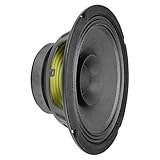
- HANDLES IT ALL: The 8FR250 full-range driver is an excellent choice when space is at an absolute minimum, eliminating the need for a tweeter
- DESIGNED FOR EFFICIENCY: This loudspeaker has a dual cone design, the primary cone handles low to midrange frequencies while the smaller secondary cone increases high-frequency response from 50 Hz to 18,000 Hz.
- SOLID STRUCTURE: The combination of a low-distortion motor system with a copper ring and a unique woven-cloth dust cap provides exceptional clarity, detail, and dynamics at an impressive 93.5 dB of sensitivity.
- POWER YOU CAN RELY ON: This driver has an impressive 250 Watts of program power and 125 Watts of RMS power at 8 Ohms, enough to handle a full range of audio.
- UPGRADE TODAY. HEAR THE DIFFERENCE: The PRV Audio FR Series sets a new standard of value in high-performance Full Range drivers.
How to choose between them
- Smallest practical desktop speaker: Dayton PS95-8.
- Low-power or high-efficiency system: FaitalPRO 3FE25-8.
- Compact paper-cone project with the most bass-oriented published profile: Tang Band W3-2141.
- Premium specialist cabinet: Markaudio Alpair 5.3.
- Budget 4-inch metal-cone project: Dayton DMA105-4.
- Real bass and higher output: pair any suitable full-range driver with a powered subwoofer and high-pass filter.
Important buying criteria
Sensitivity and impedance
Check the measurement convention before comparing sensitivity. 2.83 V into 8 ohms is approximately 1 W, while 2.83 V into 4 ohms is approximately 2 W. A 4-ohm driver can therefore appear about 3 dB more sensitive under a 2.83 V test simply because it receives twice the power. Also check the minimum impedance, not only the nominal label.
Power handling and maximum output
Wattage is not a loudness rating. Maximum output depends on sensitivity, Xmax, thermal limits, enclosure loading, frequency, distortion, listening distance and the number of drivers. A 20 W amplifier is not automatically safe for a 20 W driver, and more power cannot overcome excursion limits. Clipping from an undersized amplifier can also damage a driver.
Enclosure and baffle
Fs, Qts, Vas, Sd and Xmax influence the enclosure alignment. Baffle width affects diffraction and bass balance; sealed, vented, transmission-line, open-baffle and horn-loaded designs behave differently. An arbitrary box can produce thin, boomy or uneven results even with a good driver.
Dispersion
As cone diameter becomes large relative to the wavelength, treble becomes more directional. Aim a small driver toward the listening position when appropriate, and evaluate off-axis response rather than only the on-axis curve. A speaker can image convincingly at one seat yet sound dull farther to the side.
Filtering and subwoofers
A single-driver design may avoid a conventional woofer-to-tweeter crossover, but it can still benefit from baffle-step compensation, shelving, notch filtering, DSP, a protective high-pass filter or a subwoofer crossover. A subwoofer is strongly recommended for film effects, organ, electronic bass, bass-heavy music, high playback levels and room-filling output. High-passing the small driver reduces excursion and distortion.
A practical enclosure workflow
- Set the listening distance, room size and target SPL.
- Select an impedance that the amplifier can safely drive.
- Download the current manufacturer datasheet.
- Model sealed, vented, open-baffle, transmission-line or horn options using the actual parameters.
- Check cone excursion at the intended power, especially below the enclosure tuning frequency.
- Inspect predicted response, port velocity and amplifier demand.
- Account for baffle step, diffraction and driver placement.
- Build a prototype or test baffle before committing to the final cabinet.
- Measure on-axis and off-axis response if possible.
- Apply modest EQ only after confirming that the driver is not being pushed beyond its excursion or thermal limits.
Common mistakes
- Buying by the lowest frequency number: frequency ranges often omit tolerance, output level and enclosure conditions.
- Putting the driver in any available box: cabinet volume and tuning determine much of the result.
- Ignoring off-axis behavior: a smooth on-axis curve does not guarantee balanced room sound.
- Choosing the wrong impedance: the DMA105-4 and alternate 3FE25 versions require particular amplifier attention.
- Expecting a 3-inch cone to fill a large room with bass: use a subwoofer, multiple drivers or a larger woofer.
- Assuming more amplifier power solves bass limitations: extra power can create distortion or damage once excursion or thermal limits are reached.
- Treating manufacturer adjectives as measurements: terms such as “low distortion” or “state of the art” should remain attributed unless independently tested.
Bottom-line recommendations
For a first compact point-source project, buy the Dayton PS95-8 and follow a modeled enclosure design. Choose the FaitalPRO 3FE25-8 when amplifier efficiency and sensitivity are priorities. Select the Tang Band W3-2141 for a compact paper-cone build with a more bass-friendly published T/S profile. The Markaudio Alpair 5.3 suits experienced builders who want a premium specialist project, while the Dayton DMA105-4 is the practical budget choice for a 4-inch, 4-ohm aluminum-cone system.
Whichever driver you choose, design the cabinet, verify the amplifier load and plan for a subwoofer or high-pass filter if you need genuine bass or higher output.
The Tool Desk
Outbyte Driver Updater FREEScan for outdated or missing drivers - takes under a minuteDriver Scan →Outbyte PC Repair FREERepair Windows errors before they cause bigger problemsFix Now →Quick Recap
Product prices and availability are accurate as of the date/time indicated and are subject to change. Any price and availability information displayed on Amazon at the time of purchase will apply.

