PartCrafter is an open-source research tool that turns a single RGB image into several separate, inferred 3D triangle meshes. Its approximately 34-second benchmark is genuine—but it was recorded on an NVIDIA H20 GPU, not an ordinary laptop. For construction professionals and makers, the practical value is rapid concept modelling and approximate fabrication, not dimensionally accurate replacement parts.
What PartCrafter does
PartCrafter—short for PartCrafter: Structured 3D Mesh Generation via Compositional Latent Diffusion Transformers—takes one image and predicts a 3D object as multiple semantically distinct meshes. The project is associated with contributors from Peking University, ByteDance AI Lab and Carnegie Mellon University, and its official implementation is available on GitHub.
As an Amazon Associate I earn from qualifying purchases.
A conventional single-image-to-3D system generally produces one mesh for the whole object. PartCrafter instead attempts to decompose the image into components. A chair, for example, might yield separate geometry for its seat, back and legs. The exact result depends on the image and the model’s interpretation; the output is not guaranteed to match the object’s true physical construction.
Free tools Windows power users keep installed
One-click scans. No signup required.
Why separate meshes matter
Part-level output can be more useful than a single fused object when a model needs editing. Individual components can potentially be moved, recoloured, replaced, remodelled or printed separately in Blender or another mesh editor.
#1 Best Overall
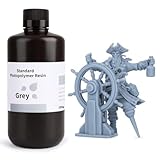
- 【Low Shrinkage and High Precision】ELEGOO photopolymer resin is specially designed for reducing volume shrinkage during the Photocuring process, which ensures the high precision of the print model with smooth finish.
- 【Fast Curing and Great Stability】ELEGOO 405nm Rapid Resin was designed to significantly reduce printing time with its excellent fluidity. Meanwhile its great stability and proper hardness ensure a unworried printing experience and successful printing.
- 【Bright and Stunning Colors】With high quality pigments and photo-initiators inside ELEGOO UV-Curing resin, the models printed with resin have a very pure and stunning color effect just like an artwork.
- 【Wide Applications】Given the outstanding performances, ELEGOO standard resin is suitable for most DLP/LCD 3D printers. Works best with the LCD 3D Printers.
- 【Safe and Secure Packaging】Leak-proof bottle fully wrapped with a plastic bubble bag and exquisite designed package box make sure the resin stays in place where they belong
The separation is semantic inference, not engineering-grade segmentation. Parts may be missing, wrongly divided, fused, intersecting, floating or geometrically implausible. The model’s research contribution is a compositional latent representation with separate token sets for parts, combined with hierarchical attention intended to preserve both local detail and overall object coherence. In plain language, it tries to model both the pieces and their relationship to the complete object. Read the research paper for the technical method.
How fast is “in seconds”?
The PartCrafter project site reports approximately 34 seconds for its benchmark generation. That figure was recorded on an NVIDIA H20 GPU with 40 GB of memory. It should not be treated as a guaranteed result on a desktop or laptop GPU.
Real elapsed time also includes image preparation, model loading, rendering and—on a first run—downloading the weights. Generation speed varies with hardware, the requested number of parts and token settings. The repository states an 8 GB CUDA-capable GPU minimum, while the project site recommends 16 GB or more for a more practical experience. Its default token count is 1,024 per part for object-level generation and 2,048 per part for scene-level generation.
Recommended Free Tools
The site’s reported benchmark also lists a Chamfer distance of 0.1726 and an F-score of 0.7472, compared with 18 minutes for HoloPart in the listed comparison. These are project and paper benchmark figures, not an independent test or a promise of equal performance on every image.
What a single image cannot tell the model
A photograph does not contain complete 3D measurements. PartCrafter fills in missing information using learned visual patterns and therefore produces a plausible reconstruction rather than a scan.
Rank #2

- 【Low Shrinkage and High Precision】ELEGOO photopolymer resin is specially designed for reducing volume shrinkage during the Photocuring process, which ensures the high precision of the print model with smooth finish.
- 【Low Volume Shrinkage】Low shrinkage and good stability reduce volume shrinkage during the curing process. Therefore, after cleaning and post-curing, the molded prints will not be noticeably deformed or cracked over a long period of time.
- 【Low Viscosity & Good Fluidity】With excellent fluidity, the resin can quickly reflow to the area between model and release film, which improves the printing success rate, and reduces printing time.
- 【Safe and Low Odor】ELEGOO standard photopolymer resin is specially formulated with less odor and a very pure and bright color. There is less pungent smell during printing, thus maintaining a freshening printing environment.
- 【Bright and Stunning Colors】With high quality pigments and photo-initiators inside ELEGOO UV-Curing resin, the models printed with resin have a very pure and stunning color effect just like an artwork.
- The rear and underside are inferred.
- Exact dimensions, tolerances, wall thicknesses and material properties are unknown.
- Perspective may distort proportions.
- Shadows or textures may be mistaken for geometry.
- Thin features may disappear.
- Holes may be filled and separate components may be merged.
- Symmetry and repeated elements may be reconstructed incorrectly.
- An object that appears functional may become only a visually convincing shell.
That distinction is critical for construction work. A generated bracket, clip, hinge or replacement cover may look correct while being too weak, incorrectly sized or unsafe. It must not be treated as a measured component merely because it resembles the source image.
Images that give the best results
Use an isolated object on a relatively plain background. A well-lit three-quarter view that exposes depth is generally more informative than a flat, tightly cropped or heavily obstructed image. The object should occupy much of the frame, with its components clearly separated.
Avoid crowded scenes, extreme perspective, motion blur, strong shadows, reflective or transparent surfaces and images that hide important features. PartCrafter’s optional background-removal and vision-language-model paths can assist with preparation or part suggestions, but they add dependencies; the VLM route requires a Gemini API key.
Installing PartCrafter locally
The documented workflow is Linux- and NVIDIA-CUDA-oriented. The repository lists Python 3.11 and PyTorch 2.5.1 with CUDA 12.4 in its tested environment, on Debian 12 with NVIDIA H20 GPUs. The following commands reproduce the setup described in the current README:
conda create -n partcrafter python=3.11.13
conda activate partcrafter

pip install torch==2.5.1 torchvision==0.20.1 torchaudio==2.5.1
  --index-url https://download.pytorch.org/whl/cu124

git clone https://github.com/wgsxm/PartCrafter.git
cd PartCrafter
bash settings/setup.sh
Users without root access can also install the graphics libraries listed by the repository:
Rank #3

- ①【Easy to Use】- SUNLU standard resin has strong fluidity and is compatible with different printers and printing speeds. The printed products are easy to form and are suitable for novices.
- ②【Low Shrinkage】- During the curing process, the standard resin has a low shrinkage rate, providing accurate size and shape of the printed parts.
- ③【Good Stability】- Standard resin has good tolerance to weak acids, greases, etc., and the printed works are not easy to deform, which is suitable for the manufacturing of most printing needs.
- ④【Easy to Post-process】- The surface of standard resin printed works is hard and smooth, and it is easy to color after printing. It is one of the best choices for hand-made printing.
- ⑤【High Cost-Effectiveness】- Standard resin provides good performance and durability at a relatively low cost, making it an affordable choice for those with a limited budget.
conda install -c conda-forge libegl libglu pyopenglThe required inference weights are documented as downloading automatically into pretrained_weights/PartCrafter and pretrained_weights/RMBG-1.4. Windows users are directed to community setup guidance rather than a first-party Windows package, so platform-specific fixes may be required.
Running object-level inference
The official README provides this example:
python scripts/inference_partcrafter.py
  --image_path assets/images/np3_2f6ab901c5a84ed6bbdf85a67b22a2ee.png
  --num_parts 3
  --tag robot
  --render
--num_parts is user-specified. You can also use the optional vision-language-model-assisted route:
GEMINI_API_KEY=your_key python scripts/inference_partcrafter.py
  --image_path assets/images/np3_2f6ab901c5a84ed6bbdf85a67b22a2ee.png
  --part_suggest
  --tag robot
  --rmbg
  --render
The repository also documents a combined workflow using --part_suggest, --style_transfer, --rmbg and --render. Check the current README for output locations and updates before running a production workflow.
Is the result ready for a 3D printer?
Not automatically. PartCrafter produces triangle meshes, not a dimensioned, parametric CAD solid. A mesh can be valuable in a CAD-adjacent workflow, but it does not contain sketches, constraints, feature history or reliable physical measurements.
For a decorative model, prop or rough visual prototype, the output may become printable after cleanup. For an accurate construction component, it should normally be used as a visual reference that is remodelled around measured dimensions.
Do these 3 things before closing this tab:
1Repair Windows errors before they cause bigger problems2Scan for outdated or missing drivers - takes under a minute3Clear out junk files and repair common Windows errorsRank #4

- 【Both Strength and Toughness with High Promotion】 Compared to the excellent tensile and bending strength of the previous version of ABS-like resin + , Anycubic ABS-Like Resin Pro 2 has strengthened the performance of toughness, increases the elongation at break by more than 100%, and the finished model is much stronger, which can be used to print high-strength and high-toughness models such as structural parts, industrial prototype parts, and fixtures.
- 【Performance far Superior to ABS-Like Resin】 Anycubic ABS-Like Resin Pro 2 is developed with a high elongation at break which can even reach to 35~40%. Compared to ABS-like resin +, it has increased by 114%.
- 【High Fluidity, High Success Rate】 Low viscosity and high flowability shorten curing time and make models easier to form. Anycubic ABS-Like Resin Pro 2 enables fast reflow, reducing delamination in model print. At the same time, the backplane adhesion is better, effectively reducing the risk of printing failure.
- 【High Precision with Low Shrinkage】With an even lower shrinkage rate, the chance of distortion is decreased. Achieve top-notch precision and display sharp, vivid details in your prints.
- 【Low Odor for Pleasant Printing】 Our low-odor formula reduces discomfort for those sensitive to smells, creating a more pleasant printing environment.
A practical print-preparation workflow
- Inspect each component. Open the result in Blender or another mesh-inspection tool and identify floating, fused or implausible parts.
- Check topology. Look for holes, non-manifold edges, self-intersections, disconnected fragments and inverted normals.
- Establish scale. A single image provides no trustworthy real-world scale. Use a known reference or measure the original object.
- Add thickness. Thin surfaces may need solidification or remodelling to survive printing.
- Rework interfaces. Rebuild holes, threads, joints, clips and mating surfaces parametrically where fit or strength matters.
- Separate or combine parts. Move, split or merge components according to the intended assembly.
- Export geometry. STL or 3MF can be used for slicing. STL carries geometry, not colour or PBR texture data.
- Inspect in the slicer. Check wall thickness, minimum feature size, overhangs, supports, orientation and the slicer’s repair warnings.
- Print a small test. Validate fit and dimensions before committing to a full-size part.
A slicer accepting a file does not prove that the part is mechanically correct, watertight or safe. For load-bearing, safety-critical or dimension-sensitive work, use measurements, conventional CAD, photogrammetry or a structured-light scan instead.
Where PartCrafter is useful
- Decorative objects and figurines.
- Props and visual prototypes.
- Early design exploration.
- Approximate covers and non-load-bearing shapes.
- Multi-component concept models that need separate editing.
- Construction visualisation or workshop mock-ups where exact dimensions are not the primary requirement.
Where it is a poor choice
- Gears, brackets, hinges, bearings, threads and clips.
- Load-bearing or safety-critical components.
- Interlocking parts with known clearances.
- Watertight containers that have not been carefully repaired and tested.
- Objects with hidden cavities, complex undersides or internal mechanisms.
- Any replacement part whose dimensions must be guaranteed from the image alone.
PartCrafter compared with other options
| Tool | Main strength | Best fit |
|---|---|---|
| TripoSR | Very fast local single-image reconstruction | Quick prototypes and previews when one object mesh is sufficient |
| TRELLIS.2 | Detailed textured and PBR-oriented assets | Visualisation and game-style assets; STL conversion is geometry-only |
| Tripo AI or Meshy | Hosted compute and simpler setup | Users without a compatible local GPU; check current plans and limits |
| Blender | Manual editing, repair and remodelling | Cleaning and correcting generated meshes |
TripoSR’s official repository reports generation in under 0.5 seconds on an NVIDIA A100 and about 6 GB of VRAM under default settings. That makes it attractive for speed, but it is not primarily a structured multi-part generator. TRELLIS.2 is more relevant when textured digital assets matter; converting GLB to STL removes those textures because STL stores geometry rather than material data.
Cloud tools are easier to try, but they do not solve the fundamental accuracy problem. PartCrafter’s distinctive advantage is local, open-source experimentation with predicted part separation—not universal superiority in surface quality, topology or mechanical accuracy.
Common problems and recovery steps
Installation errors
CUDA mismatches, unsupported GPU architectures, missing EGL/OpenGL libraries, incompatible Python or PyTorch versions, insufficient VRAM and failed weight downloads are common causes. Recreate the documented environment, match the CUDA-enabled PyTorch build, install the listed graphics libraries and confirm that the expected weight directories exist. Reducing the number of parts or token count may help with memory pressure.
Bad geometry
If the backside is missing, pieces float, parts intersect or the model has the wrong component count, try a cleaner image, a different view, a different --num_parts value or background removal. Generate more than one candidate and manually repair the important areas.
Best Value

- Higher Heat-Resistance: The 3D printed models with ABS-Like 3.0 Plus maintains its physical shape and mechanical properties at higher temperatures (up to 55 celsius grad), which effectively reduces the risk of material failure due to high temperatures.
- High Strength and Impact Resistance: Printed models are tough, bending without breaking easily and can withstand certain levels of tension and stress, featuring high hardness and toughness. Resin products can be tapped and drilled without cracking.
- High Precision and Low Shrinkage: Ensures high model forming accuracy with smooth surfaces and clear printing details and features low shrinkage rates.
- Good Fluidity: ELEGOO ABS-Like Resin 3.0 Plus Resin exhibits excellent fluidity, allowing it to flow back quickly to fill and cure the surface of printed models, which enhances the success rate of model printing by reducing the release force after resin curing.
- Fast Curing: Balances model performance and detail while improving printing speed. Shortens curing time, enhancing the efficiency of LCD 3D printers.
Printing errors
Non-manifold warnings, thin walls and unsupported overhangs require mesh repair, added thickness, changed orientation or supports. Separate incorrectly fused components and establish scale from a known measurement. Critical interfaces should be remodelled rather than trusted to an inferred mesh.
Licensing considerations
The PartCrafter code repository identifies itself as MIT-licensed. That does not automatically give every bundled model, dependency, training dataset, input image or external service identical terms. Review the licences and model cards for PartCrafter, TripoSG, RMBG-1.4 and any optional components before commercial use. The optional Gemini-assisted workflow also involves an external provider and its own terms.
Bottom line
PartCrafter is a promising open-source image-to-structured-mesh research tool, and its multi-part output is more interesting than another system that simply wraps an entire object in one mesh. The approximately 34-second H20 benchmark explains the headline, but not the complete workflow. Expect model downloads, CUDA setup, mesh inspection, scale correction, repair and slicer validation.
Crashes, No Sound, or Screen Glitches?
Random freezes, missing sound and display glitches usually trace back to one bad driver. Find and replace yours safely.Free scan · under a minutePC Slower Than It Used to Be?
A free scan shows the junk files, broken settings and background clutter dragging Windows down - then fixes them in one click.Free scan · Windows 10 & 11Use it to accelerate concepts, decorative prints and editable approximate assets. Do not use a single-image reconstruction as proof that a bracket, fitting or replacement component has the right dimensions or strength. When accuracy matters, measure the object and rebuild it in conventional CAD or capture it with a suitable 3D-scanning method.
Quick Recap
Product prices and availability are accurate as of the date/time indicated and are subject to change. Any price and availability information displayed on Amazon at the time of purchase will apply.




