“The Mother(board) Of All CNC Controllers” refers to Barton Dring’s 6-Pack CNC Controller: an open, modular ESP32-based control board built around six stepper-driver positions and five plug-in CNC I/O sockets. Its appeal is not that it replaces every CNC controller, but that one motherboard can be configured for very different machines.
The project was introduced in 2020 around Grbl_ESP32. The current project repository continues to document the hardware and also includes FluidNC configuration material. Availability, pricing, and the status of complete assembled kits must be checked from current supplier information rather than assumed from the original announcement.
As an Amazon Associate I earn from qualifying purchases.
Why a CNC controller needs to be modular
A small three-axis router, a dual-motor gantry, a lathe, a laser, and a VFD-equipped mill do not need the same electronics. They may differ in:
- Number of axes and motors
- Stepper modules or external drives
- Limit, homing, probe, and emergency-stop inputs
- Spindle-control requirements
- Relay, coolant, vacuum, valve, or tool-changer outputs
- Signal voltage, isolation, and noise protection
A conventional GRBL shield is inexpensive and simple, but its fixed pinout can become restrictive as a machine grows. The 6-Pack approach puts the common infrastructure on a motherboard and moves machine-specific functions onto replaceable modules.
#1 Best Overall

- MKS DLC32 MAX
- CNC 4 axis card
- GRBL controller
- GRBL 32 bit ESP32 controller
The motherboard is deliberately boring; the capability comes from the modules and firmware.
What the 6-Pack motherboard contains
The board is approximately 134 × 132 mm and provides the shared power, connectors, control electronics, and expansion paths needed by the plug-in hardware. Its principal features include:
- An ESP32 module socket
- Six stepper-driver positions
- Five CNC I/O module sockets
- MicroSD-card storage
- Two fan connectors
- A JTAG interface
- Power and housekeeping circuitry
- Main machine connectors
- Terminals and signal paths for external drives
The board-level design is documented in the 6-Pack CNC Controller repository. Newer source files are identified there as being hosted through OSHWLab.
Six motion channels: six axes, dual motors, or external drives
Six stepper channels can be assigned in several ways. A machine might use them as six independent axes—such as X, Y, Z, A, B, and C—or use two channels for one axis with dual motors.
Dual motors are especially useful on a wide gantry. With suitable firmware configuration and homing hardware, each motor can be controlled independently so the gantry can be squared during homing. In that arrangement, six channels do not necessarily mean six physical axes: two channels may serve one mechanically coordinated axis.
The driver sockets accept common Pololu- or StepStick-style modules, including:
- A4988-type modules
- DRV8825-type modules
- Trinamic modules
- Trinamic SPI modules, including sensorless-stall-detection options where supported
- Jumper adapters for external stepper drives
External drivers receive step, direction, and enable signals. The documentation describes 5 V signaling suitable for optocouplers, with selectable common-high or common-low arrangements.
Quick wins for a faster PC:
Scan for outdated or missing drivers - takes under a minuteDriver Scan →Repair Windows errors before they cause bigger problemsFix Now →The ordinary board specification is six channels. The project documentation also describes a possible expansion arrangement using additional shift-register outputs to drive as many as 14 external-driver motors. That is an expansion possibility, not the normal six-channel capability and should not be treated as a plug-in 14-axis product.
Rank #2
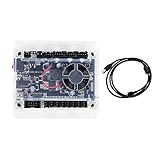
- Model: Upgraded 3 Axis GRBL 1.1F USB Port GRBL Control Board; Input voltage: 24VDC
- Support software: GRBL Contol/Candle(3 axis)/Universal Gcode Sender; Support System: Windows XP/7/8/10
- Support Motor: Support XYZ three-axis control, spindle.Support stepper motor: 12V, maximum current of 2A or less is recommended within 1.5A and additional heat. (Any stepper motor Nema17,Nema23);Support spindle: Support 24VDC Spindle PWM speed 0%-100%,also support 3-pin PWM/TTL signal control module
- New functions: Add 2-pin emergency stop button port,probe port,XYZ limit port and add the power button switch;Applications: The control board can be used with the 1310,1610-PRO, 3018,3018-PRO and 3018-PRO MAX etc engraving machines
- IMPORTANT: This is a control board, NOT plug-and-play. Pls Connect 24VDC to board, then connect USB to PC. Driver: Install your CH340 driver. In Device Manager > "Ports", verify "USB-SERIAL CH340 (COMx)" appears. Software: Use GrblControl/Candle. Select same COM port, set baud rate to 115200, click "Connect".Unlock: After connect, click "Unlock" or send $X command Final Check: If connected but no movement, release emergency stop, ensure limit switches off, then click "Reset" & "Unlock"
The five CNC I/O sockets
Each socket is intended for a plug-in module rather than a fixed function. The original module lineup illustrates why that matters.
Four-switch input module
This module provides four switch inputs with optocouplers, filtering, and Schmitt-trigger cleanup. It is suited to limit switches, homing switches, probes, and similar machine inputs. Isolation and signal conditioning are valuable in a CNC environment, but they do not eliminate the need for good cable routing and grounding.
Relay module
A relay module can control accessories such as a spindle contactor interface, coolant pump, vacuum system, valve, or other low-frequency machine function. The relay contacts are not a substitute for correctly rated mains switching or a properly engineered safety circuit.
The Tool Desk
Outbyte PC Repair FREERepair Windows errors before they cause bigger problemsFix Now →Outbyte Driver Updater FREEFix the driver behind crashes, sound loss and screen glitchesFind Drivers →RS-485 module
The RS-485 module is intended primarily for compatible VFD spindle controllers. Communication is not automatically universal: different VFDs may use different registers, baud rates, wiring, and command conventions. A Huanyang-compatible setup, for example, should not be assumed to work unchanged with every RS-485 VFD.
0–10 V module
This module provides an analog spindle-speed command and optically isolated direction outputs for VFDs that use those interfaces. It supplies a control signal; it does not replace the VFD, spindle, mains-rated wiring, shielding, grounding, parameter configuration, or emergency-stop system.
Buffered 5 V output module
Four buffered 5 V outputs can be used for enable, direction, PWM, laser-power, or other control signals. The exact assignment depends on firmware and the machine’s electrical design.
How the module interface works
The published CNC module definition provides each socket with:
- Four independent I/O pins
- Four bused pins for interfaces such as I2C or SPI
- Ground
- 5 V
- Motor-supply voltage
The open module specification allows builders to design their own boards for specialized functions. The typical motor supply is 12 V or 24 V. The specification advises drawing no more than approximately 1 amp from either the 5 V or VMot supply through the module interface. Higher-current loads should have their own power connector.
Rank #3

- Product: 4 Axis USB Mach3 Control Board; Port:USB interface is applicable to any netbook, notebook, desktop, tablet and other PC compatible computers with USB interface; As long as Mach3 can run,the control card can be used; Support computer system:Windows XP/7/8/10
- 4 Axis Linkage:Support for 4 Axis linkage, you can connect four stepper motor drives or servo drives; Maximum step-pulse frequency is 100KHz,which is suitable for the servo or stepping motor; One status LED, indicate connection status on the board
- Output Signal Ports:Have 0-10V signal output,you can use mach3 software to control the spindle motor speed; 4 general-purpose isolated relay drive output interface, can drive four relays for controlling the spindle starts, forward rotating and reverse rotating, pumps and other device; Support for connecting electronic handwheel; Handwheel interface: 2x5P row needle
- Input Signal Ports:4 general-purpose inputs, you can connect the limit switch, estop switch, probe , back to zero and other device; Need use external 24V DC power supply to isolate USB and external port, and to make the system more stable
- Applications:CNC Router,Milling Machine,Engraving Machine,Carving Machines,Cutting industry,Medical equipment,industrial equipment and automation devices etc
That last point is easy to overlook. A socket can distribute control signals and modest module power; it should not be treated as a general-purpose high-current supply for a spindle accessory, heater, pump, or other demanding load.
Why the ESP32 mattered
The 6-Pack was designed during the transition from traditional 8-bit AVR-based GRBL hardware to more capable ESP32 controllers. The ESP32 offered more processing capability, greater memory, flexible I/O, and built-in Wi-Fi and Bluetooth hardware.
The design also used an I2S-based shift-register approach to expand outputs and generate high-rate motion signals. The original technical description reported a 125 kHz step rate and described jitter-free stepping through that hardware-assisted method. Those are design claims from the project documentation, not independent measurements by this publication.
The associated Grbl_ESP32 repository describes the firmware as a port of GRBL CNC firmware for ESP32 hardware. The current 6-Pack repository still references Grbl_ESP32 while also including FluidNC configuration files. That distinction matters: the historical project framing was 6-Pack plus Grbl_ESP32, while current users must verify the exact board revision, pin map, driver support, and configuration requirements for the firmware they intend to run.
What machines can use it?
| Machine or use | Why the modular design helps |
|---|---|
| Three- or four-axis router | Install only the required motion channels and switch inputs. |
| Wide dual-motor gantry | Use separate channels for gantry motors and configure independent squaring. |
| Lathe | Choose the spindle and I/O interfaces required by the machine. |
| Laser | Use buffered PWM, enable, and safety-related inputs where appropriate. |
| VFD-equipped mill | Choose RS-485 or 0–10 V control according to the VFD. |
| Larger machine | Use external stepper or servo drives rather than relying on small plug-in modules. |
| Experimental machine | Design a custom module around the published electrical and mechanical rules. |
What it is—and what it is not
The 6-Pack is hardware plus an open firmware ecosystem. It is not a turnkey industrial CNC control. A complete machine still requires:
- An ESP32 module
- Stepper-driver modules or external drives
- A suitable power supply
- Motors, mechanics, and machine wiring
- Spindle and VFD equipment where applicable
- Limit, homing, probe, and emergency-stop circuits
- Firmware configuration
- A sender or control interface
- Enclosure, cooling, connectors, and suitable cable management
The controller generates and coordinates signals. It does not determine a machine’s accuracy, rigidity, backlash, motor sizing, drive tuning, or cutting performance.
Safety and electrical limitations
Open hardware does not make a CNC machine automatically safe. VFDs, spindle wiring, mains voltage, moving parts, and emergency stops require separate engineering decisions.
Do these 3 things before closing this tab:
1Clear out junk files and repair common Windows errors2Scan for outdated or missing drivers - takes under a minute3Repair Windows errors before they cause bigger problems- Use shielded motor and spindle cables where appropriate.
- Separate logic wiring from high-current and high-voltage wiring.
- Use deliberate grounding and bonding practices rather than casually joining grounds.
- Do not connect industrial signals directly to ESP32 GPIOs unless the electrical levels and protection are suitable.
- Use optocouplers or purpose-designed interfaces where isolation is required.
- Design the emergency stop to remove hazardous energy through an appropriate hardware safety circuit. A software input alone is not a sufficient machine E-stop.
ESP32 pins are not interchangeable. Some have restrictions involving input-only operation, output capability, PWM, boot behavior, or shared buses. The module definition and the configuration for the exact board revision should be checked before assigning a function.
Rank #4

- This controller has burned grbl1.1 firmware, Due to trade secrets, the controller cannot brush firmware
- All-optical isolation immunity
- Can be connected to a high-power driver
- Support 48V 500W DC spindle work
- 16 times motor subdivision
Common failure points
Incorrect driver orientation
Plug-in StepStick modules can be damaged by reversed installation or incompatible pinouts. Confirm the module orientation, socket markings, and module documentation before applying power.
Inadequate cooling
A driver’s advertised current rating depends on thermal conditions, heatsinking, airflow, and the specific module. Small plug-in drivers are not automatically suitable for high-current CNC axes.
Wrong spindle interface
RS-485, 0–10 V, PWM, relay control, and direction signals are different systems. Select the module based on the VFD’s documented interface rather than the spindle’s brand name alone.
PC Slower Than It Used to Be?
A free scan shows the junk files, broken settings and background clutter dragging Windows down - then fixes them in one click.Free scan · Windows 10 & 11Crashes, No Sound, or Screen Glitches?
Random freezes, missing sound and display glitches usually trace back to one bad driver. Find and replace yours safely.Free scan · under a minuteOverloading module power pins
High-current accessories should use their own power entry when required by the module specification. Do not route substantial load current through a low-current expansion connector.
Assuming firmware configurations are universal
Axis assignments, step polarity, direction polarity, homing direction, spindle settings, limits, and module pin maps must match the actual hardware and firmware configuration.
Confusing the controller with the machine
A sophisticated controller cannot compensate for a flexible frame, poor grounding, backlash, undersized motors, badly tuned drives, or unsuitable tooling.
Independent reader supportYour contribution helps us test, update, and keep practical guides available for everyone.Building or sourcing one in 2026
The design is publicly documented, but the original 2020 article discussed an anticipated production run rather than guaranteeing permanent commercial availability. The available project material does not establish current stock, current retail pricing, or the availability of every assembled board and module.
What’s actually slowing this PC down?
Pick the symptom - the matching free tool is one click away.
Before ordering or fabricating, verify:
- Whether the main board is currently available assembled.
- Whether the required I/O modules are available.
- Which ESP32 module footprint and width the current board supports.
- Whether the intended firmware is Grbl_ESP32, FluidNC, or another specifically documented option.
- Whether the current board files match the 2020 hardware revision.
- Whether the machine requires 3.3 V, 5 V, opto-isolated, RS-485, or analog spindle interfaces.
- Whether the chosen drivers are electrically and thermally appropriate.
- Whether external drives require common-high or common-low signaling.
- Whether high-current devices need separate power wiring.
- Whether the machine has a proper hardware emergency-stop circuit.
The project repository is the best starting point for current design files and compatibility information. The historical Tindie page linked by the project should be treated as a vendor reference, not proof of current inventory.
Best Value

- 32 bits ESP32 MCU,wifi inbuilt
- X,Y1,Y2,Z axis, Support TTL and PWM
- TS35 offline control
- Support Web,APP control
- Power DC 12-24V
How it compares with other controller approaches
Basic Arduino/GRBL shield
A basic shield is usually the better choice for a simple three-axis machine when cost, availability, and ease of setup matter more than expansion. Its fixed architecture becomes less attractive when the machine needs additional axes, VFD interfaces, isolation, or custom I/O.
6-Pack-style modular ESP32 controller
The 6-Pack occupies the middle ground: substantially more expandable than a basic shield, while remaining open and builder-oriented. The trade-off is more wiring, more configuration, and more responsibility for selecting compatible modules and designing the enclosure and safety system.
grblHAL hardware
grblHAL is another open firmware ecosystem with hardware implementations including higher-performance microcontroller platforms. It may be a better fit when a supported board, different processor, or specific grblHAL feature is more important than the 6-Pack module system.
Free tools Windows power users keep installed
One-click scans. No signup required.
LinuxCNC/Mesa-style systems
These systems can be attractive for builders who need a computer-based control architecture, extensive I/O, or advanced integration. They generally demand more setup and system administration than a self-contained ESP32 controller.
Integrated commercial controllers
Commercial systems can provide more complete machine integration, support, diagnostics, and a defined ecosystem, often at greater cost and with less freedom to modify the electronics. The Hackaday discussion positioned the 6-Pack as an intermediate option; that was contemporary commentary, not a current market ranking.
Who should choose it?
The 6-Pack is a strong candidate for a technically capable builder who has a custom machine, expects to expand it, needs six motion channels or unusual I/O, and values open hardware. It is particularly compelling when the choice of spindle interface, external drives, isolated inputs, or custom modules matters more than plug-and-play installation.
It is a poor fit when current commercial availability, warranty support, certified safety functions, closed-loop motion, encoder feedback, rigid tapping, or advanced industrial cycles are mandatory. It is also unnecessary if a simple three-axis GRBL board already meets the machine’s requirements.
Recommended Free Tools
Verdict
The “motherboard” pun is justified by the architecture, not by a claim that this is literally the best CNC controller for every machine. Barton Dring’s 6-Pack design solves a real problem: it gives one ESP32-based platform enough motion and I/O flexibility to serve routers, lasers, lathes, VFD-equipped machines, dual-motor gantries, and custom builds.
Its strength is modular electrical accommodation. Its cost is the responsibility that comes with open hardware: selecting drivers, matching interfaces, configuring firmware, managing noise and grounding, providing cooling, and building a proper safety system. For a beginner seeking a ready-to-run controller, a simpler or more integrated product is likely a better choice. For a builder who wants a configurable CNC control platform rather than a fixed shield, the 6-Pack remains an unusually thoughtful design.
Quick Recap
Product prices and availability are accurate as of the date/time indicated and are subject to change. Any price and availability information displayed on Amazon at the time of purchase will apply.

