Do not connect power strips or surge protectors to one another, and do not use an extension cord to supply a power strip unless the specific equipment and governing authority expressly allow it. In a U.S. 120-volt home, office, shop, or construction setting, the safer choice is one listed, properly rated device connected as instructed—or a properly installed receptacle when the need is permanent.
Daisy chaining may appear harmless when only a few devices are plugged in. It does not automatically create an immediate overload, but it adds connection points, increases cord length and resistance, can hide the weakest component, and may violate product instructions or workplace requirements. Those conditions can contribute to overheating, arcing, equipment failure, electric shock, and fire.
As an Amazon Associate I earn from qualifying purchases.
What counts as daisy chaining?
Daisy chaining means connecting power-distribution devices or extension cords to one another instead of connecting each device directly to an appropriate receptacle. Common examples include:
The Tool Desk
Outbyte Driver Updater FREEScan for outdated or missing drivers - takes under a minuteDriver Scan →Outbyte PC Repair FREERepair Windows errors before they cause bigger problemsFix Now →- A power strip plugged into another power strip.
- A surge protector plugged into another surge protector.
- An extension cord plugged into another extension cord.
- An extension cord supplying a power strip.
- A mixed chain containing an extension cord, power strip, surge protector, and additional downstream strips.
- One upstream strip feeding several downstream strips or cords.
Plugging several suitable, low-power devices into one properly rated power strip is not, by itself, daisy chaining. The hazard is connecting the power-distribution devices to one another.
#1 Best Overall
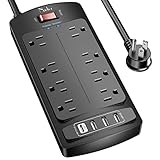
- 【Power Strip with 8AC outlets & 4 USB】- Power bars with surge protector with 8AC outlets & 4 USB charging ports (1 USB C Outlet), 6 Feet Heavy Duty extension cord, surge protector(2700 Joules) with overload protection protects against spikes and fluctuations.
- 【USB- C Fast & Smart Charge】- 4 USB Charging ports, each USB A port features 2.4A Max output. USB C charging port features 3A MAX. Built- with smart technology, detecting charging devices and deliver optimal charging speed automatically, compatible with most USB devices. NOTE: The UCB-C port doesn't support any other devices which need 9~22V charging voltage.
- 【8AC Surge Protector Outlets】- This power Strip provides 2700 joules of surge protection for electronic devices and serves as a reliable power extension cord. (The “Protected” indicator light turns on to indicate that your devices are protected.)
- 【Safety and Certificate】- ETL safety certified, with extension cord and other major components certified by ETL. The over current protection switch limits the power strip's working current to certain setting, so it will not get hot during usage. Environmental protection and fire-resistance PC shell with flame retardant at 1382℉ makes it more durable and longer lifetime.
- 【What You Get】- Nuetsa Power strip, Maunal, 30-day return, our worry-free 12-month, and reliable customer service will respond to you within 24 hours.
The short answer from electrical-safety guidance
OSHA guidance says listed relocatable power taps should be connected directly to a permanently installed branch-circuit receptacle—not series-connected to another power strip or connected to an extension cord. Listed or labeled equipment must also be used according to its instructions.
OSHA primarily regulates workplaces, so this is not a universal statement that every household daisy chain is a crime. Residential requirements can depend on locally adopted electrical codes, building rules, landlord policies, insurance requirements, and the product’s instructions. It is nevertheless a strong safety rule for homes and workplaces alike: do not build a chain when a single suitable connection or permanent wiring is the correct solution.
Why a daisy chain can overheat
Electric current flowing through resistance produces heat. Every cord has conductor resistance, and every plug-and-receptacle connection introduces another contact point. Longer or thinner cord paths generally have more resistance and greater voltage drop.
Free tools Windows power users keep installed
One-click scans. No signup required.
In a chain, the first cord or strip carries the current for everything connected downstream. That upstream component may be the weakest link even when a downstream strip has a higher stated rating. The result can be a cord, plug, receptacle, or connection operating under more stress than its appearance suggests.
The Office of Compliance explains that interconnected cords add resistance and can generate additional heat, especially when cords contact combustible materials. Heat becomes more difficult to dissipate when cords are covered, coiled, pinched, run under rugs, trapped behind furniture, or placed near insulation, paper, sawdust, fabrics, or other combustible materials.
Loose, damaged, corroded, or poorly fitting contacts create a more localized problem. A small contact area can become hot enough to discolor plastic, melt a housing, arc, or damage the plug without necessarily causing an immediate breaker trip.
Rank #2

- All the Power You Need: Features 12 AC outlets, 1 USB-C port, and 2 USB-A ports to power appliances, mobile devices, and more. Total USB output is shared across all USB ports, with a maximum output of 15W.
- Fast Charge Your iPhone: Use the 20W USB-C port to give your iPhone 15 a high-speed charge from 0-50% in just 26 minutes.
- 8-Point Safety System: Combines surge protection, fire resistance, overload protection, temperature control, and more to protect you and your devices.
- Optimized Layout: Features extra space between outlets to accommodate bulky plugs. The 5 ft cord is ideal for desks (4 - 5 ft wide), bedside tables, and sofa side tables.
- What You Get: Anker 351 Power Strip, 2 mounting screws, welcome guide, our worry-free 18-month warranty, lifetime* $200,000 connected equipment warranty, and friendly customer service.
That does not mean every chain will inevitably catch fire. A lightly loaded chain may work for a long time. The defensible safety conclusion is that chaining increases opportunities for misuse, unnoticed overload, connection failure, trip hazards, and overheating—and commonly conflicts with the intended use of listed products.
Crashes, No Sound, or Screen Glitches?
Random freezes, missing sound and display glitches usually trace back to one bad driver. Find and replace yours safely.Free scan · under a minutePC Slower Than It Used to Be?
A free scan shows the junk files, broken settings and background clutter dragging Windows down - then fixes them in one click.Free scan · Windows 10 & 11Why a breaker or surge protector is not a safety guarantee
A built-in breaker protects only within limits
A power-strip breaker is not a substitute for approved wiring. It may respond to excessive current through that strip, but it does not correct an undersized upstream cord, a loose connection, damaged insulation, or a physically unsafe route. A breaker may also fail to trip immediately when a connection is heating gradually or arcing intermittently.
The practical limit is set by the weakest suitable component: the circuit, receptacle, plug, cord, strip, adapter, or connection. A downstream strip with a breaker cannot make an upstream component capable of carrying more current.
Surge protection addresses a different hazard
A surge protector contains components intended to limit certain transient-voltage events. It does not increase the amount of power a branch circuit can safely provide, prevent all electrical faults, or make a chained installation acceptable. Multiple surge protectors do not create unlimited surge protection or additional amperage.
A joule rating, when present, is related to surge-energy handling—not the safe continuous load of the strip. UL distinguishes ordinary power strips from surge-protective devices; not every power strip is a surge protector.
Power strip, surge protector, extension cord, UPS, or permanent wiring?
| Device | What it does | What it does not do |
|---|---|---|
| Power strip | Provides multiple receptacles from one plug. It may include a switch or breaker. | It does not increase the circuit’s available capacity or automatically provide surge protection. |
| Surge protector | Provides multiple outlets and components intended to limit certain transient voltage events. | It does not make an overload, damaged cord, or daisy chain safe. |
| Extension cord | Temporarily extends power from a receptacle to an appliance or device. | It is not a substitute for permanent wiring and should not normally be used to supply a power strip. |
| UPS | Provides battery backup and, depending on the model, voltage regulation and surge protection. | It is not an unlimited outlet multiplier and is not intended for heating appliances or unsupported high-wattage loads. |
| Permanent wiring | Provides a properly installed receptacle as part of the building’s electrical system. | It requires assessment and installation appropriate to the circuit, grounding, location, and applicable code. |
The Consumer Product Safety Commission describes extension cords separately from power strips, taps, and appliance cords. Cord type, conductor size, length, grounding, and indoor or outdoor rating all matter.
Rank #3
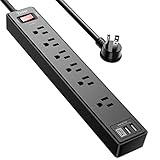
- Power Strip with 6 Outlets & 3USB Ports: 6 AC Surge protector outlets(1680 Joules) including 1 Widely Spaced Outlet, 2 USB A Ports & 1 USB C Port, 6 feet power cord, Surge protector indicator and 10A Overload Protector switch protects against spikes and fluctuations.
- Smart Charging USB Ports: Build in smart charging technology, Each USB A port features 2.4A Max output. USB C charging port features 3A MAX, 3 USB ports can charge almost any USB device (smart phone, tablet, fire stick, e-reader, blue tooth headphones, portable speaker etc).
- Surge Protector outlet: The 6 AC outlets provide surge protector against electrical spikes. with response speed less than 1Ns, and minimum energy-absorbing capacity of 1680 Joules, its response time is much shorter than the single MOV surge protector circuit, It truly provides great protection of your precious plugged-in devices.
- 6 Feet Flat Plug Power cord with Cable Ties: 6 Ft Extension Cord makes it more flexible, Reusable Fastening Cable Ties Can tie up the unused cord and make it better organized. the Mounting hole at the back allows this wall mount power strip to be securely installed in various applications, such as wall mounts, floor mounts, workbenches, under counters & more.
- Our After Sale Service: Our friendly and reliable customer service will respond to you within 24 hours. You can purchase with confidence, with our 30-day return and 12-month warranty.
Loads that should not use a power-strip chain
Never use a daisy chain for equipment that produces heat, has a substantial motor, or can draw high current. Examples include:
- Space heaters.
- Portable air conditioners.
- Microwaves, toasters, toaster ovens, coffee makers, and electric kettles.
- Hair dryers and curling irons.
- Washing machines and clothes dryers.
- Refrigerators and freezers, unless the manufacturer specifically permits the chosen connection.
- Sump pumps, compressors, power tools, welders, and other high-current equipment.
- Large printers, copiers, and equipment with substantial starting or operating current.
Connect these loads to an appropriate grounded wall receptacle or dedicated circuit as required by the equipment and installation. Do not rely on a generic consumer power strip. Avoid assigning a universal wattage limit: check each appliance’s nameplate, installation instructions, and the circuit’s capacity.
OSHA guidance describes relocatable power taps as suitable for low-powered equipment such as computers, peripherals, and audio/video equipment. Even for those loads, the strip must be listed, undamaged, correctly rated, and used as instructed.
Quick wins for a faster PC:
Repair Windows errors before they cause bigger problemsFix Now →Fix the driver behind crashes, sound loss and screen glitchesFind Drivers →How to assess an existing setup
- Calculate the load. Add the nameplate wattage or amperage of connected equipment. Pay particular attention to heating elements and motors.
- Identify the weakest component. Consider the circuit, receptacle, adapter, strip, plug, cord gauge, cord length, and connection condition.
- Check the environment. Damp, outdoor, hot, dusty, combustible, public-access, and industrial locations require equipment suited to those conditions.
- Look for physical hazards. Cords across walkways or under doors can be crushed, cut, tripped over, or damaged by furniture and vehicles.
- Read the instructions. The product listing and manufacturer’s directions control permitted use, including connections to UPS units and downstream equipment.
A chain that is used repeatedly or left in place for months is usually evidence that the outlet location or circuit needs to be addressed. Extension cords are intended for temporary use, not as a substitute for building wiring.
How to dismantle a chain safely
- Turn off and unplug the equipment, beginning with high-load appliances. Do not test a suspicious chain by leaving it energized.
- Grip each plug body—not the cable—and unplug it carefully.
- Inspect every plug, receptacle, cord, strip, and adapter.
- Look for warmth, discoloration, melted plastic, scorch marks, odor, buzzing, crackling, intermittent power, cracked housings, loose receptacles, damaged insulation, or bent or missing grounding pins.
- Remove the chain rather than merely rearranging it.
- Connect suitable low-power equipment to one correctly rated listed strip connected directly to the wall, as its instructions require.
- Move high-load equipment to an appropriate wall receptacle or have the circuit evaluated.
- If a receptacle trips, becomes warm, sparks, smells burnt, or shows damage, stop using it and contact a qualified electrician.
- In a workplace, report the condition to facilities personnel or the safety officer.
Do not continue operating a hot, discolored, buzzing, melted, or intermittently powered setup to see whether it fails. Those are warning signs, not diagnostic tests.
What a safer setup looks like
Low-power desk or entertainment equipment
Use this arrangement:
Wall receptacle → one listed power strip → low-power devices
Rank #4

- 【4+4 Outlets Power Strip with 4 USB Ports】- The 3-side power strip with 8AC widely outlets and 4 USB charging ports, each USB A port features 5V/2.4A Max output. USB C charging port features 5V/3A MAX. can power up to 12 devices simultaneously.
- 【Surge Protector Power Strip with 3 Side Design & Wide Space】- 3-side design that makes it easier to make the plugs not covering any outlet, and the 8 AC outlets with 1.8 inches long space in between, larger than standard 1.5-inch socket. Larger spacing makes it easier to use for all kinds of equipment. The compact design saves more space, suitable for the home, office, and college dorm room.
- 【Multi Safety Protection】- ETL Certificates. This power strip has overload protection, short-circuit protection, over current protection, over-voltage protection and overheating protection. The surge protector with overload protection protects your electrical appliances from lighting, surges or spikes. The minimum energy-absorbing capacity of 900 Joules. It will automatically cut power to protect connected devices when voltage surge is overwhelming.
- 【6 Ft extension cord with Flat Plug】- The 45° flat plug design prevents the bottom plug from clogging and allows for easy installation in tight spaces; the 6-foot power cord allows for flexibility, and two mounting holes on the back allow for secure installation of this power outlet in a variety of applications.
- 【 Our After Sale Service 】- ETL Certificates. Our friendly and reliable customer service will respond to you within 24 hours. You can purchase with confidence, with our 30-day return and 12-month warranty.
Choose a strip with enough outlets and a cord long enough to reach without tension. More outlets provide convenience, not more available power.
Do these 3 things before closing this tab:
1Fix the driver behind crashes, sound loss and screen glitches2Clear out junk files and repair common Windows errors3Scan for outdated or missing drivers - takes under a minuteEquipment located farther away
Use one correctly rated extension cord only when temporary extension is genuinely necessary. Do not connect multiple cords or use an extension cord to feed a power strip unless the particular equipment and authority expressly permit that configuration. If the distance is permanent, install a receptacle near the equipment.
High-power, motor-driven, or permanently installed equipment
Use an appropriate wall receptacle or have a qualified electrician evaluate whether a dedicated circuit, new receptacle, grounding correction, or other work is needed.
Outdoor or damp locations
Use cords and equipment rated for the environment and appropriate ground-fault protection. The CPSC advises using outdoor-rated cords and GFCI protection for outdoor tools and appliances. Keep connections away from standing water and protect them from damage without covering them in a way that traps heat.
Independent reader supportYour contribution helps us test, update, and keep practical guides available for everyone.Buying a safer replacement
When a single strip is appropriate, check:
- A legitimate mark from a recognized independent testing laboratory, such as UL or ETL. Verify that the mark corresponds to the actual manufacturer and model.
- Voltage, amperage, cord type, conductor size, and intended indoor or outdoor environment.
- An intact grounding path where grounded equipment is used.
- A cord length that reaches the receptacle without another cord.
- Instructions that clearly describe acceptable loads and use.
- Housing and receptacles that are undamaged and mechanically secure.
The CPSC has warned about products involving undersized wires, loose connections, improper grounding, faulty components, and counterfeit certification labels. A low price does not prove a product is unsafe, and a familiar brand does not excuse ignoring its ratings or instructions. Documentation and correct use matter.
For example, a long-cord consumer strip may suit a small group of low-power electronics. A commercial metal strip may be more suitable for an office rack or workshop equipment cluster. A surge-protected model adds transient-voltage protection for appropriate electronics but does not solve an overloaded circuit. A UPS may suit computers, networking equipment, or storage devices when selected by watt capacity, runtime, outlet type, and manufacturer-approved load—not by outlet count alone.
Best Value

- 【28-in-1 Versatile Power Strip】 FCC, RoHS safety certified, with the extension cord and flat plug certified by UL. Superdanny power strip surge protector has 22 grounded 3-prong outlets and 6 USB ports, providing power for all devices that you need to plug in at one location. Perfect for gaming or media set up, surround sound system, TV, phone, tablet, PC, laptop, gaming computers, lamps, and other devices simultaneously.
- 【Widely Spaced Outlets】 The unique design of this USB power strip prevents bulkier plugs from blocking other outlets, as the outlets are spaced enough. There are four rows of outlets that give you multiple ways of plugging in a variety of cords. The power strip helps organize your cords, accommodate your numerous adapters, save space with much less clutter. Note: The side outlets cannot be rotated.
- 【Smart USB Fast Charging】 Not need to find adapters or plugs for your USB devices. This power strip flat plug is a nice upgrade since there are 5 UBS-A & 1 USB-C charging ports. The built-in smart charging technology allows USB C chargers to detect your devices automatically and deliver the fastest possible charge up to 5V/3A.
- 【Mountable and Flat Plug】 There are 4 keyholes on the back, so you can mount this flat extension cord onto the wall or furniture easily, 4 screws and 1 marking sheet included. The 45°angled flat plug fits perfectly in narrow spaces like behind a bookshelf, nightstand, or the TV, and does not cover the bottom receptacle of a duplex outlet. The 6.5 ft heavy duty extension cord delivers power (1875W/15A) where it is needed.
- 【Multi Safety Protection】SUPERDANNY offers FREE replacement for this power strip surge protector of unacceptable quality within 1000 days. Backed with 8-fold safety protection: fire-retardant casing, 2100J surge protection, overload protection, grounded protection, short-circuit protection, over-current protection, over-voltage protection, and overheat protection.
UPS connections, outlet extenders, and special cases
Can a power strip connect to a UPS?
There is no universal answer. Follow the UPS manufacturer’s instructions regarding downstream strips, surge protectors, battery-backed outlets, surge-only outlets, total wattage, and supported loads. Some manufacturers may permit a basic non-surge distribution device; others prohibit downstream devices. Do not use a strip to defeat the UPS’s load or outlet limits.
What about a wall-mounted outlet extender?
Treat multi-plug adapters and taps cautiously. Verify their listing, rating, mechanical stability, grounding, and instructions. An outlet multiplier is not automatically equivalent to a properly selected power strip.
What about holiday lights?
Follow the lighting product’s instructions and limits for connected strings and current. Do not assume that general power-strip advice overrides the product’s specific requirements.
What about professional production, IT, or construction equipment?
Professional systems may use listed rack PDUs, temporary power distribution, cord reels, or venue-approved equipment. Those systems must be designed and approved for the application. They are not ordinary household daisy chains, and commercial equipment still has load, grounding, environmental, and connection requirements.
Workplace and construction considerations
In workplaces, OSHA requires listed or labeled equipment to be used according to its instructions. OSHA also publishes requirements and guidance concerning flexible cords, including workplace electrical hazards and construction flexible-cord use. The Office of Compliance discusses temporary workplace wiring and dangerous mixed chains.
Do not turn a workplace-specific temporary-wiring limit into a universal household rule. Requirements can vary by setting, jurisdiction, adopted code, jobsite policy, and equipment. For construction sites, facilities, offices, and public areas, report recurring outlet shortages, nuisance trips, warm receptacles, or long-term cord use to the responsible safety or facilities professional.
When to call an electrician
Get qualified electrical help when:
- You need cords continuously because outlets are too far away or insufficient.
- A breaker trips repeatedly under ordinary use.
- A receptacle, plug, or wall plate becomes warm, discolored, loose, or damaged.
- You smell burning, hear buzzing or crackling, see sparks, or find melted plastic.
- You need a dedicated circuit for equipment with a heating element, motor, compressor, or high current demand.
- The building’s grounding, wiring age, or circuit capacity is uncertain.
- You need outdoor, damp-location, workshop, or construction-site power distribution.
Stop using visibly damaged or overheated equipment. If there is smoke or an active fire, leave the area and call emergency services; do not handle energized equipment.
Recommended Free Tools
Quick Recap
Final checklist
- Do not plug power strips or surge protectors into one another.
- Do not chain extension cords.
- Do not use a generic strip for high-load heating or motor-driven equipment.
- Connect one listed strip directly to the wall for suitable low-power devices.
- Use one properly rated extension cord only for a genuinely temporary need.
- Keep cords uncoiled, uncovered, undamaged, and away from heat, water, combustibles, and walkways.
- Check the nameplate load, cord rating, grounding, certification mark, and manufacturer instructions.
- Replace hot, damaged, melted, loose, or discolored equipment.
- Install a properly located receptacle when temporary cords have become a permanent solution.
Product prices and availability are accurate as of the date/time indicated and are subject to change. Any price and availability information displayed on Amazon at the time of purchase will apply.

