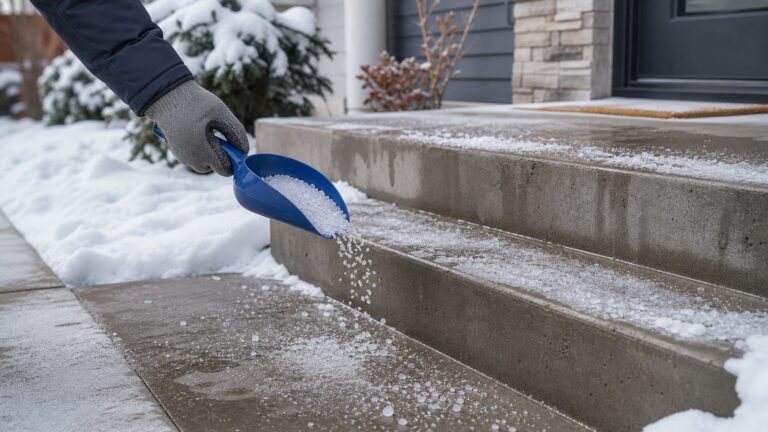
The best time to salt a driveway is usually before ice bonds firmly to the pavement—not after a thick layer of snow and ice has accumulated. Use a light pretreatment when conditions call for it, remove snow mechanically as soon as practical, and reserve deicer for thin residual ice and dangerous patches. The exact timing depends less on the clock than on pavement temperature, precipitation type, and whether the surface is clear enough for the product to reach it.
The most effective driveway deicing sequence
For most residential driveways, the most efficient approach is a three-stage process:
As an Amazon Associate I earn from qualifying purchases.
- Before the storm: If freezing rain, sleet, or a hard-to-remove ice layer is expected, apply a light, even pretreatment to clean or nearly clean pavement.
- During or immediately after snowfall: Shovel or snow-blow as soon as practical. Fresh, loose snow is much easier to remove before vehicles and foot traffic compact it.
- After clearing: Spot-treat only the thin bonded ice, refrozen areas, shaded sections, slopes, and other locations where slipping is a particular concern.
The objective is not to cover the driveway in salt. It is to weaken the bond between ice and pavement, remove most of the snow without chemicals, and use the smallest amount of deicer needed to restore safe footing.
When to pretreat a driveway
A light pretreatment can be useful when the pavement is currently clear or nearly clear and a storm is likely to create bonded ice. It is particularly helpful before:
#1 Best Overall

- Environmental Consideration - This advanced formula is notably less corrosive to concrete than traditional ice melt. The environmentally conscious choice for responsible winter safety management. Apply 2-4 ounces per sq yrd
- Versatile Usage - Perfect for all outdoor surfaces including driveways, sidewalks, steps, balconies, patios, and walkways. The effective formula works in temperatures below zero down to -15, providing reliable performance throughout winter
- Use It Ahead Of Time - This is easy to apply with a shaker or straight from the bag; It is an affordable way to prevent ice formation and should be spread prior to snowfall to make shoveling easier; Follow instructions on the bag for best results
- SAFETY-MAX FORMULA Prevents Refreezing: Once your sidewalk, steps, driveway, or parking lot are clear, they will not refreeze; This adds safety for cars and pedestrians in extreme cold weather
- Freezing rain or sleet;
- Rain followed by freezing temperatures;
- A storm expected to produce a thin, hard-to-scrape ice layer;
- Conditions in which snow will be difficult to remove promptly, such as overnight accumulation or limited access.
Pretreatment gives the deicer a chance to interfere with the bond between the pavement and incoming ice. Later, shoveling or scraping should require less force and less chemical product.
Pretreatment is not a guarantee. Heavy snow, drifting, rain-on-snow, and runoff can dilute or displace the material. Do not interpret a pretreated driveway as one that no longer needs attention. Plan to clear it mechanically during or after the event.
When not to salt immediately
If the driveway is already covered with a deep layer of loose snow, spreading granular salt over the top is usually a poor first move. The product may be unable to contact the pavement, and much of it can be lost in the snow or carried away with meltwater.
What’s actually slowing this PC down?
Pick the symptom - the matching free tool is one click away.
Shovel or blow first. Then apply deicer to the ice that remains. This exposes the pavement, concentrates the product where it can work, and reduces waste.
Rank #2
- Professional Grade Performance - This powerful ice melting formula starts working instantly on contact with ice and snow. The melt ensures complete coverage and lasting results, making winter maintenance effortless and effective. In money-saving 50lb bag
- SAFETY-MAX FORMULA Prevents Refreezing: Once your sidewalk, steps, driveway, or parking lot are clear, they will not refreeze; This adds safety for cars and pedestrians in extreme cold weather
- Versatile Usage - Perfect for all outdoor surfaces including driveways, sidewalks, steps, balconies, patios, and walkways. The effective formula works in temperatures below zero down to -15, providing reliable performance throughout winter
Do not keep adding salt simply because the driveway has not cleared within a few minutes. Deicer must dissolve in liquid water, and it works slowly in very cold, dry, or heavily compacted conditions. Scrape where possible, follow the product label’s dwell-time guidance, and reassess before applying more.
Temperature matters more than the calendar
There is no universally correct rule such as “salt the night before” or “salt first thing in the morning.” The important question is whether the product can work at the temperature of the pavement—not merely the air temperature reported by a weather app.
Rock salt, or sodium chloride, is inexpensive and widely available, but its performance declines as temperatures fall. Guidance from extension and environmental agencies places its practical working range roughly in the mid-teens to the mid-20s Fahrenheit, with best performance generally above about 20–25°F. These are approximate figures, not guarantees. Pavement temperature, moisture, sunlight, concentration, and the specific formulation all affect results.
The Tool Desk
Outbyte PC Repair FREERepair Windows errors before they cause bigger problemsFix Now →Outbyte Driver Updater FREEScan for outdated or missing drivers - takes under a minuteDriver Scan →At lower temperatures, do not assume that using a much larger quantity of rock salt will solve the problem. Check the label and choose a product whose stated working range matches the expected pavement conditions. Calcium chloride generally works at lower temperatures than sodium chloride, while magnesium chloride and calcium magnesium acetate have different temperature performance, costs, and environmental trade-offs.
None of these alternatives is automatically harmless. A lower-temperature product can still injure plants, corrode metal, affect concrete, and contribute chloride or other contaminants to runoff. Compare the active ingredient, labeled temperature range, application instructions, and warnings before buying. If you are comparing products, look for low-temperature ice melt by active ingredient and label—not simply by the words “ice melt” on the package.
What to use in very cold weather
When chemical melting is unreliable, an abrasive may provide more immediate benefit. Sand, traction grit, and similar materials do not melt ice; they provide friction under shoes and tires.
Use an abrasive when:
- The temperature is below the effective range listed for your deicer;
- You need immediate traction while waiting for mechanical removal or sunlight;
- The driveway is near sensitive landscaping, a drainage channel, or a waterway and you want to minimize chloride use;
- You are treating a small walking route rather than trying to melt an entire surface.
Abrasives can be tracked indoors and can wash into storm drains. Sweep up unused material after the event where practical, and do not treat sand as a substitute for scraping bonded ice.
Do these 3 things before closing this tab:
1Repair Windows errors before they cause bigger problems2Fix the driver behind crashes, sound loss and screen glitches3Clear out junk files and repair common Windows errorsRank #3

- Scotwood Industries 9.5J-Heat Prestone Driveway Heat Concentrated Ice Melter, 9.5-Pound (Two Pack)
For this use, traction sand for icy driveway is a more accurate choice than a product marketed only as a melting agent: the purpose is grip, not chemical melting.
How much salt should you use?
More salt does not make ice disappear proportionally faster. Excess product increases the risk of damaged vegetation, contaminated runoff, corrosion, and wasted money.
University extension guidance commonly gives a rough residential reference of about 12 ounces—approximately one standard coffee mug—for a 20-foot driveway or about 1,000 square feet. Treat this as a general starting point, not a universal rate. Product formulations differ, and the package label controls.
Apply crystals in a thin, even distribution. Individual grains should be separated rather than piled in ridges or handfuls. A simple test is to inspect the pavement after the ice has melted and the surface has dried: if large amounts of salt remain visibly scattered, the application was probably excessive.
A small spreader can make an even application easier than throwing handfuls. A handheld salt spreader is especially useful for avoiding concentrated piles along steps, wheel paths, and driveway edges. Keep its setting conservative and adjust only if the label calls for a heavier application.
Do not copy a municipal road-treatment rate onto a residential driveway. Road crews manage different surfaces, traffic loads, drainage systems, and safety conditions. A private driveway generally needs spot treatment, not a broad roadway application.
Rank #4
- Environmental Consideration - This advanced formula is notably less corrosive to concrete than traditional ice melt. The environmentally conscious choice for responsible winter safety management. Apply 2-4 ounces per sq yrd
- Versatile Usage - Perfect for all outdoor surfaces including driveways, sidewalks, steps, balconies, patios, and walkways. The effective formula works in temperatures below zero down to -15, providing reliable performance throughout winter
- SAFETY-MAX FORMULA Prevents Refreezing: Once your sidewalk, steps, driveway, or parking lot are clear, they will not refreeze; This adds safety for cars and pedestrians in extreme cold weather
- Use It Ahead Of Time - This is easy to apply with a shaker or straight from the bag; It is an affordable way to prevent ice formation and should be spread prior to snowfall to make shoveling easier; Follow instructions on the bag for best results
A practical storm-day procedure
Before precipitation begins
- Check the forecast for precipitation type and duration.
- Consider the expected pavement temperature, not just the air temperature.
- Clear leaves, dirt, and existing debris if practical; deicer works best when it can reach the surface.
- If bonded ice is likely, apply a light, even pretreatment rather than a thick blanket of salt.
- Keep product away from drains, planting beds, and areas where meltwater will collect.
During snowfall
Remove snow periodically when accumulation is manageable. Several light clearing passes are generally easier than waiting for a deep layer to become wet, compacted, and icy. Give priority to walking routes, slopes, steps, and areas used by vehicles.
After the storm
- Shovel or snow-blow down to the pavement as far as practical.
- Scrape thin bonded areas with a suitable tool.
- Apply deicer only to the remaining ice and high-risk patches.
- Wait for the product to work according to its label instead of immediately adding more.
- Scrape again if necessary, then remove slush so it does not refreeze.
A snow shovel for driveway supports the most important part of the process: mechanical removal before chemical treatment. Choose a tool you can control safely, and avoid trying to break thick ice with excessive force that could damage the pavement.
Quick wins for a faster PC:
Repair Windows errors before they cause bigger problemsFix Now →Scan for outdated or missing drivers - takes under a minuteDriver Scan →Clear out junk files and repair common Windows errorsFree Scan →Concrete, asphalt, plants, and runoff
Salt is not harmless to the driveway or the property around it. Chloride-laden meltwater can move into lawns, planting beds, streams, and lakes. Salt can also contribute to soil buildup, plant injury, metal corrosion, and deterioration of concrete and other masonry. Splash from passing tires can carry dissolved salt onto nearby foliage and structures.
Reduce the risk by:
- Using the least amount needed for safe passage;
- Keeping piles of salt away from lawns, gardens, trees, and shrubs;
- Sweeping unused crystals from dry pavement;
- Preventing concentrated meltwater from flowing directly into storm drains or waterways where practical;
- Using traction-first methods in environmentally sensitive areas;
- Storing deicer sealed and dry so it does not leak or spread before it is needed.
Calcium chloride, magnesium chloride, and calcium magnesium acetate are not universally “safe” replacements. They may offer different melting performance, but each has its own cost and potential effects on plants, concrete, metal, soil, and water. The right choice depends on the site and the product label.
Independent reader supportYour contribution helps us test, update, and keep practical guides available for everyone.Pets and ice-melt products
Ice-melt products vary, so do not make a universal safety assumption about every chemical or brand. Follow the label, keep animals from licking treated surfaces or eating spilled product, and store the container where pets cannot reach it. If a pet walks across treated pavement, follow your veterinarian’s advice and the product-specific precautions rather than relying on a general claim that one category is harmless.
Best Value
- Effective Ice Melter: Blue Heat ice melt pellets quickly eliminate snow and ice on driveways, sidewalks, and steps for fast winter weather relief
- Powerful Melting Action: Works in temperatures as low as -25 degrees Fahrenheit, providing fast and efficient snow and ice removal with superior heat distribution
- Pet-Friendly Formula: Designed with pets in mind, this ice melter is safer for paws and reduces the risk of irritation, making it ideal for homes with dogs
- Versatile Use: User-friendly 50-pound bag allows for simple spreading on walkways and other outdoor areas, preventing over-application with a visible blue tint
- Safe Application: Made from a blend of calcium, magnesium, and sodium, these pellets are safe for concrete, plants, and vegetation while minimizing impact
Never use fertilizer as homemade deicer
Fertilizer and urea-containing products should not be used as a casual substitute for ice melt. Nutrients can be carried in runoff and contribute to water pollution. A product being capable of dissolving ice does not make it appropriate for a driveway, lawn edge, or drainage area.
Quick decision guide
| Driveway condition | Best first step | What to avoid |
|---|---|---|
| Clear pavement; freezing rain or hard ice expected | Light pretreatment with a suitable, label-rated product | Applying a thick layer “just in case” |
| Loose snow already covering the driveway | Shovel or blow first; spot-treat afterward | Broadcasting salt over deep snow |
| Thin bonded ice | Apply a small amount of appropriate deicer, wait, then scrape | Repeatedly adding salt without reassessing |
| Very cold pavement | Check the product’s low-temperature rating; use traction material if needed | Assuming more rock salt will overcome the temperature |
| Driveway beside plants, drains, or waterways | Minimize chloride and prioritize removal or traction | Leaving piles or allowing concentrated runoff |
The bottom line on timing
The best time to salt is usually before ice bonds tightly, after removing loose snow, and only when a small amount can reach the pavement and work at the current temperature. Treat timing as a process, not a fixed hour: pretreat lightly when appropriate, clear snow promptly, spot-treat residual hazards, and sweep up what remains.
Frequently Asked Questions
Should I salt my driveway before or after it snows?
If freezing rain or a hard-to-remove ice layer is expected, a light pretreatment before the event can weaken the bond. After snowfall begins or ends, remove loose snow first and use deicer only on residual bonded ice and hazardous patches.
At what temperature does rock salt stop working?
Rock salt becomes progressively less effective as pavement temperatures fall. Practical guidance places its useful range roughly from the mid-teens to the mid-20s Fahrenheit, with best performance generally above 20–25°F. Check the specific product label because conditions and formulations vary.
Can I put salt on top of deep snow?
It is usually better to shovel or blow first. Salt applied over deep loose snow may not reach the pavement, can be displaced or diluted, and wastes product. Spot-treat the ice that remains after clearing.
Free tools Windows power users keep installed
One-click scans. No signup required.
Is calcium chloride safer than rock salt?
Not universally. Calcium chloride can work at lower temperatures, but it may still affect plants, concrete, metal, soil, and water. Choose based on the active ingredient, temperature rating, label directions, and conditions at your property.
The Bottom Line
Use a light pretreatment before likely ice bonding, shovel as soon as practical, and spot-treat only the remaining ice. Temperature and pavement condition matter more than whether it is the night before or the morning after a storm. When rock salt is too cold to work, or runoff is a concern, prioritize scraping and traction over adding more chemical.
Quick Recap
Product prices and availability are accurate as of the date/time indicated and are subject to change. Any price and availability information displayed on Amazon at the time of purchase will apply.