Windows Errors? Fix Them Before They Spread
Repair common Windows errors and clear accumulated junk for a smoother, more stable PC - no reinstall needed.Free scan · no reinstallCrashes, No Sound, or Screen Glitches?
Random freezes, missing sound and display glitches usually trace back to one bad driver. Find and replace yours safely.Free scan · under a minuteSome links on this page are affiliate links: if you buy through them we may earn a commission, at no extra cost to you.
The best freestanding tub depends on your bathroom, not on a universal ranking. For many U.S. remodels, a 59- to 63-inch acrylic soaking tub is the most practical place to start. Choose a compact Japanese-style tub when upright deep soaking matters more than a long reclined position, stone resin when substantial construction and a sculptural finish justify the added weight and cost, or a 70- to 71-inch model for a spacious primary bath after checking the floor, delivery route, drain, and hot-water supply.
These are specification-supported recommendations based on published manufacturer and retailer information—not hands-on testing or installation. Treat each pick as a strong option for a particular use case, and verify the final model’s current dimensions, weight, hardware, warranty, price, and availability before ordering.
As an Amazon Associate I earn from qualifying purchases.
Short answer: If you want the broadest practical starting point, investigate a 59- to 63-inch acrylic freestanding soaking tub. The category offers a familiar footprint, moderate water capacity, and generally easier handling than dense stone-resin or cast-iron alternatives. It is not automatically the right choice, though: a deep Japanese-style tub may better suit a small room, while a large primary suite may justify a 70-inch dual-slope tub—provided the structure and water-heating system can handle it.
A freestanding tub is independent of the surrounding walls, but it still needs a nearby drain and water supply, a level and adequately supported floor, a compatible filler, and a delivery path wide and strong enough to bring it into the room.
Popular on Amazon
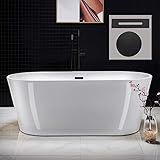
- Dimensions and specifications: Exterior dimension 67'' long x 31 1/2'' wide x 22 4/5'' deep, effective tub capacity 60 gallons
- Non-slip design: Meets ASTM standards for slip resistance, smooth easy-to-clean surface that won't discolor over time
- Premium quality construction: Made from 100% high gloss white LUCITE acrylic, reinforced with ASHLAND resin & fiberglass
- Design inspiration: Luxury, comfort, and chic style, ample yet economical size fits a variety of spaces
- Enduraclean: Easy clean, easy maintenance, stain-resistant, scratch-resistant surface that maintains its high gloss
Quick comparison: the strongest options by use case
| Best for | Specification-supported pick | Published dimensions | Capacity / listed weight | Main caution |
|---|---|---|---|---|
| Most remodels | 59- to 63-inch acrylic freestanding soaking tub | Examples: Streamline N290WH, 59.1 × 29.1 × 28 in.; Getpro GP-347R-59W2, approximately 59 × 30 in. | Streamline: 59 gal.; Getpro: 62 gal. Streamline soaking height: 15 in.; Getpro soaking depth: 15.75 in. Listed product weight should be verified for the chosen model. | Do not assume all acrylic tubs have the same construction, drain hardware, overflow, certification, warranty, or shipping weight. |
| Premium material | Badeloft BW-04-L | 59 × 29.5 × 22.4 in. | 63 gal.; 308 lb. | Its dense construction and listed weight require delivery and floor-support planning. |
| Substantial 61-inch design | Badeloft BW-08 | 61 × 31.5 × 23.6 in. | 64 gal.; 348 lb. | A strong sculptural option only if the route into the bathroom and the floor can accommodate it. |
| Medium premium model | Badeloft BW-03-M | 62.9 × 31.5 × 21.7 in. | 66 gal.; 240 lb. | Confirm the interior bathing posture and faucet compatibility rather than judging by exterior size alone. |
| Small-footprint deep soak | Badeloft BW-06-S or BW-08-S | Both are 47.2 in. long. BW-06-S: 27.5 in. wide × 27.6 in. high; BW-08-S: 27.6 in. wide × 30.7 in. high. | Capacity was not included in the supplied specifications. | Shorter Japanese-style tubs are deep and upright; check step-over height, interior seat dimensions, and accessibility. |
| Spacious primary bath or potential two-person use | Badeloft BW-02-XL or BW-03-XL | Both are 70.8 in. long. BW-02-XL: 31.5 in. wide × 21.3 in. high; BW-03-XL: 35.4 in. wide × 24.4 in. high. | BW-02-XL: 77 gal., 436 lb.; BW-03-XL: 80 gal., 330 lb. | Check structural capacity, hot-water supply, drain alignment, and every turn in the delivery path before purchase. |
Dimensions, capacities, and weights are published figures supplied for this guide. Capacity may be measured to the overflow and is not the same as the water volume used during an ordinary bath.
Best starting point for most remodels: a 59- to 63-inch acrylic tub
Acrylic is the most sensible first category for many standard U.S. bathroom remodels because a roughly 5-foot tub can provide a comfortable soaking footprint without committing the project to the weight and price of a premium mineral-composite tub. It is also a broadly stocked format, which can make replacement, comparison shopping, and coordination with common bathroom layouts easier.
Recommended Free Tools
Two useful current-market examples illustrate the category. The Streamline N290WH is listed at 59.1 by 29.1 by 28 inches, with a 59-gallon capacity and a 15-inch soaking height. The Getpro GP-347R-59W2 is listed at approximately 59 by 30 inches, with a 62-gallon capacity and a 15.75-inch soaking depth. Those figures make both reasonable starting points for a typical remodel, but they do not establish that either is the best tub for every user.
When comparing a 59-inch acrylic freestanding bathtub, look past the word “acrylic.” Confirm whether the tub uses pure, reinforced, or layered acrylic; whether it has double-wall construction; whether the drain and waste-and-overflow hardware are included; how the overflow is designed; what certification claims apply; and what the actual product and shipping weights are. Warranty terms matter as well. Two tubs with similar exterior dimensions can have materially different installation requirements and long-term ownership considerations.
Why this category works
- Familiar footprint: A 59- to 63-inch length fits many primary and larger hall bathrooms more readily than an extra-large tub.
- Moderate capacity: The published 59- to 62-gallon examples are less demanding than the 77- to 80-gallon large models, although the water-heater requirement still needs to be checked.
- More manageable handling: Acrylic is generally a more accessible material category for delivery and placement than a tub weighing several hundred pounds, but the selected model’s shipping weight is the figure that matters.
- Many configurations: Flat-bottom, sloped-back, double-slipper, and other forms are available, so bathing posture can be matched to the user rather than chosen from exterior appearance alone.
Best label: Best starting point for most remodels—not a blanket claim that every acrylic tub is equal.
Best premium material: stone resin
Stone resin is the premium choice for buyers who want a dense, substantial tub with a sculptural appearance and are prepared to solve the associated logistics. Badeloft’s published freestanding lineup includes 27 models ranging from 47.2 to 74.8 inches. At the time of research, its listed prices ran from approximately $3,290 to $4,418; those prices are volatile and should be checked again immediately before publication or purchase.
The most important practical distinction is weight. The Badeloft specifications supplied for this guide list the BW-04-L at 308 pounds, the BW-08 at 348 pounds, and the BW-03-M at 240 pounds. Those are tub weights before adding water and the bather. A stone-resin model may be perfectly appropriate on a properly reviewed floor, but it is not a casual substitute for a lighter tub on an upper level or through a difficult stair turn.
Best premium 59-inch option: Badeloft BW-04-L
The BW-04-L is the most compact of the highlighted premium options at 59 by 29.5 by 22.4 inches. Its listed capacity is 63 gallons and its listed weight is 308 pounds. That combination makes it a reasonable specification-supported choice when the buyer wants a premium material without moving to a 70-inch footprint.
Its 59-inch length does not eliminate the need for a structural and delivery review. Measure the full route from the delivery point, and have the installer confirm the finished floor and assembled load before ordering.
Best sculptural 61-inch option: Badeloft BW-08
The BW-08 measures 61 by 31.5 by 23.6 inches and is listed at 64 gallons and 348 pounds. It is a substantial 61-inch option for a bathroom with enough visual and physical space around the tub. The 348-pound listed tub weight is the deciding caution: delivery access, floor support, and placement equipment deserve as much attention as the finish.
Best medium premium option: Badeloft BW-03-M
The BW-03-M measures 62.9 by 31.5 by 21.7 inches, with a listed 66-gallon capacity and 240-pound weight. It offers a longer medium-size footprint while weighing substantially less than the highlighted BW-08. That comparison is useful, but it does not mean the BW-03-M will feel lighter or more comfortable in every bathing position. Review the interior dimensions, back angle, rim height, and filler reach.
Manufacturers may make claims about stone resin’s antibacterial properties, lifetime durability, or specific heat-retention performance. Those claims should be treated as manufacturer statements rather than independently verified conclusions. The defensible buying point is simpler: the published weights are substantial, and the material category deserves careful planning.
Best for a small bathroom: Japanese-style soaking tubs
A Japanese-style soaking tub, often called an ofuro, uses a different bathing posture from a conventional Western tub. It is shorter and deeper, encouraging the bather to sit upright in a deep soak rather than stretch out in a long reclined position.
The highlighted Badeloft compact models are both 47.2 inches long. The BW-06-S is listed at 27.5 inches wide and 27.6 inches high; the BW-08-S is listed at 27.6 inches wide and 30.7 inches high. Their small exterior length can solve a footprint problem, but the extra height changes how a person gets in and out.
Free tools Windows power users keep installed
One-click scans. No signup required.
Do not size a deep tub by length alone
- Compare the interior seat length and width, not only the outside dimensions.
- Check the effective soaking depth and where the overflow sits.
- Evaluate the rim and step-over height for the people who will use the tub.
- Confirm that the bather can sit without knees, shoulders, or elbows pressing uncomfortably against the walls.
- Consider mobility, balance, grab-bar needs, and the ability to exit a deep tub safely.
- Verify the faucet spout reach and drain location for the selected model.
Best label: Best compact deep-soak format, subject to an interior-dimension and accessibility check. A short tub is not necessarily an easier tub to enter.
Best for a spacious primary bath: large or two-person tubs
A large freestanding tub can provide more room for one bather and may accommodate two people more comfortably, especially when it uses a dual-slope design. But “two-person tub” should not be treated as a guarantee: shoulder room, interior contours, faucet placement, and each person’s size determine whether two people can actually bathe comfortably.
The Badeloft BW-02-XL is listed at 70.8 by 31.5 by 21.3 inches, with a 77-gallon capacity and a 436-pound tub weight. The BW-03-XL is listed at 70.8 by 35.4 by 24.4 inches, with an 80-gallon capacity and a 330-pound weight. The BW-03-XL is wider but has the lower listed tub weight; the BW-02-XL is narrower and substantially heavier. That is why comparing only length or capacity can lead to a poor installation decision.
The floor-load reality
Using the approximate weight of U.S. water, 77 gallons is roughly 642 pounds of water and 80 gallons is roughly 667 pounds. Adding the listed tub weight puts the water-plus-tub subtotal near 1,078 pounds for the BW-02-XL and 997 pounds for the BW-03-XL, before adding a person or people. The real bathing load depends on fill level, because a listed capacity may be measured to the overflow, but the calculation shows why an upper-floor installation needs professional review.
Quick wins for a faster PC:
Clear out junk files and repair common Windows errorsFree Scan →Fix the driver behind crashes, sound loss and screen glitchesFind Drivers →Also popular on Amazon

- ✅ [DIMENSIONS AND SPECIFICATIONS]: Exterior dimensions: 59" Length x 29-1/2" Width x 22-4/5" Height; Internal dimensions: 43-1/4"Length x 19-5/8" Width; Water Depth to Overflow: 14-1/2" Deep. – Effective Tub Capacity: 57 Gallons.
- ✅ [NON-SLIP DESIGN]: This Non-Slip bathtub meets ASTM standards for Slip Resistance to keep our customers safe while providing a smooth easy-to-keep clean surface that won’t discolor over time.
- ✅ [PREMIUM QUALITY CONSTRUCTION]: WOODBRIDGE bathtub is made out of 100% high gloss white LUCITE acrylic and reinforced with ASHLAND resin & fiberglass. All of these are top-quality materials that are rarely used by others due to a relatively high cost.
- ✅ [DESIGN INSPIRATION]: WOODBRIDGE bathtub is a luxury, comfortable, and chic style. Its size is ample yet economical allowing it to fit a variety of spaces. Gently sloping lines follow the natural curves of your body providing exceptional comfort.
- ✅ [ENDURACLEAN]: Easy clean, easy maintenance, stain-resistant, scratch-resistant surface that maintains its high gloss. Can be used for a long time. And keep bright and clean as new.
Ask the manufacturer, structural professional, or qualified contractor to confirm that the finished floor can support the assembled load. This is particularly important for stone, composite, and cast-iron tubs, and for any installation over a framed floor rather than a slab.
Hot-water planning
A large listed capacity can also exceed what a standard water-heating setup comfortably supplies. Capacity is not the same as the amount of hot water drawn from the heater—the incoming cold water is mixed during filling—but a large tub may still require an above-average or dedicated water-heating arrangement. Some manufacturer specifications, including MTI’s guidance for certain freestanding tubs, explicitly flag this possibility. Have the plumber or mechanical contractor compare the tub’s intended fill level with the home’s water-heater recovery and available hot-water capacity.
Best label: Best for a spacious primary bath after structural, delivery, drain, and hot-water checks.
Independent reader supportYour contribution helps us test, update, and keep practical guides available for everyone.Installation requirements that can change the buying decision
A freestanding tub is not necessarily a drop-in purchase. The tub may sit away from the wall, but the plumbing still has to arrive at the correct location, and the drain must connect through the floor without colliding with framing or other services.
1. Measure the entire delivery route
Measure the finished bathroom footprint and every part of the route from the delivery point: exterior and interior doorways, halls, stair landings, stair turns, elevator openings, and tight corners. Include packaging dimensions where the retailer provides them. A tub that fits the finished room can still be impossible to turn through a hallway or bring up a stair.
2. Confirm the finished floor
The floor should be level, solid, and adequately supported. A contractor should review the structure for the complete load, not just the empty tub. Check whether the tub has adjustable leveling feet and follow the manufacturer’s method for supporting and leveling it; do not assume the feet can correct a significantly uneven floor.
3. Locate and dry-fit the drain
Confirm the existing drain rough-in before ordering. The drain may need to be moved or replaced with a dedicated freestanding-tub drain system. Manufacturer installation guidance commonly calls for positioning and leveling the tub, dry-fitting the tub and drain, checking alignment, and testing the drain and overflow for leaks before the installation is closed up.
One relevant accessory is the freestanding tub drain. Oatey’s Universal Freestanding Tub Drain is described as connecting to a 1.5-inch DWV system or to a 2-inch system with its included adapter. Oatey also specifies a 4-inch subfloor opening and an 8-inch joist space for its installation design. Those dimensions are not universal requirements for every tub; compare them with the selected tub’s manual, the actual floor framing, and local plumbing configuration.
Do these 3 things before closing this tab:
1Fix the driver behind crashes, sound loss and screen glitches2Clear out junk files and repair common Windows errors3Scan for outdated or missing drivers - takes under a minuteMAAX’s F2 Drain is a different example of why compatibility matters. MAAX identifies it as exclusively compatible with selected MAAX freestanding tubs and lists a minimum of 10 3/8 inches between the rough floor and the ceiling below for the drain and P-trap assembly. It should not be treated as a universal drain for unrelated models.
4. Plan the tub filler
Most freestanding layouts need a floor-mounted, wall-mounted, or model-approved deck-mounted filler. If the bathroom has no existing tub faucet, a floor-mounted tub filler can keep the supply connection beside the tub, while a wall-mounted filler may work better when the tub is positioned close to a finished wall. The choice depends on wall construction, supply placement, finish, spout reach, valve configuration, and local plumbing requirements.
Do not choose a faucet by finish alone. Confirm the spout reaches the tub without splashing over the rim, the controls remain accessible, the supply lines can be routed correctly, and the filler is compatible with the tub’s placement and installation manual. A faucet that is described generally as a freestanding-tub faucet is not automatically universal.
5. Verify the waste-and-overflow hardware
Check exactly what arrives with the tub. Some models include drain hardware or specify approved waste-and-overflow components; others require the installer to purchase them separately. Compare the overflow location, drain finish, pipe size, connection method, and access requirements. Never order a generic kit solely because it appears to match the tub’s exterior finish.
What’s actually slowing this PC down?
Pick the symptom - the matching free tool is one click away.
6. Level, connect, and leak-test
After the drain and filler are aligned, the installer should level and secure the tub according to the manufacturer’s instructions, complete the waste and overflow connections, and test both the drain and overflow for leaks. Kingston Brass’s installation guidance includes placing and leveling the tub, marking the drain position, confirming the drainpipe location, and adjusting leveling feet where applicable. Use the selected tub and drain manuals as the controlling instructions, and use a licensed plumber where local code or the project scope requires one.
DIY preparation is not the same as DIY plumbing
Permitted DIY preparation may involve tub installation tools, leveling equipment, sealant, and leak-testing supplies, but the correct materials depend on the drain manufacturer and tub manual. Some assemblies call for silicone rather than plumber’s putty, for example. A tool list cannot substitute for a plumbing plan, structural review, or code-compliant connection.
How to choose between the categories
| Choose this | When it makes sense | Do not overlook |
|---|---|---|
| 59- to 63-inch acrylic | You want a practical starting point for a conventional remodel and do not need an unusually deep or oversized tub. | Construction layers, included hardware, actual shipping weight, warranty, and the exact interior dimensions. |
| Stone resin | You prioritize a dense, sculptural premium fixture and have the budget and access for a heavier installation. | Floor support, delivery equipment, stair and doorway clearances, and the difference between manufacturer claims and independently verified performance. |
| Japanese-style soaking tub | You have limited length and prefer sitting upright in a deep soak. | Step-over height, safe entry and exit, interior seating comfort, overflow height, and accessibility. |
| 70- to 71-inch tub | You have a generous primary bath and want more interior room or possible two-person use. | Water volume, floor load, hot-water recovery, drain location, filler reach, and whether the delivery route can handle the tub. |
Price and availability: verify before publication or purchase
Freestanding-tub prices and stock change quickly because of promotions, shipping costs, sellers, finishes, and regional availability. At the time of research, Home Depot displayed the Streamline N290WH at $705.88 after a displayed discount, while Badeloft listed its highlighted stone-resin freestanding models within a much higher premium range of approximately $3,290 to $4,418. These figures are snapshots, not durable market prices.
Before publishing a buying guide or placing an order, recheck the live listing for the exact model, finish, dimensions, capacity, product weight, shipping weight, included drain, warranty, delivery terms, return policy, and stock status. Do not assume a tub is available through a particular marketplace unless that live listing has been confirmed.
Final pre-order checklist
- Bathroom footprint: Measure the finished floor area and leave enough working space to clean around the tub.
- Delivery path: Measure every doorway, hallway, stair turn, landing, and elevator route from the delivery point.
- Exterior dimensions: Record length, width, height, rim height, and any base or leveling-foot dimensions.
- Interior comfort: Check the seat dimensions, back slope, usable soaking depth, overflow height, and expected bathing posture.
- Drain rough-in: Confirm the drain location, pipe size, subfloor opening, joist clearance, P-trap arrangement, and manufacturer-approved components.
- Faucet: Select floor-, wall-, or deck-mounted hardware only after confirming supply routing, spout reach, controls, and compatibility.
- Floor: Have the finished floor and complete assembled load reviewed, especially for upper floors and heavy stone-resin or cast-iron tubs.
- Hot water: Compare the intended fill level with the home’s water-heater capacity and recovery rate.
- Hardware: Verify whether drain, waste-and-overflow, leveling parts, and other installation components are included.
- Final documents: Download the exact installation manual and confirm the model number, warranty, delivery terms, return policy, and current price.
Frequently Asked Questions
Are freestanding tubs difficult to install?
They can require more planning than a wall-adjacent or alcove tub. The installer must coordinate the floor drain, waste-and-overflow assembly, tub filler, leveling, floor support, and leak testing. The tub’s installation manual and local plumbing code control; a freestanding design does not eliminate the need for rough-in work.
Can a freestanding tub go on an upper floor?
Potentially, but the structure must be evaluated for the complete load: tub, water, and bather or bathers. Large models can approach or exceed 1,000 pounds when the listed tub weight and a full water load are combined, before adding people. Have a qualified contractor or structural professional review the floor before ordering.
Does a 60-inch tub hold 60 gallons?
No. Exterior length does not indicate capacity. The highlighted 59-inch examples are listed at 59 and 62 gallons, but capacity may be measured to the overflow and usable bathing volume is lower. Compare the manufacturer’s capacity, interior dimensions, and intended fill level.
Do all freestanding tubs use the same drain kit?
No. Drain compatibility depends on the tub, waste-and-overflow design, pipe size, subfloor opening, joist clearance, and local plumbing configuration. Some products are model-specific, such as MAAX’s F2 Drain, while others have defined connection requirements, such as Oatey’s Universal Freestanding Tub Drain. Check the exact manuals before purchasing.
The Tool Desk
Outbyte PC Repair FREERepair Windows errors before they cause bigger problemsFix Now →Outbyte Driver Updater FREEScan for outdated or missing drivers - takes under a minuteDriver Scan →The Bottom Line
For a typical remodel, begin with a 59- to 63-inch acrylic freestanding soaking tub, then eliminate any model that fails the drain, faucet, delivery, floor, hot-water, or interior-comfort checks. Choose stone resin for a premium, substantial fixture only after confirming its much higher weight and price. Choose a Japanese-style tub for upright deep soaking, and reserve 70-inch-plus models for bathrooms and structures designed to support their size and load.
Quick Recap
Product prices and availability are accurate as of the date/time indicated and are subject to change. Any price and availability information displayed on Amazon at the time of purchase will apply.

