Use municipal water when people may drink it, touch it during food-related work, or when a drinking-water benchmark is required. Use verified STP-treated water for approved non-potable work, and use harvested rainwater as a seasonal supplement. The safe choice depends on test results, treatment reliability, storage, pumping, cost, cross-connection controls and permissions in your state and city.
The decision in one view
Construction sites and landscapes often use large volumes of water for dust suppression, curing-related cleaning, equipment washing, toilet flushing and irrigation. Supplying every one of those uses with potable water can consume a scarce, higher-grade resource. India’s current reuse direction supports treated wastewater for non-potable applications, while rainwater harvesting is promoted as a supplementary source.
As an Amazon Associate I earn from qualifying purchases.
That does not make the three sources interchangeable. Municipal water is the most predictable source and has a drinking-water quality framework. STP water is acceptable only when the treatment plant is performing, the intended use is non-potable, and the system is separated and monitored. Rainwater can be clean at collection but can pick up contaminants from roofs, gutters, tanks and stagnant storage.
Free tools Windows power users keep installed
One-click scans. No signup required.
| Question | Municipal water | STP-treated water | Harvested rainwater |
|---|---|---|---|
| Best role | Drinking, worker facilities, food contact and uses requiring potable quality | Approved non-potable construction, flushing, washdown and irrigation | Supplemental irrigation, dust control and washdown where supply and treatment are adequate |
| Consistency | Generally the most predictable, subject to interruptions and local restrictions | Depends on plant operation, tertiary treatment, pumping and conveyance | Seasonal and dependent on rainfall, catchment and storage |
| Main quality concern | Compliance with drinking-water requirements | Pathogens, solids, organics, nutrients, salinity and treatment reliability | Roof and air contaminants, turbidity, microbiology and storage deterioration |
| Infrastructure | Metered connection or tanker, storage and pumping | Dedicated non-potable tank, dual piping, disinfection where needed and testing | Catchment, first-flush diversion, covered tank, filtration and overflow |
| Permission risk | Water-supply conditions, scarcity controls and construction restrictions | State pollution-control and project conditions; no untreated discharge | Building, drainage and local harvesting requirements |
The practical rule is simple: match water quality to exposure. Do not use potable water merely because it is available, but do not downgrade a use to reclaimed or rainwater without documented treatment and separation.
#1 Best Overall

- 17 IMPORTANT PARAMETERS: The Varify Premium Drinking Water Test Kit offers an unrivaled, complete analysis of your drinking water by testing for 17 essential parameters. This includes crucial tests for chlorine, fluoride, lead, iron, bacteria, and more, ensuring that you're fully informed about the quality of your water. With this extensive range of testing capabilities, you can detect contaminants and imbalances that could affect your health, providing a holistic view of your water's safety.
- PREMIUM QUALITY: Varify stands out with its professional-grade quality, ensuring that every test strip in the kit meets the standards of precision and reliability. Crafted with meticulous attention to detail, this kit is designed to provide you with a dependable and thorough analysis of your water's composition.
- EASY TO USE: Varify's water test strips and Bacteria Test kits feature a user-friendly, color-coded system for quick and precise water quality assessments. With clear color changes indicating various parameters, these strips make complex data easily understandable, ensuring you can evaluate your water's safety effortlessly in just minutes.
- ACCURATE AND RELIABLE: Varify's water test kit comes with 100 strips in 5 separately sealed pouches (20 strips each), preserving freshness and extending shelf life for dependable testing. It also includes 2 easy-to-use bacteria tests that deliver results in 48 hours, ensuring thorough and accurate assessment of your water's safety and cleanliness. This design ensures precision and convenience in monitoring your water quality.
- WATER TESTING KITS THAT GIVE BACK: With every Varify test kit, not only do you secure the safety of your drinking water with our precise and easy-to-use testing solutions, but you also contribute to a global cause. A portion of proceeds goes to Water For Good, fighting water poverty in Central Africa. This means each test not only brings peace of mind to you but also supports #CleanWaterWorldwide, making a real difference in communities in need.
Where STP water fits on a construction site
The Ministry of Jal Shakti identifies treated wastewater uses including flushing, fire protection, vehicle washing, landscaping and horticulture. Guidance reproduced by NITI Aayog and JICA also quotes a CPCB direction that “secondary treated sewage should be mandatorily sold for use for non-potable purposes such asindustrial process, railways & bus cleaning, flushing of toilets through dual piping, horticulture and irrigation.” The same direction says “no potable water to be allowed for such [above] activities.” The wording is a policy direction, not a blanket authorization for every site; state and local rules can be stricter.
Suitable non-potable tasks
- Dust suppression on haul roads and unpaved areas, provided aerosols will not expose the public or workers to avoidable risk.
- Cleaning vehicles, plant and tools where runoff is contained and does not enter storm-water drains.
- Toilet flushing through a clearly separate dual-piping system.
- Landscape irrigation and horticulture after checking salinity, sodium, chloride, nutrients and pathogen controls for the soil, crop and irrigation method.
- Cleaning hardstandings and other work where the water will not contact drinking-water equipment, food or medical materials.
Uses that require a different source or additional approval
- Drinking, cooking, handwashing intended to meet drinking-water quality, or filling potable dispensers.
- Food-contact cleaning and any process in which residues can enter food or beverages.
- Worker showers or first-aid uses unless the water is separately treated and approved to the applicable potable standard.
- Direct discharge to a storm-water drain, watercourse or ground without the required permission and treatment.
Quality numbers to put in the specification
NITI Aayog/JICA guidance reproduces CPCB criteria for new sewage-treatment plants: pH 6.5–9.0, BOD no more than 10 mg/L, COD no more than 50 mg/L, TSS no more than 20 mg/L, ammoniacal nitrogen no more than 5 mg/L, total nitrogen no more than 10 mg/L and fecal coliform below 100 MPN/100 mL. These are treated-effluent benchmarks. They are not a universal permission for every end use, and a project, pollution-control board or client may impose tighter values or extra parameters.
For irrigation, the headline limits are not enough. Ask for electrical conductivity or total dissolved solids, sodium, chloride, alkalinity, nutrients and any metals relevant to the source. Salty water can damage soil structure or sensitive plants even when BOD and TSS comply. Sprinklers and public-facing irrigation also warrant a documented disinfection residual or other pathogen-control approach.
Windows Errors? Fix Them Before They Spread
Repair common Windows errors and clear accumulated junk for a smoother, more stable PC - no reinstall needed.Free scan · no reinstallCrashes, No Sound, or Screen Glitches?
Random freezes, missing sound and display glitches usually trace back to one bad driver. Find and replace yours safely.Free scan · under a minuteOperational controls
Obtain current plant operating records and laboratory reports, not a one-time commissioning certificate. Install a dedicated, covered storage tank and label every tank, valve and outlet “NON-POTABLE—STP TREATED WATER.” Use physically separate pipework, color coding, backflow prevention and locked or controlled filling points. A person unfamiliar with the site should be able to distinguish the system immediately.
Environmental-clearance conditions commonly require tertiary treatment, periodic quality monitoring, on-site reuse for activities such as landscaping, flushing or cooling, and a prohibition on discharging untreated sewage or treated water into storm-water drains. Build those conditions into the method statement, inspection plan and subcontractor briefings.
Rank #2

- Clear Range: This house water testing kit offers clear, easy to read results and acceptable ranges for all substances. The water contaminant tester delivers clear results on any type of water
- Easy to Use: The water hardness test kit for water softener is as easy as adding the water, setting a timer, and reading the results. The pH strips for water testing come with an easy-to-read results guide
- Easy to Understand: The water tester for drinking water comes with a clear guide on the outside of the bottle that lines up with each strip, from alkaline level to soft characteristic readings
- Data Sheet Included: These water testing kits for drinking water include a data sheet to record readings for later analysis. The complete water tester for chemicals has it all
- Peace of Mind: This well water test kit comes with a 17-in-1 test strip and 2 separate bacteria tests to check for coliform and e coli. Knowing what’s in the water for peace of mind is easy
When municipal water is the right choice
Municipal water is the default where people consume the water, where it contacts food, or where the contract or authority requires drinking-water quality. The Government of India references BIS 10500 as the benchmark for piped drinking-water quality. A municipal connection is also useful when a process needs stable quality and pressure and the site cannot reliably operate a treatment, storage and testing system.
Potable supply is often unnecessarily high-grade for ordinary dust suppression, vehicle washing and landscape irrigation. Before allocating it to those tasks, check whether an approved treated-water source is available and whether local scarcity rules restrict construction use. During supply interruptions, maintain a contingency plan rather than quietly connecting a non-potable tank to the potable network.
Recommended Free Tools
Controls for a municipal connection
- Confirm the connection approval, meter arrangement, tariff and any seasonal construction-water restrictions.
- Protect the incoming line against backflow from hoses, tanks, concrete washout and chemical dosing equipment.
- Keep potable taps and hose reels physically separate from reclaimed-water outlets.
- Use a covered tank if storage is required, and clean it under the water supplier’s or project’s hygiene requirements.
- Track consumption so leaks, unauthorized filling and avoidable non-potable use are visible.
How harvested rainwater performs
Rainwater can reduce demand on both municipal and STP supplies, especially during a wet season. Its reliability is governed by local rainfall, roof or hardstand area, runoff losses, tank volume and the length of the dry season. A small catchment with a small tank will not replace a continuous tanker supply during a long dry period.
Collecting it safely
- Use a catchment whose coating, roofing and drainage materials are suitable for the intended non-potable use.
- Install a first-flush diverter so the initial runoff, which can carry dust, bird droppings and roof deposits, is excluded from the tank.
- Fit screens at inlets and overflows, and keep the tank covered to block light, insects and debris.
- Provide a drain or cleanout point so sediment can be removed without entering the distribution line.
- Filter before pumps, sprinklers or sensitive equipment; choose filtration for the actual turbidity and nozzle size.
There is no single national rainwater-quality number established for every construction or landscaping use. Roof materials, air pollution, animals, storage time and maintenance change the result. Test stored water for the intended task rather than assuming that rainwater is potable. At minimum, consider turbidity, pH, conductivity or TDS and microbiology when people may contact the water. Re-test after long storage, an unusual contamination event or a change in catchment.
Using rainwater through the dry season
Size storage from a documented water balance: expected rainfall, catchment area, runoff coefficient, required daily volume and the longest anticipated dry spell. Keep an overflow route that cannot erode the site or flood adjacent property. A level indicator and low-level alarm help operators switch to STP or municipal backup before pumps run dry. Do not blend sources in a common tank unless the tank, treatment and labeling have been designed for the combined risk.
Rank #3
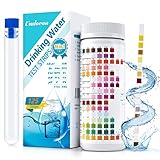
- 🌍 【16-in-1 Water Test Kit】- With Umlecoa water quality test kit, you may know level of Water Hardness, Free Chlorine, Iron, Copper, Lead, Nitrate, Nitrite, Mps, Total Chlorine, Fluoride, Cyanuric Acid, Ammonia Chloride, Bromine, Total Alkalinity, Carbonate, pH easily. Covers main influencing factors which pollute your swimming pool ,hot tub or drinking water quality.
- 🌍【Fast & Accurate Results】- Get accurate results in minutes in just 3 steps. ①Dip an testing strip into water for 2 sec. ②Remove it and hold horizontally for 30-60 sec (Please don't shake excess water off). ③Compare to color chart with up to 99% accuracy. It’s never been this easy to take a drinking water testing, even a child can do it, save your time and money from long trip to laboratory.
- 🌍 【Wide Applicability】- Umlecoa 16 in 1 water test strips can be applied to a wide range of water inspection, including drinking water, pool, hot tub, spa, pond, aquarium and industrial waste water and more water quality test, it is ideal for water testing at home, laboratory or school. For the health of you and your family, please use the professional water test strips to detect water quality standards.
- 🌍 【Home Test Kit】- Package includes: 125 test strips, test tube with cap (help with testing). Ready to use, for your convenience. All kits have safety measures to ensure the quality of your test strips. Economical 125pcs test strips for water in a handy bottle with color card, easy to carry to test anywhere according to your own needs (Tip: Be sure to tighten the cap after taking out the test strip).
- 🌍【Healthy Water & Happy Life】- We promise, we follow a strict quality control on each package and each batch, so you never need to worry about inconsistent or faulty readings on these test strips. If you have any concerns about our water test kit, please contact us now! Umlecoa after-sales service team is online 7*24 hours. Our expert team will provide an efficient and satisfactory solution.
Choose by task, not by source preference
| Site task | Preferred starting point | Conditions before use |
|---|---|---|
| Worker drinking water, kitchen and food contact | Municipal or separately certified potable supply | Meet the applicable drinking-water benchmark; never connect an STP or rainwater line |
| Toilet flushing | STP water or rainwater | Dual piping, backflow protection, clear labels, adequate treatment and local approval |
| Dust suppression | STP water or rainwater, with municipal backup | Control spray drift, worker exposure, runoff and sediment; verify quality and supply continuity |
| Vehicle and equipment washing | STP water or rainwater | Contain wash water, manage oils and chemicals, and prevent discharge to storm drains |
| Landscape irrigation | Rainwater, STP water or a blend by season | Check salinity, sodium, chloride, nutrients, pathogens, plant sensitivity and irrigation method |
| Concrete or material process water | Source specified by the mix or equipment manufacturer | Confirm that dissolved salts, organics and solids will not affect setting, strength, finishes or warranties |
| Fire protection | Dedicated approved non-potable reserve where permitted | Meet fire authority, hydraulic and reliability requirements; do not compromise drinking-water protection |
Concrete production deserves a project-specific decision. The general non-potable reuse policy does not establish that any STP or rainwater is suitable for a particular mix. The concrete designer or supplier should approve the water against the relevant mix requirements and testing plan.
Step-by-step source selection and commissioning
- List every demand. Separate drinking and hygiene, dust, washing, flushing, irrigation, curing-related cleaning and process water. Record daily and peak volumes, pressure needs and the people who may contact each use.
- Classify exposure. Mark each task as potable, close-contact non-potable, or controlled industrial use. Apply the strictest category where spray drift, splash or runoff can reach workers or the public.
- Check permissions first. Review the state pollution-control board, municipal water authority, building approval, environmental-clearance conditions and client specifications. Water is primarily a state subject, so local requirements may exceed national baselines.
- Verify the source. For STP water, obtain the latest laboratory report and plant log. For rainwater, inspect the catchment, first-flush device, tank and filtration. For municipal water, confirm the connection and any scarcity restrictions.
- Compare delivered cost. Include tariff or tanker charges, transport, electricity for pumping, tank and pipework, tertiary treatment, disinfection, laboratory testing, maintenance, standby supply and the cost of disposing of rejected water. A nominally free source can be expensive if it needs a new pump, long pipeline or frequent cleaning.
- Design separation. Use independent tanks and pipework where practical; otherwise use engineered backflow protection, air gaps, locked valves and a documented cross-connection test. Label outlets and hose reels in a durable, visible format.
- Commission with testing. Flush and disinfect new lines as applicable, sample the water at the point of use, verify pressure and flow, and record the result before authorizing the connection.
- Operate by trigger levels. Define actions for failed tests, low tank level, pump failure, odor, turbidity, algal growth, a treatment-plant alarm or a prolonged dry spell. The response may be isolation, retesting, treatment adjustment or a switch to an approved backup.
Testing and records checklist
Use field instruments for rapid checks and an accredited laboratory for compliance decisions. The sampling point should represent the water actually reaching the user, not only the plant outlet or roof inlet.
- STP: pH, BOD, COD, TSS, ammoniacal nitrogen, total nitrogen and fecal coliform against the applicable criteria; add conductivity/TDS, salinity, sodium, chloride, nutrients, metals and residual disinfectant where the use requires them.
- Rainwater: turbidity, pH, conductivity/TDS and microbiology when contact is possible; add metals or other contaminants when the roof, coating or surrounding activity creates a plausible source.
- Municipal: retain the supplier’s compliance information or project sampling required by the authority, and investigate changes in taste, odor, color or pressure.
- All sources: record sample date, location, result, operator, tank level, treatment status, corrective action and release decision.
- Log cubic metres used from municipal, STP and rainwater sources. Compare the log with meters, tanker tickets and rainfall so leaks and unexplained losses are found quickly.
Set a written sampling frequency based on risk, authority conditions and plant variability. “Periodic” is not a substitute for a schedule: state who samples, who reviews results and who has authority to stop use.
Independent reader supportYour contribution helps us test, update, and keep practical guides available for everyone.Common failure modes and fixes
A non-potable line is mistaken for potable water
Correct it with permanent labels, distinct pipe color, locked filling points, physical separation, backflow protection and induction for every new subcontractor. Test for cross-connections after alterations, not only at handover.
STP quality passes once and then deteriorates
Check aeration, clarification, filtration, disinfection, sludge handling, power continuity and operator logs. Isolate the supply, notify the responsible plant operator, sample at the point of use and use an approved backup until results meet the project requirement.
Quick wins for a faster PC:
Fix the driver behind crashes, sound loss and screen glitchesFind Drivers →Repair Windows errors before they cause bigger problemsFix Now →Rank #4

- Every test counts: Water insecurity can cause health problems, and having suffered from it myself, I am keenly aware that I do not want to see any more families affected. HEVEIS is committed to encouraging families in the United States to be aware of water quality issues and to take steps to test water quality regularly and resolve problems in a timely manner. To eliminate the physical effects of water quality. Small actions add up to a big difference, so take action now for the health of you and your family
- Complete and comprehensive: Water testing kits for drinking water offers the most extensive and comprehensive drinking water test kit, so if you want to test your drinking water quality quickly and comprehensively, it's all you need! Once you have it, you'll have peace of mind for the whole family
- Easy to use for everyone: No need to be a specialist, even a child can do it independently; results are obtained in 3 simple steps and the home water test kit is accompanied by clear graphic instructions
- Easy-to-read, real-time record: Still worried about the bottle's colorimetric difficulties and indicator results you can't remember? The water quality test kit is equipped with an independent color comparison chart and record card; by comparing the test strip with the color comparison chart, the results are instantly available and can be recorded on the record card immediately. The record card is also convenient for later analysis of water quality
- In-depth understanding of water quality: Based on actual test results and compared to the EPA standards book, you can clearly understand the meaning and implications of each indicator to help protect your and your family's health. The drinking water testing kit includes EPA standards and detailed descriptions of each indicator. Please contact us if you require a numerical description
Irrigation causes leaf burn or soil problems
Test conductivity, sodium, chloride, alkalinity and nutrient loading; review application rate, drainage, crop tolerance and sprinkler or drip method. Reduce exposure, blend only under an agronomist-approved plan, or change source.
Rainwater storage becomes foul or blocked
Clean the catchment and tank, repair screens, inspect the first-flush device, remove sediment and verify filtration. Re-test before returning the tank to service.
Water use is cheaper on paper but costly in operation
Recalculate total delivered cost with pumping energy, testing, tank cleaning, downtime, tanker queues, treatment chemicals and rejected batches. Compare the cost per usable cubic metre, not the price at the source.
What to put in the project method statement
- A source-and-use diagram showing potable and non-potable networks, tanks, pumps, overflow and discharge points.
- Water-quality limits and sampling locations for each use, with responsible personnel and laboratory requirements.
- Tank, pipe and outlet labeling standards, backflow controls and a cross-connection inspection procedure.
- Rainwater catchment and first-flush maintenance, STP performance review and municipal interruption procedures.
- Runoff, wash-water and sludge management that prevents untreated sewage or treated water from entering storm-water drains.
- Trigger levels and stop-work or source-switch actions for failed results, equipment failure, drought or a change in local permission.
Keep approvals, laboratory certificates, calibration records, tanker receipts, meter readings, inspection photographs and corrective-action logs with the site environmental file. These records demonstrate that reuse was controlled rather than assumed safe.
The Tool Desk
Outbyte PC Repair FREERepair Windows errors before they cause bigger problemsFix Now →Outbyte Driver Updater FREEScan for outdated or missing drivers - takes under a minuteDriver Scan →Frequently asked questions
Frequently Asked Questions
Can STP water be used for curing concrete?
The reuse guidance supports non-potable applications, but it does not approve every concrete mix. Obtain written acceptance from the concrete designer or supplier and test the proposed water against the mix requirements before use.
Best Value

- The Earth Force Low Cost Water Monitoring Kit can be used to test fresh, brackish, or saline aquatic environments.
- This complete kit includes a manual with step-by-step, diagrammed instructions; an easy-to-use laminated color chart, and all the necessary apparatus and non-hazardous TesTabs to test ten water samples (three samples for coliform).
- A popular, economical tool for learning the basics of water quality.
- Students will have fun analyzing sample water for eight different test factors.
Is rainwater automatically safe because it comes from the sky?
No. Roof dust, bird droppings, roofing materials and storage conditions can change its quality. Use first-flush diversion, covered storage and filtration, and test the stored water for the intended task.
Can I connect an STP tank to the municipal line as a backup?
Not as an unprotected connection. Use separate systems or engineered backflow prevention and air gaps approved by the relevant authority, with clear labeling and documented cross-connection testing.
What happens if STP test results fail the project limit?
Isolate the affected water, stop the relevant non-potable use, investigate treatment and conveyance, obtain a confirmatory laboratory sample, and switch to an approved backup until the responsible authority or project manager releases the source.
What’s actually slowing this PC down?
Pick the symptom - the matching free tool is one click away.
Who decides whether reclaimed water is allowed on a site?
The applicable state and local authorities, project environmental-clearance conditions, client specifications and the site’s responsible design and environmental professionals collectively determine the permitted use. National guidance is a baseline, not a replacement for local approval.
Quick Recap
Product prices and availability are accurate as of the date/time indicated and are subject to change. Any price and availability information displayed on Amazon at the time of purchase will apply.

