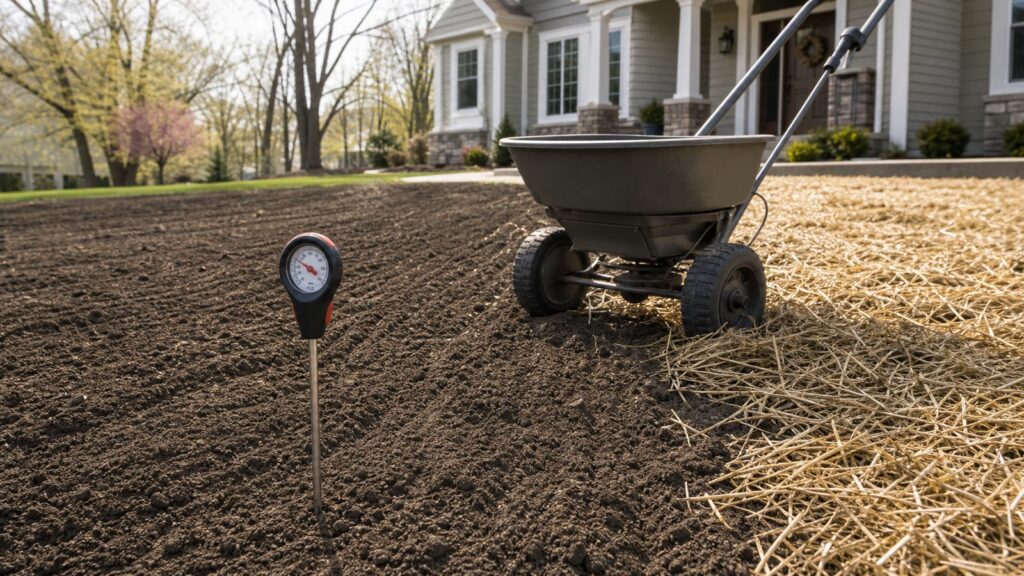
The best time to plant grass seed in spring depends less on the date printed on a lawn care calendar and more on three field conditions: your grass type, your soil temperature, and your local frost pattern. For cool-season lawns, seed when the top 2 to 4 inches of soil is consistently about 50 to 65 degrees Fahrenheit. For warm-season lawns, wait until soil is consistently 65 to 70 degrees Fahrenheit or warmer and the risk of frost has passed.
That usually means late April to May in USDA zones 3 and 4, late March to April in zones 5 and 6, March to April for cool-season grass in zone 7, May to June for warm-season grass in zone 7, and April to June for warm-season seed in zones 8 through 10. Those are useful windows, not guarantees. A shaded north-facing yard in zone 6 can lag two weeks behind a sunny south-facing yard across town.
On our construction and closeout sites, we treat spring seeding like a stabilization job, not a bag-of-seed chore. The seed has to touch prepared soil, the grade has to drain, the surface has to stay damp, and the grass species has to match the climate. Get those pieces right and spring seeding can repair winter damage, thicken a thin yard, or stabilize a new lawn area. Get them wrong and the same seed becomes bird food, washout, or crabgrass competition.
As an Amazon Associate I earn from qualifying purchases.
Free tools Windows power users keep installed
One-click scans. No signup required.
Start With Soil Temperature, Not the Calendar
USDA Plant Hardiness Zones are based on average annual extreme minimum winter temperature. They are excellent for understanding winter survival, but they are not seeding calendars by themselves. A zone tells you how cold your area tends to get in winter; it does not tell you whether your lawn soil is warm enough at 8 a.m. this week.
The practical job-site method is simple: use a soil thermometer at 2 to 4 inches deep in the morning for several days. Morning readings matter because they show the cooler side of the daily cycle. If cool-season seed is going into soil that is still bouncing between 42 and 48 degrees, germination will be slow and uneven. If warm-season seed is planted into 58-degree soil, it may sit there while weeds move faster.
Use these decision rules:
- Cool-season grasses: tall fescue, Kentucky bluegrass, perennial ryegrass, and fine fescue. Seed in spring when soil is consistently 50 to 65 degrees and daytime highs are roughly 60 to 75 degrees.
- Warm-season grasses: bermudagrass, bahiagrass, centipedegrass, and seeded zoysiagrass. Seed when soil is at least 65 degrees, preferably closer to 70 degrees, and frost risk is past.
- Transition-zone lawns: do not use one date for everything. Tall fescue may be seeded in March or April, while bermudagrass often needs May or June.
The last spring freeze date also matters. NOAA freeze data shows that last freeze timing changes with latitude, elevation, coastal influence, urban heat islands, and local terrain. Two homes in the same USDA zone can have different frost risk, especially if one is in a low, open area and the other is in a warmer urban neighborhood.
#1 Best Overall

- SUN AND SHADE GRASS SEED: This combination lawn seed, grass fertilizer, and soil improver thrives in a variety of conditions
- WHEN TO APPLY: Use this sun and shade lawn grass seed mix to seed a new lawn or overseed an existing lawn in the spring or fall when daily average soil temperatures are consistently between 55°F and 70°F, or air temperatures between 60°F and 80°F
- GROW THICK, GREEN GRASS: Scotts Turf Builder Grass Seed Sun & Shade Mix features Root-Building Nutrition crafted to help establish deep roots to build a better, stronger lawn
- WHERE TO USE: This grass seed for lawns is designed for full sun and moderate shade, and has medium drought resistance with medium to high durability
- COVERAGE: One 5.6 lb. bag of Scotts Turf Builder Grass Seed Sun & Shade Mix has a new lawn coverage of 745 sq. ft. and an overseeding coverage of 2,240 sq. ft.
Spring Grass Seeding Timing by USDA Zone
The table below gives practical spring windows for most residential lawns. Use it as a planning guide, then confirm with a soil thermometer and a 7- to 10-day forecast before buying materials or scheduling a crew.
Quick wins for a faster PC:
Scan for outdated or missing drivers - takes under a minuteDriver Scan →Repair Windows errors before they cause bigger problemsFix Now →| USDA zone | Typical spring window | Best grass type | Soil temperature target | Contractor note |
|---|---|---|---|---|
| Zones 3-4 | Late April to May | Cool-season: Kentucky bluegrass, fine fescue, perennial ryegrass, tall fescue where adapted | 50-65 degrees F | Use spring mainly for repair and overseeding. Save full renovations for late summer or early fall when possible. |
| Zones 5-6 | Late March to April, sometimes early May | Cool-season: tall fescue, Kentucky bluegrass, perennial ryegrass, fine fescue | 50-65 degrees F | Watch crabgrass pressure closely because crabgrass starts germinating around 55 degrees F soil temperature. |
| Zone 7 | March-April for cool-season; May-June for warm-season | Tall fescue or warm-season grasses depending on region, sun, irrigation, and use | 50-65 degrees F for tall fescue; 65-70 degrees F or warmer for warm-season | This is the transition zone. Match the seed to the lawn’s long-term summer heat and winter exposure. |
| Zones 8-10 | April-June for warm-season seed | Bermudagrass, bahiagrass, centipedegrass, zoysiagrass where locally adapted | 65-70 degrees F or warmer | Cool-season grass is usually a temporary winter overseed or special microclimate choice, not the main permanent lawn. |
For zones 3 through 6, fall is still the preferred season for major cool-season lawn establishment because seedlings get cooler weather, less weed pressure, and more time to root before summer heat. Spring can still work, but it should be treated as a narrower window. If you seed cool-season grass too late in spring, the seedlings may enter July with shallow roots and low drought tolerance.
For zones 8 through 10, the common mistake is going too early. Warm-season grass is built for heat, but its seed still needs warm soil. A warm afternoon in March does not mean the ground is ready. Wait for consistent soil warmth and stable weather.
Choose the Right Grass Before You Buy Seed
The seed label matters. The right spring timing will not save the wrong grass species. A shaded, irrigated, low-traffic lawn in Minnesota needs a different mix than a full-sun, low-water yard in Georgia or Texas.
Cool-season options
Tall fescue is a strong choice in many zone 5, 6, and 7 lawns because it handles heat and traffic better than many cool-season grasses. Tall-fescue-heavy mixes are often seeded around 5 to 10 pounds per 1,000 square feet depending on site conditions, use, and the exact blend.
Kentucky bluegrass creates a dense, spreading lawn, but it is slower to germinate. It can take 2 to 3 weeks to show well. That delay matters in spring because homeowners often stop watering after the ryegrass in a mix appears, while the bluegrass is still working. Typical Kentucky bluegrass rates may be around 2 pounds per 1,000 square feet, depending on the mix and renovation method.
Perennial ryegrass germinates quickly and is useful in blends, but it should not be chosen only because it pops first. Fast emergence is helpful; long-term suitability matters more.
Fine fescue can be useful in lower-input and shaded areas, but it should be matched carefully to traffic, moisture, and mowing expectations.
Warm-season options
Bermudagrass is common for sunny, durable lawns in warmer regions. It wants heat and sun. Seed too early and germination suffers; seed too late and establishment may not be strong before cooler fall weather arrives.
The Tool Desk
Outbyte PC Repair FREERepair Windows errors before they cause bigger problemsFix Now →Outbyte Driver Updater FREEFix the driver behind crashes, sound loss and screen glitchesFind Drivers →Bahiagrass is often chosen for lower-maintenance warm climates and larger areas, but the texture and appearance are different from a manicured cool-season lawn.
Centipedegrass can work in the Southeast where lower fertility and lower mowing inputs are desired, but it is not a fit for every soil or traffic pattern.
Rank #2

- Sun and shade grass seed for use in full sun to medium-shaded areas
- This bag of tall fescue grass seeds for lawns covers up to 4,000 sq. ft.
Zoysiagrass is often installed as sod or plugs, but seeded varieties exist. It is slower to establish than bermudagrass and needs patience.
Prepare the Seedbed Like a Small Grading Job
Grass seed does not need luxury treatment, but it does need contact with mineral soil. Seed scattered over thatch, leaves, compacted clay, or old dead grass will germinate poorly. On job sites, we look at grade, drainage, compaction, soil condition, and erosion risk before we look at the seed bag.
Recommended Free Tools
A reliable spring seeding sequence looks like this:
- Test the soil. Check pH and major nutrient needs before throwing fertilizer at the lawn. Correcting pH can matter more than adding more nitrogen.
- Remove heavy debris and loose thatch. Seed must reach soil. A thin layer of old turf is fine; a mat that keeps seed suspended is not.
- Fix drainage and grade first. Low spots, tire ruts, and washout channels should be corrected before seeding. A finished lawn surface should shed water without concentrating flow across bare soil.
- Loosen the surface. For thin lawns, core aeration or slit seeding improves seed-to-soil contact. For bare soil, rake or lightly till the top layer without creating a fluffy bed that settles unevenly.
- Seed at the correct rate. More seed is not automatically better. Over-seeding can create weak seedlings fighting for the same water and nutrients.
- Rake lightly. A good target is to have only about 10 to 15 percent of the seed still visible after raking.
- Firm the soil. Use a light roller or lawn roller with minimal weight. The goal is contact, not compaction.
- Mulch where needed. Straw, erosion-control blanket, or hydroseeding mulch can protect seed from drying out and washing away.
- Water immediately. The first irrigation should wet the seedbed without moving seed downhill.
For slopes, swales, and new-construction yards, hand broadcasting is often not enough. Erosion-control blanket, tackified straw, or hydroseeding can be the difference between a stabilized surface and a spring thunderstorm sending seed into the gutter. On permitted construction work, final stabilization and erosion control are often part of closeout, not optional landscaping polish.
Watering New Grass Seed in Spring
Spring seeding fails more often from inconsistent moisture than from bad seed. The upper soil surface must stay damp until germination is complete for every species in the mix. That is easy to underestimate when ryegrass appears in 5 to 10 days but Kentucky bluegrass still needs another week or two.
Use this watering pattern as a starting point:
- Days 1-14: water lightly 1 to 3 times per day as needed to keep the top 1/4 to 1/2 inch of soil damp. Do not create puddles or runoff.
- Days 15-28: reduce frequency gradually and water a little deeper as seedlings root.
- After first mowing: shift toward deeper, less frequent watering to encourage roots. Many lawns perform better with about 1 inch of water per week from rainfall and irrigation combined, adjusted for soil and heat.
Clay soil may need shorter cycles because water runs off before it soaks in. Sandy soil may need more frequent light watering because it dries faster. Slopes need slower application rates or temporary protection. If a municipal watering restriction is in place, adjust the timing or consider delaying seeding rather than starting a lawn you cannot legally water.
PC Slower Than It Used to Be?
A free scan shows the junk files, broken settings and background clutter dragging Windows down - then fixes them in one click.Free scan · Windows 10 & 11Outdated Drivers Are Slowing You Down
One free scan finds every outdated or missing driver and matches the right update for your exact hardware.Free scan · exact hardware matchDo not mow too early. Wait until seedlings are tall enough that mowing removes no more than the top third of the blade. For many cool-season lawns, first mowing is often around 3 to 4 inches of height, using a sharp blade and dry ground.
Spring Weed Pressure and Crabgrass Timing
Spring cool-season seeding overlaps with crabgrass. Crabgrass can begin germinating around 55 degrees Fahrenheit soil temperature, which is right in the same range where many cool-season grasses start well. That is the main reason fall is the better renovation season in much of the North.
The mistake to avoid is applying a standard crabgrass preventer or weed-and-feed product before seeding. Many pre-emergent herbicides prevent desirable turf seed from germinating too. Read the label closely. If the product is not specifically labeled as safe for new seed, assume it can interfere.
For spring seeding, the best weed-control plan is usually:
- Seed at the right soil temperature, not too late.
- Improve turf density with correct seed rate and good contact.
- Use starter fertilizer only as soil test and label directions allow.
- Delay broad weed control until the new lawn is mature enough for the labeled product.
- Spot treat later instead of sacrificing germination at planting.
There are starter-safe herbicide options for certain turf situations, but they are product- and species-specific. This is where a local lawn professional or extension recommendation can prevent an expensive mistake.
Rank #3

- This pack of lawn seeds is ideal for new lawns, overseeding and lawn repair
- All-purpose lawn grass seed mix formulated and mixed specifically for the region of the country where it is sold
- Pennington Contractors Grass Seed Mix is a pack of spring and fall grass seeds for lawn
- Pennington Contractors Grass Seed Mix is a pack of spring and fall grass seeds for lawn
- See effects in 7 to 21 days with this grass patch repair for lawn
What Spring Lawn Seeding Costs in 2026
Spring seeding can be inexpensive if you are repairing a small thin area. It can also become a real site-work line item if the lawn needs grading, topsoil, erosion control, irrigation attention, or old turf removal.
| Project type | Typical 2026 cost range | What changes the price |
|---|---|---|
| Grass seed material | About $2-$6 per pound for common turf seed | Premium coated, drought-tolerant, shade, native, or low-mow mixes cost more. |
| DIY reseeding, 5,000 sq ft | About $50-$300 for seed alone; $150-$700+ with supplies and rentals | Starter fertilizer, soil test, compost or topsoil, straw, aerator rental, and spreader rental add cost. |
| Professional lawn seeding | Commonly about $0.09-$0.20 per sq ft, or roughly $427-$1,514 total on many residential jobs | Prep level, access, soil condition, labor market, and contractor minimums drive the quote. |
| Professional 5,000 sq ft seeding | About $500-$1,000 for basic work; $1,750-$4,250 with full prep, grading, amendments, and labor | New lawn work costs more than simple overseeding. |
| Hydroseeding | About $0.06-$0.22 per sq ft; often $2,136-$4,897 per acre, with $300-$500 minimums | Good option for larger areas, slopes, and faster coverage where mulch and tackifier help. |
| Installed sod comparison | Often about $0.87-$1.76 per sq ft, with some guides showing $1.00-$2.60 per sq ft | Sod is much faster but substantially more expensive than seed. |
Hidden costs are where homeowners get surprised. Water use during establishment can be noticeable. A failed seeding after applying the wrong pre-emergent can force a full redo. Heavy rain can wash seed out of a sloped yard. Irrigation systems may require backflow inspection or local permitting. In some municipalities, grading and erosion-control permits apply when you change drainage, disturb larger areas, or work near stormwater routes.
When to DIY and When to Hire a Pro
DIY seeding makes sense when the yard is mostly level, the soil is not badly compacted, irrigation is available, and you are overseeding or repairing a manageable area. If you can mow the yard safely, push a spreader evenly, rake the surface, and water consistently for several weeks, you can handle many spring overseeding jobs.
A reasonable DIY scope is a 500 to 5,000 square foot thin lawn where the grade already works. Expect to spend a weekend on prep and setup, then several weeks managing water. Rent a core aerator if the soil is compacted. Use a broadcast spreader for larger areas and a hand spreader for edges and patches. Mark irrigation heads before aerating or slit seeding.
Hire a pro when the work starts to look like site preparation instead of lawn care. That includes new-construction yards, compacted subsoil, steep slopes, drainage corrections, large bare areas, erosion-control requirements, poor access, or lawns where failure would be expensive. A contractor can bring slit seeders, aerators, Harley rakes, compact loaders, hydroseeding equipment, erosion blankets, and the crew size to finish before weather changes.
For a homeowner, the dividing line is not pride; it is risk. A 1,000 square foot overseed is forgiving. A 12,000 square foot sloped backyard with bare clay and stormwater flow is a different job.
Independent reader supportYour contribution helps us test, update, and keep practical guides available for everyone.Permits, Irrigation, and Site Safety Notes
Basic overseeding usually does not require a permit. Regrading, changing drainage, disturbing larger soil areas, working near storm drains, or installing irrigation can trigger local requirements. Some jurisdictions require grading or erosion-control permits. Construction sites covered by stormwater rules may need final stabilization before closeout. Irrigation systems can require backflow prevention, inspection, and approved connection details.
Do these 3 things before closing this tab:
1Repair Windows errors before they cause bigger problems2Scan for outdated or missing drivers - takes under a minute3Clear out junk files and repair common Windows errorsBefore you move soil, ask three practical questions:
- Will this change where water flows?
- Will bare soil be exposed during a rain event?
- Will an irrigation system connect to potable water?
If the answer is yes, check local rules before work starts. It is cheaper to install a silt fence, blanket, or proper backflow device upfront than to redo the work after a washout or failed inspection.
Also protect utilities and site features. Call 811 before any digging, grading, irrigation trenching, or stake-driving that could reach underground lines. Keep soil and seed out of storm drains. Do not run compact equipment across septic fields, shallow irrigation lines, or soft wet soil unless the site has been evaluated.
Common Spring Seeding Mistakes to Avoid
The biggest mistake is planting by calendar date only. A warm weekend can be followed by a cold week, and soil temperature changes slower than air temperature. Confirm the soil and forecast before seeding.
The second mistake is using USDA zone as the only guide. Zone 6 in a windy inland site is not the same as zone 6 in a protected urban lot. Elevation, exposure, shade, soil type, and irrigation all change the result.
Rank #4

- WHEN TO APPLY : This lawn seed mix of Kentucky bluegrass seed, perennial ryegrass, and fine fescue grass seed germinates best when daytime temperatures are between 60°F and 80°F with no danger of frost
- PATCH & REPAIR: Scotts EZ Seed Patch & Repair Sun and Shade is a revolutionary grass seeding product that makes grass patch repair for lawns easy; it's designed to fill in bare spots and repair lawn damage
- COVERAGE: One 3.75 lb. jug of EZ Seed Patch & Repair lawn grass seed mix covers up to 85 sq. ft. in 3 easy steps: prep the area, evenly apply the seed and water until no more water is being absorbed
- WHERE TO USE: This sun and shade lawn repair grass seed mix is guaranteed to grow anywhere with proper care including in full sun, dense shade, high traffic areas and on slopes
- SUN AND SHADE GRASS: Contains a combination of high performance grass seed for lawns, mulch that expands to surround the seed, controlled release fertilizer, tackifier to help keep seed from washing away and a protectant to help keep seedlings safe
The third mistake is seeding cool-season grass too late in spring. If the seedlings are still weak when summer heat arrives, watering demand climbs and survival drops. In zones 3 through 6, if you miss the good spring window, it may be smarter to stabilize bare soil lightly and schedule the real renovation for late summer or fall.
Other common failures include applying crabgrass preventer before seeding, burying seed too deep, skipping soil testing, leaving seed on compacted thatch, using the wrong grass for shade or traffic, and stopping irrigation as soon as the first green haze appears.
The Bottom Line
For spring grass seeding, use the growing zone to set your planning window, then let soil temperature make the final call. Cool-season lawns usually want 50 to 65 degree soil. Warm-season lawns usually need at least 65 to 70 degree soil after frost risk has passed. In zones 3 through 6, spring is best for repair and overseeding; fall is usually better for full renovation. In zones 7 through 10, match the grass type carefully because cool-season and warm-season lawns operate on different clocks.
What’s actually slowing this PC down?
Pick the symptom - the matching free tool is one click away.
The work is not complicated, but it is sequence-sensitive: test soil, correct major problems, prepare the grade, create seed-to-soil contact, seed at the right rate, firm the surface, protect it from washout, and water long enough for the slowest seed in the mix to establish. That is how you turn spring seeding from a hopeful weekend chore into a lawn that can actually make it through summer.
Frequently Asked Questions
What soil temperature is best for planting grass seed in spring?
Cool-season grass seed performs best when soil is consistently about 50 to 65 degrees Fahrenheit. Warm-season grass seed should generally wait until soil is at least 65 degrees, preferably 70 degrees or warmer, and frost risk has passed.
Is spring or fall better for planting grass seed?
For cool-season lawns in much of the northern U.S., fall is usually better because weeds are less aggressive and seedlings have more time to root before summer. Spring is still useful for repair, overseeding, and stabilization when timed correctly.
When should I plant grass seed in USDA zone 5, 6, 7, or 8?
Zones 5 and 6 are often late March through April for cool-season grass. Zone 7 is usually March to April for tall fescue and May to June for warm-season grass. Zone 8 is typically April to June for warm-season grass seed.
What’s actually slowing this PC down?
Pick the symptom - the matching free tool is one click away.
Can I plant grass seed before the last frost?
It is risky. A light frost may not kill all seed, but cold soil slows germination and can leave seed exposed longer. For warm-season grass, wait until frost risk is past. For cool-season grass, use soil temperature and the 7- to 10-day forecast before seeding.
Can I use crabgrass preventer after planting grass seed?
Many crabgrass preventers also stop turf seed from germinating. Use only products specifically labeled as safe for newly seeded lawns and your grass type. When in doubt, prioritize establishment first and handle weeds later.
How much does it cost to seed or overseed a lawn in 2026?
Common 2026 professional seeding ranges are about $0.09 to $0.20 per square foot, with many jobs around $427 to $1,514 total. A 5,000 square foot DIY reseed may cost $150 to $700 or more once seed, soil test, fertilizer, mulch, rentals, and prep supplies are included.
Quick Recap
Product prices and availability are accurate as of the date/time indicated and are subject to change. Any price and availability information displayed on Amazon at the time of purchase will apply.

