A solar panel’s watt rating is not its daily energy production. A 400 W panel can produce up to 400 W of DC power under Standard Test Conditions, but its real output changes with sunlight, temperature, angle, shade, equipment losses, and season. With four equivalent peak-sun-hours and an illustrative 80% delivery factor, a 400 W panel produces about 1.28 kWh per day.
A solar panel produces its rated wattage only under standardized test conditions—not continuously throughout the day. A 400-watt panel is rated to produce up to 400 watts of DC power at a particular moment. In a real installation, its daily energy production depends on sunlight, temperature, orientation, shading, system losses, and the number of equivalent peak-sun-hours available at the site.
As an Amazon Associate I earn from qualifying purchases.
For a practical estimate, use:
Daily energy (kWh) = panel wattage ÷ 1,000 × peak-sun-hours × system delivery factor
The Tool Desk
Outbyte PC Repair FREERepair Windows errors before they cause bigger problemsFix Now →Outbyte Driver Updater FREEScan for outdated or missing drivers - takes under a minuteDriver Scan →Using four peak-sun-hours and an illustrative 80% delivery factor, a 400 W panel would produce approximately 1.28 kWh per day. That is an estimate, not a guarantee. Actual output may be higher or lower depending on the location, season, weather, roof design, equipment, and operating conditions.
#1 Best Overall

- ⚡ Professional-Grade PV Testing Measures maximum power (Pmax) up to 1000W, open-circuit voltage (Voc: 12-80V), and short-circuit current (Isc: 35A) with ±0.8% accuracy, ideal for validating solar panel performance in R&D, manufacturing, and field maintenance.
- ⚡ MPPT Efficiency Optimization Tracks Vmp (80V) & Amp (35A) in real-time to identify panel degradation or shading issues, helping installers maximize energy harvest and ROI for residential/commercial systems.
- ⚡ Industrial Safety & Durability Rated CAT III 1000V/CAT IV 600V with double-insulated probes, meeting IEC/EN 61010 standards for safe use on high-voltage PV arrays and combiner boxes.
- ⚡ Smart Data Management Features data hold + backlit LCD for reading values in dark environments (e.g., rooftops)
- ✅ Engineered for Solar Professionals Auto-ranging simplifies operation for technicians, while IP54 dust/water resistance and low-power auto-off ensure reliability in outdoor installations.
Watts and kilowatt-hours are not the same
Many solar-output mistakes come from treating power and energy as interchangeable:
- Watts (W) measure the rate at which a panel produces electricity at a given moment.
- Watt-hours (Wh) and kilowatt-hours (kWh) measure the amount of energy produced over time.
For example, a panel producing an average of 200 W for five hours generates approximately 1,000 Wh, or 1 kWh, before additional inverter, battery, or other conversion losses.
A panel’s nameplate rating is therefore a capacity figure, not a promise of daily production. A 400 W panel does not produce 400 W for four, eight, or 24 hours.
Do these 3 things before closing this tab:
1Clear out junk files and repair common Windows errors2Fix the driver behind crashes, sound loss and screen glitches3Repair Windows errors before they cause bigger problemsWhat does a panel’s watt rating mean?
Manufacturers rate photovoltaic modules under Standard Test Conditions (STC). STC commonly uses:
- 1,000 W/m2 of solar irradiance;
- a cell temperature of 25°C; and
- an AM1.5 reference solar spectrum.
These conditions provide a consistent basis for comparing panels in a laboratory. Outdoor conditions are rarely identical. Irradiance changes during the day, cells become hotter than the surrounding air, the panel may not face the sun directly, and the inverter and wiring introduce additional losses.
A panel can briefly approach its rated output when sunlight is strong, the module is relatively cool, the panel is well aligned with the sun, and the electrical system allows it to operate at its maximum-power point. Even on a bright day, however, the instantaneous reading will commonly be below the nameplate rating.
How much energy does a solar panel produce per day?
The most useful first estimate is based on equivalent peak-sun-hours. The calculation is:
What’s actually slowing this PC down?
Pick the symptom - the matching free tool is one click away.
Daily kWh = (panel watts ÷ 1,000) × equivalent peak-sun-hours × delivery factor
The delivery factor represents the electricity remaining after practical system losses. It should be treated as an assumption for estimating—not as a universal rating for every installation.
Illustrative daily-output examples
| Panel rating | Peak-sun-hours | Assumed delivery factor | Estimated daily energy |
|---|---|---|---|
| 100 W | 4 | 80% | 0.32 kWh |
| 200 W | 4 | 80% | 0.64 kWh |
| 400 W | 4 | 80% | 1.28 kWh |
| 400 W | 5 | 80% | 1.60 kWh |
For the 400 W, four-hour example:
0.4 kW × 4 hours × 0.8 = 1.28 kWh per day
These figures are useful for understanding the calculation, but they are not production guarantees. A roof in a shaded, cloudy, or snowy location may produce substantially less, while a well-oriented site with strong solar resource may produce more.
Peak-sun-hours are not daylight hours
Four peak-sun-hours does not necessarily mean the panel receives four hours of daylight. Peak-sun-hours convert changing sunlight throughout the day into the equivalent number of hours at 1,000 W/m2.
Rank #2

- ⚡ Professional-Grade PV Testing Measures maximum power (Pmax) up to 2000W, open-circuit voltage (Voc: 12-150V), and short-circuit current (Isc: 35A) with ±0.8% accuracy, ideal for validating solar panel performance in R&D, manufacturing, and field maintenance. shading issues, helping installers maximize energy harvest and ROI for residential/commercial systems.
- ⚡ MPPT Efficiency Optimization Tracks Vmp 150V) & Amp (35A) in real-time to identify panel degradation or
- ⚡ Industrial Safety & Durability Rated CAT III 1000V/CAT IV 600V with double-insulated probes, meeting IEC/EN 61010 standards for safe use on high-voltage PV arrays and combiner boxes.
- ⚡ Smart Data Management Features data hold + backlit LCD for reading values in dark environments (e.g., rooftops)
- ✅ Engineered for Solar Professionals Auto-ranging simplifies operation for technicians, while IP54 dust/water resistance and low-power auto-off ensure reliability in outdoor installations.
For instance, a site could receive usable sunlight over a much longer period, but with irradiance varying from weak morning and afternoon levels to stronger midday levels. Those changing conditions may add up to four equivalent hours at the reference irradiance.
Peak-sun-hours vary with:
- geographic location;
- season and day length;
- cloud cover, haze, and rain;
- panel tilt and azimuth;
- nearby trees, buildings, chimneys, and roof features; and
- snow, dust, and other obstructions.
How much would a 6 kW solar array produce?
A 6 kW DC array has six times the nameplate capacity of a 1 kW array, assuming comparable conditions and no inverter or other system bottleneck.
Using four equivalent peak-sun-hours and an illustrative 80% delivery factor:
6 kW × 4 hours × 0.8 = 19.2 kWh per day
If that daily average applied uniformly throughout the year, the result would be approximately 7,008 kWh annually. Real production will not be uniform. Monthly and seasonal totals change with weather, sun angle, day length, snow, shading, orientation, inverter clipping, degradation, and downtime.
Recommended Free Tools
A 6 kW array’s DC nameplate capacity also does not mean the home receives 6 kW of AC electricity continuously. The inverter converts the panels’ DC output to AC, and the system may produce less—or occasionally be limited by the inverter at high output.
What reduces solar panel output?
1. Irradiance, clouds, and weather
Solar cells need light, and output generally falls when clouds, haze, rain, dust, or nearby obstructions reduce irradiance. Production changes constantly over the day and across the year as the sun’s position and the available daylight change.
Snow can have two effects: a bright surface may reflect light toward a panel after the panel is clear, but snow covering the module can sharply reduce or stop production until it sheds or is removed safely.
2. Orientation and tilt
The angle at which sunlight strikes the module affects the available output. In the Northern Hemisphere, due-south orientation and a tilt near the site’s latitude are general starting points for maximizing annual production. They are not universal design rules.
A roof’s actual geometry may make another orientation more practical. Southeast- through southwest-facing roof planes can perform well in many residential applications, while a design intended to emphasize morning or afternoon production may deliberately use a different orientation.
For construction or reroofing work, assess roof pitch, azimuth, obstruction heights, future shading, equipment clearances, attachment locations, and local structural and electrical requirements before treating the available roof area as usable solar area.
3. Heat
Bright sunlight does not guarantee nameplate output. Photovoltaic cells generally perform better at lower temperatures. As cell temperature rises, current may increase slightly, but voltage usually falls more substantially, reducing total power.
Rank #3

- Comprehensive Solar Panel Testing: UT673PV solar MPPT meter can effectively identify any abnormalities in solar panels by testing their maximum power, peak power voltage, peak power current, open circuit voltage, and short circuit current
- Wide Measurement Range: Maximum power test (Pmax) 5~800W, Peak power voltage (Vmp) 12~60V, Peak power current (Imp) 0~35A, Open circuit voltage (Voc) 12~60V, Short circuit current (Isc) 0~35A
- Multi-Language Support and Simultaneous Display: Featuring a spacious screen and automatic measurement capabilities, this device conveniently displays all measurement results simultaneously. Free switching of multiple languages ( EN, FR, DE, IT, ES, SV, PL, CZ )
- Portable and Self-Powered Design: Large screen and multiple result display. No batteries needed, powered by the solar panel. Equipped with MC4 test lead. Its portable design enables easy carrying, greatly enhancing the operational and maintenance efficiency for photovoltaic manufacturers, installers, and end users
- Complete Package Contents: What you get: 1 x UT673PV Solar MPPT Meter, 1 x paper Manual, 1 x Cloth Bag, 1 x MC4 wrench Tool, 1 x MC4 test lead with Safety Class CAT 0 60V rating
This is why a hot, fully illuminated roof-mounted panel can produce less than its STC rating. Module temperature—not simply the outdoor air temperature—is relevant, because dark modules exposed to strong sunlight can become considerably hotter than the surrounding air.
Free tools Windows power users keep installed
One-click scans. No signup required.
4. Shade and electrical mismatch
Partial shade from a tree, chimney, parapet, vent, or neighboring structure can reduce output disproportionately, particularly in conventional string arrangements. The effect depends on the system design, the pattern and timing of the shade, bypass-diode behavior, and the affected modules.
Microinverters allow panels to operate more independently. As a result, shade or a fault affecting one panel does not influence the rest of the array in exactly the same way as it may in a central or string-inverter arrangement. That does not make a shaded roof productive; it changes how the impact is managed.
5. Inverter and wiring losses
Solar modules produce DC electricity. Most household and grid-connected systems use an inverter to convert that DC electricity to AC. Conversion is not lossless, and additional losses can occur in wiring, connections, mismatch, monitoring equipment, and other components.
Inverter architecture also affects how differences in panel orientation, shading, and module performance influence the delivered AC output. A panel-level system and a string-inverter system may therefore produce different practical results on the same roof.
Windows Errors? Fix Them Before They Spread
Repair common Windows errors and clear accumulated junk for a smoother, more stable PC - no reinstall needed.Free scan · no reinstallCrashes, No Sound, or Screen Glitches?
Random freezes, missing sound and display glitches usually trace back to one bad driver. Find and replace yours safely.Free scan · under a minute6. Dirt, snow, degradation, and downtime
Dust, pollen, bird fouling, industrial grime, and snow can block light. Poor connections, equipment faults, planned maintenance, communication failures, and grid or inverter downtime can also reduce energy delivered over a month or year.
Modules gradually lose output as they age, but the rate is not one universal percentage. It varies by technology, product, environment, and the dataset used to report it. A realistic long-term estimate should use the module manufacturer’s current warranty and degradation information rather than applying a generic figure.
Does panel efficiency determine how much power it produces?
Efficiency is the percentage of incoming solar energy converted into electricity. It is important, but it is not the same as the panel’s watt rating and does not by itself predict household energy savings.
Two panels with the same nameplate wattage may have different physical dimensions if their efficiencies differ. Higher efficiency is particularly valuable when roof or mounting area is limited because more rated capacity can fit into the available space.
Quick wins for a faster PC:
Fix the driver behind crashes, sound loss and screen glitchesFind Drivers →Repair Windows errors before they cause bigger problemsFix Now →Scan for outdated or missing drivers - takes under a minuteDriver Scan →Efficiency does not mean a panel produces its rated wattage in all conditions. A high-efficiency panel can still lose output because of heat, shade, clouds, poor orientation, dirt, inverter conversion, or other system limitations.
How to get a location-specific estimate
For a serious design or purchasing decision, use a location-based PV model rather than a national average or a single peak-sun-hours assumption. NREL’s PVWatts calculator estimates grid-connected photovoltaic production using inputs such as location, system size, weather data, orientation, tilt, and loss assumptions.
Rank #4
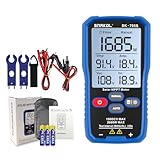
- MPPT Power Measurement: Designed for photovoltaic modules to accurately measure Pmax, Vmp, Imp, Voc and Isc, enabling fast and reliable performance checks during installation and maintenance.
- 2000W / 150V DC MAX: Supports up to 1000W output power, 80V DC maximum voltage and 0–45A current, suitable for most residential and commercial PV panels.
- AUTO & MANUAL Mode: Automatic mode for continuous measurements and manual mode for controlled single tests, ideal for commissioning, servicing and inspection tasks.
- 3.2" LCD Display With Backlight: Large 3.2-inch LCD screen with backlight and data hold function ensures clear readability when working outdoors.
- Portable & Ready To Use: Compact, lightweight tester with rear hanging slot. Includes test leads, alligator clips, storage pouch and user manual for immediate operation.
A useful estimate should identify at least:
- the site or weather-data location;
- total DC array size;
- module orientation and tilt;
- shading assumptions;
- inverter size and configuration;
- loss assumptions;
- expected monthly and annual production; and
- whether the result represents DC module output, inverter AC output, energy sent to the grid, or energy available after battery charging.
PVWatts documentation includes a default total system-loss assumption of approximately 14% for one version of its model. That value should not be treated as a universal deduction for every installation: modeled inverter behavior and other system effects mean the final AC result is not produced by simply subtracting one fixed percentage from every array.
If the estimate will be used for a roof replacement, new construction, financing decision, or system contract, a professional solar site assessment can account for roof obstructions, shading, structural constraints, equipment placement, electrical service, and local requirements. A production estimate is not the same as a guarantee of savings or a guaranteed energy yield.
How to measure a panel’s actual output
Measurement is useful when a panel or array appears to be underperforming, but a single watt reading is only a snapshot. Compare readings under similar irradiance, module temperature, orientation, shading, and load conditions.
For a module-level power check
A solar MPPT power meter can measure a compatible module’s maximum power, voltage, and current through suitable solar leads. Products such as the UNI-T UT673PV and Jonard SPM-800 are examples of this category. They are most useful for comparing a module’s measured maximum power with its nameplate rating under similar conditions.
These meters do not turn a momentary test into a daily production forecast. A reading can be low because the panel is shaded, hot, poorly oriented, dirty, or receiving weak irradiance—not necessarily because the module is defective.
For electrical troubleshooting
A PV digital multimeter with MC4 test leads may be appropriate for installers and technically qualified troubleshooters who need to check voltage, current, polarity, or string and module faults. This is not a general-purpose homeowner purchase.
PV arrays and electrical panels can present shock and arc-flash hazards. Use instruments and leads rated for the actual voltage category and connector system. Do not open, disconnect, or modify energized PV equipment without the required training, protective equipment, and local authorization. Generic meters and improvised leads are not interchangeable with appropriately rated PV test equipment.
For checking sunlight at the site
A solar irradiance meter can measure instantaneous irradiance in watts per square meter. Some site-assessment instruments also measure module temperature and help document orientation and tilt. This can help distinguish poor solar resource from an equipment problem.
An irradiance reading is not a daily or annual energy forecast. It describes the conditions at the time and place of measurement; a production model still needs location, weather, orientation, system size, and loss assumptions.
For measuring household production over time
A solar energy monitor or compatible Wi-Fi energy meter is more useful than a one-time panel reading when the question is how much the home produces each day, month, or year. Depending on the system, monitoring may occur at the inverter side, grid side, or whole-home level.
Compatibility matters. Check the inverter interface, meter type, current-transformer placement, wiring, communications method, electrical-panel configuration, and local installation requirements. Work inside an electrical panel should be performed by a qualified person where required.
Best Value

- 【Accurate Solar Panel Tester with MPPT】 Get precise solar readings every time. This solar panel tester measures Pmax, Voc (3–90V), and Isc (0–40A) with high accuracy. Built-in MPPT tracking ensures reliable performance data for solar panel testing, troubleshooting, and system optimization.
- 【Plug & Play – Easy for Beginners】 No complicated setup. Simply connect the MC4 cables and start testing instantly. Supports both auto and manual modes, making this solar tester perfect for beginners and professionals.
- 【Large Sunlight-Readable LCD Display】 3.2-inch LCD screen clearly shows voltage, current, and power at once. Designed for outdoor use, the display remains easy to read even under direct sunlight.
- 【All-in-One Solar Power Meter & PV Tester】 Works as a solar power meter, PV tester, and photovoltaic multimeter. Ideal for solar panel installation, maintenance, fault diagnosis, and performance testing in RV, home, and off-grid systems.
- 【Multi-Protection & Durable Design】 Built-in protection against over-voltage, over-current, reverse polarity, and overheating. Shock-resistant housing ensures durability for long-term outdoor and field use.
Portable 400 W panels: why the label still needs context
A 400 W portable panel uses the same basic nameplate principle as a roof-mounted module: 400 W describes its rated DC power under specified test conditions. It does not mean a portable power station will receive 400 W continuously.
Real charging power depends on sun intensity, panel angle, temperature, cable and connector losses, the power station’s solar-input limits, charging electronics, and whether the station is already limiting its input. A portable panel should therefore be matched to the storage system’s permitted voltage, current, connector, and input wattage.
For camping, RV, or emergency use, evaluate the panel and the battery or power station as one system. A panel’s watt rating is generation capacity; a battery’s watt-hour rating is storage capacity. Neither number alone tells you how long a specific appliance will run.
What’s actually slowing this PC down?
Pick the symptom - the matching free tool is one click away.
Common mistakes when estimating solar output
- Assuming a 400 W panel produces 400 W all day: 400 W is an instantaneous rated capacity under STC.
- Multiplying wattage by daylight hours: use equivalent peak-sun-hours, not simply sunrise-to-sunset time.
- Using one loss percentage as a guarantee: actual losses depend on the design, weather, equipment, shading, soiling, and availability.
- Confusing watts with battery capacity: watts describe power; watt-hours describe stored or produced energy over time.
- Assuming efficiency predicts savings: household savings also depend on array size, electricity use, rates, export rules, storage, and system performance.
- Comparing measurements taken under different conditions: irradiance, temperature, orientation, shading, and electrical load must be considered.
- Ignoring roof constraints: the theoretical roof area may be reduced by setbacks, access paths, vents, skylights, structural limits, and shading.
A practical way to answer “How much will my panels produce?”
- Identify the array’s DC nameplate size. Add the panel ratings, or multiply panel count by the individual panel rating.
- Determine the site’s solar resource. Use a location-specific model rather than assuming a convenient number of daylight hours.
- Document orientation, tilt, and shading. Roof pitch and compass direction can materially change the result.
- Account for system delivery. Include inverter conversion, wiring, soiling, mismatch, temperature, degradation, and downtime as appropriate.
- Separate DC, AC, battery, and household figures. Confirm what each quoted or monitored number actually measures.
- Validate with monitoring. Use inverter or energy-monitoring data over weeks and months, not one unusually sunny or cloudy day.
The most defensible answer is therefore site-specific: a panel’s wattage tells you its rated power, while a PV model and long-term monitoring tell you how much energy the completed system is likely to deliver.
Frequently Asked Questions
How much power does a 400 W solar panel produce?
A 400 W panel is rated to produce up to 400 W of DC power under Standard Test Conditions. With four equivalent peak-sun-hours and an illustrative 80% delivery factor, it would produce about 1.28 kWh per day. Actual results depend on location, weather, heat, orientation, shade, soiling, inverter losses, and downtime.
How do you calculate solar panel output?
Daily energy is estimated as panel watts divided by 1,000, multiplied by equivalent peak-sun-hours and a system delivery factor. For example, 0.4 kW × 4 hours × 0.8 equals 1.28 kWh per day.
Are peak-sun-hours the same as daylight hours?
No. Peak-sun-hours are the equivalent number of hours at 1,000 W/m2 of irradiance. They account for changing sunlight intensity and are not the same as the total number of daylight hours.
Windows Errors? Fix Them Before They Spread
Repair common Windows errors and clear accumulated junk for a smoother, more stable PC - no reinstall needed.Free scan · no reinstallOutdated Drivers Are Slowing You Down
One free scan finds every outdated or missing driver and matches the right update for your exact hardware.Free scan · exact hardware matchWhat is the difference between watts and kilowatt-hours?
A panel’s watt rating measures its power capacity at a moment under specified test conditions. Kilowatt-hours measure the energy produced over a period of time, such as a day, month, or year.
How can I find the expected output for my roof?
Use a location-specific PV production model that includes system size, weather data, orientation, tilt, shading, and loss assumptions. Long-term inverter or energy-monitoring data is the best way to verify the completed system’s actual production.
The Bottom Line
Bottom line: A 400 W solar panel is rated for up to 400 W of DC power under STC, but a reasonable illustrative estimate with four peak-sun-hours and an 80% delivery factor is about 1.28 kWh per day. For a reliable figure, model the actual location, roof orientation, shading, equipment, and losses, then verify production with long-term monitoring.
Quick Recap
Product prices and availability are accurate as of the date/time indicated and are subject to change. Any price and availability information displayed on Amazon at the time of purchase will apply.

