Quick wins for a faster PC:
Repair Windows errors before they cause bigger problemsFix Now →Fix the driver behind crashes, sound loss and screen glitchesFind Drivers →Clear out junk files and repair common Windows errorsFree Scan →Snow mold is a cold-weather lawn disease that shows up after snow melts as circular, matted patches of gray-white, straw-colored, or pinkish turf. Most home lawns recover with drying, light raking, and normal spring growth. The cases that turn expensive usually have another property problem underneath: wet leaves left in place, grass that went into winter too tall, compacted soil, thick thatch, poor drainage, or snow piles sitting on the same lawn edges for weeks.
On our job sites, we treat snow mold as a property-maintenance issue, not just a turf disease. The lawn is reacting to winter conditions around the house: grading, downspout discharge, shaded hardscape edges, plow routes, foot traffic, and where shoveled snow is stored. If those conditions repeat every winter, the snow mold usually repeats too.
As an Amazon Associate I earn from qualifying purchases.
The practical answer is this: prevent snow mold in fall, be patient in early spring, and only spend money on reseeding or fungicide when the turf crowns are actually dead or the same high-value areas get hit year after year.
What Snow Mold Looks Like
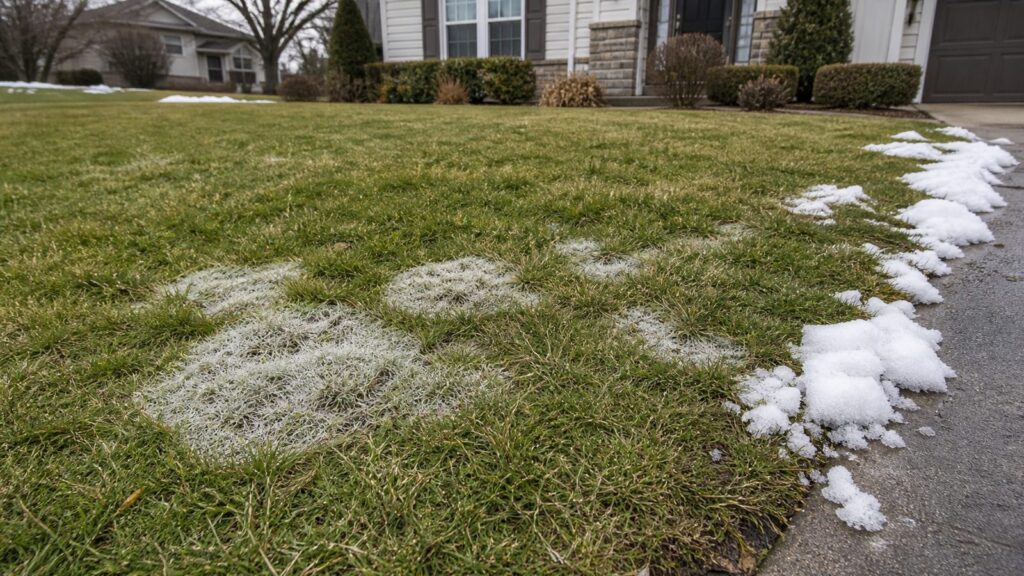
Snow mold usually appears as round or irregular patches after snow cover pulls back. Patches may be a few inches wide or 1 to 2 feet across, and several patches can merge into larger damaged-looking areas. The grass often looks flattened, matted, bleached, gray, or tan. In wet morning conditions, you may see a fine gray-white webbing over the blades. In pink snow mold, the patch edge can have a salmon, copper, or pink cast.
#1 Best Overall

- Heavy duty 1" diameter expandable metal rake for leaves painted black to prevent rusting and bending under heavy use.
- 9" small rake head is designed for raking pine straw in tight spots and it does the trick to het leaves out from around small shrubs or flower beds.
- 17" wider rake head makes heavy raking in your backyard easier and will rake the tall grass in the orchard even on the uneven ground.
- 30-58 inch Long Handle rake allows people of all heights to use comfortably. Handle comes in multiple pieces with center poles.
- 1 mins to assemble collapsible rake by screwing poles together with no extra tools required and easy to carry for camping.
The most common homeowner mistake is assuming every brown patch in March is dead. Snow mold often damages leaf blades more than the growing point of the plant. If the crown is alive, new green growth can push through once temperatures rise and the area dries out.
Quick field check
Wait until the lawn is firm enough to walk on without leaving footprints. Gently part the matted grass with your fingers or a leaf rake. If you see green shoots at the base or new growth coming from the center or edges, give the lawn time. If the crown area is mushy, blackened, bare, or does not green up after several weeks of normal spring weather, that patch may need reseeding.
Gray Snow Mold vs. Pink Snow Mold
There are two main snow molds found on lawns. Gray snow mold is caused by Typhula species. Pink snow mold, also called Microdochium patch, is caused by Microdochium nivale. They look similar at first glance, but they do not behave the same way.
The Tool Desk
Outbyte Driver Updater FREEFix the driver behind crashes, sound loss and screen glitchesFind Drivers →Outbyte PC Repair FREERepair Windows errors before they cause bigger problemsFix Now →| Type | Typical Conditions | What It Usually Damages | Homeowner Concern Level |
|---|---|---|---|
| Gray snow mold | Extended snow cover, especially where snow sits over wet or unfrozen turf | Mainly leaf blades | Usually cosmetic on home lawns |
| Pink snow mold | Cool, wet weather; can occur with or without snow cover | Leaf blades, crowns, and sometimes roots | More likely to require repair if severe |
For a homeowner, the distinction matters because gray snow mold usually looks worse than it is. Pink snow mold can be more damaging, especially in cool, damp areas that stay wet well into spring. If you get recurring pinkish patches along a north-facing walk, shaded fence line, or low spot near a downspout, look beyond the grass and fix the site condition.
Why Snow Mold Happens
Snow mold thrives when cold, wet turf is trapped without airflow. The highest-risk situation is snow falling on unfrozen ground, then staying deep or compacted for a long time. The grass is still biologically vulnerable, moisture is trapped, and the surface is insulated under snow.
Common triggers include grass entering winter too tall, late-season nitrogen pushing lush growth, heavy leaf cover, thick thatch, poor drainage, compacted soil, snowblower discharge, plow piles, and repeated foot traffic over snow-covered turf. The same 4-foot strip along a driveway often gets hit because it receives salt splash, compacted plow snow, shade from the house, and meltwater from the pavement.
Thatch deserves a measured response. A thatch layer under about 1/2 inch is usually not a reason to dethatch. A thick, spongy layer over 1/2 inch can trap moisture and reduce airflow, but tearing up a thin or stressed lawn can create more damage than the snow mold did.
Fall Prevention That Actually Works
The best snow mold control happens before the first lasting snow. Once spring damage is visible, you are mostly managing recovery. By fall, you can change the conditions that allowed the disease to develop.
Keep mowing until growth stops
Do not let cool-season grass go into winter long and floppy. Keep mowing until the lawn stops growing. For many cool-season lawns, the final cut should be around 2 inches, or roughly 1 to 1.5 inches shorter than the normal mowing height without scalping. Scalping weakens turf; leaving it too tall creates a mat under snow.
Remove leaves before lasting snow
A thin layer of chopped leaves can break down and feed soil. A wet mat of whole leaves blocks air and makes a perfect snow mold blanket. If leaves are still covering more than about 10 to 20 percent of the lawn before a forecasted lasting snow, mulch them finely or remove them.
Rank #2

- Practical Garden Cleanup Set :This set includes an 18-inch wide adjustable garden rake with a 36-73 inch extendable handle, featuring 25 sturdy metal tines for effortless leaf and debris collection. It also comes with a reusable 32-gallon leaf bag for easy cleanup and waste collection.
- Sturdy & Durable :Made of rust-resistant stainless steel, this heavy-duty leaf rake is strong enough to gather leaves without bending or breaking. The 25 metal tines ensure efficient and thorough raking, making it ideal for lawn and garden maintenance.
- Adjustable Handle for All Ages :The rake’s extendable handle, adjustable from 36 to 73 inches, makes it suitable for both kids and adults. Extend it for effortless yard work or shorten it for children to use with ease and flexibility.
- Reusable Leaf Bag Included :For added convenience, the set includes a 32-gallon garden bag made of woven polypropylene, a tear-resistant, waterproof, and pressure-resistant material designed for long-term use in yard cleanup.
- Easy to Assemble & Carry :The foldable lawn rake saves space and fits easily in your backpack or car trunk, making it perfect for outdoor activities such as pet waste cleanup or campsite tidying. Assembly takes just one minute,simply screw the poles together with no additional tools required.
Professional leaf removal in 2026 commonly runs about $79 to $326 per visit, $160 to $290 for a standard 1/4-acre yard, or $191 to $592 per project depending on tree density, wet leaves, haul-away fees, and local bag rules. That can be cheaper than repairing large dead patches in spring.
Aerate compacted lawns before winter
Core aeration helps compacted soil breathe and drain. For cool-season lawns, late summer to early fall is usually the right window because the grass can recover before winter. Professional lawn aeration in 2026 typically averages about $104 to $202 for a residential lawn, with price driven by lawn size, slope, access, soil compaction, and whether overseeding is bundled.
Avoid late soluble nitrogen
Heavy quick-release nitrogen late in fall can push tender growth that is more disease-prone. Use a soil test instead of guessing. The goal is a lawn that enters winter healthy and hardened off, not lush and soft.
Plan where snow will go
This is where construction thinking helps. Before the first storm, decide where shoveled or plowed snow can melt and drain. Avoid building deep, long-lasting banks over the same turf every storm. Spread piles where practical. Keep discharge away from low, shaded lawn pockets and areas already receiving downspout water.
If a lawn edge gets snow mold every year, inspect the physical conditions: pavement pitch, downspout outlets, compacted clay, curb edges, sidewalk salt, north-facing shade, and where plows stack snow. Grass rarely fails in isolation.
Recommended Free Tools
What To Do When Snow Mold Shows Up In Spring
Start with restraint. Early spring turf is easy to damage, especially when soil is wet or thawing. Aggressive raking, power raking, or dethatching while the lawn is muddy can rip out crowns and create ruts.
Wait until the lawn surface is firm. Then lightly rake matted areas with a leaf rake to lift the blades and improve airflow. Do not dig into the soil. Remove leftover leaves, sticks, and packed debris. Sun and air are the cheapest treatment.
Most residential snow mold improves as temperatures rise and the lawn resumes growth. You can topdress minor depressions with a light layer of compost or screened topsoil, but do not bury live crowns. If bare soil remains after the surrounding lawn is actively growing, spot seed those patches.
Repair Costs: What Homeowners Actually Spend
Snow mold recovery can cost almost nothing or several hundred dollars depending on severity. Light damage usually needs patience and a rake. Severe or recurring damage may justify aeration, overseeding, drainage correction, or preventive fungicide.
Windows Errors? Fix Them Before They Spread
Repair common Windows errors and clear accumulated junk for a smoother, more stable PC - no reinstall needed.Free scan · no reinstallCrashes, No Sound, or Screen Glitches?
Random freezes, missing sound and display glitches usually trace back to one bad driver. Find and replace yours safely.Free scan · under a minute| Task | Typical 2026 Cost | Best Use |
|---|---|---|
| DIY light spring recovery | Low cost; rake, bags, small amount of seed, compost, or topsoil | Matted patches with live crowns and visible spring regrowth |
| DIY lawn fungicide | Often about $5-$8 per 1,000 sq. ft. per application | Targeted prevention only when product label matches the disease |
| Professional aeration | About $104-$202 for a typical residential lawn | Compacted lawns, poor drainage, recurring winter stress |
| Professional dethatching | Commonly $65-$300; some projects average near $180 or range $100-$600 | Measured thatch over about 1/2 inch |
| Overseeding or reseeding | About $0.10-$0.20 per sq. ft.; often $95-$230 for small-to-medium lawns | Dead crowns, bare patches, thin turf after recovery period |
| Aeration plus overseeding | Often about $240-$360 for medium properties | Thin lawns that need both soil relief and new seed |
| Professional fungicide treatment | Often higher than standard treatments; a $50 visit may become roughly $75 | High-value or recurring snow mold areas before lasting snow cover |
| Full recovery package | Commonly $250-$600+ for many suburban lawns | Cleanup, aeration, overseeding, and fertility after severe damage |
The best value is usually fall cleanup plus aeration where soil is compacted. Paying for fungicide on a normal home lawn with one mild snow mold event is usually overkill. Paying to fix drainage or snow storage on a repeat problem area can make sense because it addresses the cause.
Rank #3

- QUICK LAWN SWEEP: This adjustable garden rake lets you quickly clean leaves, grass clippings and small debris off your lawn. It's the versatility that makes it such a find - one rake for both wide sweeping and delicate work. PLEASE NOTE: this tool is not meant for cement or heavy-duty debris.
- REACHES THE SMALLER PLACES AS WELL: The rake's teeth expand from 8" to 23" wide and lock in any position in between - wider than most adjustable rakes. Set it narrow to work under hedges, between flower beds or among perennials without damaging your plants; set it wide for fast cleanup of leaves and pine straw.
- LIGHTWEIGHT TELESCOPIC STEEL HANDLE: Built to last with a high-grade steel structure that withstands sunlight and the elements. The handle telescopes from a collapsed 32" to a full 63" and locks at any length in between with a simple turn of the hand, so users of all heights can rake comfortably.
- EASY STORAGE IN MINIMUM SPACE: The adjustable fan folds to a tight profile, so there's no struggle to fit a long handle into a small space - perfect for the garage, shed, RV or camping. Low maintenance too: the teeth are made of galvanized steel wires to prevent rust.
- ORDER WITH CONFIDENCE. We at TABOR TOOLS stand behind our products. Please don't hesitate to contact us for support, questions about our products, or spare parts you might need.
Fungicide: When It Helps and When It Does Not
Fungicides for snow mold are preventive, not curative. Once the spring patches are visible, spraying usually will not repair dead grass or instantly clear matted turf. Preventive applications are made before the first permanent snow cover. In many cold-weather regions, that timing falls around late November, but the correct window depends on local weather.
For most home lawns, cultural prevention is enough: mow properly, remove leaves, manage thatch, improve drainage, avoid late quick-release nitrogen, and stop piling snow on vulnerable turf. Fungicide is more reasonable for high-value lawns, properties with repeated severe pink snow mold, or turf areas where snow cover persists for long periods every year.
There is also a legal and safety side. Pesticide applicator rules vary by state. Commercial applicators generally need proper certification or licensing to apply restricted or professional pesticide products. Homeowners using DIY products should follow the label exactly, including target disease, application rate, personal protective equipment, reentry directions, and runoff precautions. The label is not a suggestion; it is the use instruction.
When To DIY vs. When To Hire a Pro
DIY is usually enough when
Handle it yourself if the patches are mostly cosmetic, the grass is greening from the base, and the lawn surface is firm. Light raking, debris removal, and normal spring mowing will often carry the lawn back. Spot seed only where crowns are dead and bare soil remains after the rest of the lawn is growing.
Hire a lawn pro when
Bring in a professional if damage returns every year, covers large areas, has a pink cast and slow recovery, or leaves dead patches that need renovation. A pro can measure thatch, evaluate compaction, time aeration and overseeding, and apply preventive fungicide if it is justified and legal in your area.
Bring in a construction-minded eye when
If the same lawn edge fails next to a driveway, patio, walk, retaining wall, or downspout, the issue may be grading or water movement. Look for hardscape that sheds meltwater onto turf, compacted clay from past construction, low spots that hold water, or snow storage patterns that keep the grass buried two weeks longer than the rest of the yard.
On our projects, we pay attention to finish grade, drainage paths, and where winter maintenance will push snow. A lawn that sits 1 inch too low beside pavement can collect water, salt, debris, and compacted snow all winter. Turf care helps, but the durable fix may be regrading, redirecting a downspout, adding soil, or changing how snow is stored.
Do these 3 things before closing this tab:
1Clear out junk files and repair common Windows errors2Fix the driver behind crashes, sound loss and screen glitches3Repair Windows errors before they cause bigger problemsCommon Mistakes That Make Snow Mold Worse
The biggest mistake is letting grass enter winter too long. Tall blades collapse under snow and trap moisture. The second is leaving wet leaves or heavy clippings on the lawn. The third is trying to fix spring damage too aggressively while the soil is soft.
Other avoidable problems include applying heavy quick-release nitrogen late in fall, piling driveway snow on the same shaded turf all winter, compacting snow with foot traffic or parked vehicles, dethatching without measuring thatch, and reseeding before you know whether the existing crowns are alive.
Rank #4

- 【Bigger Leaf Rake Head】- Suitable for Both Wide & Narrow Area. Expand the 7-23" adjustable garden rake head to easily pick up leaves, clippings and loose lawn debris in wide aera. Compact the yard rake for leaves in tight areas like under hedges or between flower beds
- 【64" Adjustable Metal Rake】-Extend the handle of rakes for lawns to match your raking height, it can be used by men, women and children. With Flexible tines, this collapsible rake will not pull your lawn grass off like those rake for leaves with stiff sheet-tines.
- 【Lightweight Rake Yet Durable】- Upgrade thickened Alumimum handle! This grass rakes for lawns is improved to be both lightweight and durable, only 1.5 pounds thus save effort and less fatigue after long-time work
- 【Efficient Raking in Each Pass】- Larger head of this collapsible rake for camping collects more dry leaves in each pass efficiently. Adjust the yard rake head at any width easily in seconds by turning yellow lock anytime
- 【Portable & Space-Saving Storage】- You can compact the rakes for gardening easily for space-saving storage in gerage or throw into car trunk for camping. Note this rake for leaves is NOT designed for heavy duty use such as rock
Patience matters in spring. Give the lawn a few weeks of active growing weather before deciding it has failed. Spending $250 to $600 on a recovery package too early can be unnecessary if the crowns are alive and the turf is simply matted.
A Practical Winter Lawn Checklist
In early fall, inspect drainage, low spots, compacted areas, and thatch depth. If soil is compacted, schedule core aeration while the lawn still has time to recover. If thatch is over about 1/2 inch, consider dethatching during the proper growing-season window rather than waiting until spring mud season.
In late fall, keep mowing until growth stops and aim for a final cool-season height around 2 inches without scalping. Remove or finely mulch leaves before lasting snow. Avoid heavy late soluble nitrogen unless your soil test and local turf guidance support the timing and product.
Before storms, decide where snow will go. Keep piles lower and more spread out where practical. Avoid repeatedly burying shaded, poorly drained, or already weak turf. In spring, wait for firm ground, lightly rake matted patches, let the turf dry, and reseed only after dead crowns are obvious.
Snow mold looks alarming, but most home-lawn cases are manageable. The real win is not chasing every patch in March. It is setting up the lawn in October and November so it goes into winter short, clean, drained, and uncovered by heavy mats of leaves or snow.
Frequently Asked Questions
What does snow mold look like on a lawn?
It usually appears after snow melts as circular or irregular matted patches. The grass may look gray-white, tan, straw-colored, or slightly pink. Patches can be a few inches wide or merge into larger damaged areas.
Free tools Windows power users keep installed
One-click scans. No signup required.
Will snow mold go away on its own?
Often, yes. Most residential snow mold is cosmetic and improves once the lawn dries and starts growing. Light spring raking can restore airflow, but aggressive raking on muddy soil can cause more damage.
What is the difference between gray and pink snow mold?
Gray snow mold usually needs extended snow cover and mostly damages leaf blades. Pink snow mold can develop in cool, wet conditions even without snow and is more likely to injure crowns and roots.
When should fungicide be applied for snow mold?
Fungicide is preventive, not curative. It is typically applied before the first permanent snow cover, often in late fall depending on region. It is usually reserved for recurring, severe, or high-value lawn areas.
Should I dethatch after snow mold?
Only dethatch if the thatch layer is actually thick, usually over about 1/2 inch. Do not power rake or dethatch while spring soil is muddy or the turf is dormant, because that can tear up living crowns.
What’s actually slowing this PC down?
Pick the symptom - the matching free tool is one click away.
How short should I mow before winter?
For many cool-season lawns, the final cut should be around 2 inches, or about 1 to 1.5 inches shorter than normal without scalping. Keep mowing until growth stops.
Quick Recap
Product prices and availability are accurate as of the date/time indicated and are subject to change. Any price and availability information displayed on Amazon at the time of purchase will apply.

