What’s actually slowing this PC down?
Pick the symptom - the matching free tool is one click away.
A small bedroom does not need more decorating tricks. It needs better decisions. The best small bedroom ideas protect the clear path around the bed, use wall space instead of floor space, improve lighting, and avoid blocking windows, outlets, HVAC registers, and emergency escape routes.
On our job sites, the small rooms that work best usually have three things in common: a measured plan before anything is purchased, one strong storage wall instead of scattered furniture, and lighting that does not eat up nightstand or dresser space. Cosmetic upgrades can be done for a few hundred dollars. A broader bedroom remodel can run about $2,500 to $15,000 for standard work, while larger or more custom bedroom remodels can land closer to $12,000 to $28,000. The difference is scope: paint and shelves are one thing; new flooring, closet systems, electrical changes, built-ins, door relocation, or legal bedroom conversion are another.
As an Amazon Associate I earn from qualifying purchases.
Use the ideas below as a practical menu. Each one includes who should do the work, what to check before starting, and the cost range we would expect a homeowner to consider in 2026.
Start With the Room Plan Before Buying Furniture
Before choosing a bed frame, dresser, or closet system, measure the room. Mark the bed location, closet door swing, bedroom door swing, window operation, outlets, switches, floor vents, return-air path, baseboard heaters, and any emergency escape opening.
#1 Best Overall

- Premium Material : The under bed storage containers are made from high-quality, odorless, three-ply composite non-woven thick fabric, foldable and breathable, keep clothing fresh from long-term storage. NO cardboard NOR metal supports insert, arrive to you collapsed and packaged in a clear storage bag.
- 95L Large Capacity : Each Underbed Storage Bags has 90 Liter or 24 Gallon load capacity, dimensions: 39 (L) x 20 (W) x 7 (H) inch, 7 inch height designed for most underbed space, the 4 Long Smart Cube bags works well for storing items like gifts wrap, blankets, linens, bedding, pillows, bed sheets, comforters, towels, children's stuffed animal toys, seasonal clothes, clothes, shoes, Halloween holiday decorations, Christmas wrapping papers ornament and etc. Ideal dorm room essentials storage and laundry room packing bags for girls guys
- Clear Window : The storage bins has large transparent see-through PVC window, which helps you to locate your items at a glance, easily access to what you need. The under-bed organizer used under beds, in closets, on shelves or under sofa. A good choice for room organization and storage.
- Reinforced Handles : The wide handles of the clothes storage bags are double-stitched with thick fabric, sturdy enough to pulling out from underbed and moving in your house, dependable for long time use.
- Sturdy Fastener : High quality stainless steel fastener closure design make it have a long service life, two-way smooth fastener closure make it slide along easily, and fully zippered closure preserves items from dust, pest, and humidity damage. Organize your space with under bed storage totes from Budding Joy.
For a small bedroom, aim for at least 24 inches of walking clearance on the main side of the bed. Thirty inches feels better if the room allows it. If two people use the room, try to keep both sides accessible, even if one side is tighter. A queen mattress is 60 by 80 inches, and the frame can add 2 to 8 inches depending on style. That extra frame bulk matters in a 10-by-10 or 10-by-11 room.
Best for: DIY planning. Cost: Free to $50 for tape, painter’s tape, graph paper, or a basic room-planning app. Time: 1 to 2 hours.
Do not skip this step. Most small-bedroom mistakes happen before the first screw goes into the wall.
21 Small Bedroom Ideas We Use in Real Remodels
1. Build One Full-Height Storage Wall
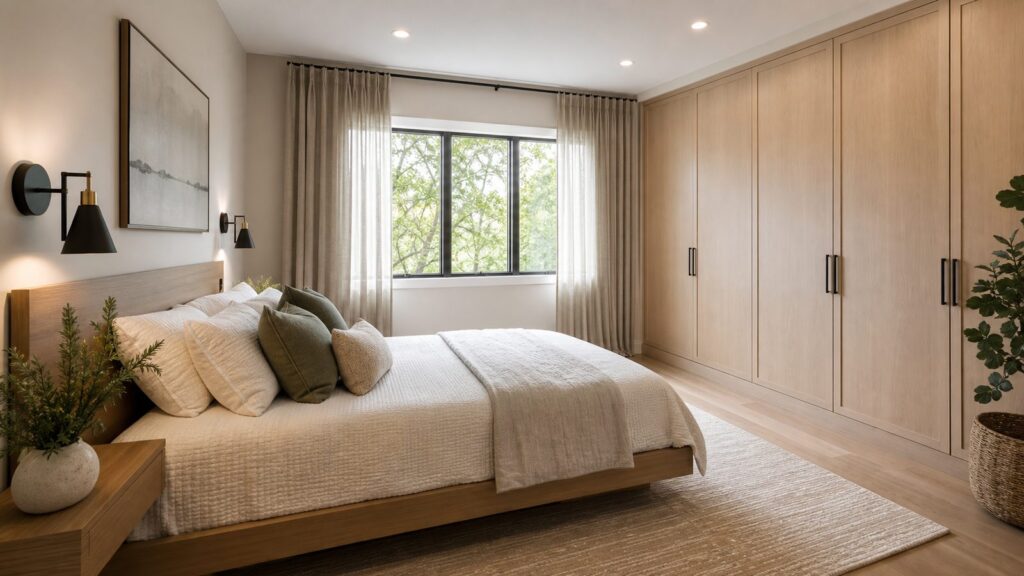
Instead of squeezing in two dressers, a bookcase, and a nightstand, consolidate storage on one wall. A full-height storage wall can include hanging space, drawers, shelves, hamper storage, and a small open drop zone. This works especially well on the wall opposite the bed or on the least valuable wall without windows.
Who should do it: Carpenter or closet installer for built-ins; skilled DIY for modular systems. Cost: Custom closet sources show roughly $485 to $2,313 for many projects, with common averages around $1,033 to $2,128. Higher-end custom systems can run $3,500 and up for reach-ins, and fully custom installed systems can reach $20,000 depending on materials, drawers, lighting, and millwork. Job-site tip: If walls are open during a remodel, add blocking so shelves, rods, and future hardware have solid fastening points.
2. Replace Table Lamps With Wall-Mounted Lighting
Table lamps are a poor use of space in a tight bedroom. Wall sconces, plug-in swing-arm lights, or pendant lights free up the nightstand and make the room feel more intentional.
Who should do it: DIY for plug-in fixtures mounted into studs or proper anchors; electrician for hardwired sconces or new switches. Cost: Plug-in sconces often run $40 to $200 each. Hardwired lighting varies widely, but expect electrical labor to increase if walls need fishing, patching, or new switch legs. Best use: During a remodel, hardwire the lights and put each side on its own switch.
The Tool Desk
Outbyte PC Repair FREEClear out junk files and repair common Windows errorsFree Scan →Outbyte Driver Updater FREEScan for outdated or missing drivers - takes under a minuteDriver Scan →3. Use Under-Bed Drawers, Not Random Storage Bins
Under-bed storage works when it is easy to reach. Drawers, wheeled boxes, or a storage bed are cleaner than loose plastic bins shoved under a frame. Before buying, measure the actual clearance from floor to frame and check whether drawers can open without hitting rugs, nightstands, walls, or radiators.
Who should do it: DIY or handyman for assembly. Cost: Storage beds often range from a few hundred dollars to $2,000-plus. Furniture assembly averages commonly cluster around $102 to $221, with many homeowners paying about $148. Clearance check: A drawer that needs 24 inches to open is useless if the walkway is only 18 inches.
4. Choose a Low-Profile Platform Bed
A low-profile bed can make the ceiling feel higher and reduce visual bulk. Platform beds also eliminate the box spring, which can lower the sleep surface by 6 to 9 inches. That said, low is not always better. Older homeowners, tall homeowners, and anyone with mobility concerns may prefer a higher mattress height.
Who should do it: DIY or furniture assembler. Cost: Usually the price of the bed plus $100 to $220 for assembly if hired out. Construction note: If the room has baseboard heat or low outlets, check that the new frame does not block airflow or access.
Recommended Free Tools
5. Install a Reach-In Closet System
A basic builder closet with one shelf and one rod wastes vertical space. A reach-in system with double hanging, drawers, shelves, and shoe storage can often eliminate a dresser. In a small bedroom, that floor space is more valuable than the cost of a better closet.
Who should do it: Handyman, carpenter, closet company, or advanced DIY. Cost: Small reach-in systems often start around $1,000 and can run $3,500-plus with drawers, doors, lighting, and upgraded finishes. National custom closet figures commonly show $30 to $50 per square foot, with broad installed ranges from about $1,500 to $20,000 for custom work. Job-site tip: Confirm stud layout before loading shelves. Drywall anchors alone are not enough for heavy rods and drawers.
6. Swap Swinging Closet Doors for Sliding Doors
A swinging closet door can consume 24 to 30 inches of usable floor area. Bypass doors, bifold doors, or barn-style sliding doors may help, depending on the room. Pocket doors are even cleaner, but only when the wall cavity allows it.
Who should do it: Handyman for simple door swaps; carpenter for pocket doors or trim modifications. Cost: Basic sliding or bifold door replacement may be a few hundred dollars in labor plus materials. Pocket doors can become expensive if electrical, plumbing, framing, or wall repair is involved. Permit likely: Usually not for a simple closet door swap, but structural changes or electrical relocation can trigger permit requirements.
7. Mount Curtains High and Wide
Mount curtain rods closer to the ceiling and extend them beyond the window casing. This makes the window look larger and keeps more glass exposed when the curtains are open. In a small bedroom, daylight is square footage you can feel.
Who should do it: DIY or handyman. Cost: $75 to $400 depending on rod, panels, and installation. Safety check: Keep fabric clear of baseboard heaters, floor vents, and windows that must open for ventilation or emergency escape.
8. Use mirrors Where They Reflect Light, Not Clutter
A mirror can make a compact bedroom feel brighter, but placement matters. Put it where it reflects daylight, a calm wall, or a clean storage zone. A mirror facing open shelving, laundry, or a busy desk doubles the visual noise.
Rank #2

- Under-the-bed storage bag (2-pack) helps keep items safely stored, freeing up extra closet and drawer space
- Fabric bag with clear vinyl top to easily identify contents
- flat loop handles allow for convenient access and portability; bag can be folded flat and put away when not in use
- Zipper closure helps protect items from dust; store seasonal clothing, blankets, extra linens, keepsakes and more
- Dimensions: 18 x 42 x 6 inches
Who should do it: DIY for small mirrors; handyman for large or heavy mirrors. Cost: $50 to $500-plus depending on size and frame. Install note: Use proper wall anchors or hit studs. Heavy mirrors should not hang from small picture hooks.
Do these 3 things before closing this tab:
1Clear out junk files and repair common Windows errors2Fix the driver behind crashes, sound loss and screen glitches3Repair Windows errors before they cause bigger problems9. Paint With Tone-on-Tone Color
Small bedrooms do not have to be white. Tone-on-tone paint uses related colors on walls, trim, doors, and built-ins to reduce visual chopping. Soft greens, warm grays, muted blues, clay tones, and off-whites can all work. The goal is a calm envelope, not a room where every surface competes.
Who should do it: DIY or painter. Cost: Professional interior painting commonly runs $2 to $6 per square foot. Bedroom-specific costs often land around $300 to $800, with a 12-by-12 bedroom commonly around $400 to $600. Prep, trim, ceiling height, drywall repairs, accent walls, and premium low-VOC paint add cost. Time: 1 to 2 days for most bedrooms, longer if repairs are needed.
10. Replace Heavy Flooring With a Lighter, Cleaner Surface
Old carpet can make a small room feel dusty and visually heavy. Laminate, LVP, or hardwood can brighten the room and simplify cleaning. In bedrooms, flooring is usually less complicated than in kitchens or baths, but furniture moving, baseboards, transitions, and subfloor leveling still matter.
Who should do it: Flooring installer for best results; skilled DIY for floating floors. Cost: Laminate commonly runs about $3 to $13 per square foot installed, with detailed 2026 cost ranges around $6.91 to $11.81 per square foot. LVP is broadly about $3 to $12 per square foot installed. Hardwood usually runs about $6 to $25 per square foot installed. Job-site tip: Check door clearance after new flooring and underlayment are installed.
11. Add high shelves Over Low-Use Areas
High shelves work well over a desk, above a dresser, over the bedroom door, or along a wall that cannot hold deeper furniture. Keep them shallow enough that the room does not feel like a storage aisle. Eight to 12 inches deep is often plenty for books, boxes, baskets, and display items.
Who should do it: DIY, handyman, or carpenter. Cost: $50 to $500 for basic shelves; more for custom millwork. Install note: Fasten into studs or blocking whenever possible. For heavier shelves, bracket spacing and wall type matter.
12. Use a Desk as a Nightstand
If the small bedroom also needs a work surface, skip the separate nightstand. A compact desk beside the bed can hold a lamp, charger, book, and laptop. Keep depth around 18 to 24 inches if the walkway is tight.
Who should do it: DIY. Cost: $100 to $600 for most compact desks, more for custom. Electrical note: If cords run across a walkway, the layout is wrong. Add an outlet or choose another wall.
Quick wins for a faster PC:
Scan for outdated or missing drivers - takes under a minuteDriver Scan →Clear out junk files and repair common Windows errorsFree Scan →Fix the driver behind crashes, sound loss and screen glitchesFind Drivers →13. Build a Headboard With Storage Niches
A custom headboard can replace two nightstands. Shallow niches, small ledges, integrated sconces, and concealed outlets give each sleeper a place for a phone, book, and water glass without crowding the floor.
Who should do it: Carpenter and electrician if outlets or hardwired lighting are included. Cost: A simple DIY headboard may be a few hundred dollars. Custom millwork with wiring can climb into the low thousands. Code note: Electrical work should be accessible and done to local code. Do not bury extension cords inside woodwork.
14. Use shallow wardrobes Instead of Deep Dressers
A standard dresser can be 18 to 22 inches deep, and drawers need room to open. A shallow wardrobe, tall cabinet, or wall-mounted cabinet may store more while using less floor area. This is especially useful in older homes with small closets.
Who should do it: DIY assembly, handyman anchoring, or carpenter for built-ins. Cost: $200 to $1,500-plus depending on cabinet quality and installation. Safety note: Tall wardrobes should be anchored to framing, especially in children’s rooms.
15. Put Corners to Work Carefully
corner shelves, corner desks, and triangular nightstands can solve awkward layouts, but they should be used selectively. A corner packed with shelves can make a small room feel busier. Use corners for one clear purpose: books, a charging station, a small desk, or a plant.
Who should do it: DIY or handyman. Cost: $50 to $400 for most simple corner solutions. Planning note: Make sure corner furniture does not interfere with curtains, closet doors, or HVAC airflow.
16. Size the ceiling fan Correctly
A ceiling fan can improve comfort in a small bedroom, but oversized fans look awkward and can create too much air movement. For compact bedrooms, many rooms are served well by fans in the 36- to 44-inch range, depending on square footage and ceiling height. Low ceilings may require a flush-mount fan.
Who should do it: Electrician unless an existing fan-rated box is already present and the homeowner is qualified. Cost: Ceiling fan installation commonly runs a few hundred dollars, with cost affected by wiring, controls, ceiling height, and whether a fan-rated box must be installed. Safety check: A standard light box is not automatically rated for fan movement and weight.
Crashes, No Sound, or Screen Glitches?
Random freezes, missing sound and display glitches usually trace back to one bad driver. Find and replace yours safely.Free scan · under a minuteWindows Errors? Fix Them Before They Spread
Repair common Windows errors and clear accumulated junk for a smoother, more stable PC - no reinstall needed.Free scan · no reinstallRank #3

- CUT THE CLUTTER - If you’re looking to maximize your closet storage, then our slim, compact, under bed storage bags are just what you need to take your home organization a notch higher!
- MULTIPURPOSE STORAGE - Make use of under-utilized space with our large storage organizer that's great for children's stuffed animal storage, kitchen storage, blanket storage, and more!
- QUALITY THAT AMAZES - Made of lightweight, breathable non-woven polypropylene material, our under bed storage bins are meant to stand the test of time. Designed to withstand rips and keep from scratching the floors!
- THOUGHTFUL DESIGN - Our clothing storage box set boasts a reinforced handle for easy maneuvering and sliding under any bed. The see-through plastic cover ensures that you'll never lose track of what's inside.
- FOLDABLE & SPACE-SAVING: Designed with a collapsible structure, these under bed storage bags fold flat when not in use, making them easy to store in closets, drawers, or shelves. Lightweight yet durable, they’re simple to carry and tuck away, keeping your home neat and organized.
17. Create a Real Decluttering Zone
Small bedrooms fail when daily items have no landing place. Add hooks behind the door, a shallow tray near the entry, a hamper that fits the closet, and one closed bin for items that are used weekly but not daily.
Who should do it: DIY. Cost: $25 to $200. Builder’s view: This is not just organization. It protects the remodel. A well-built room still looks bad if every surface becomes storage.
18. Treat Awkward Niches as Built-In Opportunities
Older homes often have chimney bumps, sloped ceilings, odd alcoves, and shallow recesses. Instead of fighting them, turn them into shelves, a desk nook, a wardrobe wall, or a reading corner. A 12-inch-deep niche can be extremely useful if it is planned well.
Who should do it: Carpenter for built-ins; handyman for simple shelving. Cost: $300 to $3,000-plus depending on finish level. Job-site tip: Before cutting into walls, check for electrical, plumbing, HVAC, and structural conditions.
Free tools Windows power users keep installed
One-click scans. No signup required.
19. Improve Sound Control When Walls Are Open
Small bedrooms often share walls with bathrooms, laundry rooms, stair halls, or living spaces. If you are already remodeling, consider insulation in interior walls, better door seals, solid-core doors, or resilient sound-control details where appropriate.
Who should do it: Contractor or carpenter. Cost: Varies by access and scope. Adding insulation while walls are open is far cheaper than reopening finished walls later. Best timing: During drywall, electrical, or larger bedroom remodel work.
20. Move or Rehang the Bedroom Door
A bedroom door that swings into the wrong spot can ruin a small room. Sometimes rehanging the door to swing the other direction helps. In other cases, a pocket door or high-quality sliding door is the better answer.
Who should do it: Carpenter or contractor. Cost: Simple rehanging may be modest. Pocket door retrofits can become a larger carpentry and drywall job. Permit note: Door changes are usually simple, but moving walls, electrical, or structural framing can require permits.
21. Preserve Legal Egress and Window Operation
If the room is used as a bedroom, emergency escape and rescue access matters. Under commonly used residential code standards, sleeping rooms generally need at least one operable emergency escape and rescue opening. Common egress window sizing includes a minimum net clear opening of 5.7 square feet, minimum clear opening height of 24 inches, minimum clear opening width of 20 inches, and sill height no more than 44 inches above the floor. Grade-floor openings may be allowed at 5.0 square feet in many jurisdictions. Local amendments vary, so verify with your building department.
Who should do it: Contractor; permit likely when adding or enlarging an egress window. Cost: Highly scope-dependent because framing, excavation, drainage, siding, interior finish, and structural headers may be involved. Planning note: Do not place beds, dressers, desks, or storage systems where they block window operation or the escape path.
Independent reader supportYour contribution helps us test, update, and keep practical guides available for everyone.Small Bedroom Upgrade Cost Guide
The table below gives realistic 2026 planning ranges. Actual costs depend on labor rates, room condition, access, materials, old-home surprises, and whether electrical, framing, drywall, trim, or permits are involved.
| Upgrade | Typical 2026 Cost | Best Trade | Hire Level |
|---|---|---|---|
| Paint a bedroom | $300-$800 per room; often $400-$600 for a 12×12 room | Fastest visual improvement | DIY or painter |
| Laminate flooring | $3-$13 per sq. ft. installed; detailed ranges around $6.91-$11.81 | Clean look at moderate cost | DIY or flooring installer |
| LVP flooring | $3-$12 per sq. ft. installed | Durable, low-maintenance surface | DIY or flooring installer |
| Hardwood flooring | $6-$25 per sq. ft. installed | Long-term value and repairability | Flooring installer |
| Reach-in closet system | Often $1,000-$3,500+; custom systems can go much higher | Can replace bulky furniture | Handyman, carpenter, closet installer |
| Furniture assembly | Commonly $102-$221, average around $148 | Saves time on beds, wardrobes, desks | Handyman or assembler |
| Standard bedroom remodel | About $2,500-$15,000, with lower-cost averages around $6,500 | Paint, flooring, trim, storage, lighting | Contractor |
| Larger custom bedroom remodel | About $12,000-$28,000, with averages around $20,000 | Built-ins, electrical, doors, custom finishes | Contractor |
When to DIY and When to Hire a Pro
DIY is a good fit for measuring, decluttering, painting if the walls are sound, assembling furniture, hanging light shelves, installing curtain rods, and adding plug-in wall lights. These projects are low-risk when you use proper anchors, avoid overloading shelves, and keep clearances intact.
Hire a handyman when the work requires accurate fastening, heavy mirrors, wardrobe anchoring, basic closet systems, door hardware changes, or furniture assembly that must be square and secure. A good handyman can also help with small trim repairs and shelf installation.
Hire an electrician for hardwired sconces, new outlets, ceiling fans, dimmers, smart switches, or any work inside electrical boxes. For ceiling fans, verify the box is fan-rated. For headboards and built-ins, do not hide extension cords or power strips inside enclosed millwork.
Rank #4

- Large Capacity: This under bed storage bag measures 39.4"(100cm) x 19.7"(50cm) x 7.1"(18cm) and has a capacity of 95L which can easily hold 20 sweaters, 4 thick blankets and 14 sheets. Ideal for under-bed storage, closet or shelves.
- Reinforced Handle: The 4 reinforced handles on the front and sides allow you to pull them out in any direction from under bed. They are resistant to damage during transport. The clothing storage bag is 7.1"(18cm) tall, designed to accommodate different under-bed spaces.
- Sturdy Material: The storage containers for organizing are made of breathable non-woven fabric, they are sturdy and keep their shape, providing effective protection for your clothes.
- Top Clear Cover: You will easily identify the items inside through the clear PVC window and quickly open the lid to get them. Also, it is easy to clean, just wipe it with a damp cloth when it gets dirty.
- Smart Use of Space: Perfect for use in the closet, shelf and under bed. These under bed storage bins maximize the space under your bed. It can be folded to save space when not in use.
Hire a carpenter or remodeling contractor for built-ins, pocket doors, reframing, door relocation, egress window work, drywall changes, sound-control upgrades, and any project where walls are opened. These are the jobs where existing wiring, plumbing, framing, insulation, and code requirements can change the plan.
Permits are most likely when you add or enlarge windows, alter framing, move electrical, change structural walls, or convert a room into a legal bedroom. Permit rules are local, but the risk is not abstract. A room that lacks compliant emergency escape access may create safety problems, resale issues, and inspection headaches.
Free tools Windows power users keep installed
One-click scans. No signup required.
A Practical Order of Work
If you are improving a small bedroom in phases, start with the layout. Measure the room and decide what must leave before anything new comes in. Next, solve storage with the closet or one main storage wall. After that, handle electrical and lighting, because outlet and switch locations affect furniture placement. Then paint, flooring, trim, window treatments, and furniture.
For a weekend refresh, the order is simpler: declutter, patch, paint, install curtain rods high and wide, add plug-in sconces, and replace oversized furniture with pieces that fit the measured plan. That can be done for a few hundred dollars to a couple thousand dollars depending on paint, fixtures, and furniture.
For a true remodel, plan on more coordination. Flooring, built-ins, lighting, door changes, closet upgrades, and drywall work should be sequenced so finished surfaces are not damaged twice. On our projects, we would rather spend more time planning the storage and electrical layout up front than ask a homeowner to live with cords, blocked drawers, or a closet system that misses the studs.
Final Builder Advice
The best small bedroom idea is not a color, a mirror, or a specific bed. It is discipline. Keep the window usable. Keep the walking path clear. Use the walls. Build storage where it belongs. Put lighting where people actually read, charge phones, and get dressed. Size the furniture to the room instead of hoping the room will forgive the furniture.
If you are spending under $1,000, focus on paint, curtain placement, plug-in lighting, under-bed storage, and decluttering. If you are spending $1,000 to $5,000, prioritize the closet, flooring, better lighting, and properly scaled furniture. If you are spending $5,000 to $20,000-plus, bring in a contractor-level plan: built-ins, electrical improvements, door changes, sound control, and code-compliant egress where needed.
A small bedroom can be one of the most efficient rooms in the house. It just has to be designed like space is expensive, because in real construction, it is.
Frequently Asked Questions
What is the best layout for a small bedroom?
Start with the bed, then protect at least 24 inches of main walking clearance where possible. Keep the window and egress path open, avoid blocking vents and outlets, and consolidate storage on one wall instead of spreading furniture around the room.
How much does it cost to remodel a small bedroom in 2026?
A simple update can cost a few hundred dollars for DIY paint, storage, and lighting. A standard bedroom remodel commonly runs about $2,500 to $15,000, while larger custom remodels with built-ins, electrical work, flooring, or door changes can run about $12,000 to $28,000.
Do these 3 things before closing this tab:
1Scan for outdated or missing drivers - takes under a minute2Repair Windows errors before they cause bigger problems3Fix the driver behind crashes, sound loss and screen glitchesWhat small bedroom upgrade gives the most storage?
A well-designed reach-in closet system or full-height storage wall usually gives the biggest practical gain. It can replace a dresser, reduce clutter, and use vertical space that standard furniture misses.
Can I put a ceiling fan in a small bedroom?
Yes, but size it to the room and ceiling height. Many compact bedrooms work with a 36- to 44-inch fan. Always verify that the ceiling box is fan-rated before installation.
Do small bedroom remodels need permits?
Cosmetic work usually does not, but permits may be needed for electrical changes, structural framing, door relocation, adding or enlarging windows, or converting a room into a legal bedroom. Check local requirements before work starts.
What makes a room legally usable as a bedroom?
Rules vary locally, but sleeping rooms generally need safe emergency escape and rescue access. Common egress window standards include 5.7 square feet of net clear opening, 24 inches minimum clear opening height, 20 inches minimum clear opening width, and a sill no more than 44 inches above the floor.
Quick Recap
Product prices and availability are accurate as of the date/time indicated and are subject to change. Any price and availability information displayed on Amazon at the time of purchase will apply.

